Comedians: Patton Oswalt (with his star wars bit), Sarah Silverman (scripted as always), Blaine Capatch (then wastes half his running time on lame stephen hawking jokes), David Cross (dog jokes?), Jasper Redd, Eugene Mirman (keeps the props and charts to a minimum), Maria Bamford (voices), Brian Posehn.

“Comedy”: Dana Gould (extended blowjob joke not as good as louis ck), Zach G (had nothing to say), Steve Agee (the gay neighbor who is not posehn in sarah silverman’s show), Jon Benjamin (as usual with prepped material that overstays its welcome), Andy Kindler, Morgan Murphy, “Seth” G.

Movie is shot on batman-bad-guy angle and edited in a way that does not pretend it was a seamless show, which is kinda refreshing for being more truthful than usual, but kinda sad because we get the full-length intros of each comic but abbreviated actual comedy.

More shorts from “The Movies Begin” disc 1.

President McKinley at Home (1897): the first president on film plays with his hat and looks uncomfortable.
image

Pack Train at Chilkoot Pass (1898), reportedly recreated at the start of chaplin’s gold rush but I couldn’t say for sure.
image

Sky Scrapers of New York City from North River (1903)
image

Georgetown Loop, Colorado (1903) – those are passengers waving their hankies out the window to be on camera.
image

San Francisco: Aftermath of Earthquake (1906) – awesome film, I had no idea.
image

The Dog and His Various Merits (1908)
image

Moscow Clad In Snow (1908) – just what it says
image

Aeroplane Flight and Wreck (1910)
image

The faces of the leads are not shown until the fifteen minute mark. For the first sixth of the movie there’s only the poetic narration faded with shots of their bodies and hands.

I don’t know what to say when confronted with Resnais or Marker movies, keep throwing out “poetic narration”.

image

Rest of the movie is conventional by comparison with the intro and with 90% of “Last Year at Marienbad”, but then “Marienbad” came afterwards and I’ve watched it a bunch of times, so I would have to say that.

IMDB plot: “While shooting an international movie about peace in Hiroshima, a married French actress (Emmanuelle Riva) has a torrid one night stand with a married Japanese architect (Eiji Okada). They feel a deep passion for each other and she discloses her first love in times of war in the French town of Nevers to him. He falls in love with her and asks her to stay with him in Hiroshima.”

image

The film is such a dream that when I finish watching it I seem to wake up and forget most of the details. This is the second time I’ve seen it and it never quite sticks. Ahh, dvd commentary will help.

Writer Marguerite Duras is a novelist whose book is sitting on my bedside waiting for me to read (update: oooh, it was good). Lead actor Okada was in Naruse’s “Mother”, “Rififi In Tokyo”, “X From Outer Space” and “Lady Snowblood”. He played the lead in “Woman in the Dunes”, the main character’s boss in “The Face of Another” and the man in white in “Stairway to the Distant Past” (released the same year Okada died). Riva (still alive) was in “Kapo” the same year, then starred in “I Will Walk Like a Crazy Horse” and played Binoche’s mother (?) in “Blue”. Shot by super master Sacha Vierny (“Marienbad”, “Muriel”, Bunuel, Ruiz, Greenaway) and Michio Takahashi (“Gamera vs. Barugon”). Editor Henri Colpi won the palme d’or at cannes two years later (tying with Viridiana) with his directorial debut.

image

Below is from the commentary track.

The intro reminds of Pompeii and “evokes the very beginnings of life”.

On the woman’s visit to Hiroshima’s hospitals and landmarks: “it will never be more than a theme-park experience”

Scenes from “Children of Hiroshima” are used precisely for their lack of authenticity, and the images remind of Nazi death camps.

Resnais was commissioned to make a film about the atomic bomb with Marker scripting, but it fell through, leading instead to this film.

Resnais and Varda both love cats (surely not as much as Marker does!)

Duras “would become the high priestess of French literature in the 1960’s and 70’s”

Despite not writing his own screenplays, “Resnais can fairly be described as an auteur because a majority of his feature films and many of his shorts deal with the nature of memory and its relationship to the present. Memories have a vivid present-tense quality in Resnais’s cinema and in Marienbad… they are almost indistinguishable from current incidents.”

Hey wow, he mentions “The Koumiko Mystery”.

The star of “Children of Paradise” had a similar thing happen – an affair with a german officer, then publically shamed with hair cut off after the war.

Resnais is an expert on comic books.

image

image

image

image

“Innocence will overcome destruction.”

More poetry (written and filmed) on death and war. Narration is about the town of Guernica destroyed by German (film says Nazi?) bombings in ’37 during the Spanish Civil War, while the visuals are of Picasso paintings, then a sculpture at the end. Mournful in tone, dark, with crossfades between paintings and segments, a few lighting and editing tricks to tell the story. Most of the screen time is not the Guernica painting – that’s just one of the ones they use. The writing by Paul Éluard is good but didn’t strike me as great as the Night and Fog narration. I enjoyed the score by Guy Bernard (Statues Also Die). The visuals are more of a Picasso showcase than a filmmaker showoff, though it’s all cut together very effectively.

image

image

Co-directed by Robert Hessens, Resnais’s Oscar-winning accomplice on the Van Gogh short.

Paul Éluard was a poet who associated with Dali, appeared in L’Age d’or, was quoted in Alphaville, and died shortly after this film was released. Same photographer as on Gauguin and Van Gogh. Resnais credited as editing himself. Narration by the princess from Cocteau’s Orpheus.

image

image

Starts with a Jean Cocteau quote and animated/drawn images on TV. It’s “un film de Chris Marker”, no fooling around with that. Music by Toru Takemitsu (uncredited on IMDB) who scored a bunch of classics like “Double Suicide”, “Kwaidan”, “Pitfall” and “Ran”. Co-produced by “Le chat Pompon” (hmmm).

image

Marker meets “by chance” a young girl at the ’64 Tokyo Olympics, quickly loses interest in the Olympics themselves and instead follows her around the city, pondering shops and trinkets, symbols and national and personal identity as in Sans Soleil. Halfway through the picture, Marker “disappears”, goes back to France, and the narration is taken over by Koumiko, tape-recordings of her answers to his interview questions about current events, beauty, love, animals, and finally WWII. Catherine Lupton’s book notes that “this premise enables Marker to synthesize all the widely disparate methods and idioms explored in his films so far: a light-hearted personal travelogue, the investigative interview and the melancholy and disquieting fiction.”

image

Koumiko stops under a billboard for “The Umbrellas of Cherbourg”, then the camera follows pedestrians with umbrellas while the theme song from that film plays… nice.

Marker’s trademark animal appearances: a googly-eyed owl on an outdoor sign, a whole cat montage, and Koumiko imitating both animals.

image

Beautiful movie, just as essential as the other Marker films I’ve managed to see. I ended up liking it a lot more than I thought I would, despite the horrid video quality.

“Marker’s fond and playful homage to the French New Wave… The fluid roles that Koumiko plays for the camera mesh with the presentation of Japan as a ‘world of appearances,’ as Marker would later call it in Sans Soleil”.

image

So I’ve finally watched The Searchers. For a couple years I’d heard that it was one of The Greatest Films so wanted to see it badly, but then I changed my mind and decided I probably wouldn’t like it because of John Wayne, then I stewed on that for a few years until finally it sat as maybe the movie I’d been meaning to see longer than any other.

All those expectations, and I end up liking it. Worst of all, I thought John Wayne was good, damn it all.

IMDB plot summary: “Ethan Edwards, returned from the Civil War to the Texas ranch of his brother, hopes to find a home with his family and to be near the woman he obviously but secretly loves. But a Comanche raid destroys these plans, and Ethan sets out, along with his 1/8 Indian nephew Martin, on a years-long journey to find the niece kidnapped by the Indians under Chief Scar. But as the quest goes on, Martin begins to realize that his uncle’s hatred for the Indians is beginning to spill over onto his now-assimilated niece. Martin becomes uncertain whether Ethan plans to rescue Debbie…or kill her.”

Jeffrey Hunter (Jesus in King of Kings) is Wayne’s sidekick nephew and Vera Miles (psycho, the wrong man) is the nephew’s love interest. Natalie Wood and her young sister Lana play the kidnapped Debbie. John Wayne’s iconic performance in The Searchers came the same year as one of his most hated roles ever, as Genghis Khan in The Conqueror.

Very meaningful opening shot:
image

Horses are neat:
image

Hunter tries to temper Wayne’s anti-Indian rage:
image

Indians are neat:
image

Very meaningful closing shot:
image

So what’s the new “movie I’ve been planning to see longer than any other”?
Sunset Blvd? Weekend? Nashville? Something I started and never finished like Crumb or Night On Earth? DVDs I bought ages ago like Benjamin Smoke and Henry V? I’m gonna go with Hitchcock’s The Lady Vanishes.

SEPT 2006:

Funniest zombie movie ever. Funnier than “Return of the Living Dead” and “John Carpenter’s Ghosts of Mars”… combined! Even Katy liked it.

image missing

image missing

image missing

image missing

image missing

—————–
UPDATE: DEC 2007

Katy might have liked it the first time, but she’s had quite enough of it now, and played computer games through most of the movie when I was showing it off to Dana this week. Well, no, obviously she still LIKES it, otherwise she would’ve either left the room or suggested something else. Dana did not immediately declare it the funniest zombie movie ever, so the screening was a partial failure. I got to watch “Heart of the World” beforehand, so I was obviously the happiest person in the room.

Not quite what I’d expected. Thrilling, tense, exciting movie. Brolin and Bardem are impassive Western types, TL Jones is unexpectedly the protagonist. Hardly any music. Good chase scenes in river (brolin vs. a dog) and on abandoned city streets at night (vs. bardem).

TV star Garret Dillahunt played Tommy’s deputy. Kelly Macdonald, who I did not recognize from “Tristram Shandy”, was Brolin’s wife. I knew I’d seen Brolin somewhere… he was a lead in “Planet Terror” (and in The Goonies). Stephen Root as “man who hires Wells”.

On the way home, I was pondering the storyline, decided out loud that while most movies tell you “these are some things that happened”, this movie instead says “this is the way things are.” But I don’t remember what I meant by that.

P. Nugent of Screengrab says about the Coens/Fargo:
“I tend to think of the Coens as surface guys who put an incredible amount of conscious planning into the physical details of their movies, and who are inhumanly aware of how they expect both critics and audiences to respond to their cleverness. It might sound as if I’m one of those people who sometimes badmouth the Coens for being ‘merely’ clever, but cleverness is something I’m all for; at the very least, it sure beats lack of imagination. … Fargo is a smart, impressive movie, but it is also a movie outside what I think of as their best range, and a movie that I think they made for the outside world, a movie pitched at the mainstream.”

Great paragraph from E. Kuersten from his year-end roundup in Bright Lights:
“The Coens love circles… who doesn’t? In NO COUNTRY, locks come flying off in all directions leaving beautiful round holes in which to have light issue, peeping tom doors of perception through which one is able to read at least one thing: a circle! The hula hoops in HUDSUCKER, the hair cream tins in BROTHER; the hubcaps in MAN WHO WASN’T THERE… What do they mean? Exactly! Take ZODIAC, the amazing police procedural that disappears into the same plot void which drowned the old LEBOWSKI. Again, all you’re left with in the end is the shuddering realization that “Hurdy Gurdy Man” is the scariest song ever written. And then in the other corner, you’ve got Tommy Lee Jones playing more or less the same character in both NO COUNTRY and IN THE VALLEY OF ELAH, that is to say, the leather face of America as it looks off from the Medusa-eye view of the circular zodiac watch screen and crumbles to dust. There’s no easy answers, not no more.”

UPDATE: Watched again April ’08 under slightly adverse conditions. Not as caught up in the tension of the thing this time. I admire it as a technical achievement, great acting and direction, but I’ve been veering more towards Black Book because BB has all of those things as well as Something To Say. I’m not sure that No Country is saying anything valuable, and I’m not sure that the Tommy Lee Jones bits pondering the death of decent human behavior offers enough food for thought to outweigh the rest of the film’s constant reveling in human misbehavior.

MAY 2025: I ain’t reading anything above because my early posts are terrible and I was an idiot, but I had a good time watching the beautiful blu-ray of this great movie.

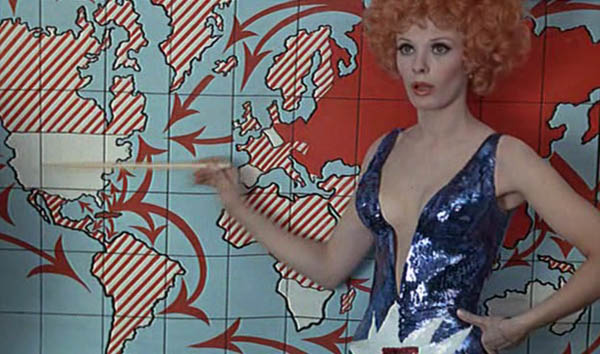
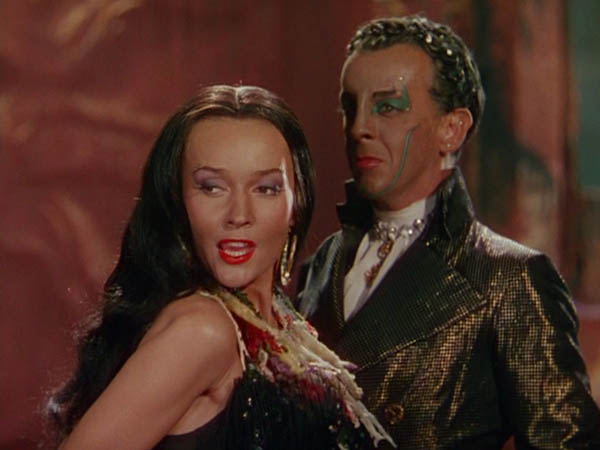
Bing Crosby is a broadway star and Donald “Melvin” O’Connor is a TV star, and they are cast as co-headliners in a big broadway play and set loose to find a leading lady. Hilarity ensues! You see, Melvin finds hot French dancer Zizi Jeanmaire and Bing finds blonde singer Mitzi Gaynor (Les Girls, South Pacific), then each guy falls for the other guy’s girl. Meanwhile, Mitzi’s dad (Phil Harris, who voiced Baloo in Disney’s Jungle Book), in a kind of unimportant side plot, is going to be arrested for not paying taxes on his gambling winnings when the cruise ship lands in America. Big ol’ whatever on that part.

Bing and Melvin show their compatibility by riffing on “You Gotta Give The People Hoke” with some lightly bearable prop humor, then Mitzi gives us the title song and Zizi does “I Get a Kick out of You”. They all sing Katy’s fave “You’re The Top”. Melvin and Mitzi bond on the ship’s deck to “It’s Delightful/Delicious/De-lovely” while Bing yearns for Zizi with “All Through the Night”. Out of nowhere, Melvin does a cool dance in the children’s play room, bouncing balls to the beat of “You Can Bounce Right Back”, and Bing does a fakey swami bit with “A Second-hand Turban and a Crystal Ball”. Those last two songs (and “Hoke”) somewhat suck, and not coincidentally were the three numbers not written by Cole Porter. We close on the second year of their hit Broadway show with all four performers doing “Blow Gabriel Blow” and the no longer jailed father in attendance, how sweet.

Katy’s pick, we both enjoyed. Bing and Mitzi seem to be better singers than dancers, and Zizi and Melvin vice versa. Playful little movie with mostly good music, doesn’t seem like the kind of thing that would’ve been a huge smash hit.

Prop comedy:
image

Zizi:
image

Mitzi & Melvin:
image

“a second hand turban and a crystal ball”
image

image