“Storyboards are stupid, stupid things.” – Béla Tarr
37 shots (not counting credits) in 145 minutes, so average 4-minute shots, with all but a handful of scenes contained within a single shot. Camera usually in slow, gliding motion. Stark b/w photography.
Same editor as Tarr’s previous films (Tarr’s wife, now also credited as co-director), same composer and same author of the source novel. Similar in look and feel to Satantango for sure, which means it’s long and slow in a beautiful and captivating way. I never get bored watching these movies, and I don’t even have a theory for why that is… they ought to be boring as all hell, especially Satantango, but I’d gladly watch each one again.
From reading the credits you’d think it’s a grand communal project, not a film by one clear artistic voice. IMDB credits six people for cinematography, unbelievable, including a Kansas native (an acclaimed indie filmmaker), a French steadicam operator who worked on Amelie and The Science of Sleep, and unsurprisingly the guy who is sole credited cinematographer for Satantango and Damnation. Must read source novel sometime, “The Melancholy of Resistance” by Laszlo Krasznahorkai.
Opens in a bar at closing time, Janos Valuska positioning the other bar patrons into a model of the solar system, the camera spinning and rotating around them.

Janos walks to uncle Gyuri’s house (how does Tarr manage to make walking scenes the highlights of his films?) to put him to bed. Stops outside to watch a massive truck slowly roll into town, carrying an exhibition with a giant stuffed whale, various curiosities in jars, and “the prince”, a mysterious dwarf.
Next morning, townspeople are all alarmed, talking doom and destruction. Janos delivers some papers, goes back to his composer uncle Gyuri’s house and listens to Gyuri give a strange music-conspiracy speech.
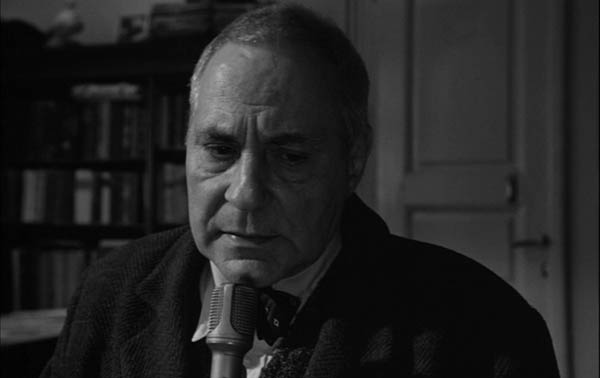
Walks through the town square where groups of people are gathered whispering rumors amonst themselves. Thinking himself less naive and superstitious than the rest, Janos pays his 100 forints (about 50 cents) and tours the trailer. Walks home, sees uncle Lajos, must be tired by now cuz I can’t figure when Janos sleeps… but no time for rest, because his aunt Tunde (Gyuri’s estranged wife) comes with threatening news.

If Janos doesn’t get Gyuri to help her efforts gathering a town decency committee (presumably to eject the whale exhibition), she will move back into Gyuri’s house and make his life hell. So Gyuri and Janos get right on that.

They get some lunch, carry on, finally part and Janos goes back to the square, where he is accosted by the ever-more-restless townpeople gathered there. I’m starting to wonder if all of these are townspeople, or if some are outsiders drawn by the exhibition (which nobody but Janos is ever seen entering). Janos visits aunt Tunde to report, but she is with a raving police chief and Janos is sent to put the chief’s rowdy kids to bed. Okay, by now Janos has got to be tired, but he walks back to the square (sees uncle Lajos on the way) and sneaks into the trailer, hearing the trailer guy talking with the Prince (seen only in shadow) raving about chaos and destruction. Janos escapes and runs, hearing explosions in the distance behind him, presumably caused by the Prince’s riot-provoking megalomaniacal speech to the crowd.

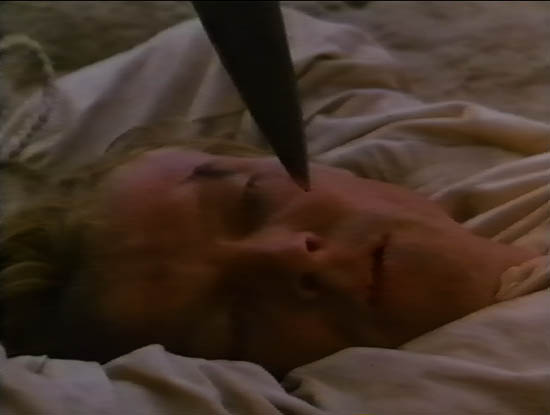
Janos hides while the townsfolk smash up the trailer (off-camera) and tear up a hospital for some reason, terrorizing the people within including a very sad naked old man. Aftermath of that, everyone files slowly out of the hospital, Janos walks around and discovers uncle Lajos dead, and army men interview Tunde.

Back home, Janos sees aunt Harrer looking for her husband Lajos. She tells Janos that the army men are looking for him and he should flee town. He does so, running along the train rails until a helicopter catches him.

Gyuri is visiting Janos in a hospital. Is Janos mad? “Nothing counts. Nothing counts at all.” Gyuri leaves, walks through the square, examines the eye of the whale laid out on the destroyed trailer in the middle of town.

Main actor (Janos) is german Lars Rudolph (The Princess and the Warrior). His uncle Gyuri Harrer is Peter Fitz (Au revoir, les enfants) and aunt Tunde is Hanna Schygulla (star of Marriage of Maria Braun and other Fassbinders). Guy who played Petrina (Irimiás’s sidekick) in Satantango shows up as a hotel porter, and Janos’s neighboring aunt and uncle (I’m unclear whether these people are all actual aunts and uncles) played Halics and Mrs. Kráner in Satantango. I recognized Mrs. Schmidt in a scene as well.
Visual themes of space, shadows, enormity, eclipses, light disappearing.
MovieMartyr: “The film’s title gains meaning when János overhears his uncle György, a cooped-up music theorist, talk about tonal scales. He explains that the Werckmeister scale, upon which the musical octave is based, is a false construct, and is not true to natural sound since it cannot convey the full range possible in nature. He elaborates, stating that since all music is based on this faulty foundation, it is all inherently false. With his description of these musical concepts, György seems to tap into the film’s undercurrents. Certainly, the defective musical scale is roughly analogous to the broken political state of the country that the film is set in. His suggestion that all music is unnatural seems to set up a competition between the natural and unnatural (light and dark) that runs throughout the work. That he’s driven his wife Tünde out of his house with his obsession toward his out of tune piano doesn’t bother him in the least.”
Scope: “The climactic storming of the hospital, and the formation of the mob, is given more significance in the film than the novel. And although such an alteration suggests that Tarr intends Werckmeister Harmonies to be read as an allegory of fascist violence, the film does not offer any specific political causes for the violence. Rather, Tarr situates the violence as a function of modernity and industrialization, and, more abstractly, as having a cosmological basis.”
Sight & Sound: “The one truly identifiable centre of malevolence is Tünde, a reactionary opportunist exploiting superstition to gain power in the name of order. It may even be that her musicologist ex-husband Eszter, obsessed with the theories of 17th-century German composer Werckmeister, has himself contributed to disturbing the harmonic order of things by withdrawing from any active involvement; at the very least he is a representative of an enfeebled intelligentsia, vainly fiddling with abstractions while the world burns.” … “In the end the defeated thinker Eszter finally visits the whale, now beached and exposed in the wrecked square and more inscrutable than ever. It’s hard to imagine a more downbeat ending the complete triumph of entropy and reaction yet this conclusion derives a profound grace from the extremity of its pessimism. Explaining the cosmos to his drunks, Valuska pleads, “All I ask is that you step with me into the bottomlessness”, and that is essentially Tarr’s invitation to the viewer. The enigmatic harmonic preoccupations alluded to in the title suggest that this film rich in movement, low on dialogue aspires, as the old phrase has it, to the condition of music. But Tarr’s true achievement is to attain the condition of silence, and of bottomless, awesomely inscrutable nightmare.”
Online articles mention 39 shots, so one of us has mis-counted.
Béla Tarr: “We never use the script. We just write it for the foundations and the producers and we use it when looking for the money. The pre-production is a very simple thing. It takes always a minimum of one year. We spend a year looking all around and we see everything. We have a story but I think the story is only a little part of the whole movie. I have to tell you I absolutely hate the movies that I can watch at the theatres. They are like comics. They always tell the same stories. We don’t like these stories because for us every story is always the same old story from the Old Testament. After the Old Testament we have no new stories.”
Interviewer: “I just think there is a trend in world cinema towards this sort of existential terror and chaos.” Tarr, being awesomely elusive: “No, I just wanted to make a movie about this guy who is walking up and down the village and has seen this whale.”
“If you want to make a colour movie, and you go out onto the street, and you want to create the right atmosphere, you must paint the whole street, because every house is red, blue, green and so on. And you have no colours, you just have some colour chaos. For me it’s a kind of naturalism, the colour movie. With black and white you can keep it more stylistic, you can keep more of a distance between the film and reality which is important.”
same 2001 interview: “Do you know Georges Simenon? After the New York Film Festival one American producer called us. He wants to work with us. And he sent us a script which is full of shit and we said no, no, no. And afterwards he had another idea which we also said no to. And finally we proposed to him this short story by Simenon. The title is L’homme De Londres (The Man from London). And now we are working on this project. The script is ready. And this American producer founded this European company in Denmark and he moved from New York to Copenhagen. And we will start this project now which I hope we can complete.”
“You know the final cut took just half a day!”
May 2024: Watched the new restoration and read the novel… slowly. Fortunately there are only a few characters, with verbose tangles of thoughts, so it’s hard to find a paragraph break to put the book down but easy to pick up later. As always, Lasz-Krasz’s books in English seem like impossible feats of translation. The book has multiple perspectives including dim postman Valuska, while the movie entirely follows Valuska, who seems less dim. A different person dies in the riot (V’s mom in the book, Mr. Harrer here). The movie’s advantages include gorgeous photography and music, a compelling Valuska performance, and his unknown fate at the end. Replaced some screenshots above – more: