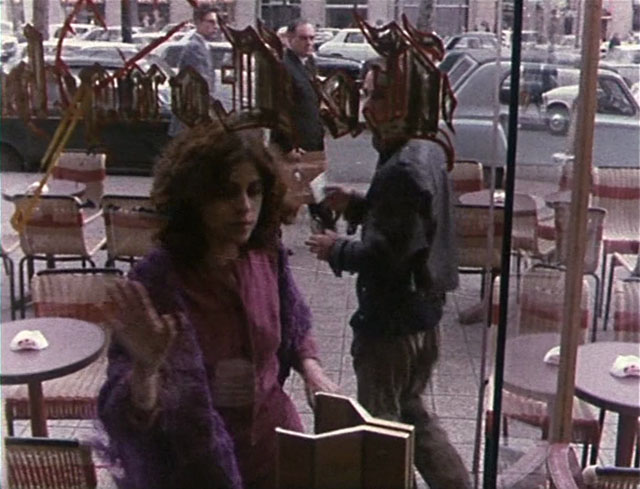
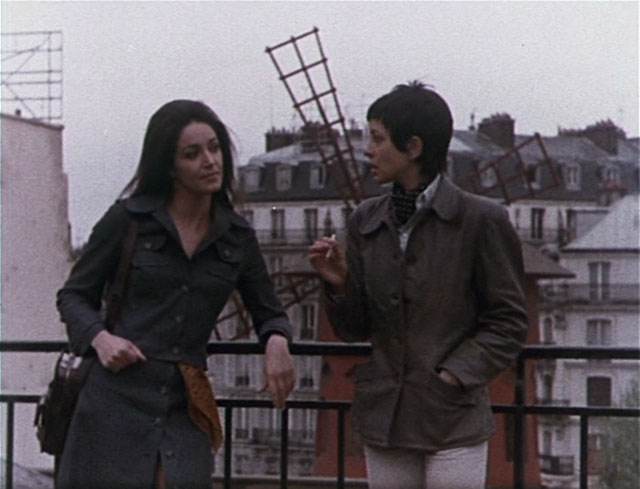
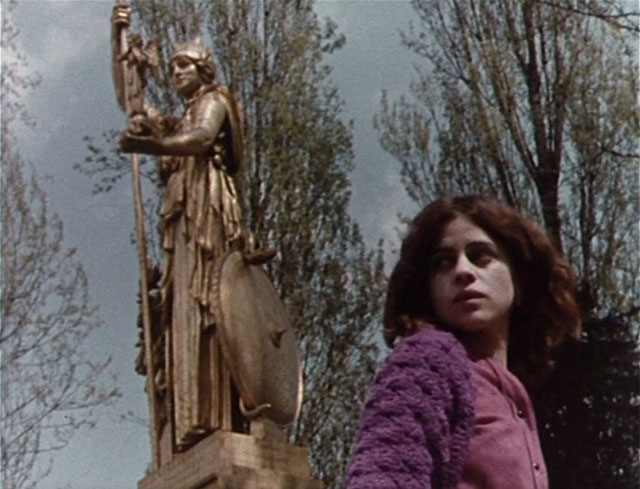
Stiller manages a perfectly realistic virtual-reality simulator set in the future so government (and increasingly, industry) can make predictive policies. And about ten minutes into the three and a half-hour movie I realized that Stiller is himself a fictional character inside a virtual reality. I knew this because I’ve seen science fiction before, and the story was seeming familiar – turns out it’s based on the same source novel as The Thirteenth Floor. Fortunately, Stiller figures this out at the halfway point, after obsessing over an erased security chief whom only he can remember, so we’ve got the whole second half (episode – this was a TV miniseries) to deal with this info. More fortunately, there’s no slow grinding of the plot gears as the characters slowly realize something that I already know, because the film is 100% fun to watch, even while being obvious. Fassbinder has found a way to make low-budget, no-effects TV sci-fi look terrific, covering every surface with mirrors and windows and screens (you catch sight of the camera crew pretty often – another fun game), creeping around corners with his Ruizian camera (with sparing use of the requisite 70’s zooms) and playing with perspective. With this and Sam Fuller’s Dead Pigeon on Beethoven Street being my only touchstones, I have to assume that mid-70’s German television was amazing.

Stiller (Klaus Lowitsch of Peckinpah’s Cross of Iron), the shortest person in the movie, is taking over the project because his predecessor/father-figure Vollmer has unexpectedly suicided. Vollmer’s daughter Eva, Stiller’s main squeeze, has grown distant, the corporate project head (Stiller’s boss) Siskins is becoming more demanding, and Stiller’s new secretary Fromm (Fassbinder regular Barbara Valentin) is obviously a spy, implanted to keep Stiller abreast of the situation.

Get it?

Stiller gets more impertinent, programs a singing, tap-dancing version of his boss into the simulacrum. He goes on the run after his mid-movie revelation, realizing that Vollmer was killed for finding out the same thing. Eva reappears, says she’s from the real world, that Vollmer never had a daughter until she programmed herself in a few days before, that they have many virtual worlds but this one captured attention for being the only one that created its own sub-virtual-world. And since the real Eva is in love with the virtual Stiller, she helps him escape by swapping psyches with someone outside.

Eva and Stiller trying to pull a Minority Report pose:

I liked the electronic music, daring for 1973, but sometimes the bonkers, intense squeals which occur when Stiller is troubled would make Ash upset. I also like that you can have fully naked women on German television. Don’t know much about Fassbinder, assumed he’s kinda Nick Ray meets Doug Sirk meets Sam Fuller meets Hedwig, based on my decade-ago half-rememberance of watching The Marriage of Maria Braun.

Stiller being told that he’s a fictional character:

Stiller sneaks into a theater while on the run from the law, watches what appears to be based on the last few minutes of Dishonored:

Nashville Scene rightly calls it “a film that feels somehow inevitable in your viewing, a missing link that should have been there all along.”

Another key reference for World on a Wire is Jean-Luc Godard’s own lone foray into sci-fi, 1965’s Alphaville. Much like Godard’s film, World generates a futurescape from the present mostly by judicious selection. Abandoned building sites, freeways and glass skyscrapers, it seems, are forever. (In the final moments of World, Fassbinder completes the homage as Alphaville’s star, Eddie Constantine, makes a cameo appearance.)

Eddie C.:

Film Quarterly:

Despite not actually being an adaptation of a Dick fiction, World on a Wire has more in common with the wry mordancy of Dick’s work than many official Dick adaptations, not least in the way that it shows each of its three nested worlds as being equally drab. We actually see very little of the world “below” (the world inside the Simulacron) and almost nothing of the world “above” (the world one level up from what we first took to be reality). The world below we see only in snatched glimpses of hotel lobbies and inside a lorry driver’s cab. But it is the revelation—or non-revelation—of the world above at the climax of the film that is most startling. Instead of some Gnostic transfiguration, we find ourselves in what looks like a meeting room in some ultra-banal office block. At first, the electronic blinds are down, momentarily holding open the possibility that there will be some marvelous—or at least strange—world to be seen once they are up. But when they do eventually rise, we see only the same grey skies and city- scape.

Vollmer, just before his death:

White-hatted Gaston is visiting Dr. Maillard’s psychiatric hospital when they’re met at the gate by a loony-acting guard, and I suddenly realized this was based on the same Poe story as Svankmajer’s Sileni, and is going to suffer in comparison. Gaston is welcomed into the asylum, led by the swirly-robed man on the DVD cover, while his red-hatted friend (Martin LaSalle, star of Pickpocket) is attacked in the woods and his woman raped. It just isn’t a bad 1970’s movie unless a woman gets raped.

The guy from the DVD cover:

The girl from Alucarda’s DVD cover – what’s she doing here?

The movie’s in English, which the actors are having trouble getting used to – some words are pronounced differently each time they’re spoken. Gaston’s straight Rod Serling line delivery conflicts badly with Maillard’s strangely-accented rapid-fire drama. It wants to look like Vadim’s Spirits of the Dead segment with the careful posing of actors and scenery before the camera. One of those euro-art films, but from Mexico. Moctezuma also made the Satan-in-a-convent movie Alucarda, which I saw but can’t much remember.

White hat and red hat:

Lunacy:

This one is more masculine than Sileni, less interested in the daughter/prisoner character Eugenie than in Gaston and Maillard (Claudio Brook – Simon of the Desert himself), but really it doesn’t seem too interested in any of them. There are some half-hearted pursuits and mysteries, and even the tarred/feathered “real doctors” in the basement scenes have little explanation (and nothing like the terribly doomed finale of Svankmajer’s version). The “hero” never does a thing; the prisoners escape on their own. It’s a series of crazy scenes, signifying nothing.

Claudio having an epic shout:

Eugenie’s revenge:

Onscreen text, much talk about the workers, pictures of Hitler and holocaust, calm voiceover and mentions of may 68. Yup, it’s a post-60’s Godard film, alright. Here he takes his textual analysis to new heights, obsessing over the word AND (or ET). It manages a level of interest similar to Tout va bien, significantly higher than Letter to Jane.

No onscreen credits (at least on my copy). The last Godard-Gorin collaboration, Mieville taking over for Gorin. Once again they speak within the film about its own creation and intent.

“In 1970 this film was called Victory. In 1974 it is called Here and Elsewhere.” Looks like Victory was a Palestinian propaganda movie. “Here” they stage scenes of a family watching television, and filmmakers displaying stills one by one before a camera. Lots of talk about the nature and meaning of images. It’s not as bad as it sounds.

Rosenbaum:

Jean-Luc Godard’s short feature about the PLO was initially shot with Jean-Pierre Gorin in the Middle East in 1970, but when he edited the footage with Anne-Marie Mieville several years later, many of the soldiers that had been filmed were dead. Reflecting on this fact, as well as on the problems of recording history and of making political statements on film, Godard and Mieville produced a thoughtful and provocative essay on the subject. Coming after the mainly arid reaches of Godard’s “Dziga Vertov Group” period (roughly 1968-1973), when his efforts were largely directed toward severing his relation with commercial filmmaking and toward forging new ways to “make films politically,” this film assimilates many of the lessons he learned without the posturing and masochism that marred much of his earlier work. The results are a rare form of lucidity and purity.

One of the first movies in ages that we’ve tried to watch with people over, ending as usual in failure. I knew it would be sci-fi with an environmentalism theme, but wasn’t prepared for the woeful hippie Joan Baez songs. Pretty good story/ending/character with pretty good physical action and pre-Star Wars model work, with a couple of exceptional elements. First, obviously, Bruce Dern is wonderful and gets better in the second half when he has nobody but himself and his robot drones to act against. Then there’s the drones – they worried me because I couldn’t figure them out. They’re not shaped correctly to have an actor inside, their robotic parts are truly 1970’s-robotic-looking (simple and slow), but their leg movements looked too natural to not be human. I wouldn’t have guessed there were amputee actors inside. Effects whiz Trumbull brings some of his 2001: A Space Odyssey expertise to a sequence where Dern pilots the ship through Saturn’s rings to escape detection – otherwise it’s mostly bunches of boxes painted silver in front of a starfield.

Two “drones” in foreground, with greenhouse-pod behind:

No explanation is given, but Earth sends commands for the deep-space (why didn’t they stay in orbit?) stations that hold the last of the dystopian planet’s plants and wild animals to detonate their greenhouse pods and return home. Three fun-lovin’ astronaut dudes wheel off in their rovers with suitcases full of nukes to complete the task, but Dern loses his cool, kills one of ’em with a shovel (his leg is hurt in the scuffle) and lets the others explode in a doomed greenhouse, then escapes past Saturn (“killing” one of his three drones, which gives him and the other drones more distress than the human deaths do). Interestingly, the submarine-style radio/radar silence of the title is never directly addressed in dialogue or on computer screens – it’s just inferred that Dern is making his escape, leaving the authorities to believe that his ship was destroyed. I’d give Trumbull and his writers (two of whom would later write The Deer Hunter, the other would become a major TV procedural-show writer/producer) credit for letting the audience add interpretation instead of overexplaining everything, but other evidence (like the blatant, subtext-killing Baez songs, the oversentimental but otherwise extremely simple robots and Dern’s confusing leg-injury subplot) would indicate bungled storytelling instead.

There’s not much suspense left after Dern has killed off his fellow astronauts. The movie tries to make us care when he’s joyriding his dune-buggy and injures a robot, and tries to make us believe that a botanist wouldn’t realize that plants need sunlight. But really it’s all build-up to the last five minutes, when he’s located and about to be “rescued”. He sets the sole working robot to the task of watching over the last garden dome, then jettisons it to safety and sets nukes to blow himself (and his rescuers?) into space-junk.

Part of the same financing program to let young filmmakers run wild on low-budget pictures, along with American Graffiti and The Last Movie. Sounds like a program they should’ve continued. Music by PDQ Bach under his real name.

The earliest Oliveira movie I’ve seen by three decades – and he was making movies three decades earlier than this. That would explain why this already feels like the work of an old master, even though I was considering it “early Oliveira.” The camera’s not as exactingly positioned as in Resnais films like Melo and Love Unto Death, but it has a similar feeling to those, the masterful European period dramas that seem at time to be filmed plays but with a mysterious sense that there’s always something more going on.

The Silent Gardener:

According to the wikipedia, Oliveira fell afoul of the government in the mid-60’s, accused of surrealism, then was silent for years until this film’s release. More: “With its lyrical surrealism and farcical situations, the film was a shift from his earlier work about lower class people. Based on a play by Joao Cesar Monteiro . . . Past and Present was the first of what has become known as Oliveira’s “Tetralogy of frustrated loves”. It was followed by Benilde or the Virgin Mother, Doomed Love and Francisca. Each of these films share the theme of unfulfilled love, the backdrop of a repressive society, and the beginning of Oliveira’s unique cinematic style.” It’s got that mannered surrealism typical of Bunuel’s late career – you can see how the two filmmakers got tangled together. Couldn’t tell if Oliveira was abusing the film’s soundtrack in various ways or (most likely) if the broadcast source of my video copy was a bit wonky. Second movie I’ve seen recently to use music by Mendelssohn. There’s not much written about the film online – even my most reliable Oliveira-advocate Rosenbaum had not seen this one, as of his writings circa Christopher Columbus, The Enigma.

First scene is a gathering of friends attending the funeral of Vanda’s ex-husband Ricardo. She abuses current husband Firmino, forbids him from attending. I don’t think Ricardo has just died – this is “the burial of his remains” two years later? “A year after his death, she married Firmino, and a year later, she fell in love with the former husband. An unhealthy passion for the deceased husband, the same that bothered her in life, and, at the same time, what an anger for poor Firmino!”

Firmino with hateful wife Vanda:

Also at the party: Fernando (sideburns, glasses) and Noemia (light hair, pulled back), a divorced couple with a better, more loving relationship than when they were married. Honorio (balding) and Angelica (reddish hair) are married, but slightly-shaggy, Depardieu-looking Mauricio is in love with Angelica. And finally there’s Daniel, the deceased Ricardo’s identical twin brother. Firmino is caught considering stabbing his wife to death, but holds back.

A year later, Firmino writes a suicide note then leaps from the window (comically avoiding being caught by the silent gardener). It takes him days to die, days his wife Vanda spends cursing his name and ordering a coffin – and the friends all gather at the house again. Angelica has been living with Mauricio, but he tells her to return to her husband (“This adultery will make you appreciate more the virtues of fidelity, just as a trip abroad reveals the sweetness of the homeland”) because he’s now in love with Noemia.

Cheaters Mauricio and Angelica:

Moments before her husband dies, Daniel reveals to Vanda that he’s really Ricardo, that the brothers had swapped clothes before the fatal car accident and he swapped his wedding ring afterwards.

“Vanda, your husband is dead”
L-R: Noemia (Manuela de Freitas of some Joao Cesar Monteiro films), Honorio (Duarte de Almeida of Magic Mirror, The Convent), Fernando, Angelica.

Another year – A judge has declared that Vanda and Ricardo are still married, so she’s now in love with the dead Firmino. Angelica is back with Mauricio and getting dumped again.

Ricardo spies Vanda hanging pictures of deceased Firmino around the house:

Daniel/Ricardo:

A friend is getting married, so the friends gather again, and the movie ends with the exchanging of wedding vows and Mendelssohn’s Wedding March.

I probably put off watching this for so long because I’d written down years ago that I’d already seen it, in the dark days of the pre-blog era. No recollection of any scenes while watching, so that must’ve been in error. Based on a novel, though I wonder how much of the original writing is left after Roeg got through with it. Roeg’s first movie with a solo directing credit. Jenny Agutter (“the girl”) went on to star in An American Werewolf in London and Child’s Play 2, Nic Roeg’s son Luc (“white boy”) is now a producer, worked on Spider and We Need to Talk About Kevin, and David Gulpilil, only 18 when this came out, became the most reliable Aboriginal actor from The Last Wave to Ten Canoes.

The kids are on a picnic with their father, when he starts shooting at them then torches the car and kills himself. Hardly fazed, the kids walk off into the wasteland. But we know from Man Who Fell To Earth and Insignificance that human emotion isn’t Roeg’s strong suit, so we focus on the visuals and editing, which are amazing and strange. For instance, mid-film there’s a page-turn transition giving the brief impression that the whole thing is a storybook. And in the middle of a cross-fade, one of the two overlapping scenes cuts to a different shot – you don’t do that!

Plenty of wildlife. Cool lizards, parakeets, cockatoos, hawks and things I don’t even know what they’re called. But it’s not a good movie to watch just for the pretty wildlife, unless you’re prepared to see David G. spear some kangaroos.

All sorts of extras on the Criterion release, which I need to get sometime. Meanwhile I’ve got P. Ryan’s essay from the website:

Toward the film’s end, it is the turn of the young aborigine to display, by means of a sexually charged ritual dance directed at the girl. The girl’s fearful rejection of him leads to another major change from the novel. There, the native boy dies from a virus to which he would not have been exposed if not for his encounter with these outsiders; in the film, the young man takes his own life. A film with two suicides and a delicately sensual nude scene was never destined for the label of “children’s classic,” and yet one can sense that Roeg has trust in the reaction of an adolescent audience, for he is speaking the truth of adolescence to us all.

Not that I’m a brilliant postcolonial scholar over here, but I saw more to David’s death than sexual rejection. When he finds the stupid white kids, they’re desperate and dehydrated. He shows them how to find food and water, leads them on a days-long hike to the place where he thinks the girl is asking to be led. She just wants her own civilization, but he bypasses roads and houses, leaving them to an abandoned farmhouse. Once there, she stops acting as his equal or follower, goes inside and cleans up, leans out the window with a bucket asking him for water, which he fetches. Now she’s in her element, and his role is to be her servant. Then a few scenes contrasting his traditional hunting methods with the shooting massacre of a rifle-toting white man – with jarring freezes and reverse photography. The mating dance seems like he’s defensively embracing his traditions and manhood, too late.

Afterwards one of the great endings, Petulia-reminiscent, as she’s back in her high apartment listening to some man talk about boring business, having a flashback to when she swam naked and free with a stranger in the outback. More from Ryan:

Much has been written about the “fragmented” style that Roeg has employed in so many of his films — Don’t Look Now, The Man Who Fell to Earth, and Bad Timing all play with linear narrative, setting subtle traps for the viewer and commanding our close attention. In Walkabout, this style serves to enhance the sense of memory that pervades the film. All coming-of-age stories are fundamentally memory stories, rooted in recollections of a time of great intensity, of growing, of puzzling, of understanding. We look back at that stage in our life and find memories of the pain we felt and the pain we inflicted, unthinkingly, because we did not understand ourselves and our burgeoning relationship to a new, strange adult world. The strangeness of that world for the girl in Walkabout is deepened by the landscape; for the aboriginal boy, it is deepened by his encounter with people for whom his lifelong training has ill prepared him.

“The happy highways where I went and cannot come again” – the closing poem is also the source of the phrase Blue Remembered Hills. And as Roeg borrowed, so was he borrowed from – one kid saying “I don’t suppose it matters which way we go” was used in the Books song Be Good To Them Always.

Oh whoops – I planned to watch Weekend first, to go from the end of Godard’s beloved 60’s period, skip over his purely political post-May-’68 work with Gorin as the Dziga Vertov Group, and resume with Tout Va Bien and Letter to Jane. But I forgot, and watched this before Weekend. No matter, probably. But as I’d heard, the Godard of the 60’s never returned after ’68. This is so similar to his 60’s movies, despite the bright pop color, the custom-built sets, meta-movie voiceover, married-couple storyline and (especially) major stars. No, it’s as talky as The Owl’s Legacy.

Long-Distance Singer Yves Montand and newly-oscar-winning Jane Fonda were both known to be politically-engaged, and both were hugely popular at the time, so it was perfect casting for Godard and Gorin – plus an opportunity for them to gripe about Montand’s previous “problematic” political films. But G & G really want to polemicize at length, so they note in the voiceover that the stars were cast and given a jaded love story out of commercial necessity.

Unwitting pawns in Godard and Gorin’s political agenda:

Boss Caprioli:

Opens with JLG’s most cinematic-illusion-shattering move yet, close-ups on all the checks he’s cutting for the film’s stars, technicians, sets and so on. The juicy center of the film (shot in nice loooong shots, many of them motionless) consists mainly of dudes giving long speeches about union labor, class divisions, the political system.

“Under a calm surface, everything’s changing. Everything’s changing within every class. And She and He, swept up in it, also change.” Yves is a formerly-idealistic filmmaker (“a screenwriter during the New Wave”), now doing commercial work. Jane is a radio news reporter, and the two are at a factory office when the workers hold a major strike and lock the boss in his office for five days. So we get interviews with the boss (Vittorio Caprioli of Il Generale della Rovere): “the glaring injustices of Marx’ and Engels’ day are over,” and the shop steward: “our salaries haven’t kept up with increasing production, and even less with corporate profits.” It’s weird for a leftist, pro-workers movie that I can easily find who played the company manager, but not which actor played Stacquet the shop steward.

Some business in a supermarket that I didn’t understand because I wasn’t paying close attention anymore, but the long back-and-forth dolly shot reminded me of the factory scene in Manufactured Landscapes. Yves and Jane at their day jobs. Scenes of the factory in operation, of struggle in the streets. A token love-story-resolution ending in a cafe, which seems extraneous even as a joke, since the couple never got any development.

Great cross-section of the factory offices:

Yves, disillusioned:

From an interview with a wide-eyed bathrobe-clad Godard: “It’s quite striking. When workers are interviewed [on TV], these people are given 15 brief seconds when they haven’t opened their mouths all year. We give them 15 seconds, or even three minutes, to speak. ‘What do you think of the strike? What do you think of your lot in life?’ Who can answer when he’s had his mouth sewn shut?”

Letter To Jane (1972)

An hour-long photo-essay posed as a letter to Jane Fonda, analyzing a newspaper photo of her in Vietnam talking (or, as Godard & Gorin rightly point out, listening) to some unidentified men. She’d visited the country after the filming of Tout Va Bien but before its release, starting the ridiculous “Hanoi Jane” controversy, during which the press took the actions of a movie star more seriously than the war itself.

Godard and Gorin take turns narrating (in English), and each takes pains to avoid any interest in their voice, so the movie becomes a didactic lullaby. I got bored almost immediately.

See also: Every Revolution is a Throw of the Dice and Farocki’s Workers Leaving The Factory

“Tommy is the only rock opera ever made” – Ken Russell

Sad Ann-Margret’s husband is killed in the war. Some time later she goes on vacation and meets Bernie (Oliver Reed) at a resort. He moves in, but one night the husband returns, disfigured from a plane crash, and Bernie kills him in front of little Tommy, who’s told that he didn’t see anything, didn’t hear anything, won’t say anything. And so he doesn’t ever again.

Tommy grows up to be curly-haired space-cadet Roger Daltrey. He’s not healed by attending Eric Clapton’s church of Marilyn worship, nor when Bernie gives him a night with extreme drug fiend Tina Turner (filling in for David Bowie), nor when he’s left with psychically abusive babysitter Paul Nicholas or sexually abusive Uncle Ernie (Keith Moon), nor from a visit to Dr. Jack Nicholson (filling in for Christopher Lee).

But one day Tommy finds something he’s good at. After defeating Elton John (who agreed to be in the movie provided he got to keep these boots) at a pinball championship, he becomes famous and attracts hundreds of groupies.

At home, mom celebrates their new wealth by throwing a bottle of champagne through the television and writhing in the bubbles, baked beans and chocolate that pour forth from the damaged set.

Tommy breaks through his mom’s mirror and starts speaking again, becomes a messiah to kids everywhere, his symbol a cross with a pinball on top. Mom is his biggest supporter, and stepdad Bernie is the financial wizard, plotting to set up Tommy camps everywhere and sell merchandise everywhere else. But their prefab religion backfires and the kids revolt, killing Tommy’s parents. But he lives to bathe in waterfalls and climb mountains with a big cheery grin.

It’s a ridiculous story, a twisted excuse for lots of music and celebrity cameos. Russell was never a huge fan of rock music (I’m not a big Who fan myself, really only enjoy “I’m a Sensation” from this soundtrack), had written a follow-up to The Devils called The Angels about false religion, which he couldn’t get off the ground. When offered to direct a movie with sympathetic ideas to his own, which Russell could help mold (he got Pete Townshend to write additional scenes and change plot details) with a pre-sold celebrity cast – a batshit-crazy musical story that needed visual accompaniment – how could Ken say no? It might not be Ken’s purest personal vision, but I double-featured it with Song of Summer as memorial screenings when I heard he’d died.

Unsurprisingly produced by Robert Stigwood, who produced Jesus Christ Superstar (and later Grease). Oliver Reed (of The Devils, of course) was doing Richard Lester’s Musketeers movies around the same time. Daltrey would be back with Russell on Lisztomania, which I need to see. And Ann-Margret needs to be much more popular – she was fantastic in this.