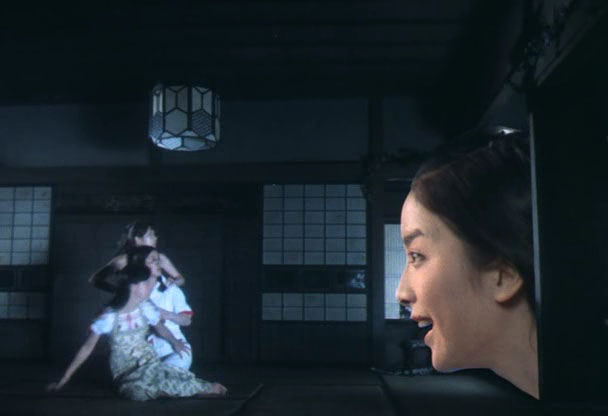
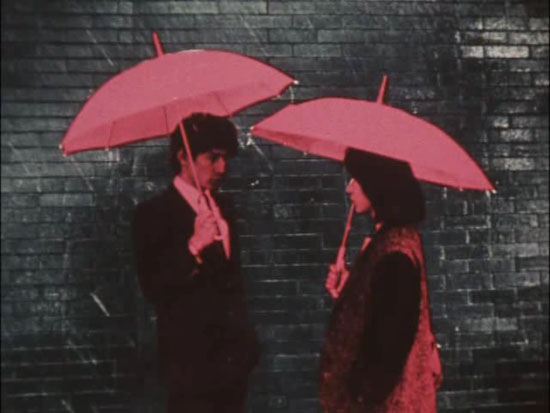
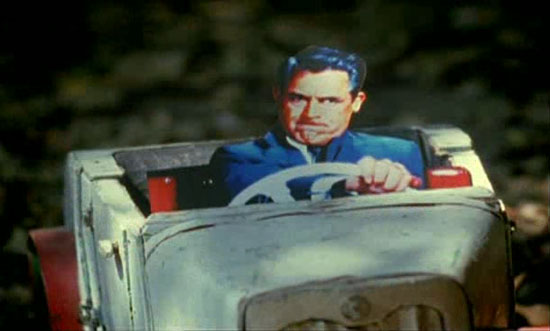
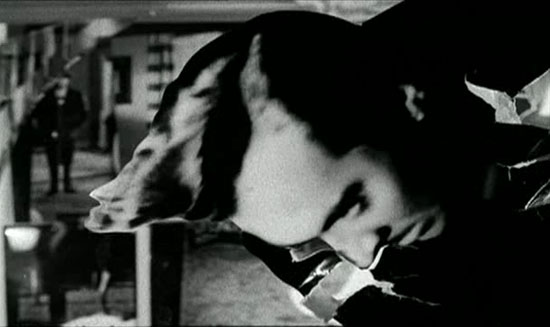
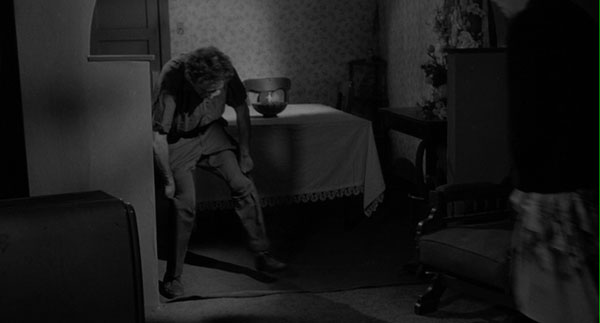
Tonight we will be Liveblogging the Japanese horror movie House!

2 Minutes In: Already I have seen editing tricks I have never seen in a movie before (maybe because they are a bad idea), an animated opening title sequence, continuity problems, poor (or poorly translated) dialogue, and music that emphatically does not fit the action. Only 85 minutes to go!

image

10 Minutes In: Cruising the IMDB… director has made forty movies since House. This is kind of like when I discovered Takashi Miike with Ichi the Killer and realized there are FORTY more things like this somewhere in the world. Only this is much stupider. Woman who plays the grandmother (below) used to be in Imamura and Mizoguchi films, and now she’s in this.

image

20 Minutes In: Holy crap is this music ever awful. So far I am not buying that this is a horror movie. If there’s any “horror” here, it’ll be extremely goofy and everyone will turn out okay (and best friends) in the end. The visual style, editing and sound mixing are all crazed. Wipes and irises all over. And there’s cat tossing!

30 Minutes In: Definitely not a horror. I feel ripped off.

image

40 Minutes In: yep, the goofy horror has begun… but it’s SO goofy it puts Sleepaway Camp to shame. It puts The Great Yokai War to shame! This one might out-goof even Princess Raccoon!

Dead fat girl’s head, mistaken for a watermelon, flies through the air and bites another girl on the butt in front of crazy-fake backdrop:
image

50 Minutes In: I wonder if Sam Raimi might’ve seen this before making Evil Dead 2. Hmmm, and I just found an unauthorized pseudo-sequel to Evil Dead 2 from Italy called House 3/Ghosthouse. So one could rename ED2 “House 2” and form a whole new trilogy. Then we can use the American House IV to finish it off… fitting, since there was no actual House 3 in that series.

image

60 Minutes In: Movie gets tiring after a while. It’s still super goofy, I’ll give it that… not quick bursts of stylistic flourishes – they are ever-present. Must have taken an age to make, with all the insert shots and models and effects and editing nonsense going on. There was some nice piano music earlier but now it’s back to the ol’ spastic theme song. Should we be seeing nude high school girls? Is that okay?

image

70 Minutes In: They just found some sort of leather-bound book of the dead, giving credence to my sequel theories. Also, a piano just ate someone. Maybe we can replace House IV with Death Bed: The Bed That Eats. Hmmm, blood spraying out of a hole in the wall and filling the room… definitely Evil Dead 2-ish. One girl you can tell is the smart one, because she wears glasses, has her hair in no-nonsense ponytails, and knows what to do when they find a book (she reads it).

image

80+ Minutes In: I think the movie just ended, but there’s another 15 minutes on the file. Oh good, here’s a music video. Are they burning the girl’s stepmom’s head? Some voiceover craaaap about the nature of love, then illustrated credits, which I always appreciate.

image

Whew, so what was that? Some kinda teen comedy horror, I suppose. There’s an intro bit where a girl is sad that her dad is remarrying, then she tries going to camp but camp is cancelled. So she and her camp friends go off to her gramma’s house instead. But gramma is an evil witch who gains power from killing children in hilarious ways. I’m not sure who is still alive at the end because I was sleepy, but apparently the stepmom shows up at gramma’s house there, and I think maybe the main girl takes control of the witch activities and something bad happens to gramma. Whoa, I made 221 screenshots… hold on and I’ll sift through them looking for plot clues. No, it’s no clearer. But needless to say, I highly recommend this movie.

image

The director is still alive and working, but the executive producer, Tomoyuki Tanaka, creator of Godzilla?? Dead, dead, dead.

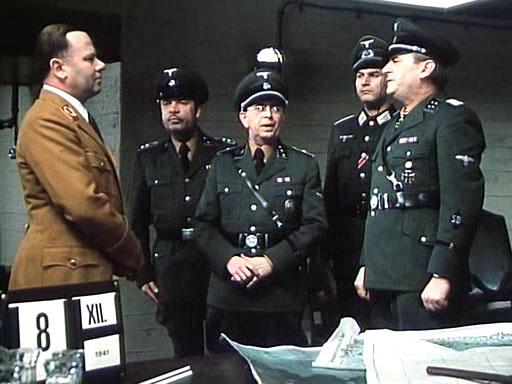
The premiere title of my personally-curated Obscure Movie Sundays monthly film screening programme was well-attended (five persons), the viewers anxious to view what my own invitation tantalizingly called “a 1977 surreal sci-fi comedy from Czechoslovakia. Set in the futuristic 1990’s, the plot involves identical twins and nazis with time machines. An obscure cult classic!” The movie lives up to the letter of that description, but wasn’t as wacky-enjoyable as it would sound. Still an affable, somewhat cheap-looking light comedy with a really good ending.

Rocket scientist Jan has an evil rocket scientist twin brother, who chokes to death on a roll at the start of the film. Jan is hot for his brother’s fiancee (an attractive girl from a family of circus performers), so Jan pretends to be his brother (barely mourned at all, so you’d think he’s a pretty crappy brother even though the two lived together) and goes to work – not knowing that this was the day the deceased brother was to participate in an evil plot to travel back in time to 1944, the turning point of WWII, and deliver a briefcase-sized atomic bomb to Adolf Hitler so the nazis would win the war. Things get fouled up royally, both in the 1990’s “present” and in 1941 (where they accidentally end up, right after Pearl Harbor, instead of ’44 like they’d planned) but finally Jan straightens everything out (easy to do when you’ve got a time machine at your disposal) and has the baddies imprisoned before they can meddle in the past. How to solve the problem of his dead brother? Jan travels back to moments after the brother’s choking accident, incinerates the body and inserts himself in its place. Result: two happy Jans are living together, one of them engaged to the evil twin’s attractive fiancee.

The bunch of baddies (right) in ’41:
image

I thought it was a funny movie, but I was the only one laughing – the others found it a little tedious. Too bad. Delightful inventions of the “future”: time travel exists but is only used for tourism, dishwashing detergent dissolves the dishes instead of bothering to clean them, and a stun-ray gun turns people to green statues (they’ll recover just fine in a few minutes, unless someone tries to move them and accidentally breaks off a limb or two). Also, the A-bomb has been miniaturized to fit in a light briefcase and the military has stopped using such weaponry, so it can only be found in museums. That’s a pretty short time window (from 1977 to 1990) from weapon advancement and miniaturization to obsolescence and declassification. Or you’d think they’d disarm the bomb they put in the museum.

My Two Jans:
image

The movie’s writer (I Killed Einstein, Gentlemen and What Would You Say To Some Spinach?), the composer (Three Nuts For Cinderella) and the director (no other movies with funny titles) all died in the last decade. Three of this film’s lead actors also appeared in What Would You Say To Some Spinach?, which came out two weeks before I was born – will have to seek that one out. The actor who played Hitler died in ’84.
image

Gymnopedies (1965, Larry Jordan)
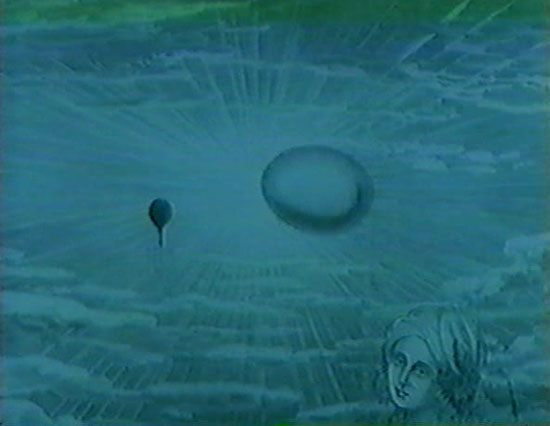
An egg floats around on different backdrops interacting with various objects, all cut-out animation a la Gilliam or Borowczyk, set to calm piano music. Feels more like a proof of concept than anything else – if there was a narrative present, I didn’t catch it. Cute, though.
image

Lipstick (1999, Pascal Aubier)
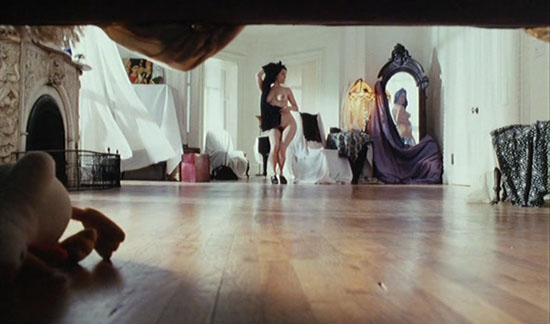
Single 6-minute shot beginning under a bed, unsubtitled. Family is getting ready to leave for a trip, the mother is briefly visited by her lover who comes in through the window. Aubier was assistant director on some French New Wave classics in the 60’s, now an actor and a director of (mostly) comic shorts. Liked this a lot (and not only because of the naked dancing), will have to check out more of his stuff.
image

Ark (2007, Grzegorz Jonkajtys)
Iffy-looking 3D animation tells apocalyptic story with a twist ending. Our guy wasn’t really the lead scientist onboard an ark of the last surviving humans searching the oceans for new land, just a crazy old man in a convalescent home. Ha! Bah.
image

Happy-End (1996, Peter Tscherkassky)
Found footage of a couple sitting down for dinner, toasting the camera, drinking… and drinking and drinking! Dancing, drinking, sitting, more drinking. Different days, different clothes, edited together, eventually with scenes superimposed atop each other, a haunted distortion of a French pop song as the soundtrack.
image

Two Solutions To One Problem (1975, Abbas Kiarostami)
Very short with narrator, two kids get in a fight over a torn book. We tally the damages then rewind, and instead of starting a fight, they help repair the book and remain friends. Nice.
image

Blah Blah Blah (2006, Dietmar Brehm)
Liquor bottles. Close-ups of objects with strong textures, overexposed porno, an action film in extreme-fast-forward, long pause on an ashtray, back to the liquor bottles, etc. Audio is a quietly rainy/windy day with a metronome hit every three seconds. Looks like old 8mm or 16mm color with some monochrome sections. Pretty alright, probably better in a theater surrounded by like-minded shorts instead of following up a cute Kiarostami piece.
image

A Girl, She is 100% (1983, Naoto Yamakawa)
Wow, that wasn’t very good at all. They must’ve thought it’d be the simplest Haruki Murakami story to film. Straightforward, with some good still photography and some bad acting by our IMDB-unknown hero, closing with some rockin’ 80’s music.
image

Foutaisies (1989, Jean-Pierre Jeunet)
Young Dominique Pinon with 80’s hair tells us about the things he likes and does not like. Very Amelie-feeling, with Delicatessen opening titles (and Deli‘s lead actress).
image

image

image

The Hitman (2001, Ruben Fleischer)
Mary Lynn Rajskub decides to be a hitman, but her first mark (Paul F. Tompkins) decides not to go through with it and asks her out instead. Just your typical indie comedy short. From the director of Girls Guitar Club, whose film career didn’t take off, I guess.

What Is That (2001, Run Wrake)
Buncha funny animated business involving insects and meat and ringing sounds. Cute, but only three minutes long and pretty inconsequential… not up to Rabbit level. Guess it’s an early work.
image

Film Noir (2005, Osbert Parker)
Awesome, very short. Like Fast Film but slower. Some After-Effects-lookin’ animation combined with models and lots of cutouts – not trying to tell a story, just cool visuals/mood. Ahhh, the internet reveals that it was all created in-camera – impressive!
image

image

image

Banquize (2005, Claude Barras)
Boyer’s French Dictionary: “banquize – heap of floating ice frozen together in close masses.” Might be called Banquise, actually. Simple animation, fat kid wears his snow clothes in summer, dreams of living on banquize and playing with penguins. One day trying to hitchhike there he drops dead from heat/dehydration. Hmm.
image

Herakles (1962, Werner Herzog)
Herzog’s very first film, six years before his first feature. This was really good, and not like anything else I’ve seen by WH. Pretty simple structure so I’ll let wikipedia take it below.
image

The film relates to six of the twelve labours of Heracles. The film starts with shots of young male bodybuilders working out in a gym, posing on a stage and flexing their muscles. Each of the labours are then announced by on-screen text in the form of a question, followed by related scenes of modern challenges intercut with the bodybuilders. The audio track of the film is saxophone jazz and sounds from a gym.

The question “Will he clean the Augean stables?” is followed by scenes of a garbage dump, “Will he kill the Lernaean Hydra?” is followed by a huge line of stopped traffic on a motorway and people walking around outside their cars, “Will he tame the Mares of Diomedes?” is followed by scenes of car racing and several race crashes including a crash into the spectators and shots of the subsequent disaster and piles of bodies, “Will he defeat the Amazonians?” is followed by scores of young women marching in uniform, “Will he conquer the giants?” is followed by shots of rubble of a destroyed apartment building and men in uniform searching the wreckage, “Will he resist the Stymphalian birds?” is followed by jets flying in formation, shooting missiles and dropping bombs on training targets. The last shot of the film is of a bodybuilder’s buttocks as he goes off the stage through the stage curtains.

image

Matta (1985, Chris Marker)
“What I am showing here is no exhibition. It is an appeal: Come and play with me! It’s a very lively game, but nothing happens.” Simple interview with Chilean artist Matta (not surprisingly an Allende supporter), an original member of the surrealist group, talking coherently about his art and all art, human beings, dimension and meaning. Would be nice to get/make a transcript. Would be even nicer to have been able to see the Matta paintings that Marker frames him against, but my video was too low-quality to make out much visual detail.
image

“Why sometimes do images begin to tremble?”

From the film:

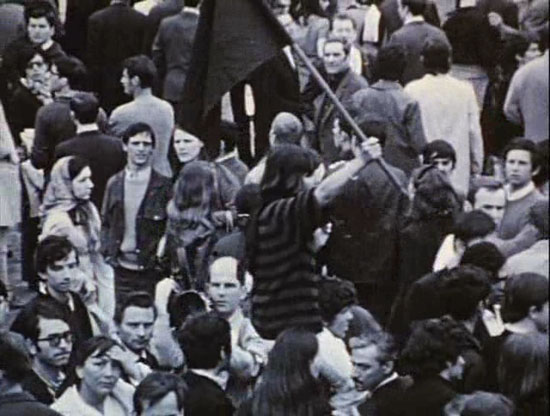
1967 saw the arrival of a rather peculiar breed of adolescents. They all looked alike. They would immediately recognize each other. They seemed to posses a silent but absolute knowledge of certain issues but to be totally ignorant about others. Their hands were unbelievable skillful at pasting up posters, handing paving stones, spraying on walls short and cryptic messages which stuck in the memory, all the while calling for more hands to pass on the message they’d received but had not completely deciphered. Those fragile hands have left us the mark of their fragility. Once they even wrote it on a banner. “The workers will take the flag of struggle from the fragile hands of the students.” But that was the following year.
image

Watched the 3-hour 2008 edit with English narration. There are so many versions of this out there… maybe next time I can watch the 2008 or 1977 French with subtitles.

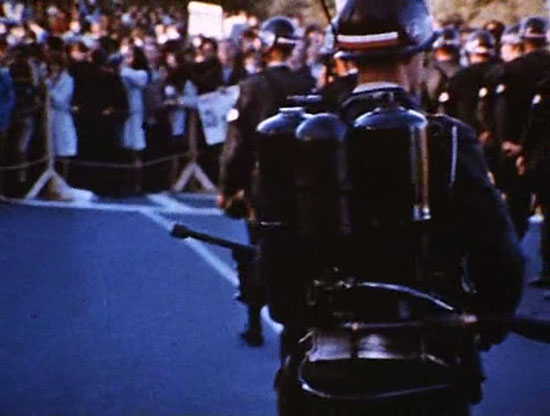
I thought I’d have more to say about it… three hours’ worth of Chris Marker’s most celebrated film, but I don’t really. Marker is mainly credited as an editor here, arranging others’ footage to show a bigger picture. There’s no wall-to-wall narration, just pops up occasionally. And I’m starting to notice a real sadness beneath many of Marker’s films… the same feeling in Chats Perches is present here. Glad I prepped a little by watching Sixth Side of the Pentagon and Battle of Chile, but I still had to check on wikipedia to see what exactly happened in Bolivia (Che Guevara killed Oct. 1967) and Prague (Jan-Aug 1968, attempted reform of Czech socialism led to 30 years of Soviet military occupation). The movie isn’t here to teach basic history of revolution – assumes you know something already, and since I quit reading The People’s History of the United States before it reached the 1900’s, I do not. Still, was able to follow the movie, thought lots of the footage was excellent, enjoyed watching and learned a little. Some segments have little gems of Marker wit in their editing or narration, but much of it is making connections between different scenes of revolution, both real and wishful, and thinking about what has been achieved, what might have been achieved. Really have to watch again sometime.
image

Either this was an early use of the electronic soundtracks that Marker would use in Sans Soleil and beyond, or the sound on my copy of the movie was pretty badly distorted. Or, more likely, both. The sound got worse during part two – there were some sections when I couldn’t make out any of the (English) dialogue.

image

Video and audio footage by: Pierre Lhomme (Mother and the Whore, Le Joli Mai, Army of Shadows), Etienne Becker (The Spiral, Le Joli Mai, Malle’s Calcutta), Michele Ray (Latcho Drom), Francois Reichenbach and his crew, Harald & Harrick Maury (The Owl’s Legacy, Day For Night, In the Year of the Pig), Théo Robichet (Band of Outsiders), Pierre Dupouey (Silence… on tourne), Raymond Adam (Jodorowsky’s Tusk), Paul Bourron of the Dziga Vertov Group, Willy Kurant (Far From Vietnam, Masculin-Feminin, Pootie Tang), Peter Kassovitz (Jakob the Liar), Paul Seban (Welles’s The Trial), Michel Fano (Rivette’s The Nun), Fernand Moskovitz (Last Tango in Paris), Yann Le Masson (Je t’aime moi non plus), Mario Marret & Carlos de los Llanos (À bientôt, j’espère), Jimmy Glasberg (Sans Soleil, Shoah), Robert Dianoux (Africa, I Will Fleece You), Jean Boffety (Thieves Like Us, Je t’aime je t’aime, Adieu Philippine), Robert Destanque (Joris Ivens’s The Threatening Sky), Hiroko Govaers (Terayama’s Fruits of Passion), Michel Cenet (Celine and Julie Go Boating), and an excerpt from Volker Schlöndorff’s The Lost Honor of Katharina Blum. That is quite a list of collaborators, though you never hear anyone talking about them.

image

English voices: Jim Broadbent (Brazil), Cyril Cusack (Fahrenheit 451), Robert Kramer (dir. Ice, Against Oblivion), Alfred Lynch (The Hill), and numerous British 1970’s TV actors.

“You can never tell what you might be filming.”

Quotes and other reactions:

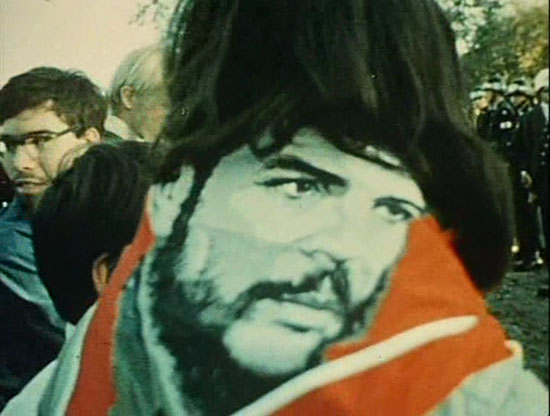
Icarus Films calls it an “epic film-essay on the worldwide political wars of the 60’s and 70’s: Vietnam, Bolivia, May ’68, Prague, Chile, and the fate of the New Left.”
image

J. Hoberman: “Marker begins by evoking Battleship Potemkin, and although hardly agitprop, A Grin Without a Cat is in that tradition—a montage film with a mass hero. Unlike Eisenstein, however, Marker isn’t out to invent historical truth so much as to look for it. (The untranslatable French title, Le Fond de l’air est rouge, is a play on words suggesting that revolution was in the air but not on the ground.)”

Paul Arthur: “In its rhythms and editing structures, Grin tries to embody the very shape and textures of historical transformation, rendering the abstraction of change as an amalgam of rapid, plurivocal, uneven, and, at times, contradictory forces aligned in provisional symmetries encompassing past, present and future perspectives.”

image

Y. Meranda: “The editing de-emphasizes the narrative structure and instead stresses the poetical interrelationships of the sequences by putting almost all of them out-of-context. … Paralleling the visual editing, the sound editing is more based on poetical considerations than on intellectual ones. … Because there is very little attention paid to the intellectual arguments and because the style goes beyond making statements about a political ideology, A Grin Without a Cat becomes much more than a left wing documentary about the left: It achieves to be a poem about revolting against the system (and not just the political system), the conformity and the order. It suggests that it is an eternal struggle that is supposed to fail (as was in the case of the New Left) most of the times. This universality, achieved by Marker’s distinctive style, is what makes the film great.”

image

Excerpts from the Lupton book:

“Marker explicitly pitched the film against what he saw as the historical amnesia surrounding the period promoted by its treatment on television, where ‘one event is swept away by another, living ideals are replaced by cold facts, and it all finally descends into collective oblivion.'”

Movie is partially composed of outtakes from other projects. “Introducing the published script, Marker wrote that he had become curious about all the material that had been left out of militant films in order to obtain an idealogically ‘correct’ image, and now wondered if these abandoned fragments might not yield up the essential matter of history better than the completed films.”

“As a groundbreaking work of visual historiography, Le Fond attempts nothing less than to give cinematic form to the chaotic and contradictory movement of world history during the tumultuous decade that it covers.”

“The reappearance of cats, even in this thoroughly politicized context, is a signal that Chris Marker was beginning to re-emerge from the anonymity of unsigned militant productions and to reintroduce into his work the familiar tokens of his own distinct presence.”

image

Chris Marker:

Scenes of the third World War 1967-1977

Some think the third World War will be set off by a nuclear missile. For me, that’s the way it will end. In the meantime, the figures of an intricate game are developing, a game whose de-coding will give historians of the future – if they are still around – a very hard time.

A weird game. Its rules change as the match evolves. To start with, the super powers’ rivalry transforms itself not only into a Holy Alliance of the Rich against the Poor, but also into a selective co-elimination of Revolutionary Vanguards, wherever bombs would endanger sources of raw materials. As well as into the manipulation of these vanguards to pursue goals that are not their own.

During the last ten years, some groups of forces (often more instinctive than organized) have been trying to play the game themselves – even if they knocked over the pieces. Wherever they tried, they failed. Nevertheless, it’s been their being that has the most profoundly transformed politics in our time. This film intends to show some of the steps of this transformation.

More images:

image

image

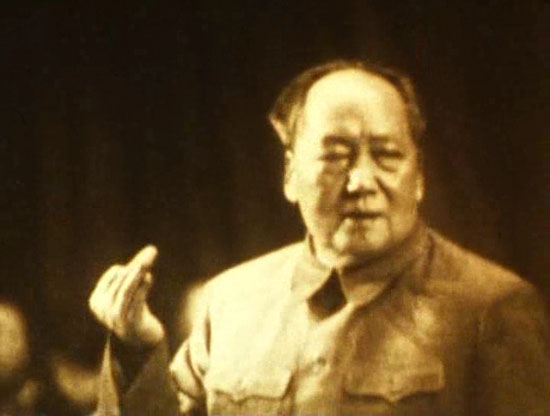
The Chairman:
image

Funeral in Prague:
image

Last footage ever shot of Salvador Allende:

image

Allende’s daughter, who would commit suicide in 1977:
image

Fidel in Russia:
image

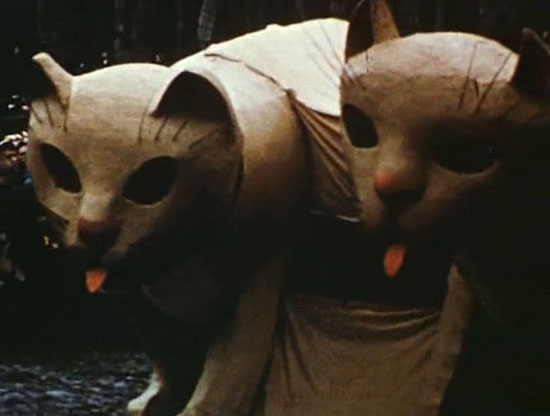
Enormous cats (no owls):
image

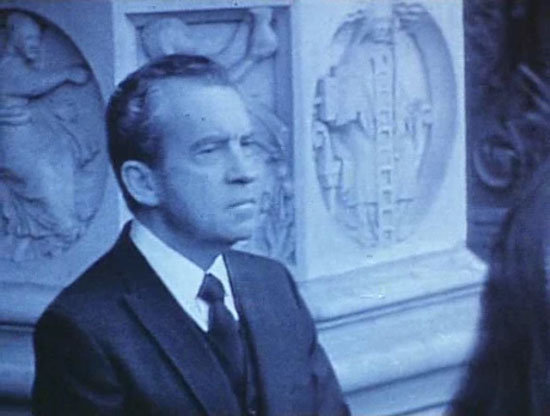
Nixon looks on:
image

“Look at my knees. Look at my knees!”
image

Things I’d forgotten about Eraserhead:

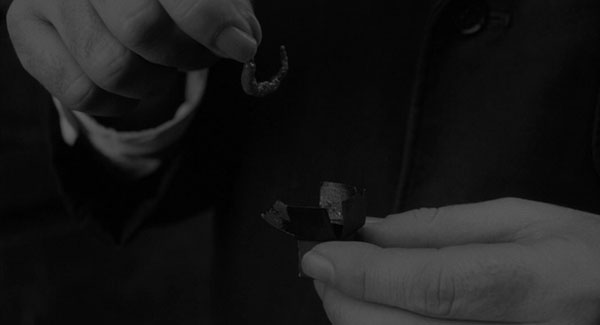
The curled insect-ring Henry gets in a tiny box in the mail and puts in a cabinet:
image

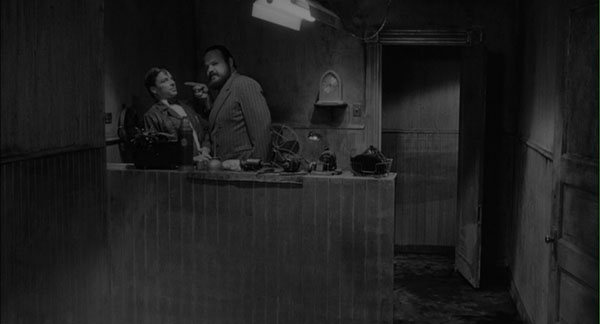
The sequence of events leading to the eraser factory. Henry enters the radiator, stands behind a railing, the baby’s head pops out of his neck, knocking his adult head on the checkered-floor ground. Blood pools, head falls into the pool and splats onto the street outside. A bum looks interested, his arm outstretched, but a boy grabs the head and runs, enters the factory. A man (Paul, below left) anxiously presses a buzzer until a bearded man (below right) comes out pointing his finger “OKAY, Paul!” Bearded man takes the boy into the back room where the eraser technician tests the head. “It’s okay.”
image

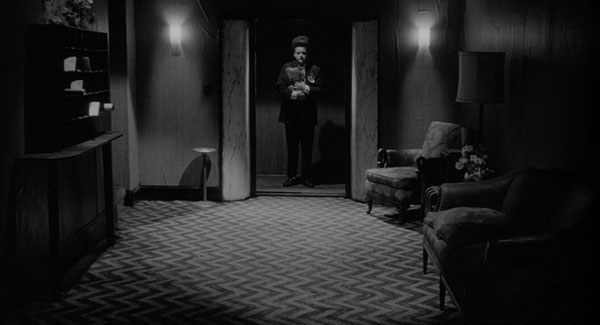
Kinda felt like I was going through the motions as cinephile and Lynch-fanatic going out by myself to watch Eraserhead on 35mm on the big screen… but WOW was it ever awesome. Such beautiful dark, dark imagery, and amazing to see it as intended sitting in a dark theater away from the comforts of home. Movie is a nightmare – that’s the most accurate description I can think of. Sure it’s a “horror film” among other things, but more importantly it is the closest thing I’ve seen to an actual filmed nightmare. There are no “dream sequences” because there’s no reality… the whole film follows a fascinating dream logic.

Made 30 years ago now. Mary’s mother Jeanne Bates (who also appeared in Mulholland Dr.) died last year. Sound man David Splet (who also worked on Days of Heaven and four other Lynch films) died in ’95. The actor who played Paul at the eraser factory, also in two John Carpenter films around the same time, died in ’98. Everyone else seems to be doing fine, but I also learned that assistant director Catherine Coulson later played the Log Lady on Twin Peaks, and co-cinematographer Fred Elmes (also shot five other Lynch movies and films by Cassavetes, Jim Jarmusch, Albert Brooks, Ang Lee, Mira Nair, and Charlie Kaufman’s new Synecdoche New York) is the only person listed on the whole IMDB to be born in Mountain Lakes, NJ. A hometown celebrity – and it’s a GOOD one!

Jack Nance was murdered Dec. 30, 1996. His final film was Lost Highway. Despite the IMDB’s claims, he’s not the same Jack Nance who co-wrote “It’s Only Make Believe” with Conway Twitty… wake up, IMDB.
image

Jack Fisk (below), alive and well and married to Sissy Spacek, has been production designer / art director on all four Terrence Malick films, two by De Palma, two by Lynch, and There Will Be Blood – an impressive career!
image

“Popular unity against the criminal bourgeoisie!”
image

Other street protest chants:
“Bourgeois shit, the street belongs to the left!”
“We need an iron hand!” (?!)

I alternately see this referred to as an epic 1979 movie, a long two-parter with a third-part postscript, or three separate movies. I guess they were presented theatrically in different ways in different countries. The 2/1 split seems right to me, as I’ll explain.

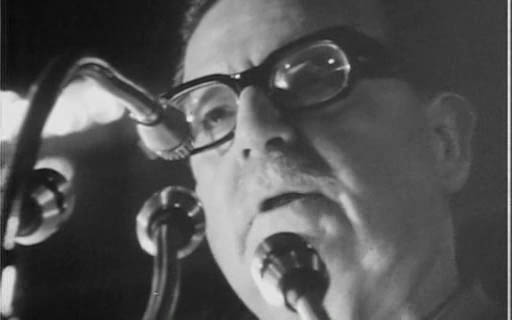
Part one drops me into the middle of an election in March 1973, which I didn’t understand until towards the end of the movie. I wondered why nobody was saying Salvador Allende’s name – turns out it was a senate election, and either the pro-Allende party lost, or they just did not gain enough seats in congress to prevent the opposition from holding a majority. So for the rest of Allende’s short reign as president, the country’s senate is mostly against him, undermining his authority. Movie is on the street, taking opinions from everyone, kind of slow at the start since I don’t know what’s happening, but excitement is in the air, and things straighten out soon enough. Cameraman is terrific, patient but curious, always looking for the best thing to shoot even if it means wandering off the person talking. I can’t believe the sound guy can keep up with him, but he does.

Salvador Allende:
image

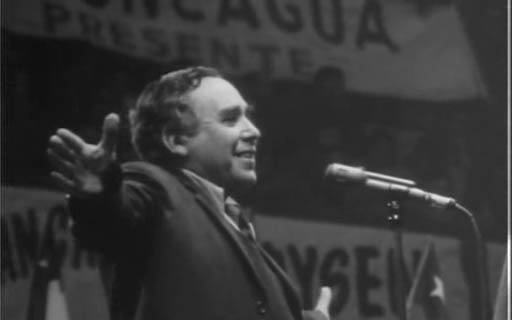
A politician:
image

image

image

Part two picks up right where the first one ends, with an attempted military coup on June 29 1973, and part two ends Sept. 11 1973 with the successful coup that killed Allende and instated General Pinochet as ruler. In between those dates, Guzmán covers everything that happens in the whole country, it seems, with access to the marches, the debates, worker meetings, everything but the secretive military that turns against its country (with help and provocation, it turns out, from the U.S. government). This is by far my favorite of the three parts, and could easily work as a standalone movie… I see the Film Forum in NYC thought so as well. The events themselves, a democratic country swerving communist then falling military-dictatorship, is the best movie material you could hope for and Guzmán and his crew make the best of it, watching from ground zero as history is made, producing one of the best docs I’ve ever seen.

Military man who shot and killed Argentine cameraman Leonard Hendrickson at the end of part one:
image

Salvador Allende, file photo:
image

Bombing of the presidential palace:
image

Pinochet addressing the nation on TV:
image

Military rule:
image

Pinochet: “After three years of support for the Marxist cancer we have been given a disaster that is economic, moral and social, that could not continue to be tolerated by the sacred interests of the mother country.” (or something like that – I think it’s all amateur-translated)

Guzmán: “From the 11th of September, all resources of the Chilean army are mobilized to repress the popular movement with the compacency of the North American government. The first armed resistance offered by some industrial cords, agricultural populations and student centers are squashed quickly in unequal fight. Thousands of people are killed and the main sport fields become concentration camps. The longest democracy in the history of Latin America ceases to exist.”

I don’t exactly wish I’d skipped part 3, but it would’ve made a nice recap six months later instead of watching it right after 1 and 2. Filmmaking in Chile wasn’t easy during Pinochet’s rule, since Pinochet was killing and imprisoning everyone who disagreed with him, including the cameraman of Battle of Chile (to whom the completed work was dedicated), so Guzmán backs up and shows further details of the workers’ movements during Allende’s presidency, not again mentioning Pinochet or the violence. The many worker meetings and the creation of multi-factory blocs and the attempted attack on Allende’s credibility by the “Christian Democrats” (his primary opposition) via a U.S.-funded transportation strike had all been covered in the previous films, but now we see them in greater depth… “depth” meaning lots of guys with sideburns talking into microphones at meetings. Since I’m not personally interested in creating a communist worker’s paradise in my own neighborhood, part three wasn’t of much use to me, but I’ll bet it’s exactly what Chris Marker was hoping for when he helped fund Guzmán’s efforts to document what was happening in the country. Marker’s own angry reaction to the coup is documented in his short Embassy, which I’ll have to watch again now that it’s on a new, clean DVD.

The transportation strike:
image

The people:
image

The sideburns:
image

The revolution:
image

Writer/director Altman, “third woman” Janice Rule, her cheating husband Robert Fortier and the actors who played Pinky’s parents (Ruth Nelson of Humoresque and blacklisted 30’s and 40’s director John Cromwell)? All dead now.

More similar in tone and style to 1972’s Images than to anything else I’ve seen by Mr. Altman. Unlike Images it’s not shot subjectively, showing the hallucinatory visions of a lead character; everything on screen is assumed to be happening. But there’s the tight psychological focus on just two characters and the slow (and sometimes overlapping) motion shots of the mystical ancient-looking paintings set to creepy flute music.

Woman 1:
image

Story goes that three sad women with names similar to “Millie” meet in a small California town (desperate, pathetic but high-spirited single Shelley Duvall, childish Sissy Spacek, and Janice Rule, a painter pregnant by her cheating husband). After each of two harsh breaks in their routine (Spacek’s attempted suicide and ensuing coma, then Rule’s stillborn birth attended by the other two), the women assume different identities. First Spacek becomes an unleashed and attractive version of Duvall’s character and Duvall becomes withdrawn and passive, then in the finale, the three move in together (the husband having met a mysterious shooting death) assuming the roles of daughter, mother and grandmother and speaking in spookily robotic tones. D. Sterritt says the ending “presents a parody of American family life as desolate as it is surreal.”

Woman 2:
image

Good movie, but I found it a little slow and wondered at the symbolism. Lots of humor, absolutely perfect performances by a post-Carrie Spacek and pre-Shining Duvall, and an extreme yellow-and-purple color palette.

Spacek uses Duvall’s social security number in her job application, an early sign of the current identity-theft crisis!

Woman 3:
image

Altman: “I’m trying to reach toward a picture that’s totally emotional, not narrative or intellectual, where an audience walks out and they can’t say anything about it except what they feel.”
image

I, An Actress (1977)
“This film gives an insight into my directing techniques while under pressure.”
A good way to start things off… George directs a screen test for a young actress and ends up in front of the camera flamboyantly showing her how he wants the scene performed. The funniest film of the evening, and it wasn’t even “written” to be funny. J. Steffen says it “becomes a commentary on his own camp persona and on the eternal problem of directing actors with wills and personalities of their own.”

Hold Me While I’m Naked (1966)
The famous one! Kuchar plays a film director whose actress quits mid-shoot out of disinterest and because George has asked her to take her clothes off. He calls around but finds nobody else, and falls into a crisis. Hilarious little movie. Played very straight, as George claims he was actually quite depressed. I wouldn’t say that the editing reminded me of Breathless and Parajanov, but Steffen did say that.

I Was a Teenage Rumpot (1960)
The young Kuchar brothers discovered three people who look completely unlike movie stars and began filmmaking careers in order to get these people onscreen. This sums up what makes Kuchar interesting and worth watching, and where all the John Waters comparisons come from. A glorious no-budget fake melodrama starring the ‘differently-shaped’ Arline, Edie and Harry.

Sylvia’s Promise (1962)
Sylvia promises that if Mike will only settle down and marry her, she’ll lose weight. The joke ending is that eight years later, they’re married and she’s lost three pounds.

Anita Needs Me (1963)
I’m not doing a good job describing these movies, and I don’t even remember which one this is because I’ve waited too long after the screening to write about ’em (ten days is too long?!?), but they’re totally fun to watch, short enough to never outstay their welcome, and different enough from each other to make seeing a bunch in a row worthwhile. It was a hoot of a screening, and I’d watch any one of ’em again.

Eclipse of the Sun Virgin (1967)
GK: “Painstakingly filmed and edited, it will be painful to watch, too.” This was my favorite of the bunch, just awesome. Unbelievably, I couldn’t remember what to say about it so I just watched it again on Ubu web… and I still don’t know what to say about it! Um, something about piano playing and humiliation and the color red? It’s poetry, and it is awesome.
Knocturne (1968)
Starring Joyce Wieland, Michael Snow’s wife. I think this one was less narrative than the others, and I’ll leave it at that.

The Mongreloid (1978)
George with a late-70’s mustache reminiscing on the time he shared with his dog Bocko. Brief sound dropouts were replaced in post-production with tiny bursts of music, keeping a playful edge on this otherwise diary-like personal short.

This was a very good program, and Kuchar is a good speaker, full of stories about an entire adult life spent making cool underground films, and the people he’s known (John Waters, Michael Snow, Ken Jacobs, Jack Smith, Jonas Mekas). Wish I could’ve made it to the other nights of screenings, featuring his storm-chasing films and diary videos. Wait, this just in:

Wild Night In El Reno (1977)
As watched on Ubu web. 6 minutes long, storm over a motel builds into the night. Probably some nice footage, but the online video flattens it out and uglies it up, and my sound dropped out after a minute. No substitute for the wonderful Eyedrum screening.

GK: “At the age of 12 I made a transvestite movie on the roof and was brutally beaten by my mother for having disgraced her and also for soiling her nightgown. She didn’t realize how hard it is for a 12-year-old director to get real girls in his movies.”

Movie is set on Sunday Nov. 16, 1981.

The President: “Screw church.”

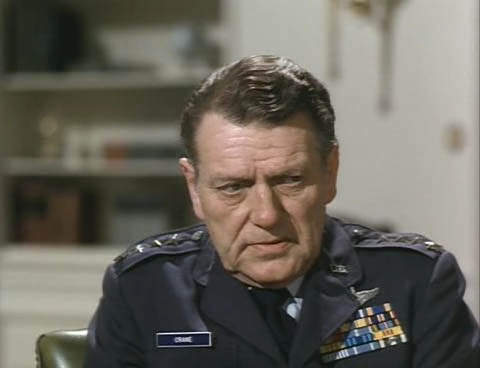
The Vietnam War was a show for the Russians, which we intended to lose, just to prove that we had the will to sacrifice troops for no good reason. General Burt Lancaster knows this and is going to force the President of the United States to publically admit it on the air. This is our premise.

Wait, it gets better. Burt will achieve this goal by taking over a nuclear missile station and threatening to launch nukes at Russia unless the President obeys.

Burt breaks in:
image

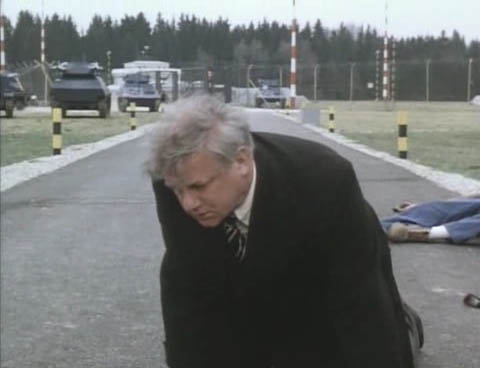
What goes wrong: Burt doesn’t count on the very evil military (who stay in power because of their legacy of secrets) being willing to kill his hostage, the President (who hadn’t even known about the vietnam conspiracy).

President Charles Durning (Waring Hudsucker, also in The Sting and Hi Mom):
image

Lancaster’s buds are Burt Young & Paul Winfield. Young gets shot in an almost-successful anti-Burt operation towards the end, and Winfield is mostly on Burt’s side but manages to reason with him a little, convince him of the futility of launching the missiles.

Winfield, of White Dog:
image

I don’t know a whole lot about Aldrich. This seemed a kinda low-budget effort, with a 70’s TV-movie look to it, except in the hugely stylish split-screens which sometimes divided into three or four simultaneous actions or angles.

image

But wait, have I mentioned that Thee Great Richard Widmark plays Burt’s nemesis General MacKenzie?

image

Widmark does go to church, seen below with his wife, one of the only appearances of a woman in the film.

image

This was the final film of Charles McGraw (below), star of “The Narrow Margin”, appeared in “The Birds” and “The Defiant Ones” and “A Boy and His Dog”, and previously appeared with Burt Lancaster over thirty years earlier in “The Killers”.

image

Other things:

Paul Winfield: “Jive-ass honky!”

Widmark’s pager goes off in church, back when that was socially awkward rather than business as usual.

Multiple product-placements for Coke.

Burt: “Gentlemen, we are now a superpower.”

image

image

image