Wow, a helluva good movie, with a lousy presentation by The Pan-African Film Festival at The High. Maybe they should’ve taken a look at the shoddy sub-VHS-quality videorecording they had before making people pay $8 each for a public screening of it.

After liking Burnett’s Killer of Sheep very much, but his shorts and his My Brother’s Wedding not so much, I was kind of anxious about this one, so chose to see it over Sembene’s Ceddo. Currently Anger isn’t out on video, but the moment it’s released, that decision will have been a mistake. Anyway.

Father of the family is named Gideon (heh). Old family friend Harry shows up one day, and suddenly Gideon falls ill and his younger son is threatening to follow in Harry’s immoral footsteps, when suddenly, thanks to some spilled marbles (preceded by Gid’s wife taking a stand against Harry), all is set right again.

Then comes the part that Ebert hated… Harry dies ten minutes before the movie ends, and the rest of the time is spent gradually reassembling the family, talking over what’s happened, and waiting (over a day) for the county coroner to show up. Dunno why Ebert wishes a more commercial rhythm upon an independently-minded film. “All movies should end the same way!”

It’s as if Burnett’s African-American family had become more well-off with each movie. Killer of Sheep they are barely getting by, My Brother’s Wedding they’re poor but surviving, and now they’ve got a nice house and a thriving multi-generational family. Harry is a reminder of the past, but there are reminders everywhere in references to slavery and folklore. The family is drawn in great detail, and the good vs. evil metaphor is clear without being hacky/obvious. Really a shockingly good movie for something nobody talks about and not available on video. Won a Sundance jury award and four independent spirit awards before sinking into obscurity, being replaced by Grand Canyon on the new release shelf.

“The Law”

image

Ouedraogo, from Burkina Faso, was a student of Gaston Kabore, director of last week’s Wend Kuuni, and also worked with Ousmane Sembene.

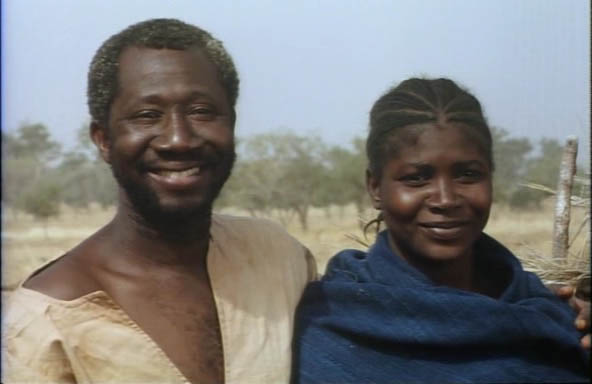
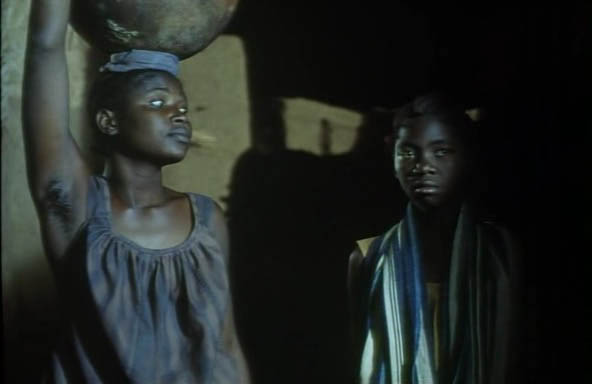
Saga (actor also in Moolaade, Yaaba, Night of Truth) has been away for a couple years, and returns to find that the woman he was promised as a wife is now married to his father. She and Saga are in love and resume their affair, with disastrous results. Saga’s brother is sent to kill him, but allows him to escape, and the illicit lovers go off to Saga’s aunt’s house… but he comes back for his mom’s funeral, exposing himself to the townspeople. The father banishes the brother, who then shoots Saga, oh and the girl’s dad hangs himself for having a part in all this.

image

Fine story (a darker Ten Canoes?), fine acting, plays at a good pace, not at all as bleak and awful as it sounds from my plot description. Won the Cannes Grand Jury Prize (a step up from the prize Yeelen won three years before), second place to Lynch’s Wild At Heart and beating out Godard, Zhang Yimou and Ken Loach.

image

Little music. A vocalist sings “Tilai… Tilai” a couple times and that’s it. Long shots, but not distractingly long.

“Claire Denis, the director of the autobiographical film Chocolat, set in colonial West Africa, notes that in Tilai every sentence starts with the name of the person who is addressed, in contrast to what she calls the vacuousness of communication among white colonials.”

image

You hear about “cult films” and films with “a cult following” a lot, but where are these cults? Is there a basement in Des Moines where ten or twelve people get together monthly to watch Richard Elfman’s Forbidden Zone? Maybe a club in Montreal that meets at a different member’s living room every wednesday night to watch a different Mario Bava movie from one guy’s prize collection of DVDs and bootleg cassettes? An Alejandro Jororowsky society in Mexico City that watches a 16mm print of El Topo once a year followed by a ritual sacrifice of farm animals?

If these movie cults literally exist, I just hope there’s one for Werner Herzog.

“Little” Dieter Dengler was about seven when WWII ended. He lived through the rebuilding of Germany, when people were boiling and eating wallpaper to get the nutrients that were supposed to be in the glue. Later became a blacksmith’s apprentice and worked at a machine shop. Got toughened the hell up by all these experiences and finally left town for the first time ever to head to America and become a pilot at age 18. Joined the air force, worked shit jobs for a few years, then quit to get a college degree, become a citizen and join the navy where he finally started flying, which is all he ever wanted to do. Got sent right away to Vietnam, and first mission he’s shot down and captured over Laos. It gets hairier from there, with deadly escapes and all the adventures that Herzog’s upcoming Rescue Dawn will be recreating. Died in Feb 2001, and there’s a “postscript” scene of his funeral on the DVD.

image

Dieter lived an exceptional life, went through very extreme ordeals, and had a single driving obsession (to fly), all making him such an obvious Werner Herzog protagonist that, a decade after shooting this documentary, Herzog is returning to the same story with Rescue Dawn.

Never one to make a “straight” documentary, interviewing Dieter and his war buddies at a neutral location, zooming in slowly on old photos and showing stock footage… no, Herzog does all that, but he also takes Dieter back to Laos. Herzog “helps” Dieter re-enact his own capture and imprisonment with props, locations and some willing Laotian men. What a terrible, wonderful idea. Dieter seems totally up for it, never breaks down into post-trauma sobbing sessions, just reports his history matter-of-factly, with Herzog’s voice occasionally coming in to ask questions or observe in his godlike way.

image

(Grizzly Man connection) Dieter: “Duane, my friend, he was gone, and from then on my motions, my progress, became mechanical. In fact, I couldn’t care less if I would live or die. But then later on, there was this bear, this beautiful bear that was following me. It was circling me in fact sometimes. It was gone and I missed it. It was just like a dog, it was just like a pet. Of course I knew this bear was there, he was waiting to eat me. When I think about it, this bear meant death to me. And it is really ironic. That’s the only friend I had at the end, was death.”

But… Herzog: “Dieter took an early retirement from the armed forces and became a civilian test pilot. He survived four more crashes and flies to this day. Death did not want him.”

image

Completely awesome movie, short and gripping and moving. I might not join the Herzog cult (they’d never stop talking about the relationship between man and nature, and they probably all have dangerous and bizarre obsessions) but I’ll sure watch more of his films.

Sort of a slice-of-life movie set on the last day of the century (which is summer in Africa). Has a Bamako-village feel to a few of the scenes. Slight, but a nice movie. Kept returning to the idea that “it’s difficult to contact people; it’s a matter of luck”, with townspeople visiting the post office to use the telephone and try calling others, usually unsuccessfully.

Otherwise, there’s a boy kicking a ball, a pretty girl on bicycle, a guy (who likes the pretty girl) returning to his hometown for new year, this guy’s father writing him a letter (descriptive at times, poetic at others), farmers chasing birds off the crops, and of course, some scenes about radios.

I like how Sissako shows the passage of time with a group of men sitting in chairs in the shade from a building, out in the street… later sitting closer to the building, then right next to it, then standing against the building, and finally (no more shade) picking up their chairs and going home.

I think there were six or eight of these last-day-of-the-century movies done by different directors as part of a Y2K film project. So far, this is the better of the two I’ve seen (vs. Hal Hartley’s Book of Life).

Katy remembers more than me:

“This is an ensemble film, with Dramane, played by Sissako, composing a letter to his father in the village of Sokolo. Dramane lives in Paris but decides to visit his village at the dawning of the new millennium because he misses the life of the village.”

“The film opens in a brightly lit supermarket in Paris, with rows and rows of cheeses. Dramane’s voice over begins there, and we switch to the village which shows people working for their food: drawing water, out in the fields. The colors also change. The brightness remains, but the yellow mud homes and the yellow sand of the village dominates the color palette.”

All seen on a wonderful DVD called The Cineseizure.

Pièce touchée (1989) – girl is reading, guy walks in the door, they kiss, he crosses behind her, she gets up. But for 15 minutes, painstakingly and obsessively re-enacted, rewound, stalled and repeated. Arnold mirrors the shot about halfway in, and flips it upside-down towards the end. An intriguing start. The main fault with this one is the annoying machine-loop audio.

Passage à l’acte (1993) – looks like a dinner scene from To Kill a Mockingbird. Boy comes running in, tells girl to hurry up, “I’m trying to”, “come on”, they run out but she stops to kiss her dad first. But all one frame at a time, with the obsessive back-forth repetition. The sound from the movie is here, so this is much less annoying than Piece Touchee… a large step towards the Andy Hardy movie, which, even had I not been told before I saw it, would recognize as the masterpiece of this bunch.

Extras: Psycho trailer (just a shower head, no text, clever), Jesus Walking On Screen trailer (“master, give me sight”), another trailer (in a train station), and a relatively serene montage of old clips called Der Osterreichfilm.

Also rewatched Alone. Life Wastes Andy Hardy (1998) a couple times. I had very little to say about it back in September ’06.

I’ll bet the actors in these films would be horrified by what Martin Arnold does to them, calling attention to every single tiny expression and movement and gesture. Sure is fun/interesting to watch though. IMDB says he did one in 2002 called Deanimated and it sounds like he’s working with some new techniques.

Arnold: “The cinema of Hollywood is a cinema of exclusion, reduction and denial, a cinema of repression. There is always something behind that which is being represented, which was not represented. And it is exactly that that is most interesting to consider.”

A surprisingly great movie. I mean, it’s Cronenberg so I oughtta like it, but at the same time it’s a late 90’s virtual reality thriller… not the kind of thing you can easily recommend to people, after the blitz that was Dark City, The Cell, The 13th Floor, The Matrix, and to a lesser extent, 1995’s Strange Days / Virtuosity / Johnny Mnemonic. But Cronie has been comfy working with virtually unreal worlds for decades, after Naked Lunch and Videodrome, and his movie easily stands above those others (not to knock Dark City).

image

It’s not the story, which is fine, or the is-it-real-or-not bits, which are well played and not overdone or inexplicable, it’s the look of the thing, the sleek style and great lighting… the compositions, which are uniformly attractive without calling attention to themselves or drowning the film in stylistic tricks. It’s genre sci-fi filmmaking that is so good it looks effortless. It won a silver bear in Berlin for outstanding artistic achievement, but was understandably ignored everywhere else.

image

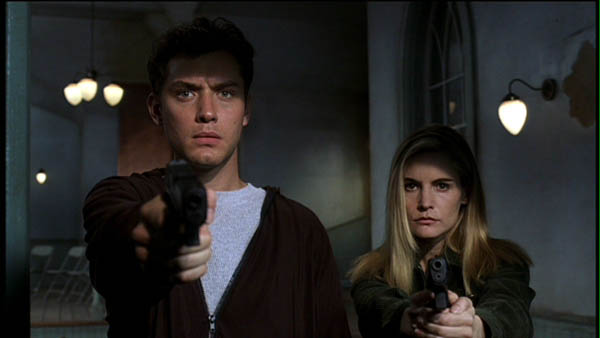
Jude Law and Jennifer Jason Leigh (spoiler alert: last 90 seconds) are underground realists out to destroy the creators of virtual-reality video games. They play the premiere of a new game with its creator (Don McKellar)’s participation, along with gamers Ian Holm, Willem Dafoe and others.

Next level: JJL is premiering her new game to a crowd of excited gamers, but when an underground realist tries to assassinate her, security guard JL comes somewhat to the rescue and they go on the run together. Along the way they meet Willem Dafoe, Ian Holm and Don McKellar, but it’s never clear who’s on their side.

Various sub-levels back and forth. The “game pods” are organic, and plug into bio-ports in your spine, but on some levels it’s a mini gamepod that merges with your spine directly. There’s spy business at a chinese restaurant, acknowledged fake accents, CGI insects, a few killings and close calls, and the deadly spoooores.

image

Has the game-life analogies you’d expect from the genre and the body-horror, sexuality and organic technology mix you’d expect from Cronenberg. Seeing the movie for a second (third?) time, it’s nice to see that the movie really doesn’t trick you, that the ending makes sense. Whether the ending is the really real “real world” or if we’re still within a simulation doesn’t matter, since of course the movie itself is a simulated reality.

image

–
OCT 2019: Watched with Dana, who said “ewwww” a hundred times, so I think it was a hit.

Movies: now more than ever!

image

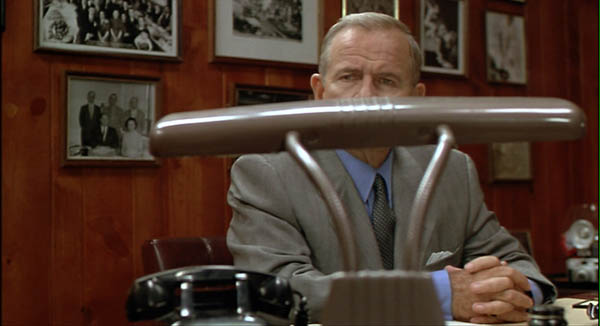
Maybe I’ve seen The Player enough times that I don’t really need to write about it. One of the only movies that I like Tim Robbins in (besides Mystic River, Shawshank Redemption, and presumably Howard the Duck).

image

Things I forgot:
Whoopi Goldberg as the smartass detective
The Swedish artist who Robbins picks up was the dead guy’s girlfriend
Dead guy was Vincent D’onofrio
The author and his brother as the excited pitch men at the end

The only other place I’ve seen Robbins’ cute coworker / ex-girlfriend is Happiness, although she’s been on TV recently.

image

Katy liked the movie but not the character.

image

The missing link between Bonfire of the Vanities and Carlito’s Way.

image

Movie’s chugging along fine for a half hour, then helloooo awkward voiceover. Something must’ve gone wrong in the editing process, or maybe test screening audiences were confused.

John Lithgow:
image

I love how De Palma keeps trying to make artful tributes to Psycho, then Gus Van Sant just up and remakes Psycho, the dummy. Killing the female lead 40 minutes in… check. Same shot in the police station from Dressed To Kill, also in a police station. Characters named Dante and Cain, heh. With the knife to the hand, the wig/dress costume, the elevator scene and the multiple personalities, this thing has Dressed To Kill written all over it. De P. is referencing himself more than Hitch this time around.

John Lithgow:
image

The fun is to figure out which characters are John Lithgow and which aren’t (spoilers: his twin brother and the kid at the restrooms are, his dad is not). Whole movie is worth it for the awesomely choreographed long-shot slow-motion finale at a hotel.

John Lithgow:
image

DVD box says: “When Jenny cheated on her husband, he didn’t just leave… he split”. But he was split from the start, and the cheating only got him to try to blame her new guy for one of Lithgow’s murders (it only stuck for about 10 minutes).

John Lithgow:
image

Looked for a second opinion but it’s (the only one?) missing from Reverse Shot’s De Palma discussion page. Maybe I’m alone, but I think it’s a real cool movie.

aaaaand John Lithgow:
image

SUCH a fun movie, I watched it twice in one day. Seen it a bunch of times before, too. Perfect balance of comedy, horror, mystery, romance, effects, live action, serious drama and loony overacting.

Commentary has fun/useless trivia, looking forward to the very long doc on disc 2. For the first time, I was seeing the extended “director’s cut”. Extra shots and scenes didn’t improve the movie necessarily, but they didn’t hurt it either. Sometimes more of a good thing is just more of a good thing. No real need for plot description since I don’t think I’ll forget it anytime soon. So here are screen shots instead.

Katy came in during the same scene twice, and didn’t seem thrilled about the whole thing.

fun deleted scene:
image

still badass even in death:
image

Michael J. dies a lot in this movie:
image

danny elfman’s favorite scene:
image

saturn award nominated Jeffrey Combs:
image

no oscars, but won lots of emmys and golden globes:
image

oscar-winning director Peter Jackson:
image