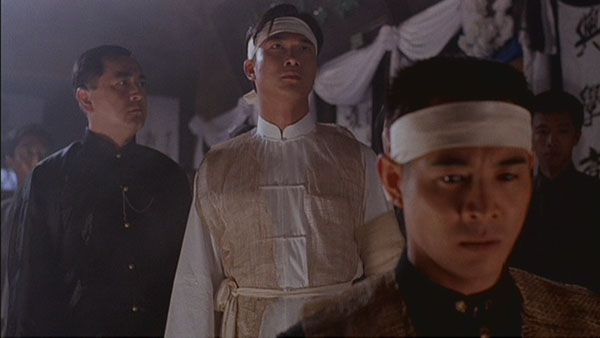
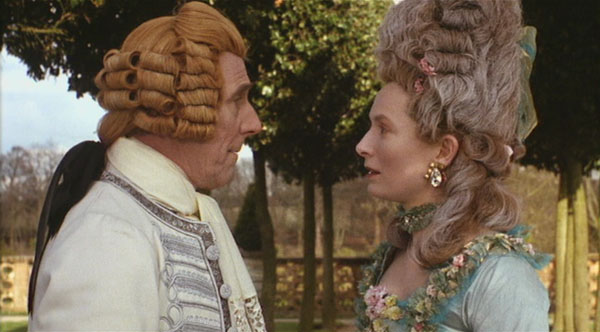
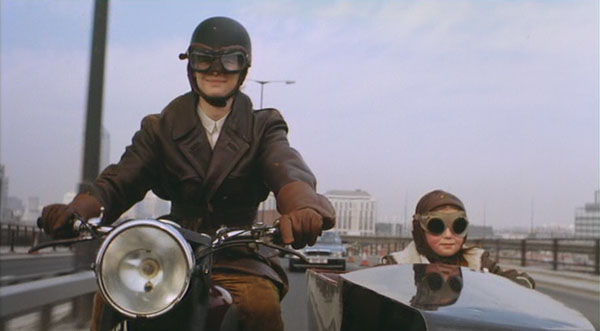
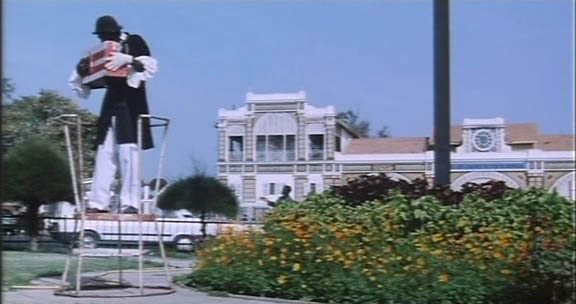
Redux is playing in theaters, so I watched the original first to get all the plot and characters straight. I know that Plot And Characters Do Not Make The Movie, but even with crazy movies like this and Out 1, I like being able to keep all that stuff straight before I can lose myself in the atmosphere of the film. Also, although there are about eight mega-superstar actors in this, I only recognize half of them. My Hong Kong/Chinese moviewatching has fallen sadly behind. A study guide follows.

Leslie Cheung is in all the framing-device scenes, probably the single star of the movie. Easily recognized throughout by the mustache. Moved out to the desert to forget his true love, Maggie Cheung, who got tired of waiting for him and married his brother. Sort of a swordsman matchmaker – hooks up would-be killers with people who need somebody killed. One day will be called Malicious West.
image
Seen him in: Farewell My Concubine, The Chinese Feast
Still need to see: A Chinese Ghost Story, A Better Tomorrow

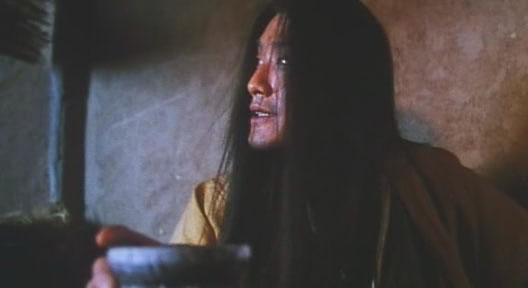
Tony Leung Ka Fai, or “Tony 2” – old friend of Leslie’s, comes around once a year. This time he brings a wine of forgetfulness for Leslie to drink, but ends up drinking it himself. Visited Maggie Cheung once a year, gave her an update on Leslie. A ladies man, I think he’s in love with Carina Lau. Will later be known as Evil East.
image
Seen him in: Dumplings
Still need to see: Election, The Lover

Maggie Cheung – object of affection of the above men. She gives the wine to Tony 2 to be given to her ex, Leslie, in hopes that Leslie will forget her. Dies of an illness before most of the movie takes place, but we don’t find that out till the end.
image
Seen her in: Irma Vep, In The Mood For Love
Still need to see: Comrades, Centre Stage

Brigitte Lin – crazy woman who comes around as a “man” trying to hire a killer for Tony 2, then comes back as herself trying to hire a killer for her “brother”. She fights and almost kills ex-flame Tony 2 herself at one point, maybe when she first met him, then later becomes obsessed with him. Finally goes off into the desert practicing sword skills on her reflection.
image
Seen her in: Chungking Express, Royal Tramp 2
Still need to see: Bride With White Hair, Swordsman 2, Police Story

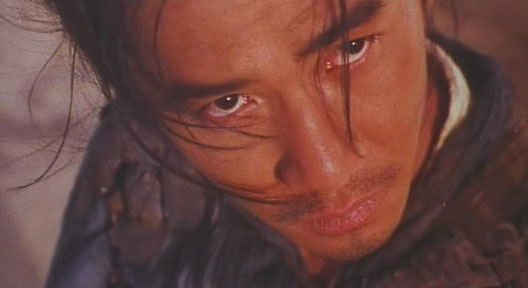
Tony Leung Chiu Wai (“Tony 1”) – former best friend of Tony 2, is quickly going blind. Needs one last high-paying job so he can afford to go home and see “the peach blossoms” (see below) before his vision fades completely. Hires on to protect a nearby town from bandits, but the bandits take too long to show up, he loses more of his sight, and he dies in the battle when clouds darken the sky. Perfect role for Tony 1, the saddest of all actors.
image
Seen him in: 2046, Infernal Affairs
Still need to see: Cyclo, City of Sadness

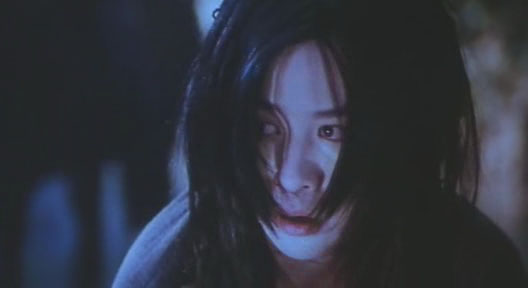
Carina Lau – beloved of Tony 1, named Peach Blossom. Mostly crouches in flashback looking awesome… has hardly any lines. She fell in love with Tony 2 years ago, which is why Tony 1 is alone and sad.
image
Seen her in: 2046 (she’s Lulu/Mimi), Flowers of Shanghai
Still need to see: Curiosity Killed The Cat, Intimates

Charlie Yeung – poor girl who wants to hire a swordsman to avenge her brother’s death at the hands of the militia with some eggs and a mule. Leslie and Tony 1 turn her down, and Tony breaks her eggs.

image
Seen her in: Seven Swords, Fallen Angels
Still need to see: Butterfly Lovers

Jacky Cheung – dirty, barefoot, badass swordsman. Leslie hooks him up, gives business and strategy advice. Jacky is well paid for defeating the bandits, and also takes on the militia in exchange for Charlie’s egg (but almost dies). Rides off with his wife (not Charlie) in the end. One day to be known as the Northern Beggar, will fight a doubly-fatal duel with Leslie years later.
image
Seen him in: Once Upon a Time in China, As Tears Go By
Still need to see: Bullet in the Head

Movie is an imagined prequel to popular novel “Eagle Shooting Heroes.” All the cast members also appear in film The Eagle Shooting Heroes, a parody dir. by Jeffrey Lau, with supposed participation by Wong and Sammo Hung. Will have to see to believe. Edit: Found it, watched in between Ashes and Redux, reviewed here, still not sure if I quite believe it! Other filmed versions of Eagle Shooting Heroes all seem to be TV series, although Royal Tramp and the Swordsman series are based on other books by the same author.

Screenshots above are from a scrappy foreign DVD (still not half as scrappy as the American disc looked), then a week later I ran out and watched Ashes Redux on lovely new 35mm (minus the topmost and leftmost 5% of the picture – thanks, Landmark). I am not considering these two separate movies, of course. Don’t know why the IMDB has a new page for Redux – they don’t have five different pages for The New World. Besides being able to see what’s going on and properly appreciate the glorious cinematography, Redux straightens out the plot threads at the start and end, the bits about the memory wine, Tony 2, Leslie and Maggie. It also cuts out a whole fight scene, the one that the original drops the viewer into at the beginning without explaining a damned thing. I miss that fight scene – it was awesome, and one of my favorite shots of the video was in it: a black-eyed, wild-haired Tony 2 giving a monstrous, slow-mo, silent scream.

I did understand everything better while watching Redux – but is that because Wong re-edited, or because I’d spent the week before studying the movie? I don’t think of myself as the type who champions straightforward stories over complex mood pieces, but Redux does probably work better. Movie leads up to this grand emotional moment of Maggie crying over her lost Leslie, talking about her failure to spend the best years of her life next to the person she loves most, and if you didn’t couldn’t make sense of the wild first ten minutes of the film, that’s not going to hit very hard. I’m apparently only good at summarizing plot and character, which, as I said three pages ago, isn’t what makes the movie. The desert, the mountains, the spinning birdcage, the haze, eclipses, sudden swordfights, and endless stories of lost love all add up to a pure and excellent film. I’m not saying it’s my favorite – most of Wong’s films are excellent – but it’s up there.

Writes T. Brogan on the film vs. novel:

The original plot actually dealt with two characters nicknamed “Evil East” and “Wicked West”, aged, respected and feared demi-gods in the pugilistic world. Arch rivals, their tussle for power was the backdrop against which Cha’s main protagonists (a pair of lovers from the entire trilogy series) were tested in terms of their wits, loyalty and love for one another. In Wong’s film, however, the hands of time have been turned back, and the focus is primarily on the two men, now portrayed in their prime, and seeks to “explain” the beginnings of their bitter feud in a progressive manner.

Wong:

Basically the film is about emotions. It’s a love story about Dongxie [Tony 2], Xidu [Leslie] and a woman, spanning half a life time. Certain emotions are eternal. When I got to the film’s ending I finally realized what Ashes of Time is about, and its relationship with my previous films. They are all about refusal and the fear of refusal. Everyone in Days of Being Wild has been refused. They become afraid of being refused, so they refuse other people before other people have a chance to refuse them. It’s the same in Chungking Express. But I think I have changed, so the film has an open ending. Tony Leung and Faye Wong don’t really know where they stand with each other, but they know they can accept each other. Ashes is most deadly. It sums up the three previous films. How do you go on with your life after you’ve been refused, and you’re afraid of being refused to begin with? So [Brigitte] Lin Chin Hsia becomes schizophrenic, Tony [1] resorts to the most destructive method to solve his problems; Leslie Cheung hides in the desert; Tony [2] drinks himself to amnesia. The only exception is Hong Qi [Jacky]. He doesn’t think being refused is a big deal. He just goes ahead to do what he thinks is the right thing.

IMDB: “What do an elderly topiary gardener, a retired lion tamer, a man fascinated by mole rats, and a cutting-edge robotics designer have in common?” That’s what I set to find out while watching this very fun, good-looking and well-edited movie. Katy got tired an hour in, liked it for the most part but didn’t enjoy my connection-drawing game.

Dave was a lion trainer who traveled with the circus. He seems ambivalent about his career, not talking it up as a great time with his beloved lions or an exhilarating and rewarding experience, mostly going over the reasons for first wanting to be involved (he idolized and eventually worked with Clyde Beatty, animal trainer and entertainer who once co-starred with Mickey Spillane in a weird-sounding mystery called Ring of Fear) and the procedures and dangers involved.

George is an elderly gardener who creates, trims and maintains the topiary sculptures in one estate garden. You get the feeling there used to be one old woman who oversaw the garden, and now there’s nobody, that he’s gardening for himself on someone else’s land. Unlike Dave, who is helping train newcomers, George has nobody following in his footsteps, and dislikes other gardeners’ methods (using electric hedge trimmers, for example).

Raymond studies and “wrangles” insects, and has become a specialist in the naked mole-rat, a mammal that exhibits insect-like behavior. He sets up a museum installation to put their society on display, and talks about their activity and relationships.

Rodney is a robot scientist trying to innovate robotic movement and behavior by putting together bunches of small robots or processes which try to solve common tasks, instead of attempting to control them with one larger intelligent system.

There are plenty of ways to link these four guys and their jobs/interests, not a large hidden theme which is the One True Key to unlocking the film. They all work with non-human life forms, trying to study and control behavior. Some offer insights into human behavior through the lens of their subjects. All but Dave work with arrays of smaller beings (robots/leaves/rats) which work together towards large tasks (or forms). I had more but I’ve forgotten half of them… IMDB commenters mention themes of growth and development, consciousness and death, or the guys as representative of different concepts of god’s existence.

I loved the editing, the music (by Caleb Sampson, who killed himself the following year), the use of stock footage (such as old Clyde Beatty films) instead of the Mr. Death re-enactments, the pacing. The movie’s got heart… these guys are really involved in what they’re doing, care about it, and each is able to express himself and his subject in an engaging, philosophic way. It’s not the connections and differences between these guys which are interesting in themselves, it’s the way Morris encourages the viewer to discover them. Wonderful.

Happy 10th anniversary to the funniest comedy of the 90’s!

In honor of this anniversary, I intended to post pictures of Jeff Bridges’ smiling eyes, but the DVD crashes my VLC player on both computers, so I will abandon this post before I am tempted to start quoting lines.

Congoma-player Marigo hasn’t paid the rent in a few months, so his landlady (the griot from Touki Bouki) has confiscated his instrument until he pays up.
image

With no way to earn a living, Marigo buys a lotto ticket from an optimistic dwarf acquaintance.
image

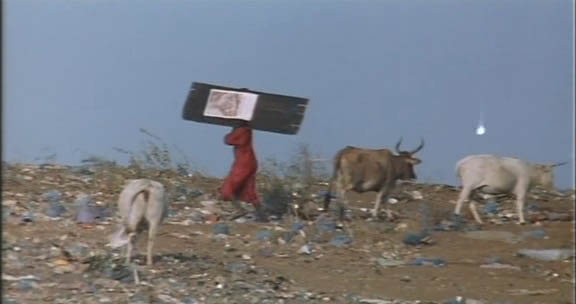
Marigo has got the winning number… but he pasted the ticket to his front door behind a poster of Yadikoon (“an African robin hood”), so he has to take the whole door to the lottery office.
image

…along the way, dreaming of the rich life…
image

…only to be told that the ticket needs to be detached from the door to be authorized.
image

So Marigo makes a run for the beach and uses the pounding surf to remove the ticket, dancing and dreaming on the rocks, losing his poster but getting the ticket off successfully, screaming ecstatic laughter.
image

I pretty much loved it.

Culturebase.net:
“We have sold our souls cheaply!“, Mambety concludes, though he never described himself as a political director. Yet his films always refer to the economic reality of his country, which is entirely dependent on the World Bank, monetary funds and French economic policy. This is true for his last two films. They were part of a trilogy on “The story of small people.” “Le Franc” and “La petite vendeuse de soleil” are from parables on the lives of people who must ask themselves the same question every morning, namely how to gather the most fundamentally necessary means to survive. The small people in this trilogy are the counterparts to the greed of the hyenas in his longer feature films.”

Filmref.com:
“Mambéty introduces the trenchant idea that the power of the imagination to raise post-colonial African consciousness does not exist in fanciful, but ultimately empty, idle dreams or wistfully dwelling over a lost – and stolen – noble past (a theme that is also articulated in Jean-Marie Téno’s films, as well as Ousmane Sembene’s Borom Sarret), but in a certain wide-eyed innocence and naïve determination that recovery and advancement are still possible with dedicated effort.”

California Newsreel:
“In both films there are conspicuous references to Yadikoon, a semi-legendary figure who in popular memory became a kind of Senegalese Robin Hood, robbing from the rich to give to the poor. In Le Franc, the main character, Marigo has a poster of Yadikoon in his room. Mambety himself named a foundation he established for Dakar’s street children after Yadikoon.”

The only hits I get from “Yadikoon” on google are from articles on these films, so either he’s a Mambety-created character or we are all spelling his name wrong.

Also watched “Echek” again, fun little flick by Adan Jodorowsky:
image

The producers (Stanley Tucci and Campbell Scott) chose an interesting script (written by Stanley Tucci and his cousin) then hand-picked directors Stanley Tucci and Campbell Scott, who cast Stanley Tucci, Tony Shalhoub, Minnie Driver and Campbell Scott.

So a vanity project, and an obvious one (for everyone other than Ian Holm, who is too shouty and shifty and will hopefully not use this on his actor’s reel).

Italian brothers Tucci and Shalhoub (who is actually Lebanese via Wisconsin) have a restaurant that is failing because the food is too authentic for the locals and the atmosphere is dead. They have time for one final feast, their “big night” if you will, with special guest of honor Louis Prima (so movie is maybe set in the late 40’s), invited by their across-the-street rival Ian Holm who is suddenly all buddy-buddy with them. But Holm lied (to get the restaurant to fold, so the brothers will come work for him) and the bank will be foreclosing soon. Before that though, we must have a raging party with the best food anyone has ever tasted, and the brothers must fight then make up in the end, their futures still unwritten.

Such a typical 90’s indie movie. Really nothing to complain about, we enjoyed it pretty well, but it’s also no more groundbreaking or artistically exciting than Shalhoub’s directorial debut (written/starring his sister-in-law) eight years later Made-Up.

Isabella is here, but with too small a part to liven up the movie… it’s really all about the men.
image

Cinematographer Ken Kelsch (an Abel Ferrara regular) here tries to emphasize the fact that Ian Holm has a mustache, without actually showing the mustache. A risky artistic move that pays off. Holm does, it is later revealed, have a mustache.
image

The anticlimactic ending (all serious indie movies have anticlimactic endings):
image

Wow, a helluva good movie, with a lousy presentation by The Pan-African Film Festival at The High. Maybe they should’ve taken a look at the shoddy sub-VHS-quality videorecording they had before making people pay $8 each for a public screening of it.

After liking Burnett’s Killer of Sheep very much, but his shorts and his My Brother’s Wedding not so much, I was kind of anxious about this one, so chose to see it over Sembene’s Ceddo. Currently Anger isn’t out on video, but the moment it’s released, that decision will have been a mistake. Anyway.

Father of the family is named Gideon (heh). Old family friend Harry shows up one day, and suddenly Gideon falls ill and his younger son is threatening to follow in Harry’s immoral footsteps, when suddenly, thanks to some spilled marbles (preceded by Gid’s wife taking a stand against Harry), all is set right again.

Then comes the part that Ebert hated… Harry dies ten minutes before the movie ends, and the rest of the time is spent gradually reassembling the family, talking over what’s happened, and waiting (over a day) for the county coroner to show up. Dunno why Ebert wishes a more commercial rhythm upon an independently-minded film. “All movies should end the same way!”

It’s as if Burnett’s African-American family had become more well-off with each movie. Killer of Sheep they are barely getting by, My Brother’s Wedding they’re poor but surviving, and now they’ve got a nice house and a thriving multi-generational family. Harry is a reminder of the past, but there are reminders everywhere in references to slavery and folklore. The family is drawn in great detail, and the good vs. evil metaphor is clear without being hacky/obvious. Really a shockingly good movie for something nobody talks about and not available on video. Won a Sundance jury award and four independent spirit awards before sinking into obscurity, being replaced by Grand Canyon on the new release shelf.

“The Law”

image

Ouedraogo, from Burkina Faso, was a student of Gaston Kabore, director of last week’s Wend Kuuni, and also worked with Ousmane Sembene.

Saga (actor also in Moolaade, Yaaba, Night of Truth) has been away for a couple years, and returns to find that the woman he was promised as a wife is now married to his father. She and Saga are in love and resume their affair, with disastrous results. Saga’s brother is sent to kill him, but allows him to escape, and the illicit lovers go off to Saga’s aunt’s house… but he comes back for his mom’s funeral, exposing himself to the townspeople. The father banishes the brother, who then shoots Saga, oh and the girl’s dad hangs himself for having a part in all this.

image

Fine story (a darker Ten Canoes?), fine acting, plays at a good pace, not at all as bleak and awful as it sounds from my plot description. Won the Cannes Grand Jury Prize (a step up from the prize Yeelen won three years before), second place to Lynch’s Wild At Heart and beating out Godard, Zhang Yimou and Ken Loach.

image

Little music. A vocalist sings “Tilai… Tilai” a couple times and that’s it. Long shots, but not distractingly long.

“Claire Denis, the director of the autobiographical film Chocolat, set in colonial West Africa, notes that in Tilai every sentence starts with the name of the person who is addressed, in contrast to what she calls the vacuousness of communication among white colonials.”

image

You hear about “cult films” and films with “a cult following” a lot, but where are these cults? Is there a basement in Des Moines where ten or twelve people get together monthly to watch Richard Elfman’s Forbidden Zone? Maybe a club in Montreal that meets at a different member’s living room every wednesday night to watch a different Mario Bava movie from one guy’s prize collection of DVDs and bootleg cassettes? An Alejandro Jororowsky society in Mexico City that watches a 16mm print of El Topo once a year followed by a ritual sacrifice of farm animals?

If these movie cults literally exist, I just hope there’s one for Werner Herzog.

“Little” Dieter Dengler was about seven when WWII ended. He lived through the rebuilding of Germany, when people were boiling and eating wallpaper to get the nutrients that were supposed to be in the glue. Later became a blacksmith’s apprentice and worked at a machine shop. Got toughened the hell up by all these experiences and finally left town for the first time ever to head to America and become a pilot at age 18. Joined the air force, worked shit jobs for a few years, then quit to get a college degree, become a citizen and join the navy where he finally started flying, which is all he ever wanted to do. Got sent right away to Vietnam, and first mission he’s shot down and captured over Laos. It gets hairier from there, with deadly escapes and all the adventures that Herzog’s upcoming Rescue Dawn will be recreating. Died in Feb 2001, and there’s a “postscript” scene of his funeral on the DVD.

image

Dieter lived an exceptional life, went through very extreme ordeals, and had a single driving obsession (to fly), all making him such an obvious Werner Herzog protagonist that, a decade after shooting this documentary, Herzog is returning to the same story with Rescue Dawn.

Never one to make a “straight” documentary, interviewing Dieter and his war buddies at a neutral location, zooming in slowly on old photos and showing stock footage… no, Herzog does all that, but he also takes Dieter back to Laos. Herzog “helps” Dieter re-enact his own capture and imprisonment with props, locations and some willing Laotian men. What a terrible, wonderful idea. Dieter seems totally up for it, never breaks down into post-trauma sobbing sessions, just reports his history matter-of-factly, with Herzog’s voice occasionally coming in to ask questions or observe in his godlike way.

image

(Grizzly Man connection) Dieter: “Duane, my friend, he was gone, and from then on my motions, my progress, became mechanical. In fact, I couldn’t care less if I would live or die. But then later on, there was this bear, this beautiful bear that was following me. It was circling me in fact sometimes. It was gone and I missed it. It was just like a dog, it was just like a pet. Of course I knew this bear was there, he was waiting to eat me. When I think about it, this bear meant death to me. And it is really ironic. That’s the only friend I had at the end, was death.”

But… Herzog: “Dieter took an early retirement from the armed forces and became a civilian test pilot. He survived four more crashes and flies to this day. Death did not want him.”

image

Completely awesome movie, short and gripping and moving. I might not join the Herzog cult (they’d never stop talking about the relationship between man and nature, and they probably all have dangerous and bizarre obsessions) but I’ll sure watch more of his films.

Sort of a slice-of-life movie set on the last day of the century (which is summer in Africa). Has a Bamako-village feel to a few of the scenes. Slight, but a nice movie. Kept returning to the idea that “it’s difficult to contact people; it’s a matter of luck”, with townspeople visiting the post office to use the telephone and try calling others, usually unsuccessfully.

Otherwise, there’s a boy kicking a ball, a pretty girl on bicycle, a guy (who likes the pretty girl) returning to his hometown for new year, this guy’s father writing him a letter (descriptive at times, poetic at others), farmers chasing birds off the crops, and of course, some scenes about radios.

I like how Sissako shows the passage of time with a group of men sitting in chairs in the shade from a building, out in the street… later sitting closer to the building, then right next to it, then standing against the building, and finally (no more shade) picking up their chairs and going home.

I think there were six or eight of these last-day-of-the-century movies done by different directors as part of a Y2K film project. So far, this is the better of the two I’ve seen (vs. Hal Hartley’s Book of Life).

Katy remembers more than me:

“This is an ensemble film, with Dramane, played by Sissako, composing a letter to his father in the village of Sokolo. Dramane lives in Paris but decides to visit his village at the dawning of the new millennium because he misses the life of the village.”

“The film opens in a brightly lit supermarket in Paris, with rows and rows of cheeses. Dramane’s voice over begins there, and we switch to the village which shows people working for their food: drawing water, out in the fields. The colors also change. The brightness remains, but the yellow mud homes and the yellow sand of the village dominates the color palette.”