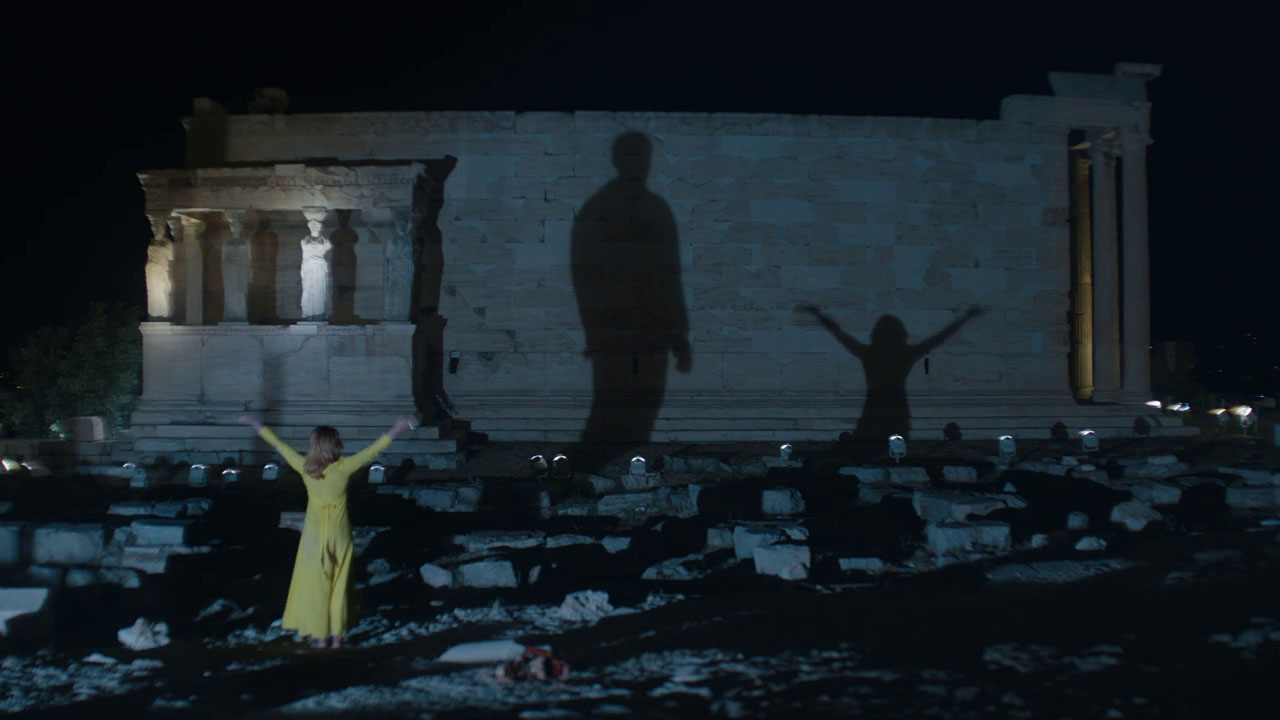
Watching the Detectives (2017, Chris Kennedy)

Silent and over a half hour long, so I played Zero Kama’s The Secret Eye of L.A.Y.L.A.H., as the director undoubtedly would’ve intended if he could’ve afforded the rights. The day or so after the Boston Marathon bombing, represented mostly through screenshots from reddit: marked-up surveillance photos and a long-distance attempt at forensic investigation by the chatmob. At least I liked that the text was against a gentle wash of dark static instead of plain digital black. Last ten minutes is just reporting news with no new redditting.


Once Upon a Screen: Explosive Paradox (2020, Kevin Lee)

Lee’s always in my feed championing essay film, so checking out one of his… it’s short and lo-fi. He parks outside the liquor store that used to be the movie theater where he saw Platoon as a kid, recalling that experience while shooting parking lots and brick walls. The credits shout out the director of The Viewing Booth, which I watched last night.


Green Ash (2019, Pablo Mazzolo)

A landscape turned into blobby light, like peering through fluttering almost-closed eyelids. Ordinary shot of a bush, but the foreground and background bushes jitter and blur independently. Light starts going crazy across grassy fields, a tricky version of Nishikawa’s Tokyo-Ebisu effect, making it feel like this is lo-fi natural footage, but simultaneously taking place in a glitching holodeck. The lush green Argentinian fields with the hand-drawn map at the end gave me La Flor flashbacks. I played Yazz Ahmed’s “Barbara” since the timing matched, very nice.


I Am Micro (2010, Shumona Goel & Shai Heredia)

Narration by a film artist who dreamed of being Godard or Pasolini before everything went commercial and became “scattered,” the camera roving the grounds of an abandoned studio.


Five by Tomonari Nishikawa – all quotes are by the director, from his website.


Tokyo-Ebisu (2010)

Scenes of a noisy train station, frames within the frames showing different actions, sometimes like a shot has been divided into a semi-grid and each segment is playing a different moment in time. Shot on film, which seems excessively difficult, since he says they’re “in-camera visual effects,” so what, mirrors? Exposing partial sections of the film then running it back?


45 7 Broadway (2013)

Times Square, and this time it’s the full frame overlapping with a time-shifted version of itself, but each source has been processed as red, green or blue, appearing to be a 3D effect gone horribly wrong, or a broken RGB projector during an earthquake, quite wonderful.


Manhattan One Two Three Four (2014)

Quick swish pans up, down, and across city buildings, rapidly cut together (“all edited in-camera”), no sound.


Sound of a Million Insects, Light of a Thousand Stars (2015)

Crackling hum, and a very scratched mothlighting blue-dyed image, the sprocket holes often visible. This one is political, the film image resulting from being buried in radioactive soil the government said was safe.


Amusement Ride (2019)

Tracking across the metal skeleton of a Japanese ferris wheel, never looking out at the typical views, the camera panning up a bit at a time, “which resembles the movement of a film at the gate of a film projector or camera.”

Guess I should’ve watched the show instead of the movie, because the antagonistic interviews with celebrities are very fun, but I didn’t need the framing story of Zach G and his crew road-tripping to conduct a certain number of interviews in a week for boss Will Ferrell. After binging On Cinema episodes, maybe it was bad timing to watch another show about a deluded low-rent awkward talk-show host.

After watching Boys State and Dope Is Death with Katy, I rounded out the trilogy of True/False catchup movies with one she didn’t want to see.

The concept is based on a Virginia Woolf quote about people looking at the same war images and perceiving them differently. The filmmaker shows a curated set of Israeli/Palestinian youtube scenes to students then narrows down to a single student with Israeli parents who sees unexpected things in the images, sometimes to the point of absurdity, and questions her about her perceptions. It appears to be raw footage shot on cellphones, but she thinks everything here is staged. “They have the kids cry in the background as an added effect,” as if it’s unrealistic that kids would cry on their own while soldiers tromp through their house. The kids’ mom is being “overdramatic” and the soldiers are even criticized for not searching the house well enough. When Israeli kids are just pelting a Palestinian home with rocks, “This doesn’t look good for Israel,” then she self-corrects, imagining an inciting event from before the camera was rolling, “Arabs throw rocks all the time.” In the second half, the director calls her back to watch the videos again alongside her own responses (so, the first half of this movie). “The viewer also has control… Film is only so real, you’re not there.” A good experiment, but I resent having to spend this much time with an overthinking college student.

Watched for the Mdou Moctar music, spent the runtime trying to remember Purple Rain. Mdou is new in a Niger town, takes on the local guitar king, but Mdou’s dad disapproves of his music and destroys his guitar. Can he impress the cute girl, find a new left-handed guitar in time for the big competition, and write a killer new song that’s even better than his previous song, which rival Morris Day Kader has stolen for his own band? Yes!

50 sword deaths in first couple minutes, a good sign, as unstoppable mustache man slays all his rivals then returns home to slay his hot girlfriend. He turns out to be our narrator Kageyama’s boss. We know he’s gonna gradually introduce K to his elite life, glimpsed when the two visit the boss’s bar, where the blood bartender runs a basement prison forcibly teaching captured yakuza to abandon their tough-guy ways – but the boss comes to an untimely end when a cowboy-hat coffin-backpack outsider shoots him with a chintzy lightning gun then kickboxer Kyoken beheads him.

The badly wounded K is revived by a bite from his vampire boss’s severed head, and not knowing how his new hunger works, he bites a townsperson which quickly unleashes a vampire plague on the town – the vamps act like yakuza and band together to torment (but not bite) the mortal yakuza. Meanwhile, kickboxer and coffin-backpack are joined by a kappa goblin and a frog furry with its own theme song. This is one of Miike’s high-energy crazypants movies, and it’s extremely fun, up there with Blade of the Immortal and Zebraman 2.

Let’s see… there’s also a tough woman named Captain whose head fills with water… K loves a hospitalized blind girl who turns out not to be blind… a sad kid whose father died turns into an enraged revenge-vampire… and there’s a bloody showdown between K and the kickboxer at the end as the frog furry grows city-sized and threatens to destroy the world.

K is Hayato Ichihara, lead/bullied boy in All About Lily Chou-Chou, has grown up to have a cool, severe face. The unblind Riko Narumi was a teen in The Great Yokai War, is also in notably bonkers movies Why Don’t You Play In Hell and Labyrinth of Cinema. The late boss has starred in a few Kore-eda films and Tsukamoto’s Fires on the Plain. The kickboxer is from Java, and The Raid movies.

Found these on Criterion, whoopee!


No Ward (2009)

Short doc focused on hurricane refugees in Texas, dreaming of life in nearby suburban Carrollton. Cocorosie and Four Tet provide glitchy drone music that wouldn’t be out of place in Tenet.


Their Fall Our All (2014)

A long way from the doc, with beautiful photography and sci-fi editing, transporting a few women and girls between realms. Mirrors reflect different people, identities get mixed up, and there’s a subplot involving a senator being blackmailed. Really good.


You and I and You (2015)

An apparently single-take video to two songs by The Dig (not the “why don’t you believe, believe in your own god” Dig), a couple and their kid walking along a road, accosted by different mystical groups until they’ve been separated and transformed.


Jimi Could Have Fallen from the Sky (2017)

“Nance humor is so chaotic,” writes a letterboxd reviewer. An imagined origin story of Jimi Hendrix in seven minutes, with a bunch of actors (incl. Nance, a purple-haired kid, a skydiver) playing Jimi, with dance scenes and audio trickery. Probably the only great biopic.

This Triet was a real treat… hmu if you need pull-quotes for the 8K reissue. Snappy movie with shocking editing, scenes overlapping, no time wasted – a temporal pincer as complex as Tenet but an hour shorter and possible to follow.

Sibyl is Virginie Efira (of Elle, and soon Benedetta), a therapist cutting back on her case load so she can write novels, then actress Adele Exarchopoulos (Blue is the Warmest Color) shows up with all kinds of twisted drama (she’s pregnant by her famous costar Gaspard Ulliel, who’s supposed to be with their director Sandra Hüller). Eventually Adele will only speak to Sibyl, so the film production flies her out to Stromboli as a go-between. Of course Sibyl is stealing all this for her writing, which the movie keeps slipping inside, shifting all the roles and drama, while in reality Sibyl is losing her sobriety and her family.

Triet’s Age of Panic and Victoria also got good reviews. This played Cannes 2019 in competition with ten other films I’ve now seen – it’s easier to catch up when there’s no Cannes 2020 to distract me.

Hey, I remember this one, it had some bright colors in it. Not like Bridgerton-bright, but pretty nice. According to the ol’ blog, I watched another adaptation of this with Katy 13 years earlier, which neither of us remembers.

Cowritten with Simon Blackwell (Veep, Breeders) and Charles Dickens (Scrooged, Oliver & Company). Dev Patel starred, Ben Whishaw the villain, Hugh Laurie and Benedict Wong were in there somewhere.

A movie where the main dialogue scene is about finding truth in film performances, which also spends 15+ minutes watching middle schoolers perform Hamlet. Bookend scenes feature a dog who hunts and eats a rabbit palling around with a quiet donkey. Someone hops a fence and collapses at a gravesite to an M. Ward song. Happy to see Franz Rogowski in a small part.

Astrid deals with a kid who’s in trouble at school, and a defective bicycle she bought secondhand from a disabled man. She meets a director whose film she hated and talks his ear off about his poor cinema decisions. A good-looking movie, I enjoyed spending time with it, even if I haven’t figured out what it’s on about. Been hearing about Schanelec for a while, mostly from Cinema Scope – before this came out, Blake Williams called her films “notoriously evasive” and says she “presents us with only enough narrative so that we feel our desire for narrative.”