Plot-summary-wise, this movie could have been a total disaster, but the director and cast perfectly nail the tone, a comically heightened satire built on increasingly horrific acts. It’s a sequel to one of those after-dark-to-die-for flicks, Offspring, but this must not be too important since most of the reviews don’t mention it.

A nice family scene:

Parents Chris and Belle have two teens (daddy’s boy, goth girl) and young Darlin’. While out hunting, Chris discovers a feral woman (Pollyanna McIntosh, who looked very different in Let Us Prey), captures her and chains her into his shed, telling the family that they need to civilize her. “We can not have people running around the woods thinking they’re animals.” This is already an alarming development, as Chris (Sean Bridgers, villain of Room, typecast as a dude who locks women in sheds) goes from kinda-smarmy to kinda-evil, but he’s gradually revealed to be much more evil than suspected. After he incapacitates his wife (Angela Bettis, May herself) and feeds one of daughter Peggy’s teachers to the dogs, Peggy releases The Woman to wreak vengeful havoc.

Mom stands up to Dad for the last time:

The family expresses concern a few times for the “dogs,” one of which is late-revealed to be another hostage woman, mutilated and kept like an animal. Fantastic, table-turning ending as The Woman wanders back towards the woods with the dog-woman and the youngest daughter, and Peggy, with all the men and grown-ups dead, opting to follow along.

I also dug the rock & roll soundtrack. The last Lucky McKee work I saw was his Masters of Horror episode Sick Girl, also starring Bettis. Back then I wrote “fun flick, not bad at all,” which was mighty high praise for the MoH series. Since then I’d forgotten that Sick Girl was about lesbian entomologists – an influence on The Duke of Burgundy?

I watched this a couple weeks after Office, not knowing they were Johnnie To’s companion pieces on the 2008 financial crisis. This one presents the corrupt business world more harshly – no lavish sets and musical numbers, just greed, theft, disappointment, ruin and murder.

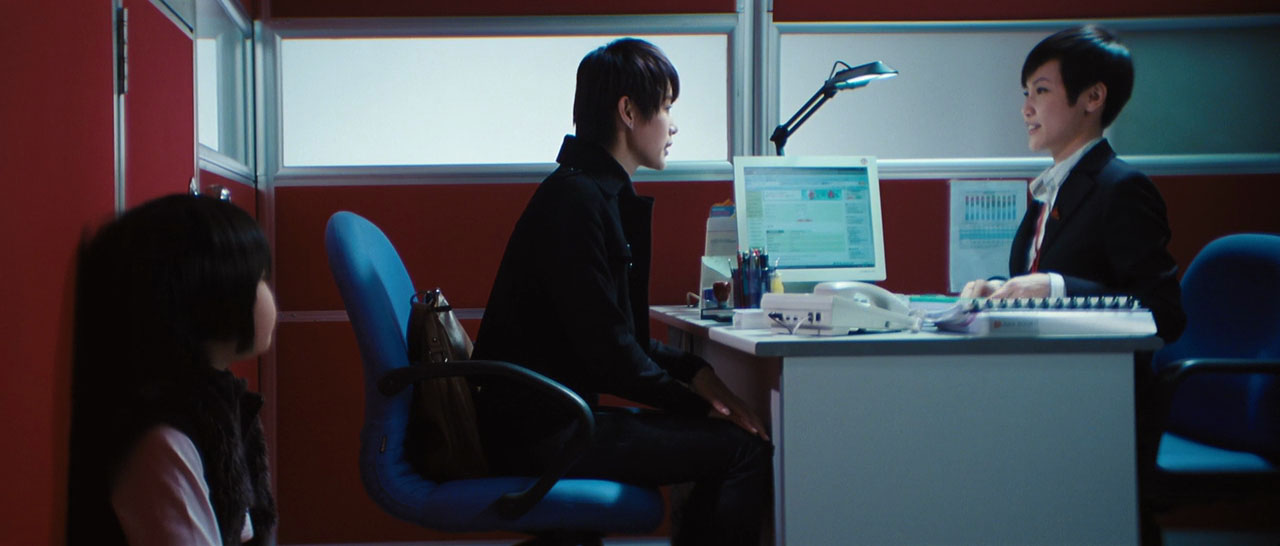
Connie meets Teresa:

An intertwining-destinies movie following a few character threads. Inspector Cheung (Breaking News star Richie Ren) is on the sidelines of the other stories while his girlfriend Connie is buying an apartment. Teresa is a banker who sells high-risk investments to confused old ladies, ends up with a pile of undeposited money when her loanshark client Yuen is murdered in the parking deck. And Panther (Ching Wan Lau, the Mad Detective) works for broke gangsters, runs around collecting money to bail out a buddy until he finds stock trader Lung who has an idea for fast cash. The real estate thing held little drama, the banking part hinged on some mild deceit (the old lady heard the phrase “high risk” a hundred times so you can’t entirely blame the banker) and coincidence, but Panther was fun – I’d watch a sequel that just followed him around some more.

Not to be confused with The Clan or The Tribe or The Wolfpack. Movies need better titles.

My first Pablo Larraín movie, and it’s unusual. Not sure what I was expecting, maybe more Matteo Garrone-style. Has a hazy digital look with odd white balance and sometimes grotesque wide lenses, and tells an odd story about a house of recovery/isolation for problem priests.

Father Matías arrives with an exquisite beard, but has been followed there by Sandokan, whom he used to molest as a boy. Sandokan yells in front of the house until Father Matías walks outside and kills himself.

Newcomer Father Matías:

So Father Garcia is sent from the church to investigate, and probably to shut down the house and scatter its residents. The residents seem less concerned with him than with Sandokan, who is still hanging around town, so they stage a crime to pin on him, murdering their own and their neighbors’ racing dogs. Sandokan gets beaten up by an angry mob, and Father Garcia agrees to leave the house alone if they’ll take care of poor Sandokan.

Investigator Father Garcia:

I didn’t get this ending, really, but liked the actors’ beards and the general muddled atmosphere of the thing. Obviously don’t know what to make of Larraín at this point – need to watch more of his work. I thought he was one of our beloved international festival auteurs (his current Jackie is getting raves) until discovering so many negative reviews of this one. Checking online, I see that Sicinski has turned in a four-paragraph review of the other The Club (“a Master Lock for your steering wheel”) which is confusing the Letterboxd commenters.

Nick Pinkerton:

There are doubtless those who will prefer the smoldering indignity of Spotlight, ever so slightly tinctured for flavor with self-recrimination, to the moral murkiness of The Club … Shot by Larraín’s regular cinematographer Sergio Armstrong, The Club is overlaid with a milky haze … it gives the impression of an all-permeating damp fog, a dramatis personae who are half-ghost, and a setting that is somewhere between the Chilean seaside and Purgatory.

Sandokan:

Looking up cast, Jaime Vadell must’ve played the oldest priest (nobody, including he, can remember his crimes) because he appeared in Ruiz’s Three Sad Tigers back in the 1960’s. Dog-killing ex-nun Sister Monica was Larraín regular Antonia Zegers, and dog trainer Vidal starred in and cowrote Tony Manero.

Quintín:

Larraín prefers to deal in his films with the low and middle classes, whom he strongly despises. If there’s a common thread running through his cinematographic output, it’s that the problem of contemporary Chilean society is not, as usually assumed, that it suffered a dictatorship for almost 20 years, during which time thousands of citizens were murdered, tortured, and disappeared, all kinds of censorship and repression was exerted, and people couldn’t leave their homes at night because of the curfew. No, for Larraín the true problem is that Chileans deserve their fate because they secretly liked to be humiliated and destroyed by the barbarians, as they thought that they were not strong enough to rebel against them.

Maybe I’m just in a mood, but this seems like one of the greatest documentaries ever. In filming eight locations (four sets of antipodes – places on land directly opposite the globe from each other), much fun is had with lenses and camera orientation. The music and sound design is terrific as well as the cinematography, and the movie’s gimmick and structure aside, he is filming absolute magic and wonder. In fact, the antipode concept is only mentioned in some opening titles, and from there it’s just observation of the chosen locations, left to viewer’s imagination and his excellent visual transitions between locales to draw geographic connections.

Won an award at the 2012 True/False Fest. We hope to attend next year, so we’re catching up on some docs we missed.

Filming locations:

Argentina/Shanghai:

I looked up a little about Kossakovsky. He teaches a documentary class – among the rules he presents to students:

– Don’t film if you can live without filming.

– Don’t film if you want to say something – just say it or write it. Film only if you want to show something, or you want people to see something. This concerns both the film as a whole and every single shot within the film.

– Don’t film something you just hate. Don’t film something you just love. Film when you aren’t sure if you hate it or love it. Doubts are crucial for making art. Film when you hate and love at the same time.

– You need your brain both before and after filming, but don’t use your brain during filming. Just film using your instinct and intuition.

– Story is important for documentary, but perception is even more important. Think, first, what the viewers will feel while seeing your shots. Then, form a dramatic structure of your film using the changes to their feelings.

– Documentary is the only art where every esthetical element almost always has ethical aspects and every ethical aspect can be used esthetically. Try to remain human, especially whilst editing your films. Maybe, nice people should not make documentaries.

Hawaii:

New Zealand/Spain:

First off, happy SHOCKtober. I kicked off the season with the restored Phantasm at the Alamo. Surprisingly complicated mythology for a late-1970’s indie horror. I’ve covered the series before and will be watching again when blu-rays (and part five) come out. I want to say I noticed the Bad Robot 4K remastering job and that the movie’s new transfer was a revelation, but nah – I’ll probably have to compare a couple scenes to the old DVD to notice the difference.

In related news, I never understood the “happy holidays” War On Christmas controversy until I started seeing everyone refer to SHOCKtober with the bland name “31 days of horror”. Come on, people.


“It’s exploitative. I have cinematic standards”
“No one gives a crap about cinematic standards, okay? It’s not the 1800’s.”

His last few movies got some rough press coverage, so this is the first M. Night movie I’ve watched in a decade, since Lady in the Water (which I liked). And it’s… pretty good. Said to be a “found footage” movie, but that seems a misuse of the term. It’s a fake documentary “shot” by its teen actors – and edited by them too, since they survive the ordeal, so the footage hasn’t been “found” Blair Witch-style.

Mom Kathryn Hahn (Parks & Rec) hasn’t spoken to her parents in 15 years but they wanna meet their grandkids, so she sends her two preposterous teens – pretentious-vocabulary Becca and junior-rapper Tyler – to visit them alone. The twist that they’re not really the grandparents but mental patients who have murdered the real grandparents and stashed them in the basement occurred to me pretty early, so instead I pondered why they’re doing it.

A couple of good things: the first-person camera technique is obviously being controlled by a very good cameraman (or the kids have been well-trained to hit their framing marks). Documentary-vet DP Maryse Alberti also shot Velvet Goldmine, and despite what I’ve heard about M. Night’s Last Airbender 3D debacle, he wants his movies to look good, so we don’t get an indifferent-looking movie. And for most of the movie, the “horror” is explained away by the fake-grandparents as embarrassing troubles of old age. The secret in the barn is incontinent grandpa’s old diapers, and the bumpy scratchy noises in the night are caused by grandma’s sleep disorder. So it was heading in an interesting direction (aging is the true horror) but then no, they’re psycho killers. I thought the emotional epilogue about forgiveness worked better than the critics seemed to.

Adam Cook in Cinema Scope was feeling emotional as well:

[Post-twist] the film gains a new dimension, one that upon a second viewing reveals the film to be aching with pain, not just between our heroes with regards to their father, but between this mentally ill couple who, in their own demented way, are trying also to reconnect with their deceased children – who died by their hands. Mental illness has figured into most of Shyamalan’s films, and the separation between sane and insane is an uneasy one that complicates the film’s layers of trauma … Found-footage horror may seem an unlikely way to create a tender portrait of damaged people clinging to each other, but then again Shyamalan’s tales have always used unusual means to tell personal stories of hope that resonate deeply – that is if you can take the leaps of faith they require.

Lead girl Toni (Royalty Hightower) is boxing with her brother at the rec center until she gets intrigued by the dance team of girls across the hall. And one by one, from older to younger, the dancers start having fits. A good example of movies being much more than their story, because this was endlessly watchable and barely had a story – lots of boxing and fitness and dance practice, the widescreen lens following Toni closely.

J. Bailey:

Holmer primarily tells her story in the brute strength of her imagery, the way the camera regards Toni as a solitary figure, even when among other people, and then subtly shifts that perspective as she finds herself in a period of discovery and reinvention. Oh, and then her dance teammates start having peculiar, unexplained seizures, a narrative shift that somehow doesn’t dismantle the delicate tonal foundation. It’s the kind of film that’s almost inexplicable — I’m not sure how it was devised, or how it was executed. But I’m glad it exists.

D’Angelo:

Formally dazzling, which might have been enough had The Fits been a short … or had its central metaphor been a tad less bluntly obvious (these fits only affect pubescent girls, you say? They’re frightening, but also liberating? Those who haven’t experienced them envy those who have? Hmm…).

Nobody wanted to pick between the Rohmer and the Pasolini, so I brought out the dark-horse Disney flick as a sorry compromise. I heard it might actually be great, but it was… okay. Had to get used to the digital animals looking so cartoony in motion, though their speech and mouth movements were the most realistic I’ve seen since Whiskers, The Kitten Who Can Name Fruit. Admittedly this was probably better in theaters in 3D, but we watched in HD on our big screen with the volume up, so I feel like if there’s real magic, we would’ve felt it. Anyway it was fun.

Songs worked better in context of the cartoon, and were pried into this version, making it feel like it’s referencing the original – so not only a remake for new audiences, but one that wants you to have watched the original. Between that and the cartoony animals wanting so badly to be real, it’s a conflicted movie – one of Disney’s “live action” remakes without much live action (the kid was okay).

Usually I don’t notice celebrity voice casting so much, but it’s hard to miss Christopher Walken (King Louie) and Bill Murray (Baloo). Katy recognized Idris Elba (evil tiger), Scarlett Johansson (evil snake), and Ben Kingsley (fatherly panther Bagheera). Apologies to Garry Shandling and Giancarlo Esposito and Lupita Nyong’o, I guess, for blending in and not sounding distractingly like stunt celeb casting.

Ignatiy V.:

Its jungle is a complete simulacrum: Everything from the birds to the leaves is artificial, which means that nothing can ever stand out as unreal. The ironic exception is Sethi’s manic Mowgli, mugging on partial sets against blue screen; in a digital world realized by a dream team of effects studios, the one real thing seems fake.

Never before realized that Baloo is a sloth bear.

A film director is in his hometown of Seoul for a night, fails to connect with a friend, hangs out with some students and gets drunk then looks up an old flame. The film director is in his hometown of Seoul for a night, connects with his friend, they hang out with a woman the friend knows named Boram and the owner of the Novel bar. A film director is in his hometown of Seoul for a night, connects with his friend and a former lead actor, and they all go to the Novel Bar. But the movie title is the first clue that these are alternate versions of the same day with recurring characters in different situations. I lost track of the female characters, but in my defense it’s all kinda disorienting. Ah, further in my defense: the old flame and the bar owner are the same actress.

Boram with the film director:

Our lead filmmaker is Joon-sang Yoo of at least five other Hong movies, and his buddy’s friend Boram from at least parts 2 & 3 was Seon-mi Song of Woman on the Beach, which is also about a film director hanging out with his friend. The only other Hong movie I’ve seen is Oki’s Movie, which also involved variations and repetition – I’m assuming from reading some reviews that most of his movies do. Played at Cannes UCR with Elena, which I watched the day before this. Dialogue-heavy with unshowy compositions, then one zoom per scene – I started to wait for the zoom, wonder when it would come. Pleasant viewing, gets more engrossing as the day(s) roll on, but didn’t leave me with an aftertaste of joy and wonder like Oki’s Movie did.

L-R: bar owner, the friend, the actor

Quintín:

The last scene of The Day He Arrives can be seen as a correction to the scene in Oki’s Movie where a young filmmaker refuses to allow his picture to be taken by a woman he meets in the park. This time, a woman says that she’s an admirer of the filmmaker, and when she asks him to pose for a photograph, he answers that he doesn’t like to do it but he complies anyway … Over the course of the film, Sungjoon experiences the usual bittersweet encounters with women, but also finds himself in a rather hostile film milieu, where he is harassed by film students, people don’t remember him or don’t like him or the other way around. In this last scene, where an unknown woman shows she cares for his work, Sungjoon seems to feel that nothing is wrong with his place in life, even if there might not be another film in his future. Hong’s previous films were always about a guy keeping pace of his career and feeling unsure about his work, whether he was successful or not.

Elena is recently married to Vlad (Andrey Smirnov, a writer/director who was working on his own film when this was shooting). He comes from a cold, rich family and she comes from a larger, lazier family. He decides not to give her college money in order to keep her oldest grandson out of the military, so she kills him with a Viagra overdose in his meds cup, burns his in-progress will, and brings cash from his safe to her son. Seems like a straightforward crime/family drama, but with details I didn’t know how to place, like the final scene, where the oldest son joins his buddies outside to beat the shit out of some people.

J. Hoberman:

The movie grows ever more emotionally complex. Beginning with the image of a dead horse that Elena spots from a train and ending with a shot of an unattended infant, the final scenes seem to spring from her guilty conscience. Largely unremarkable in themselves, the revelation of an unexpected pregnancy, the experience of a routine power failure, an instance of casual teenage brutality, and the sight of a family gathering before the TV are cumulatively disturbing.

Won second or third place in Cannes UCR, in competition with Hors Satan and Martha Marcy May Marlene.

Zvyagintsev:

One of the things that I wanted to emphasize is that money changed human nature. It is especially visible in Russia, because we never had that before due to social circumstances. All of us had 120 rubles per month and then all of a sudden 20 years ago we were thrown into the world of capitalism and consumerism, unprepared. That changed us in an unexplainable way… I’m confident that this story isn’t just about Russia, it’s about human nature, it’s universal. But just in the Russian context, it’s more visible and actualized.