I first heard about this book (and Canyon, probably) at this screening at the Nashville Film Festival presented by Dominic Angerame, executive director of Canyon.

Had been meaning to buy it ever since. Coincidentally, the day after I placed my order, Dominic posted a letter declaring that Canyon “can no longer continue as it was originally conceived and changes need to be made that are appropriate to our present day and age.” I wish that such changes included more screenings like the one at NaFF (perhaps in two years, for Canyon’s 50th anniversary) since the book didn’t captivate me the way the films do. I guess infighting between partners and artists at an indie film distributor isn’t so exciting to me.

Divided into sections representing phases of the company’s history: Formation, Incorporation, Revitalization, Intellectualization, Maintenance

Little discussion about films themselves, but much about who gets paid what percentages, festival screenings and censorship, the difficulty of raising funds and the disparity between the famous members (Bruce Conner, Stan Brakhage) whose films rent out more than half the other members combined. Mostly interesting were the reprintings of original Canyon newsletter articles.

Some favorite pieces:
Saul Landau’s account of a 1964 police seizure of Jean Genet’s Un Chant d’Amour
Robert Nelson’s 1968 summary of the Brussels festival films, followed by miscellaneous notes, then another summary of the Bellevue festival.
Robert Pike’s story about a three-minute film called God Is Dog Spelled Backwards
Brakhage’s story of the making of The Text of Light
James Broughton’s “How to Cope with the Question Period”
A couple of Kuchar cartoons
Larry Jordan’s “Survival in the … Film Market of 1979”
Warren Sonbert on film syntax

“Both books were non-fiction, Malcolm insisted… claims they were confessions.”

I like a movie that reminds me of In the Mouth of Madness. I also like 80’s children’s horror flick The Gate and its sequel, and this was made by the same team (though we have evidence that the director has since fallen straight off the quality charts). And it’s from the writer of Nightmare on Elm Street 2 (one of the good ones). So I should have loved this – and I did, even if I can see why it’s not enjoying the same reputation as Lost Boys and The Monster Squad these days.

Jenny Wright (the top-billed woman in Young Guns 2, which is to say she’s eighteenth-billed overall) plays scatterbrained bookseller Virginia, who is recently obsessed with obscure horror writer Malcolm Brand. She reads his first book, which features a murderous troll creature locked in a crate, losing herself in the book as creatively shown by the film – the transitions between real and fantasy are well done. I was more surprised that she seems to have a happy, comfortable relationship with her cop boyfriend Richard (Clayton Rohner of The Relic, April Fool’s Day), unusual for a movie.

Caught them both staring into space:

Things heat up when she finds the author’s second book, and the murders within spring to life as she reads. Randall Cook, an effects animator who worked on The Gate, The Thing, Ghostbusters, Puppet Masters 2 and 4 and other movies I used to watch on cable all the time, and therefore a major influence on my childhood dreams and the continued existence of SHOCKtober, plays the mad doctor/book author wearing a beret, a cape, some serious facial disfigurement makeup, and a mask that would please Leatherface during the last 15 minutes.

Virginia has some friends, who are, naturally, doomed to sacrified before Randy’s desire for reconstructive surgery – more Eyes Without a Face than Texas Chainsaw Massacre. An actress in her theater group loses her scalp and pretty long hair (I hadn’t thought of Randy’s baldness as a gruesome disfigurement), her friend Lenny loses his nice Italian nose, her patient bookshop coworker Mona loses her lips (a killer’s gotta have luscious lips) and I’m not sure what he wants from the pianist across the street from her apartment. Virginia skips ahead in the book to see who the next victims will be, but the cops dismiss her as a crank. When the predictable showdown between herself (with a late-arriving Richard) and Randy arrives, she unleashes the beastie from the first book (which looks suspiciously like The Gate goblins on a larger scale) for a few great minutes of stop-motion which justify everything that has come before. Brand finally turns into book pages and flutters away. Mick Garris totally ripped this off for his TV episode Valerie on the Stairs, figuring that nobody would notice – gotcha, Mick.

See also: Shadowplay

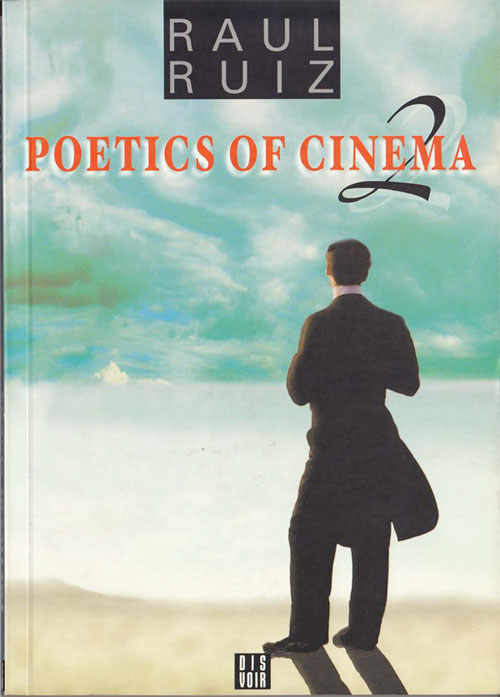
I don’t get 99% of his references, and I lose about 90% of his trains of thought, but I like these books anyway. Some good bits:

My goal is to show that certain germinal images or instant fictions are the best starting point for a film that wishes to have a poetic pretext.
On many occasions I have been asked whether: “All types of cinema must necessarily be poetic. Might a simply narrative cinema not be possible in our times? A type of cinema for which things are simply interesting as peripeteias?”
Yes and no.
I have already said this before: cinema is condemned to be poetic. It cannot but be poetic. One cannot ignore this aspect of its nature. For poetry will always be there, within out reach. If so, then why not use it?
Although it is true… that in most films poetry is incidental, more often than not it’s there partly due to the fact that it has been ignored; nor is poetry really found in so-called beautiful things: rivers, landscapes, mountains and sunsets. Rather, we find it in the haphazard intersecting of sequences, in the instances of narrative incoherence and in crossing sight lines.
Yet, it is there. It is.
From this point of view, poetry is endemic in cinema.

Describing the roles of different people on a movie set, “A lighting technician is above all a maker of shadows. Though nobody seems to notice.” He then suggests that movie studios could hire a philosopher “to destroy all that seems evident.”

Cinema ought to continually play with the harmony and lack of harmony that exists between narrative evidence and visual doubt (that which I have just seen- have I indeed seen it?)

Film is “a language, but composed solely of verbs.”

I don’t know what “this idea” refers to, and I read it twice.

In our field, in the practice of cinema, this idea… suggests the possibility of linking ideas, sequences and situations, which, though placed in different parts of the film, and despite what the distances between them may be (or rather, and I would be willing to say, the greater the distance the better), connect with each other, one reinvigorating the other. Not only because they participate in the same intensity, but also because they have the same ‘sequence of durations’. Five or six shots remind us of another five or six shots from another film and they feed each other by means of an effect that I call ‘mirrors of duration’. It’s not that these shots last the same amount of time. Rather, here we have two intensities, which I am tempted to call states of fascination, producing the effect of emotional detachment.

After beginning to describe the plot of an imaginary film:

Up till this point we’ve had a film about justice, about the act of judgment. A film about. And I seem to recall having mentioned that I find it hard to tolerate and, above all, to make films about … (We should remember that the first question that the average American viewer will pose when confronted by a film that perplexes him is: “What is this film about?”).

He swears the following is “not lacking in all good sense or reason as it might seem initially”:

A few days ago, together with some friends, we played with the following idea-situation: if we accept that what Hitler really wanted was to take possession of Vienna, then it would have been enough for him to stroll through the city’s streets, walk every now and then into one of the cafes, observe the people, breathe in the contradictory odours that escaped from the city’s chimneys. However, it seems that it was indispensable for him to be accompanied by an army and that he be worshipped by the dumbstruck masses. When we enter a film, we would like somehow to appropriate it ourselves, we wish to invade it, we would like for it to adhere to our expectations.

Oooh, a promised third volume:

In the third volume of the Poetics of Cinema, I will be much more explicit, more generous, regarding analyses of specific cases and in proposing exercises.

Ruiz notices his own book’s roundabout nature:

I would like to write: “Yet we shall develop this theme later”. But the translators, who at this very moment are rewriting my words into inadequate and foreign tongues, have already made me realise that each time I have said “but this theme will concern us later”, I have, in fact, forgotten it forever.

WTF:

How does one represent all men, Jedermann, as king of the world? As a lonely man? As the dictator who strolling through the palace of ten thousand mirrors confuses himself with his 200 doubles? Or as one who, smiling under the rain, is condemned to smile even in his coffin, for they are always filming him? The image-man, let’s say Tony Blair (NB A. Blair, the Prime Minister of Great Britain as the first edition of this book was in print, deceased two years later).

On metaphors:

Often, and at times immodestly, I have made use of metaphors in order to approach intuitively certain ideas; many of which could best be described as images and half-glimpsed visions. I hope that among them it is the angelic smile rather than the sardonic irony or the biting impetuousness that has the upper hand. ‘Metaphor’ is a word that has a bad reputation among theorists. To use it implies that one does not have clear ideas, and in that case, the best thing to do is to remain silent. That may be so and I regret it. Yet, in the present state of the arts: does anyone have clear ideas?

image

This must be the best book I’ve read on the work of a director. It’s organized just how I’d like, with articles covering all aspects of Tashlin’s work (with little overlap), interviews with Tashlin and with others about Tashlin, excerpts from his cartoons, plenty of photographs, critical write-ups of each film he directed and detailed chronology and filmography of all his work. I read the library copy straight through. Gotta adjust myself to not being able to put it on my shelf of film books since it’s so far out of print… can’t own everything, ya know.

Some edited excerpts:

Jonathan Rosenbaum:

It seems to me that “Tashlinesque” can mean one or more of five different strains in the contemporary cinema which I will list below, with appropriate examples…

A. Graphic expression in shapes, colors, costumes, settings and facial expressions derived from both animated and still cartoons and comic books: The 500 Fingers of Dr. T., I Want To Go Home, Dick Tracy

B. Sexual hysteria – usually (if not invariably) grounded in the combination of male adolescent lust and 1950s’ notions of feminine voluptuousness: Seven Year Itch, The Nutty Professor, Lord Love a Duck, The Man With Two Brains

C. Vulgar modernism: a “popular, ironic, somewhat dehumanized mode reflexively concerned with the specific properties of its medium or the conditions of its making” (Hoberman): Duck Amuck, Hellzapoppin’, Sullivan’s Travels, The Patsy, Real Life, The Purple Rose of Cairo

D. Intertextual film references: Shoot The Piano Player, Zazie dans le metro, Celine & Julie Go Boating, Who Framed Roger Rabbit

E. Contemporary social satire: products, gadgets, fads, trends: Christmas In July, A King in New York, Mon oncle, Tampopo


J. Hoberman

Tashlin’s films ultimately have less to do with the production of cultural forms than with their packaging and consumption. His America is a nation of robotic image junkies whose minds have been colonized by the media. Jerry Lewis’s landlady in Rock-a-Bye Baby does exactly what TV commercials tell her to do, even to the point of dying her hair vermilion; the movie fans in Hollywood or Bust and Rock Hunter are little more than popcorn and fan-mag consuming zombies. The protagonist of The Girl Can’t Help It is made to hallucinate singer Julie London every time he hears one of her records on a jukebox.


Bernard Eisenschitz

Although Truffaut and his colleagues at Cahiers knew little English and even less about contemporary trends in American theater and jazz… they were not caught unawares by The Girl Can’t Help It and Hollywood or Bust. Rivette, Rohmer and Truffaut rated them “masterpieces” in the same month as The Wrong Man and Chikamatsu monogatari. A phantasy view of America to be sure, but no less valid than the recent sociological approach, in which films have little place. Tashlin not only identified and denounced the contradiction of American cinema, but also embodied it, since the ambivalence of his films makes it impossible to say which side he is taking, or to be sure that he is not exploiting the very thing that he is denouncing. The Cahiers group did not only see Tashlin as radically destructive, they also appreciated the sheer beauty of what he showed.

Playing to the French title of Hollywood or Bust, Charles Bitsch wrote, “A true movie nut, Tashlin is the first to have made films for other true movie nuts.”


Tashlin in 1964

Cartoons are a very stimulating medium. For animators, the joke reigns supreme. But it’s also a world of enslavement. The world of an animator, no matter how fertile his ideas may be, is in the end, a confined frame, a tiny glass cel where his creations come to life. It’s as though the whole universe were reduced to a series of postcards. You spend your whole life splicing, flipping through cel sheets, drawing frame by frame. After a few years the whole thing becomes so debilitating that you lose all contact with the real world.

same interview, after he’d quit working at Disney in 1941…

I sought refuge at Leon Schlesinger’s where I worked on the Merrie Melodies and Looney Tunes cartoons, then went to Screen Gems at Columbia where John Hubley and I developed the “Fox and Crow” series. I became a gagman for Harpo Marx in A Night In Casablanca. The mirror sequence, which I invented specially for him, was a series of variations on an old gag … Then I worked for Eddie Bracken, and later for Bob Hope.


Tashlin in 1962

I really hate television. It’s no experience. You sit at home, you don’t get dressed and go out. It’s free – the audience doesn’t participate – they sit there and turn the dial and be critical. I detest it.


1994 interview with Bill Krohn and Joe Dante:

BK: So much live-action filmmaking today is influenced by cartoons which he was the first to do, but so little of it has any social pertinence.
JD: That’s because he was influenced by better cartoons. The people who are doing cartoons today are basing them on The Flintstones. That was the nadir; cartoons were disappearing as cartoons and becoming radio shows. Doing live-action cartoons – movies like L’il Abner, Popeye – it’s a very tough thing to do. But the Flintstones themselves were so uncartoonlike that it’ll be a little easier to translate them into live action. Whereas to do Bugs Bunny, or to do characters that really are fanciful, you just can’t do that in live action.


Mike Barrier interviews Tashlin in 1971

MB: I understand you worked on the very first development of Lady and the Tramp too.
FT: That’s right, Sam [Cobean] and I did that whole story; I’d forgotten about that.
MB: Were you working from the story that Ward Greene wrote?
FT: I don’t recall the book. Joe Grant had modeled the dog, Lady, and Sam and I did a story. I never saw the film… I think we had rats coming after the baby at the end… did they have that? Then that’s what we did.

MB: You’ve mentioned that when you made your cartoons, you were looking forward to feature work. Now that you’ve been making features for many years, have there been occasions when you’ve looked back to your cartoon work and tried to get a cartoon flavor in some of your films?
FT: Oh I guess quite often, because all the reviewers – Truffaut and Godard and all these people when they were reviewers on Cahiers du Cinema, they always treated my films, my Jerry Lewis films and all, as a cartoon. I did a picture with Tom Ewell and Jayne Mansfield [The Girl Can’t Help It] and as far as they were concerned, that was a Tom and Jerry cartoon, and the fact that his name was Tom and hers was Jerri – which I never thought of – they said, “She is the cat and he is the mouse.”


From the chronology:

1952 – Tashlin spends nearly six months working with Robert Welch on the script for “Sapphire Sal,” later re-titled Red Garters. Tashlin is originally set to direct, but when he checks off the Paramount lot in late August the production is put on hold awaiting the loan-out of Jane Russell from RKO. (Red Garters, not produced until 1954, ultimately stars Rosemary Clooney, with screenplay credit going to Michael Fessier.)

For the first time, this is an entry about a book I’ve read, not a movie I’ve watched. It’s a book about film though, so I think it fits in.

I enjoyed P.C. Usai’s writings in the “1000 Movie Moments” book, so I finally tracked this down. Full of short (never more than a page long) interrelated statements about film destruction and preservation, mostly over-academic. But for each statement on the right-hand page, there’s an interesting captioned photograph on the left-hand page, so whenever I’d read the words on the right with no understanding or enjoyment, at least I’d get the photo to keep me turning to the next page. Short book, anyway, and ends with a “reader’s report” which nicely condenses the long-winded despair of the author into a few pages of focused and readable despair on the impossibility of any sort of complete archive of film history – not that such a thing would necessarily be desirable.

Some bits I liked:

p. 19: “If all moving images were available, the massive fact of their presence would impede any effort to establish criteria of relevance – more so, indeed, than if they had all been obliterated, for then, at least, selective comprehension would be replaced by pure conjecture.”

p. 49, given the degradation of the original image, and the viewer’s lack of total attention (including blinking of the eyes), “no viewer can claim to have seen a moving image in its entirety.” That one-ups F. Camper’s claims that if you’ve seen a movie on video, you haven’t seen the movie. Not even he has seen the movie!

p. 51: “It is expected that a time will come when the loneliness of the spectator will be detrimental to the pleasure of experiencing moving images.”

p. 89: “The ultimate goal of film history is an account of its own disappearance, or its transformation into another entity.”

p. 109: “The real questions is, are viewers willing to accept the slow fading to nothing of what they are looking at? Is it fair to encourage them to believe that they will never witness the inevitable, and that its actuial experience will be left to someone else?”

p. 129: “…all lost moving images have at least existed for some viewer in the past. The unseen is an integral part of our lives, even if not directly our own. … The fact that the unseen is beyond our control is an excellent antidote to our claim of authority over the visible world, and administers a good shaking up to our deluded obsession with permanence. Sooner or later you and I will both disappear, along with our visions and memories of what we have seen and the way we have seen it.”