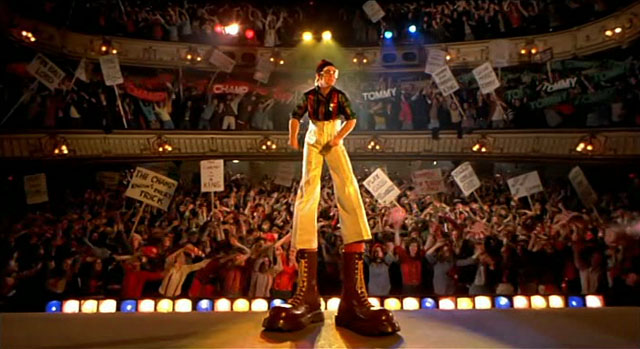
“Tommy is the only rock opera ever made” – Ken Russell

Sad Ann-Margret’s husband is killed in the war. Some time later she goes on vacation and meets Bernie (Oliver Reed) at a resort. He moves in, but one night the husband returns, disfigured from a plane crash, and Bernie kills him in front of little Tommy, who’s told that he didn’t see anything, didn’t hear anything, won’t say anything. And so he doesn’t ever again.

Tommy grows up to be curly-haired space-cadet Roger Daltrey. He’s not healed by attending Eric Clapton’s church of Marilyn worship, nor when Bernie gives him a night with extreme drug fiend Tina Turner (filling in for David Bowie), nor when he’s left with psychically abusive babysitter Paul Nicholas or sexually abusive Uncle Ernie (Keith Moon), nor from a visit to Dr. Jack Nicholson (filling in for Christopher Lee).

But one day Tommy finds something he’s good at. After defeating Elton John (who agreed to be in the movie provided he got to keep these boots) at a pinball championship, he becomes famous and attracts hundreds of groupies.

At home, mom celebrates their new wealth by throwing a bottle of champagne through the television and writhing in the bubbles, baked beans and chocolate that pour forth from the damaged set.

Tommy breaks through his mom’s mirror and starts speaking again, becomes a messiah to kids everywhere, his symbol a cross with a pinball on top. Mom is his biggest supporter, and stepdad Bernie is the financial wizard, plotting to set up Tommy camps everywhere and sell merchandise everywhere else. But their prefab religion backfires and the kids revolt, killing Tommy’s parents. But he lives to bathe in waterfalls and climb mountains with a big cheery grin.

It’s a ridiculous story, a twisted excuse for lots of music and celebrity cameos. Russell was never a huge fan of rock music (I’m not a big Who fan myself, really only enjoy “I’m a Sensation” from this soundtrack), had written a follow-up to The Devils called The Angels about false religion, which he couldn’t get off the ground. When offered to direct a movie with sympathetic ideas to his own, which Russell could help mold (he got Pete Townshend to write additional scenes and change plot details) with a pre-sold celebrity cast – a batshit-crazy musical story that needed visual accompaniment – how could Ken say no? It might not be Ken’s purest personal vision, but I double-featured it with Song of Summer as memorial screenings when I heard he’d died.

Unsurprisingly produced by Robert Stigwood, who produced Jesus Christ Superstar (and later Grease). Oliver Reed (of The Devils, of course) was doing Richard Lester’s Musketeers movies around the same time. Daltrey would be back with Russell on Lisztomania, which I need to see. And Ann-Margret needs to be much more popular – she was fantastic in this.

We open on five mumbly hoodie youths mugging a white woman – and the youths turn out to be the protagonists. So I was on the movie’s side from the start, but it only gets better. After an alien from a freshly-landed meteorite claws Moses, the mini-gang-leader, he kills it and takes it to Nick Frost’s weed room. But a hundred more meteors land, carrying far more dangerous creatures – pitch-black hairy wolf-bears with glowing teeth, looking for the slain female. So the kids mount a defense against rampaging aliens using knives, swords and fireworks, joined by the still-irritable white woman (Jodie Whittaker, title character in Venus) and opposed by cops and a mad drug dealer.

Despite all the bloody death, the movie is mostly an action/comedy – the rare successful one. It builds to one of the sweetest minutes of film I’ve seen all year, Moses carrying the group’s full arsenal racing towards a gas-filled apartment, leaping over the blind beasts under a shower of slow-motion sparks.

Luke Treadaway (one of the twins from Brothers of the Head) plays a stoner nature-channel enthusiast who helps figure out the aliens’ motivation. Writer/director Cornish goes way back with Edgar Wright and just cowrote Spielberg’s Tintin movie, so this is his big year.

I last watched this in theaters so my memory was fading. The first thing I forget about a movie is the ending. So I know Spider (Ralph Fiennes) is in a post-asylum halfway house remembering his childhood, when his mom was killed by his dad (Gabriel Byrne) and replaced by a new woman he picked up at a bar, but after that gets hazy.

John Neville (Gilliam’s Munchhausen), who plays Spider’s fellow patient, died the day before I watched this:

Miranda and her two Spiders:

Well, both women are Miranda Richardson, and young Ralph (often shown with the ghostly presence of full-grown Ralph following behind, peering through a window or hiding around a corner) takes matters into his own hands, tying his spiderweb-strings to the oven knob and turning on the gas after the new woman has passed out. But the woman who lays dead when the emergency crew arrives is Spider’s own mum, his dad weeping over her, uncomprehending.

My favorite comic-relief scene:

The central mystery of the movie seemed to be “how did a seemingly normal, if quiet and string-obsessed, boy turn into this mumbling, shuffling schizophrenic?” and one presumes it has something to do with his dad killing his mom. But the ending reveals that Spider was unhinged from the start. This is the kind of ending that makes you want to rewatch the movie with the thought that Spider’s POV is unreliable as both child and adult, but I blew it by rewatching having forgotten the twist.

British series with a brilliant premise, but kinda gets old over six episodes. Three or four would’ve been perfect. And no, I didn’t watch them all the same day. Matthew Holness (cowriter) plays Garth Marenghi, self-aggrandizing pulp horror author, Richard Ayoade (director/cowriter) plays TV producer Dean Lerner, and Matt “Dixon Bainbridge” Berry plays cheesy dreamboat actor Todd Rivers. These three present Garth’s unjustly forgotten 1980’s TV series Darkplace (which also stars Alice Lowe, Timothy Dalton’s assistant in Hot Fuzz), stopping the show frequently to comment on the story or its production. The humor comes from how terrible the show is (Dean Lerner’s acting is especially hilarious) and how deluded the cast and crew is about its greatness and importance. Both of the Mighty Boosh stars have cameos, though Vince was hard to spot under his monkey suit

The main cast:

The Boosh:

More shows to search for: Bruiser, My Life in Film, Nathan Barley, and (obviously) Man to Man with Dean Lerner

Don’t think I’ve watched a mummy movie since I was eight, because that’s the last time a living mummy seemed scary or interesting (I’m not counting the 1990’s Mummy series, since those were more about poor computer effects than mummies). But for some reason I watched this instead of The Curse of Frankenstein as my annual Hammer horror. And it wasn’t scary or interesting. Not a terrible movie, a classy-looking production but, well, it’s about a mummy. What can you do with that?

Same writer and director as Hammer’s Dracula and Frankenstein movies, starring Creature/Count Christopher Lee as the mummy and Doctors Frankenstein & Van Helsing Peter Cushing as the wimpy archaeologist who defeats it. Lee appears unbandaged in flashback scenes, a high priest with a forbidden love for a princess (Yvonne Furneaux, title character in something called Frankenstein’s Great Aunt Tillie). He tries to resurrect her after her burial and is caught, mummified alive and buried behind a secret panel in her tomb.

John FrankenHelsing Banning:

However-many years later in 1895, archaeologist Felix Aylmer (of Olivier’s Henry V) digs up the tomb despite warnings about curses. An Egyptian local (George Pastell, actually from Cyprus) who still believes in the ancient gods swears revenge and a couple years later carts the Lee-mummy to Britain and has it assassinate Felix and his buddy. Felix’s son Peter Cushing escapes due to the lucky fact that his wife is the same actress who played the Egyptian princess, and she’s able to override the mummy’s commands.

Christopher Lee, before:

… and after:

Cushing figures out the plot, manages to convince the local police of the facts (it’s rare in a supernatural movie that the police believe the hero’s story), then saunters over to the vengeful Egyptian’s house, introduces himself and insults the man’s silly religion. This of course draws another mummy visit, but this time Cushing is armed – which should lead to the terrific poster artwork with a beam of light passing through a hole in the mummy’s midsection, but sadly doesn’t. Good wins out over evil, assuming Cushing is good – the movie doesn’t mind his participation in the looting of Egypt’s sacred history for the benefit of British museums.

Kind of a slow movie, with flashbacks that repeat whole scenes we just watched 45 minutes earlier. All the IMDB trivia articles are about the various ways Christopher Lee got hurt during the production, but he still stayed with Hammer through the early 70’s.

Excited by Essential Killing, I thought I’d check out Skolimowski’s only horror film for SHOCKtober. But calling it horror is like calling Essential Killing a political drama, inadequately simple labels for such weird and complex movies. The bulk of this one is a flashback/story told by Alan Bates to Tim Curry while scorekeeping a cricket game at some kind of asylum. Bates admits that he’s changing parts of the story to keep it interesting for himself – and we’re never sure if he’s a patient or what, so the narrator is unreliable to say the least. And as the commentary notes, “casting Tim Curry as your sanity figure suggests that the world is fairly skewed.”

Alan Bates lurks:

A cowed-looking John Hurt (the year before Alien, so the earliest film I’ve seen of his – though I must find Little Malcolm and His Struggle Against the Eunuchs from ’74), a church organist by day and electronic composer in his spare time, is happily married to Susannah York (star of Altman’s Images). But one day Alan Bates (Chabrol’s Dr. M, Julie Christie’s illicit lover in The Go-Between) appears, tampers with Hurt’s bicycle tire, then invites himself over. He stalks the couple causing minor mischief then starts not-so-subtly taking over the family.

John Hurt rocks out in his home studio:

Alan Bates, head of household:

To prove his power to Hurt, they go off to the dunes and Bates demonstrates “the terror shout,” taught to him by an aboriginal magician. Somehow Hurt isn’t killed by this, but has a weird experience where he’s holding a stone, believing himself to be the town shoemaker. When he returns home, his wife is under Bates’s spell, and Hurt is the interloper. But he recalls the identity stones, goes off and smashes them to regain control of his household. Back at the house, Bates is arrested for the murder of his children (to which he confessed to Hurt and York earlier). Strange that Bates would be anxious to tell a tale which ends in his own defeat.

You can’t understand the extreme greatness of this shot without watching the whole film:

The police foolishly come for Alan Bates:

Meanwhile back in the framing story, a thunderstorm wrecks the cricket game. Jim Broadbent, in his first film role as “fielder in cowpat,” runs around half-naked smeared in mud or worse. Lightning strikes the scoring box, Bates is killed, and in another odd scene which also played over the opening credits, York comes tearing into the room where the dead lay, distraught.

Fielder in cowpat:

Reminded me of The Last Wave in its aboriginal magic and weirdly apocalyptic feel. Commentary brings up Caligari, which I should’ve thought of. The wife isn’t much of a character, just passed between the two men, but she definitely shows her acting chops in one intense sexual scene. Mostly minimal music by “the two guys from Genesis you probably have forgotten.”

The sixth-and-a-half Powell movie I’ve shown to Katy. I always think of Powell/Pressburger films as the kind of thing she’ll love, despite the fact that she hasn’t loved any, and has roundly disliked at least three. This one was going well, with a strong-willed female lead until, cornered by her confusion and desire, she falls down a well to her death. Sorry, Katy.

Hazel (Jennifer Jones) is lovely with a disconcerting gypsy accent, lives with her father Esmond Knight (just saw him in Contraband), who doesn’t seem blind at all in this movie. Rich asshole David Farrar (also kinda an asshole in Black Narcissus) hotly desires her, but she hides away from him and finally marries meek minister Cyril Cusack (Odd Man Out, Fahrenheit 451). They sleep in separate bedrooms and he can’t bring himself to touch her – shades of Smiles of a Summer Night – and so she ends up back with David Farrar, shaming her husband and outraging his mother (Sybil Thorndike) and congregation. Hazel is attracted/repelled by Farrar all along, and he seems like the love ’em-and-leave ’em type but obsesses over Hazel for years, so it’s unclear just how this is going to work out. Of course it doesn’t – she tries to run from everybody at once, wild like her pet fox (thanks, Katy) towards certain doom.

Jennifer Jones and David Farrar:

Cyril Cusack:

We knew that the fiery pagan girl wouldn’t be easily domesticated by her mild Christian husband, and would’ve known very well that she wouldn’t live through the movie if we’d paid attention to the signs: the film’s title, the bottomless pit shown in the first act, and the fact that the first time we see her at home, she’s framed inside a coffin.

Strong, deep colors and expert production design, as expected from a Powell/Pressburger/Heckroth picture. My favorite character was Andrew Vessons (Hugh Griffith) as Farrar’s contemptuous coachman. Movie was cut down considerably by David O. Selznick for the U.S. release with added close-ups and explanation, doing nothing for the film’s reputation.

A couple of characters: Hugh Griffith above and Esmond Knight below

“The past is a foreign county. They do things differently there.” No longer just a Silkworm lyric (from the same song that references “Willie” Somerset Maugham and possibly Casablanca), now back home in its proper element, or at least the film adaptation of its proper element.

A quality picture with excellent production design and fluid camera movement – like Carol Reed with a touch of Alain Resnais. It’s a perfect storm of my least-favorite types of movies: British upper-class period costume dramas and coming-of-age stories. But, highly recommended and Cannes-award-winning and all, I stuck with it and really loved the last half hour.

Kid named Leo is spending the summer with a family in the country, but his playmate Marcus (I like him – privileged asshole with a good vocabulary) gets the measles, leaving Leo to pal around with the grownups, getting involved in their secret affairs as a messenger boy. Julie Christie (between Petulia and McCabe & Mrs. Miller) is the young hottie of the household, promised to dull scarfaced Hugh Trimingham (Edward Fox of Day of the Jackal) but having a Leo-assisted affair with rough farmer Ted Burgess (Alan Bates of Secret Friends, also Chabrol’s Dr. M). Once the lovers are caught together and Julie seems lost to him, Ted shoots himself.

Fancy Hugh:

“We can’t expect to be happy all the time, can we?”

Fun sidetracks with Leo’s belief in occult curses. A dog with a name like “dry toast” (tri-toes?). A cricket ball is batted straight into the camera. A 1970’s love-triangle movie set among wheat fields, bringing to mind Days of Heaven. Little bursts of voiceover dialogue, like scenes omitted for time, or sometimes repeating what we’ve heard. An unexplained, unheard shot of a conversation between two characters we haven’t seen – only when going back through the screenshots did I notice the television set in the corner, definite sign of a flash-forward. The present day keeps breaking through into the early-century period story, and suddenly Leo is sixty (now Michael Redgrave of Mr. Arkadin, Secret Beyond the Door), summoned to visit Julie Christie (backlit to avoid displaying her old-age makeup).

“So you met my grandson”
“Yes I did”
“Does he remind you of anyone?”
“Ted Burgess”
“That’s it. That’s it. He does.”

Leo Redgrave:

Based on a famous novel, screenplay by Harold Pinter, who also wrote The Servant and Accident. Senses calls it Losey’s last great film and compliments Michel Legrand’s fine score. “Aside from its intelligence and insight, however, it hardly seems to be a Losey film—it is evocative, judicious, perfectly cast, but rather cautious.”

Shooting Down Pictures:

Occurring mostly in the past with occasional flashes to the present, Pinter’s manipulation of time feels perfunctory compared to what Alain Resnais was doing a decade prior, or even what Pinter managed in his script for Losey’s Accident. More interesting is Losey’s entymological dramatization of British manor life, exhibiting both gentility and prejudice with near-emotionless decorum. Pinter’s dialogue pinpoints the neurotic weirdness underlying British politeness with unnerving precision, and is served ably by the ensemble, especially Dominic Guard as the boy, whose naivete and unwitting indiscretions stand sharply against the hypocrisy and innuendo surrounding him.

I’ve seen a lot of wartime films by the Powell/Pressburger crew, but this one was the most fun.

Neutral ship captain Conrad Veidt (Casablanca and Thief of Bagdad baddie) and his passengers and crew are stuck at a British port having their ship searched for contraband, when a tough-talkin’ broad (Valerie Hobson of Bride of Frankenstein, Kind Hearts and Coronets) slips away. Conrad secretly follows her to shore, finds out she’s a spy, gets involved in hijinks, and foils some sort of nazi plot.

They’re all gonna laugh at you, Conrad:

To attract police attention to the baddies’ lair, Conrad turns on all the lights during the war blackout:

It was easy to follow at the time, but a month later the details are hazy. I remember the girl’s co-conspirator was Mr. Pigeon (Esmond Knight, the old guy who tosses an arrow into the king at the start of Robin and Marian), that the baddy is Van Dyne (Raymond Lovell, later in 49th Parallel). They recruit an excitable Danish chef, the brother of an officer on Conrad’s ship (played by the same actor since they share no scenes), who almost steals the film.

The credits boldly name this scene the “White Negro” Cabaret:

A. Ives for Senses:

Michael Powell and Emeric Pressburger … would later get into considerable trouble with Churchill on The Life and Death of Colonel Blimp, when they suggested that not all Germans were bad, and that traditional British codes of honour were meaningless in fighting such a ruthless enemy as the Nazis. Britain had to fight dirty, they essentially argued. These theories are also propagated by Contraband, if in a somewhat undercooked fashion. So Veidt fights dirty as he tracks down the Nazis – beating up some British officers in his quest – while the meta-cinema of Contraband (mentioned above) clearly shows an affection for a lost Germany [references Fritz Lang, stars Conrad from Cabinet of Dr. Caligari].

Inside the nazi lair:

Our friendly spies are surely doomed:

But wait! Conrad’s in the elevator with a gun:

Shootout ensues in a bust warehouse: