From Sammo Hung to Jeffrey Lau this week. After Eagle Shooting Heroes, Lau made a two-part Journey to the West with Stephen Chow called Chinese Odyssey, and a few years later, this movie has… no relation to that one – probably just a U.S. distrib capitalizing on name recognition. Heroes was produced by Wong Kar-wai, featured cast from Ashes of Time which was being shot at the same time, and jokey references to the Wong film, which ended up releasing later than the would-be parody because Wong spends years in the editing room. These two buddies have not learned their lesson, repeating the same trick here with 2046, which wouldn’t come out for two more years. Besides the Wong refs (also a Days of Being Wild joke, and people being precise numbers of meters apart) it’s got really good music, overall a snappy action-comedy.

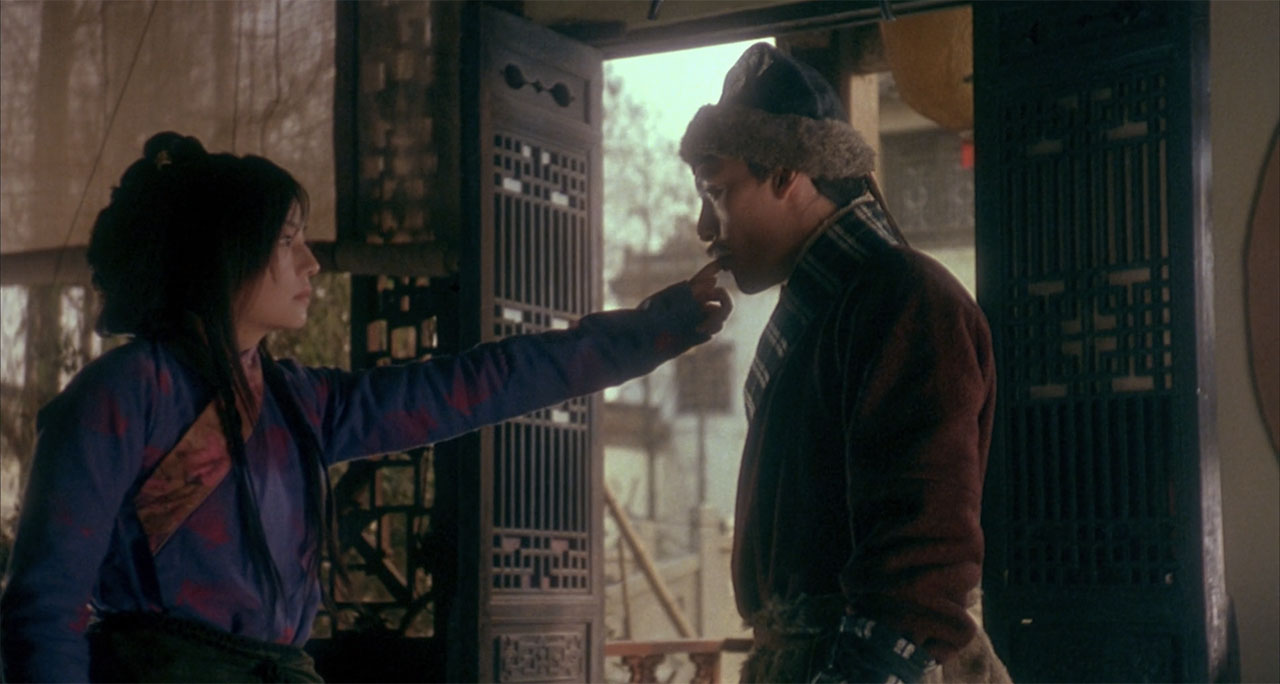
Princess Faye Wong escapes the palace, in part by smashing through the gate with her head, pursued by Emperor Chang Chen. Meanwhile, Tony Leung is the most hated man in his small town, obstructing business to his beloved sister’s restaurant (she is Zhao Wei of Three and Red Cliff) while trying to find her a man. Each sibling couple falls for their counterpart, and it looks like things will work out until the Dowager Empress Rebecca Pan (Maggie’s landlady in ITMFL) denies the marriage to Tony, and Princess Faye goes mad. As usual in Chinese movies, everyone mistakes the two lovely women for men, but this goes even further, becomes a genuinely transsexual movie when Tony and the Princess swap roles at the end.

Chang and Zhao being weird:
Tony and Faye in trouble:

I half-remembered this from watching Eros at the Landmark way back then, and the new remaster gives us a good excuse to revisit. Gong Li is a high-class call girl, whose life/career hits a rocky patch, then she has to move into a dank moldy place and gets the croup. Chen Chang is her devoted tailor in good times and bad. Besides all the perfect costuming and sumptuous dim-light photography, highlight is a scene of erotic dumpling stuffing.


There’s Only One Sun (2007)

Found this short, nonsensical spy drama on vimeo, with horrid video compression compared to The Hand blu-ray. It’s a commissioned television ad that culminates in Amélie Daure of Frontier(s) making out with her flatscreen. Before that, there’s some talk off finding an untraceable person(?) named The Light, a flashback structure, a couple murders – that’s a lot for Wong, who likes to let his camera linger, to pull off in eight minutes. Mostly it seems designed to show the brightest colors possible, bleeding into each other, to impress the rubes when the brightness is cranked up at the Best Buy video wall. No need for too many new ideas – songs are reused from the 2046 soundtrack.

Responsible Lai Yiu-Fai (Wong fave Tony Leung) and impulsive, promiscuous Ho Po-Wing (Ashes of Time star Leslie Cheung) took a trip to Argentina, ran out of money and got stuck there. Now they’re trying to make money to get home, while the pressure of being together so long has destroyed their relationship. Ho disappears for long periods, returning dramatically without warning, while Lai persistently works menial jobs at a nightclub, a kitchen and a slaughterhouse. Lai meets Chang (young Chen Chang, lately The Razor in The Grandmaster) in the kitchen, but Chang isn’t sticking around Buenos Aires long, is on his way around the world (with ITMFL-like mention of a remote place people go to leave their troubles behind). Lai finally gets the money to leave, can’t find Ho so he returns to Hong Kong, where he can’t find Chang either (only finds his family’s restaurant).

Mostly great, eclectic music choices, including my favorite Caetano Veloso song from Talk To Her. But, well, my love for Frank Zappa is eternal, and I complain that his music isn’t played enough, and I appreciate the connection between him and the Turtles song of the film’s ironic title, but “I Have Been In You” did not fit the wistful mood of the city montage after Chang left.

Lai at the waterfall:

Chang at the end of the world:

A sustained mood piece, where nothing really happens and Christopher Doyle’s brilliant cinematography heighten the emotions of everyday life – just like In The Mood For Love. But ITMFL was about the possibility of an ultimately doomed romance, and this one’s about the lingering feelings after romance has ended. It’s a much more bitter movie, and though I enjoyed seeing it in HD for the first time, it doesn’t seem like one to revisit regularly.

M. D’Angelo:

Happy Together features all of the elements that have consistently impressed me in his other pictures: elegantly moody characters; stunning cinematography (courtesy Christopher Doyle, as ever); a loose-limbed narrative that careens from shot to shot without deliberation; a general air of cinema as possibility. All that’s missing is the powerful romantic yearning that suffused Chungking Express, Fallen Angels … and even parts of Ashes of Time and Days of Being Wild. In its place, to my irritation, is endless squabbling.