Yep, they put the most beloved children’s book franchise in generations into the hands of the director of Bicentennial Man and Stepmom. Why… because he’d made Home Alone a decade earlier? Anyway, everyone knows good filmmaking doesn’t matter when it comes to franchise entertainment. And since I’d been watching all things Potter, with works by Sally (Orlando), H.C. (Hellzapoppin’) and Dennis (Secret Friends), figured it was time we gave old Harry another chance.

Sadly, Katy agreed that it’s pretty crap overall. Good scene where Hagrid busts down a door is the last good scene in the movie. There’s something about a traitorous teacher (who was it?) resurrecting the main evil dude using the titular stone, but I was ignoring most of that and wondering why they couldn’t hire kids who could act. Nice to see John Cleese and Alan Rickman anyway. I’m sure Richard Harris was a very fine performer, but I prefer Michael Gambon’s less-boring Dumbledore.

I’d like to watch more double-features by filmmakers with whom I’m not familiar… gives a better immediate sense of who they are than watching one movie, then a couple years later managing to catch another, and so on. I’ve already watched Terence Davies’s 2000 The House of Mirth but I completely don’t remember it. Must’ve been late at night on DVD or cable… the only evidence that I’ve seen it at all is my 8 rating on the IMDB, which I may have just clicked by accident one day while looking up Eleanor Bron movies. Anyway, since Of Time And The City isn’t out here, I grabbed his other two most acclaimed features Distant Voices, Still Lives (1988) and The Long Day Closes (1992).

Both movies consist of beautifully shot sketches of memories. Distant Voices (the first half) was actually made as its own movie – about three siblings growing up under their father Pete Postlethwaite’s wrath. It was deemed too short to release, so the second part, Still Lives, was written and shot after – now father is dead from cancer and the kids are grown, moving out on their own and getting married. Episodes are shown in random-associative order, all superbly shot. Lots and lots of singing – movie is basically a musical… “takes a worried man to sing a worried song”… “in the bleak midwinter”… “there’s a man coming round taking names”… “when irish eyes are smiling”… tons more, all sung by the cast in bars, on the street or at home.

It was Pete Postlethwait’s breakout year – he was in two other reasonably big films. Davies in the DVD commentary: “It’s hard to believe that one man could’ve caused so much suffering and that all these years later I would make a film about it.”
image

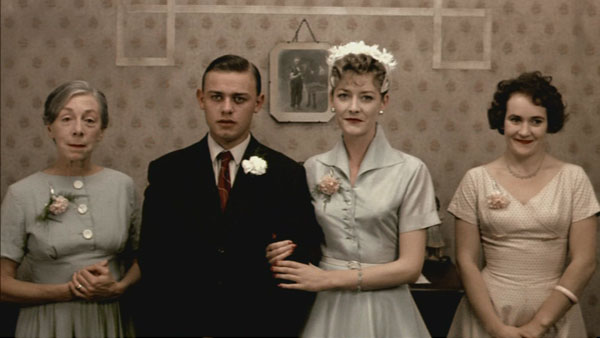
Mom, Tony, (dad), Eileen and Maisie
image

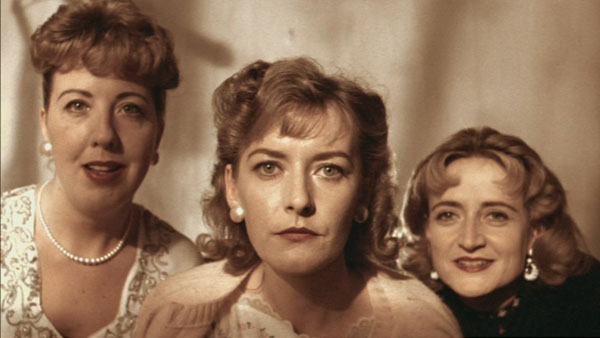
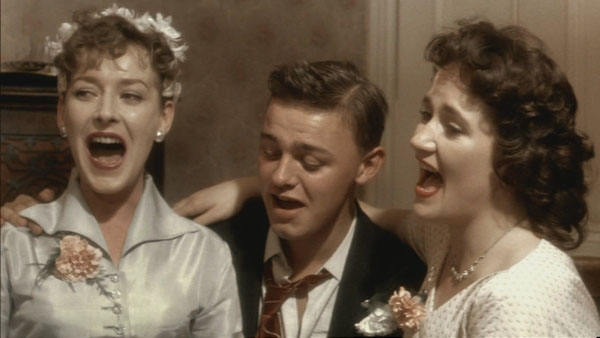
Eileen (center) was in Aki Kaurismaki’s I Hired a Contract Killer. On left is a friend – loud, outspoken Mickey (good singer, too).
image

Married life doesn’t always work out… old friend Jingles looks upset.
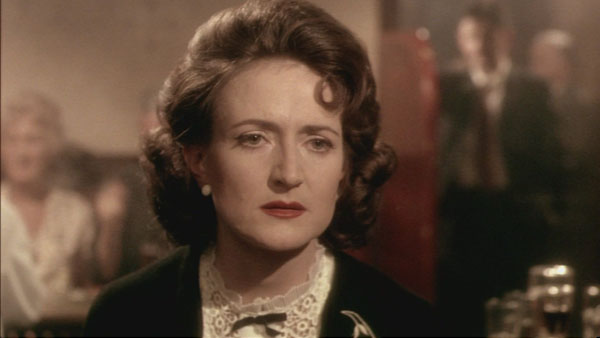
image

Davies is annoyed that viewers thought the Christmas scenes gave sympathy to the father. He says his father deserves no sympathy. Seems from the commentary like everything actually happened in his life as we see it. Creative liberties are taken, of course… fewer siblings keeps things easier to follow, events and timelines are shuffled, but the movie is a mining of his real life. Reactions from family members to the film were mixed.

image

Davies also has a wonderful voice on the commentary. I could listen to him all day. If he did EVERY dvd commentary, people might actually listen to the things. After watching the movie I assumed influence by Alain Resnais, but he says the structure is influenced mainly by T.S. Eliot’s Four Quartets.
image

Won a whole pile of awards, including at Cannes and Toronto, but lost the European Film Awards to Kieslowski and Wenders, oh well.
image

image

image

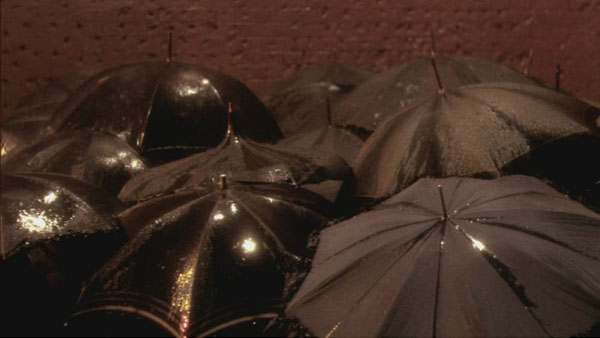
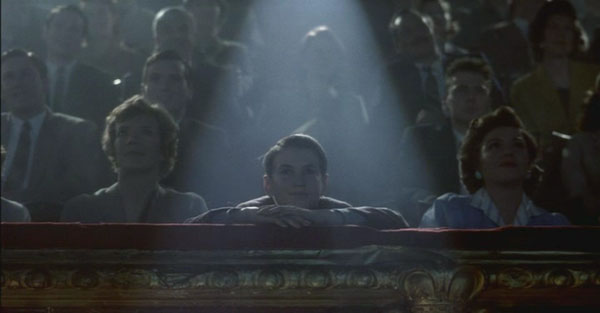
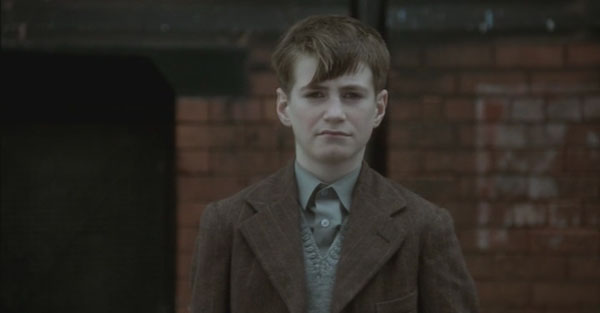
The Long Day Closes is the same kind of thing, but in a shorter timespan and focusing on one kid (young Terence Davies, or “Bud”), his relationship with mother, home life, church and school. Still plenty of singing, though not as much as the other film, and now punctuated by audio clips from classic movies (the kid is happiest at the cinema). Subjective shots through his eyes, memory adding a dreamlike quality to certain scenes, rain and snow are so constant that sometimes they occur indoors.

Exquisite between-scene transitions… this is halfway through one of ’em.
image

I’d say there’s less story here than in the other movie, more impressionistic. I don’t usually love nostalgic childhood reminiscence movies, but that’s because most aren’t as gorgeous as this one.

image

By the time I got to the DVD commentary I’d already heard the one from DV,SL so I took it for granted that everything in Long Day Closes refers to a specific, sharply remembered incident in Davies’ real childhood. Liberties are taken, of course, like how the Christmas dinner table here seems to be out on the street.

image

image

image

August 2012:
If there’s any film that should be watched on 35mm in theaters, it’s this one, and unbelievably, I got a chance. It was playing in Seattle, so Katy grudgingly agreed that we could go. Looked amazing. Nobody else in the theater but us. Katy mostly didn’t like it, dozed through the last 20 minutes, but responded to the audio clip from Tammy and the Bachelor.
image

For once, it actually worked out. I read rave reviews of a foreign film in magazines, a month or two later there’s an enticing trailer on the apple site, another month later the film actually opens – on film, in a real movie theater, in Atlanta. Compare to Opera Jawa: rave reviews in magazines, no trailer, two years later it gets two barely-advertised DVD screenings at GSU – and that’s still better than most Cinema Scope-blessed foreign films, which will never even see a video release here.

Movie has a striking look, everything so well composed (minus 10% of the top, which Regal chopped off as usual), really drew me in. An absorbing film. Bloody violence and death is handled unusually well, keeping the gruesome parts offscreen but leaving you no doubt at all what just happened. Not to say there’s no graphic horror – severed head falling into the pool, the guy falling out a high window and whanging into the building on the way down – but the horror was never the draw, movie was never reveling in gore, so when some is shown it’s more shocking. Yeah, I loved this.

Oskar, 12, has divorced parents, lives with his mom in an apartment complex, visits his dad every couple weeks, and gets relentlessly bullied at school. Eli, 12 in appearance, is a neighborhood vampire girl he meets and befriends. Eli’s caretaker-human, father-figure Hakan, moves himself and Eli from town to town, kills people and brings Eli the blood, but doesn’t seem too competent at it. A group of middle-aged friends starts to catch on to the killings and circle in on vampire and crew (in a very grounded way, no movie-hero vigilantes). Blond weakling Oskar gains confidence from his new friendship, starts to work out after school and assert himself, bashing his longtime bully in the head on a school trip. As all the threads start to come together, Hakan is killed, Eli is left to her own devices, and the bully’s crazed older brother decides to kill Oskar, leading to a breathtaking (ha) climactic scene at the school swimming pool. Ends with Oskar & Eli leaving town by train, Oskar likely to become the new Hakan, bittersweet.

Tomas Alfredson made a much-loved 3+ hour ensemble drama a few years ago called Four Shades of Brown, before that did mostly TV miniseries. Director of Cloverfield will supposedly be remaking this – a movie which is great because of its beauty and stillness. Makes sense. Sweden should respond by having Liv Ullmann remake The Dark Knight.

EDIT: Saw this again with Jimmy, because it’s still playing to enthusiastic audiences three months later… hooray!

I watch all of Clint Eastwood’s recent movies and I always feel they are High Quality Films, but that’s not always my thing. They are oscar-friendly, but not really affecting (exception: Million Dollar Baby) and don’t have anything fascinating to contribute in content (exception: Flags of Our Fathers) or form. But I definitely like ’em enough to keep watching (possible exception: Gran Torino).

We’ve got a true-story historical drama here, with awesome period street scenes of 1928 L.A., nice cinematography, great music (by Eastwood himself!) and very good acting. In her first good movie role since Sky Captain and the World of Tomorrow, A. Jolie plays Christine Collins, a mom whose kid disappears. She reports him missing among mass public distrust in the L.A.P.D., a mistrust led by crusading radio preacher John Malkovich, using his staccato vocal delivery to good effect. Police find kid, but it’s the wrong kid, then when Jolie reports it they intimidate and finally imprison her in a sanitarium to keep people from finding out the truth. Malkie helps get her out, and meanwhile a kid escapes from a rural psycho-killer and reports the murder of twenty kids. Jolie and Malkie lead court fight against the cops, simultaneously kid-killer is prosecuted, she wins, cops go down, killer is found guilty, two years later she watches him hang still unsure whether her own kid was killed or not. In postscript scene, mother of another kidnapped kid finds her son returning home after seven years away, but Jolie still never gets her closure. Saaaad movie.

Manipulative cops include Colm Feore of Titus and TV’s Jeffrey Donovan. Oscar-nom Amy Ryan, who I often see but never recognize, is a prostitute imprisoned with Christine in the sanitarium. Writer J. Michael Straczynski kept me entertained in the 80’s with episodes of He-Man and The Real Ghostbusters, and moved up from there to sci-fi channel to showtime to oscar-nominated films. Good going there, guy.

My third feature by the celebrated Hou. I only half enjoyed/understood the other two, Goodbye South, Goodbye and Flowers of Shanghai, both seen on video, but I appreciated his short The Electric Princess Picture House. So I didn’t know what to think going into this, and neither did anyone, probably, seeing how it’s in French and a semi-remake of a 30-minute children’s classic. Hou’s pacing seems more suited to the big screen than home viewing, so I’m glad it played the Landmark, and Jimmy and I (who saw The Red Balloon together in the same theater earlier this year) both enjoyed it.

Juliette Binoche is a harried puppeteer mother, Simon Iteanu is her son, Hippolyte Girardot (Lady Chatterley, La Moustache) is the downstairs neighbor, and Fang Song is the kid’s new nanny. Song is an aspiring filmmaker with a handicam who loves the film The Red Balloon. Bleach-haired Binoche once worked as an au pair, feels abandoned by her husband, wants to kick out her downstairs neighbor so her older daughter can visit this summer (but can’t find the lease contract), and does marvelous voices for the Chinese puppet show she is directing. Simon seems like a happy kid, takes piano lessons, plays pinball, has a loving relationship with his absent older sister (seen in flashback, she cancels her annual summer trip to Paris late in the movie).

Then there’s the balloon. Simon sees it at the beginning and it follows him on the subway, then to his home and on a class field trip. Song sees it at one point, also… but neither of them ever touches it. It may just be a symbol of imagination, and not a real balloon at all. The camera moves slowly, fluidly, always seeming to hover balloon-like instead of resting, and blobs of red (clothing hanging to dry, a lamp) are often hanging in the frame when the balloon itself is absent.

Just as I was noticing the long length of the shots, a bus with a large Children of Men advertisement drove by – nice. Shot by the cinematographer of most Hou films, Pin Bing Lee, who also did In The Mood For Love with Chris Doyle. Score is light piano music (all staticky on our print), and it closes with the Bobby McFerrin-sounding song from the trailer.

None of these descriptions do justice to the film, which I’m starting to think is one of the few great films I’ve seen this year. Peaceful and calming to watch despite being set mostly in a cluttered, loud, claustrophobic apartment, there’s just enough story/character/action to play upon every emotion in the book without leaning too hard on any of them, leaving me feeling like I’ve experienced & felt so much within such a minimal framework. The characters aren’t desperate, but they don’t have an easy time either. One review described Binoche as a mother under siege, and with all that’s going on around him, Simon’s childhood is under siege too. But even while portraying conflict, the movie manages to ooze joy – so much joy that it’s put a major dent in my plans to watch all the commerce-driven Hollywood product out this summer. How could The Incredible Hulk compare?

What a wonderful coincidence that I watch You’re Never Too Young, and then find out the next day that the film it remade is on Turner Classic.

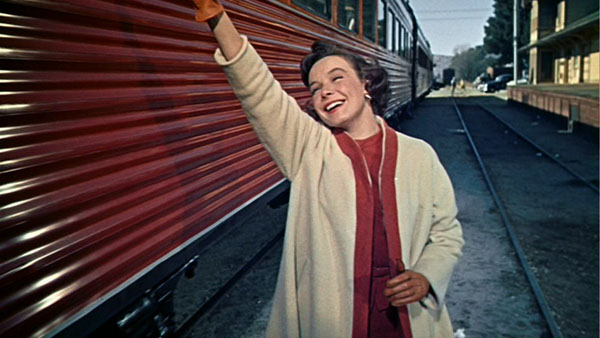
Robert Osbourne introduced as a screwball comedy, but the only thing screwball here is the premise. Movie is played as a straight, semi-romantic comedy. Same story as the Lewis flick but minus the jewel thief and with a sex reversal (and predictably there’s no equivalent to the Dean Martin character). So Ginger Rogers is the scalp-massager lured to an apartment under a false premise which gets her to leave town and have to pose as a kid to afford a ticket. She hides out in Ray Milland’s room, same thunderstorm and morning discovery scene, then has to keep up the ruse so Ray won’t get in trouble and kicked out of the military. Again, a happy ending with Ray getting his wish to be sent on active duty (makes more sense in the nationalistic war-ragin’ 40’s than in the 1955 remake) and happening to meet a finally-acting-her-own-age Ginger on the train platform (where she gives him a Katy-disapproved line about how all some girls want is a letter from their husbands-abroad every couple weeks).

Cute movie, with some major Creepiness Issues (Ginger cuddling up to Ray, wanting him while pretending to be a little girl and calling him “uncle”). Not the madcap funhouse of the remake, though… no Dean songs (they’re not missed) or speedboat chases, choral performances or marching band shenanigans. Turning the all-girls school into a military academy surprisingly doesn’t change much. Some scenes are very similar, like the long-distance call at the phone switchboard (though Jerry ups the humor with his nutty dancing and a voice-dubbing stunt). I’m sure there’s some auteurist reason why I should prefer the original to the remake, but sorry, I sorta don’t.

This came out a full decade before Ginger Rogers had a lot more fun playing a little girl in Monkey Business (another movie comparison which does this film no favors), and TWO decades before Ray Milland acquired his X-RAY EYES. Back in the 40’s he was cast not for the x-ray eyes but because he is an effective leading man, and an exact cross between Jimmy Stewart and Cary Grant. Wilder sez: “I wrote the part of the major for Cary Grant. I always wanted him in one of my pictures, but it never worked out.”

15-year-old little Lucy would grow up to play the love interest in the remake. Ray’s meddling fiancee (and Lucy’s big sister) was Rita Johnson (The Big Clock, Here Comes Mr. Jordan). The strict colonel (Lucy’s father) was Edward Fielding, who managed to portray military men, doctors, ministers and shopkeepers in over 70 films in the 1940’s despite a fatal heart attack halfway through the decade. Ginger Rogers’ mom, in her only screen appearance, played Ginger Rogers’ mom. Guy who gets a scalp massage at the beginning was Robert Benchley, the Jaws author’s grandfather. The young high-school age kids were actually 22, 21 and 16 (x2). That’s more accurate casting than the remake managed to get. The one familiar-looking boy had played Rudy in Shop Around The Corner, the kid the shop owner takes out for Christmas dinner in the final scene.

And what do I know about Billy Wilder? Not very much! Just enough to see plot parallels between this and Some Like It Hot. Saw none of the cynicism for which he’s known, but Wilder explains: “I was very careful. I set out to make a commercial picture I wouldn’t be ashamed of, so my first picture as a director wouldn’t be my last.”

Internet says the screenwriter invented the bad pickup line “Why don’t you get out of that wet coat and into a dry martini?”.

“Dig that crazy homework.”

I appreciate that none of Lewis’s movies have even vaguely believable plots. Plausibility is an unnecessary weight on the shoulders of comedy. This one has Jerry playing an aspiring barber in a fancy hotel who gets caught up in a jewel-heist plot along with haircut customer Dean and Dean’s girl Nancy (both teachers at a girls school in a distant town). Jerry mugs an oversized 11-year-old and steals his sailor outfit in order to get a half-price ticket home, but hiding out from the gun-toting jewel thief he bunks with Nancy. Once discovered, he has to keep pretending to be 11 so Nancy won’t be exposed for having a man in her private room. Of course he falls in love with her (and has to fight off teenage girls at the school), but Nancy still marries Dean, awww.

Besides playing the romantic straight-man, Dean sings five dreamy but unmemorable songs. I always think it must be hard to be the woman in those scenes, having to smile through a whole song without attracting attention away from Dean or looking too vacant.

Remake of Ginger Rogers/Ray Milland-starring Billy Wilder-directed The Major and The Minor, in which it’s the girl pretending to be a kid. Hmmm, it’s on TCM tonight. Bosley Crowther’s original New York Times review calls Lewis “noisy and ungraceful” and says the film is “on a mental level that will not demand an exertion from anyone.” Thankfully, Crowther didn’t live to see Neil Marshall’s Doomsday, but yeah, nobody would call You’re Never Too Young challenging. I just found it a cute comedy with Lewis actually at his most likeable and everyone else (Dean included) pleasant enough to watch without adding anything very distinctive.

Good DVD quality. I put this on while paying bills, expecting it to be the lesser of the Artists & Models double-feature disc, so I didn’t pay strict attention but it gradually roped me in. Perfectly fine cinematography by Daniel Fapp (Lord Love a Duck, Let’s Make Love, West Side Story) and direction by Taurog (everything from Andy Gump for President in 1924 to Dr. Goldfoot and the Bikini Machine in 1965). Written by Sidney Sheldon, screenwriter of Anything Goes and creator of I Dream of Jeannie. IMDB says his family can expect a big royalty check in 2010.

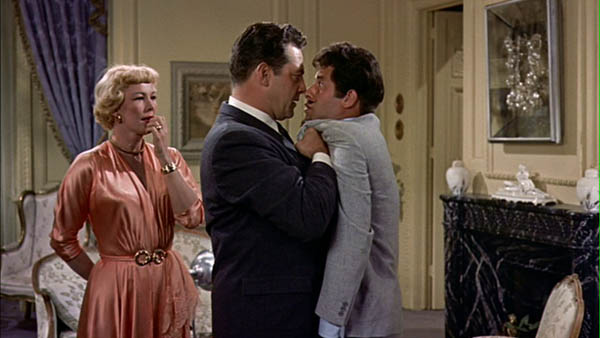
Look at these two. Hard to believe they were involved in a sinister bisexual mafia prostitute murder conspiracy. Oh wait, they weren’t… that was an Atom Egoyan movie.
image

Dean’s girl Nancy was Diana Lynn, the youngest brother’s girlfriend Gwen in Track of the Cat, went straight to television after this and died of a stroke sixteen years later.image

Nancy’s uptight co-teacher (not pictured here, since I haven’t forgiven her for being a nosy, moralistic tattletale) is Nina Foch of a buncha period films like Spartacus, The Ten Commandments and Scaramouche.

Not the first time that American Hans Conried (left) played a Frenchman named Francois – and he was also Dr. T in The 5,000 Fingers.
image

The very sinister Raymond Burr (center), fresh from playing the bad guy in Rear Window, is the jewel thief. Veda Ann Borg (left), vamped as the thief’s wife in this scene. Besides having a very awesome name, she costarred in the 1940 serial The Shadow and appeared in Guys & Dolls and Mildred Pierce.
image

Orpheus! Don’t look back!
image

Appropriate that in the water-skiing stunt-double chase scene, Lewis says “I don’t know how to do this!” against a rear-projection screen. It’s a great comic action scene, but I preferred the music performance that preceded it, with Jerry as conductor of Dean and the women’s choir. Similar to a section near the beginning when Jerry leads the girls at a march, only now instead of aping his spastic movements, they vocalize them.

All the “young high school kids” look to be in their twenties. IMDB says they were indeed. Gags involve a milk-shooting water gun, eating cigars, drinking disgusting liquids, falling into a swan pond, and other slapstick stunts, but it’s not over-the-top physical comedy. Or maybe in this post-Dumb and Dumber America, Jerry Lewis humor seems subtle. One of the gags, when Jerry pretends to be a gangster towards the end to escape the school, is referencing 1940’s William Castle movie series The Whistler. Weird how the happy ending involves the girl being left alone as Martin goes back on active army duty, which he’s been hoping to do all movie long. It’s the anti-Stop-Loss.

image

I started off the year talking about how there are so many great movies I’d like to see, it’s stupid to waste time watching bad movies… see also “The Finding Forrester Effect“. And here I am watching two bad ones in a row (this and Doomsday). Sure both viewing decisions were vaguely auteur-based since I’ve liked work by these directors before, but wasn’t Finding Forrester itself directed by a renowned film auteur? Oh well, there is no discovery without risk.

image

Chow plays a poor, uneducated, overworked, widowed single father. On top of that, his son is bullied at school, failing his classes, and can’t play sports because his shoes are falling apart. On top of THAT, Chow falls off a building at his construction job and dies. and his son cries and cries, and so does his nice teacher, and so do the only other people in the movie theater besides myself.

On the other hand, there are poop jokes and dream sequences, and the kid has a cute flubbery alien that his dad found at the dump.

Back on the first hand, the alien is beaten and squished and drowned and exploited and abandoned. Finally it kills (?) itself to resurrect Chow, god only knows why.

Movie alternates between bland and cruel. When it’s not making one of its main characters suffer, it’s not doing anything particularly exciting or interesting either. The good parts (most of them involving two extremely oversized middle-schoolers) are few, and not good enough to make this a movie worth watching.

image

It’s rare that we get a foreign film here in Atlanta less than two months after its opening date in its home country. I guess this didn’t play the festival circuit and was maybe pre-sold for US distribution after the 1-2 punch of Shaolin Soccer and Kung Fu Hustle. Anyway, it closed in a week and we’ll hopefully never hear from it again. Better luck next time in Kung Fu Hustle 2

First saw this when I was seven. Mostly memorable for being the only (?) movie I ever watched with aunt Nora. Otherwise I remember it being a pretty cool, very weird space movie which no other kids would discuss with me when I got back home to Texas because no one else had seen it.

image

Little did I know I was witnessing the feature film debuts by two new stars, Ethan Hawke (left) and River Phoenix (with the glasses).

image

Also this kid, Jason Presson, who was just as good but never got as far as his costars in the movie world (despite a cameo in Gremlins 2).

image

And Ethan’s love interest Amanda Peterson, who got her own romantic comedy starring role two years later before disappearing from the screen. She was barely in this movie, the token female character. Ethan kisses her at the end in the above cloud-flying dream-sequence, to show that he has grown up a little bit from his adventures, and to show that despite all this fooling around in basements with his boy friends, he sure ain’t gay. River still might be.

image

There’s a schoolyard villain, 17-yr-old Bobby Fite, but the coolest character is of course Dick Miller (above) as a helicopter pilot who sees the kids’ spaceship and single-mindedly tracks them down. A villain, perhaps, a stuffy adult authority figure come to put an end to their fun, but when he arrives at the clearing and sees them taking off in the ship, his reaction is unexpectedly sweet… he just smiles and stays behind the trees.

image

Computer effects by ILM, makeup by Rob Bottin (fresh off The Thing), music by Jerry Goldsmith, with James Cromwell as River’s absentminded father… a respectable crew. Not at all a bad movie, but I have a hard time summoning up much excitement for it… just a cute little journey with a refreshingly unexpected conclusion.

image

Nerdy German kid River is friends with picked-on dreamer Ethan. They love drive-ins, sci-fi and horror movies (hello, Joe Dante). Both begin to have a shared dream (the circuit board above), so River builds the board to the dream’s specs and has himself a computer-controlled floating forcefield. After teaming up with bully-baiting Jason, a tough loner kid from an unhappy home, they build a ship (called the Thunder Road, using a seat from a tilt-a-whirl) and test it out, surrounding it with the force field and buzzing their town, using alien technology to peep through Amanda’s window. After another dream which reveals the circuitry for a magical oxygen-generation board (?), they head out to infinity and beyond. Some wacky shenanigans with a giant spider aboard the alien craft that captures them, then they meet the aliens, a boy and a girl. Kids first lines: “I’ve waited all my life to say this… we come in peace.” A stunner from the aliens: “ehhh, what’s up doc?” Cartoony sound effects everywhere, kids don’t seem to know what’s going on, layers of TV shows and static all over the screen. Finally the alien craft is captured by a much much huger alien craft piloted by the parents of the TV-addict earth-meddling kid aliens who first met our heroes, and River’s gang returns to earth vaguely disillusioned. But we end on the kissing cloud dream, so it’s alright.

Bad science: “It was airtight – I couldn’t feel myself speed up or slow down.”

“They’re heeeere” reference to Poltergeist, which Goldsmith and ILM also worked on.