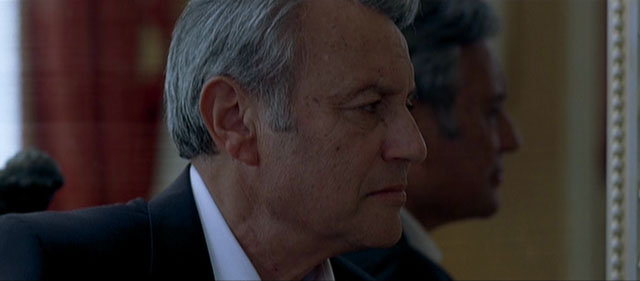
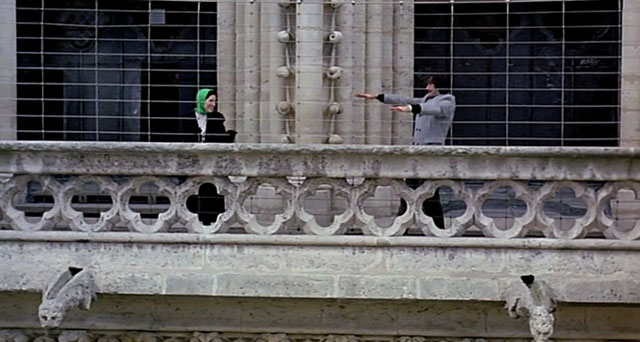
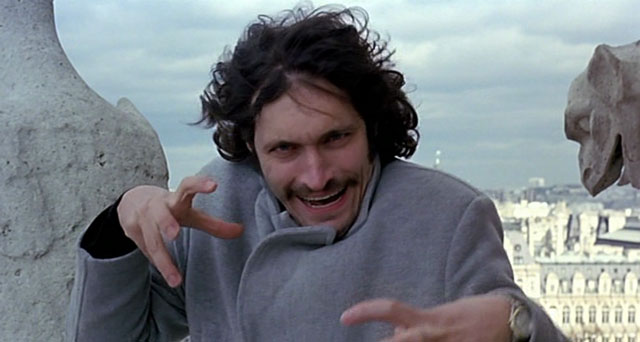
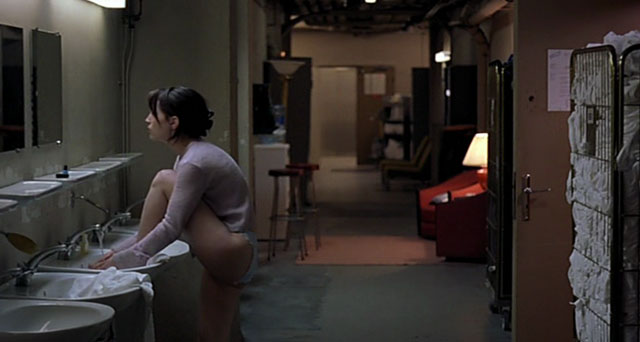
Beautiful Daiga (Yekaterina Golubeva, mysterious sister/lover of Pola X) has emigrated from Lithuania to Paris and is looking for a place to stay and work. Theo (Alex Descas, father in 35 Shots of Rum) is a struggling musician, and his brother Camille (Richard Courcet) a transvestite dancer. One of these three people might be connected to the serial “Granny Killer” who has been terrorizing Paris for a while.

Theo is from Martinique, married to Mona (Beatrice Dalle of The Intruder, also an intruder in Inside). Their relationship issues provide a solid center to the murder mystery plot – turns out Camille and his lover Raphael are the wanted criminals, killing old women and robbing their apartments for money to party.

Sort of like 35 Shots of Rum, following a few characters, you gradually realize who they are and how they know each other, more grounded and straightforward than The Intruder or Trouble Every Day – only instead of ending with a wedding, it ends with two guys being locked up.

Senses of Cinema provides a handle on many of her films: “Denis continues to explore the legacy of colonial and post-colonial societies by concentrating upon shared experiences of displacement – through an ensemble of characters who are struggling to find, return to or willfully create a sense of home, possibility, passion, belonging.”

I also watched her nine-minute segment from A Propos de Nice the following year, tragically entitled Nice, Very Nice. Young Denis regular Gregoire Colin is snatched off the sidewalk by some guys he knows, given a gun and an apparently convincing speech (we don’t hear it – there’s no spoken dialogue). Colin stops at the beach to think, then heads through a parade to a restaurant, where he finds and kills his man. The plot seems like an excuse to film the parade.

Another freewheeling Rivette film, with its 16mm look and protagonists running throughout the city of Paris in the midst of a game with ill-defined rules, seeking to unveil a conspiracy, like a scaled-down Out 1.

Two girls meet on the street, run around a Paris that seems to be populated only by themselves and various conspirators, and get caught in a game, possibly of their own making. There’s more energized music than usual for Rivette, with drums and accordion and strings. Whirling camera, 360-degree pans, many shots of local monuments also recall Out 1, specifically its final shot. But this film has a lighter touch, also bringing to mind Celine & Julie Go Boating, with its playfulness and our heroines’ mysterious bond to each other. The dialogue is a bit new-age, the actions are somewhat improv-theater, it seems to have been shot entirely in real locations, and perhaps in a hurry, since I caught the boom mic a few times.

Films in the film:

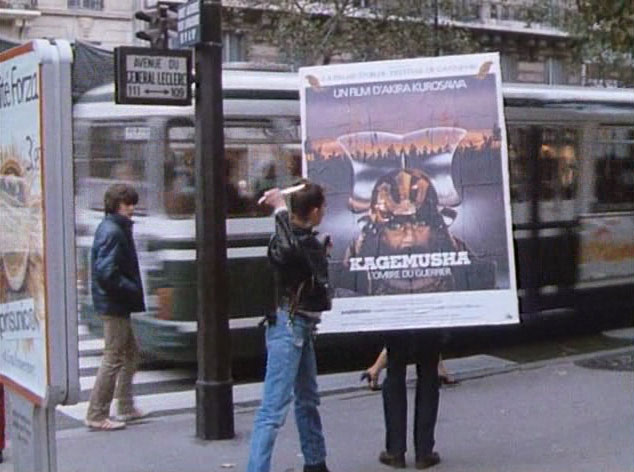
Knife-wielding Pascale vs. Kurosawa’s Kagemusha:
The Silent Scream, a spooky mansion flick:

The Big Country with Gregory Peck – in French it’s called “Wide Open Spaces”, as Pascale leads the claustrophobic Bulle into the theater for the night, to sleep close enough to the screen that she can’t see the walls

And on the way out of the theater…

Bulle Ogier stars in her fifth Rivette film along with Pascale Ogier, Bulle’s daughter, who also starred in a Rohmer movie and something called Ghost Dance before dying of a heart attack at age 26. Bulle, just out of prison, has a crippling claustrophobia and cannot step indoors, not even into a glass-enclosed phone booth, without feeling ill. Pascale, apparently homeless, hears Bulle’s story of getting caught up with the wrong crowd and sets out to keep it from happening again, tailing Bulle’s boyfriend Julien (Pierre Clementi of The Conformist, The Inner Scar).

Pascale seems to be on to something – they steal Julien’s briefcase and discover all sorts of newspaper articles about kidnappings and killings, and also a map of Paris that has been sectioned off in a spiral pattern which reminds Bulle of a “very frightening game” she used to play called the Goose game. They find a sort of key to the map on a murdered man in a cemetery and start to identify the “trap squares” in the game, beginning with places they’ve already been: Prison and the Tomb, then they proceed to play Paris like a game, hoping to survive all the trap squares and win the game.

Besides Julien, they keep running into a balding man (Jean-Francois Stevenin, the teacher in Small Change), who sometimes seems to be a companion of Julien’s and sometimes schemes with the girls independently of Julien, warning Bulle that the people responsible for sending her to prison are after her again. Pascale calls this man Max, her name for all the city’s conspirators. For example, when Bulle wonders about the explanation for the dead map-carrier in the cemetery, Pascale responds “The Max had a bullet in his guts – that’s the explanation.”

Discovering the murdered, bewigged Max

Each “trap” location presents a new challenge. At one, Pascale, who has a compulsion to carve the eyes out of advertising posters, is faced with a whole wall of those. At another, Pascale is in a fight with a white-haired Max who leaves her in a giant cobweb until rescued by Bulle, and at a third Pascale has to defeat a giant dragon, played by some sort of amusement-park ride with an added flamethrower.

While Pascale lives in this fantasy Paris, Bulle’s adventure seems more real and dangerous – she’s given a gun by Julien and keeps having to figure out whose side she’s on. Of course once a gun is introduced into the movie, someone has to get shot. Pascale kills a Max and seems unrepentant, and then Julien kills Bulle, telling her “I loved you.” But the movie’s sympathies have turned towards the inner life of Pascale – she meets Max on a bridge over the river, and they spar together, appropriately practicing “Katta – a combat against imaginary enemies.”

I was tempted to see the sparring scene above as evidence that Pascale was working alongside the Maxes all along, but no, I think she’s just an erratic character. Anyway, it wouldn’t have taken a city-wide conspiracy including Pascale to defeat the fragile Bulle.

Good one by F. Ziolkowski:

Marie’s belief in a great love with Julien, the real at the end of her quest, will eventually be fatal for her. It is Baptiste’s ability to “roll with the punches” which will perhaps save her, but at what cost? As one of the Maxes puts her through a karate exercise and tells her to fend off “imaginary enemies,” the cross-hairs of a surveillance device (a rifle scope? a camera?) appear on the screen. “They” are now being watched by others, perhaps simply by us. That is, it may be that the answer to the riddle of the labyrinth — its last door — is simply the screen on which the actors’ shadows appear.

The movie got a hateful review in the Times, and was even dismissed by Senses of Cinema. Fortunately it’s not my job to analyze its quality in relation to other Rivette films, or even other films in general – I was just along for the ride, which I enjoyed.

Insight from J. Rosenbaum:

The file of clippings concerns specific scandals of the Giscard d’Estaing regime, and the locations refer to various municipal corruptions associated with that period (e.g., the ruins of slaughterhouses in La Villette which were built and then demolished before they could be used, due to safety hazards). Rivette has indicated that the film was made prior to the French elections and with the pessimistic expectations that the same regime would remain in power; so the unexpected election of Francois Mitterand obscured and blunted part of the film’s intended impact. Rivette conceived of Marie as a continuation of the anarchist character played by Bulle Ogier in Fassbinder’s The Third Generation (1979), after she gets out of prison. Her claustrophobia was occasioned by the film’s cut-rate budget, which led to the decision to shoot the film exclusively in exteriors.

Ziolkowski again:

[Paris] for the Surrealists was not only a magical place, it also became a living organism, a protagonist in its own right, complete with motivations, deaths, rebirths, etc. … The group’s fascination with the myth of the labyrinth led them to name their most prestigious and influential review Le Minotaure. … All the elements of Surrealism are here once again: the double, the lions of the Place Denfert-Rochereau which seem ready to spring to life at any moment, the mysterious stranger who crosses one’s path in the middle of the night.

Follow the gun.

From Julien…

… to Bulle …

… to Pascale

Julien again (different gun)

Rivette: “The idea was to refer to Don Quixote and Sancho Panza. Passing from the Parisian quartiers outward to the peripheral areas, within those zones that are slightly uncertain, but without ever leaving Paris. We also wanted to show everything that was in the process of being transformed, under construction.”

Bulle and Julien atop the Arc:


Paris s’en va (1981)

“Paris Goes Away,” a half-hour movie made from scenes and outtakes from Le Pont du Nord. A narrator tells us about the Goose Game, often repeating as the images also double back on themselves. It’s a mini-Spectre version of the feature, more lightweight, with more lingering shots of monuments and less danger and conspiracy. The narration seems to imply that Bulle’s flask is her game token. Rivette’s only other short that I’ve seen, Le Coup du berger, also referenced games, if that means anything.

Le Lion Volatil:

Pascale:

Bulle:


Jacques Rivette, Le Veilleur (1990, Claire Denis)

“Artists have a portion of basic villainy, even the greatest of them.”

Agnes Godard (still Denis’s cinematographer two decades later on 35 Shots of Rum) shoots critic Serge Daney (he took over Cahiers after the Bazin/Rohmer era) in conversation with Rivette, in Parisian cafes and fields. Divided into two parts, “I – Day” and “II – Night.”

“Do we see his painting or not?” Jacques discusses preliminary thoughts on Le Belle Noiseuse before he had worked out the story or approach. Le Pont du Nord gets the most discussion time, strange, since he’d made three movies since then (Love on the Ground doesn’t get a single mention). I wasn’t crazy about the music in Le Pont du Nord so I’m glad to hear that he spent very little time selecting it.

Rivette with Serge Daney:

I wouldn’t call it a great film (sorry, Claire Denis) but it’s a great interview/conversation, worth watching again, not like a throwaway DVD extra. Loooong shots include the silences between questions, perhaps in deference to Rivette’s own long-take style. He tells of his early years, first arriving in Paris, meeting up with Rohmer, Truffaut and Godard and going to work for Cahiers with Bazin. He discusses duration in a “post-Antonioni world,” saying movies used to have pre-determined beginnings and endings and filmmakers were free to fill the middle with events, but now it seems there are fewer rules and everything takes longer to say. When asked what he’s enjoyed lately in theaters he highly recommends a Sandrine Bonnaire film called Peau de Vache.

“I don’t want to separate, to split things up. I know a lot of filmmakers, whether consciously or not, who have this notion of splitting the body into bits. Not just the face, it can be the hand or any part of the body. I always want to see the body in its entirety. I don’t have the temperment, the taste or the talent to make heavily edited films. My films focus more on the continuity of events taken as a whole.”

Time out for an interview with Le Pont du Nord’s Max, Jean-Francois Stévenin, including his entire scene as Marlon in Out 1.

Rivette again: “My feeling is these people who have been affected [by his films], and who have these individual ways of showing that, they constitute a kind of widespread secret society. We’re obviously not talking about lots of people, unfortunately for the film producers!” He talks with his hands, striking wonderful poses.

In part 2, Bulle Ogier is along for the ride, interjecting a word or two, only getting the camera to herself for a few minutes.

Serge: “When you came back to earth with Pont du Nord in the early 80’s, it was with the feeling that we adapt to things as they are, we stop tempting fate or playing Prometheus and we come back to the real world. And we remember that the beginning of the 80’s were roaring, euphoric, entertaining – very explosive, in fact. And your film takes that on board. We can feel something quite intentional in the processes which make up Le Pond du Nord and allow you to tackle the 80’s.”

Rivette’s vogue poses:

Rivette:

It’s a time when we feel such a decision has been taken. Just as Bulle said at the end, ‘I’m alive.’ As far as I’m concerned, and I have the impression that, strangely, it concerns – I won’t say everyone, there are always exceptions – many filmmakers of my generation and subsequent generations. After Out, it seemed impossible in my films to talk about the contemporary world, what we call the real world, and at that time I wanted more than anything to work on fiction, fantasy fiction films. I didn’t shoot them all because the first project was, after Out and Celine & Julie, was a film we wanted to do with Jeanne Moreau [Bulle: “Phoenix.”] and Juliet Berto and Michel Lonsdale, which was a story based on the Sarah Bernhardt myth loosely mixed up with Gaston Leroux’s Phantom of the Opera. And what came next were stories that were all different with one thing in common: the total refusal of France in the seventies. It was something I suddenly didn’t want to see anymore. And after a series of events, more or less successful films – some were far from being completely successful, unfortunate films, at least Noroit and Merry Go Round were, that were hardly seen anywhere. They were shaky films, it’s true. When I went to see Bulle and said ‘We have to do another film together and I want to do it with you,’ it was the idea that we hadn’t put these bad times behind us, that they may well continue, and we had to come to terms with it but in order to do that we had to turn it into fiction, to put it in a film. And that’s why, in Pont de Nord there’s this insistence – that may appear anecdotal ten years after – on the affairs or scandals at the end of the seventies, such as the Debreuil affair or the suicide or non-suicide of Boulin or the killing of Mesrine, that sort of stuff. As symptoms, but strong symptoms. And we shot the film, at least from my point of view I began the film, not in this atmosphere of eighties euphoria we mentioned but with the impression of being in a country – France – that was stuck. Stuck, because of a lot of things we won’t go into here – everyone remembers. But it so happened that this feeling of being stuck was so strong that it brought about a certain unblocking.

More of a narrative than in 35 Shots of Rum, and more clearly defined than in The Intruder, but still with the shuffled chronology. It’s kind of an action thriller, though it undercuts the tension by showing us the fates of certain characters at the beginning. So, will Huppert make it to the village? Yes, because we’ve seen her future, days later catching a bus to the plantation. Will the boy with the spear kill her son Manuel as he floats in the pool? No, because we’ve seen his future, burning to death in a building. Not as softly sensual as some other Denis movies, the handheld motion-blur offering more eyestrain than intimacy.

The great Isabelle Huppert is Marie, who runs her aged father-in-law’s coffee plantation (he is Michel Subor, star of The Intruder) along with her relative (brother?) Christophe Lambert (who looks a lot like Christopher Lambert from Highlander and Mortal Kombat, only this guy is pretty good and speaks French) and her son Manuel – although I’m not saying Manuel helps run anything. He stays in bed all day, slowly going nuts. She’s strong and self-sufficient, works very hard for her coffee crop, but hers is the only white family for miles around their gated house with leather sofas, while the field workers live in a hot bunkhouse with a shared flashlight. So when rebels and military forces collide in town, neither is on her side. Isaach De Bankolé (Limits of Control, Casa de Lava) plays the most mysterious character, “The Boxer”, an inspiration to the rebels who is wounded from the start of the movie, arrives in secret at the coffee plantation and dies there of his wounds a day or two later.

Shot in Cameroon but set in an unnamed African country. I appreciated some of the similarities between this and other African-made films I’ve seen, such as portable radios being an important story element. Katy didn’t join me, somehow uninterested in a film featuring African children taking arms against colonialism. It’s probably my fault for spoiling her on Isabelle Huppert with Merci pour le chocolat and on Claire Denis with Friday Night, though I still don’t see why either of those should be disliked. I have a hard time finding serious foreign movies that she’ll enjoy. Nominated for the top prize at Venice, while 35 Shots of Rum, which I liked much better, wasn’t nominated for a damn thing.

Denis, asked why Huppert kills elder Subor with a machete at the end: “They’re both left, and I think she feels someone is responsible for letting everything happen. Maybe it’s weakness, or everyone’s blindness. But she needs to do something terrifying.”

Mubi: “Denis is too sexy to be considered disjunctive, but White Material is certainly her most jolting movie, since it traces the impression of a person experiencing nothing but breakdown—in bonds, in society, in people themselves—but somehow cannot see what is happening right in front of her. … Things like relationships and motivation all seem under-defined within such a clear-cut plot, but that may be because Marie’s fate is inescapable precisely because she can’t feel or see the nuance and meaning below the surface of her life. White Material keeps it on the surface precisely because that is the quintessential failure of its colonial heroine.”

Movie opens on a border patrolwoman (Florence Loiret Caille, the eaten maid in Trouble Every Day, also in Time of the Wolf), then moves to her husband (Grégoire Colin, upstairs neighbor in 35 Shots of Rum), then quickly to the husband’s father Louis (Michel Subor of Topaz, Anatomy of a Marriage, Le petit soldat) with whom it remains, more or less, for the duration.

image

Along the way we meet a pharmacist (attractively-freckled Bambou, best known for her relationship with Serge Gainsbourg) who sleeps with Louis, Louis’s dog-owning neighbor (Béatrice Dalle, cannibal Coré in Trouble Every Day, also in Clean and Inside), a sinister blonde woman (Katya Golubeva of Twentynine Palms, Pola X, I Can’t Sleep) who stalks him obsessively, and Louis’s ex in Tahiti who will not help him find his estranged son Tikki. Oh, “and Alex Descas,” proudly proclaims the opening credits, but he only appears in one scene, in close-up, as a priest.

image

Nobody I’ve talked to seems sure of exactly what happens in this movie. Much of that can be explained by the director’s comment that some of the characters don’t actually exist except in Louis’s imagination – I’m guessing that accounts for his blonde stalker, but I’m not sure who else. Louis abandons his dogs at his wintery shack in northern France, goes to Switzerland to withdraw piles of cash, negotiates the purchase of a ship in Korea, then heads to Tahiti to look for his son (not caring half as much about his other son in France). Along the way, probably in flashback, he gets a heart transplant in Russia, the memory of which seems related to the mysterious stalker. Oh, and back in France he kills somebody with the knife he always carries.

image

Guy from Tindersticks did the music without his band – it’s quiet and upsetting and wonderful. Played at Venice with 3-Iron, The World, Kings & Queen and The Sea Inside, but lost to Vera Drake. Between this movie and Trouble Every Day, I’m thinking the director of Martyrs could be a Claire Denis fan.

image

Story interpretations vary, although apparently it helps immensely to read the essay by Jean-Luc Nancy on which the script was based. In the DVD interview, Denis describes the physical feeling the book gave her, talks about the film being a vehicle for Michel Subor as much as an adaptation of the book. “My producer also was absolutely the most perfect producer for that film, but he was also suffering from a very severe depression, and he killed himself before we finished.” – this is the same producer who worked on The Man From London.

image

Carson:

The Intruder is loaded with Marxist Dialectics, the kind of suggestive cutting collisions that were pioneered by Sergei Eisenstein. A man describes a scene in the woods to his wife as a way of setting an erotic tone between the two of them, followed by a cut to the man’s father sitting amidst tall pine trees relaxing with his dogs. A priest speaks about the variety of immoral beings in the world, followed by a cut to the film’s blank protagonist, Louis Trebor. … In order to gather any semblance of narrative momentum, one has to look towards the way that the film is essentially divided into three parts, each comprised of a different locale, though not entirely limited to it, and connected by the theme of travel and intended self-renewal. … his lonely woodland cabin on the French-Swiss border, Pusan [South Korea], and Tahiti. … The film’s tempo steadily decreases … By the finale in Tahiti, The Intruder feels like a completely different work than what its opening anticipated. The shots lengthen, the soundtrack becomes quieter, comedic scenes appear, and Denis begins interspersing the action with footage from an unfinished 60’s film called Le Reflux, also set in Tahiti and starring Michel Subor.

image

Claire Denis in Senses of Cinema:

My films are not highly intellectual, and L’Intrus is like a boat lost in the ocean drifting, you know? I think that’s the way I picture it … Even if it’s the dream of a voyage, I think it was very important for me that the film offer the two sides of the globe, the north hemisphere and south hemisphere, as the two sides of the heart.

He’s not aware of the people still around who love him. He has no respect for that. The only woman he’s gentle to, the woman with the dogs played by Béatrice Dalle, it’s because she doesn’t care for him that he’s attracted by her beauty. I would imagine that if she would let him enter her house and open her heart to him, he would disrespect her immediately. So I think Trebor is not a very lovable man. Politically, I would say he represents everything I dislike in my country, this sort of selfish-solitude mentality … So I’m happy that he is condemned at the end: He is defeated, and I think it’s only fair. But it’s interesting to me that this main character is someone I do not respect. I understand I can suffer from his anxiety, but I don’t like him. When I wrote the script, I called him A Man With No Heart, a heartless man.

[Subor] had read the script and I gave him those new [Johnny Cash] songs to listen to because I wanted him to be inspired. I told him, “Probably I will never use this as music for the film”, but I wanted him to feel that death is coming closer, to hear that voice, that man in Cash’s last two records whose life has been rich and full of love and emotion. And there is a trembling, as if the moment is coming.

For further study I rewatched Claire Denis’s episode of Ten Minutes Older in which L’Intrus author Jean-Luc Nancy talks endlessly in a train car about French homogeneity and foreigners as intruders, but didn’t find it any more interesting than last time.

I like to go into movies not knowing anything about them, but my only prior Claire Denis movies were the dreamily sexy Friday Night and the violent vampire flick Trouble Every Day. So there’s a scene early on in 35 Shots of Rum where a young guy (Grégoire Colin of Beau travail, Sex Is Comedy, Sandrine’s brother in Secret Defense) stops in an apartment building, overhearing the sounds from a room down the hall, and I thought “oh shit, he’s going to murder the people in that room,” then, “or maybe he’s in love with them!” With no frame of reference, it threw me for a few minutes. Turns out the latter was closer to the truth… it’s a (mostly) nonviolent love poem of a film.

Later I read some descriptions of the movie and found them misleading. IMDB: “The relationship between a father and daughter is complicated by the arrival of a handsome young man” – I got the impression that he’d been their neighbor for years, so what arrival? Landmark: “father and daughter realize they must confront a painful aspect of their past in order to embrace what lies ahead” – implies suspense where there is none. Presumably it refers to them visiting her mother’s grave towards the end of the film, but no dark secrets are painfully revealed there. The same description calls the film “gloriously delicate and sublime,” which is right on. It feels like that spectacular final scene of Summer Hours playing on repeat.

Lionel (Alex Descas, scientist in Trouble Every Day and airport rendezvous in Limits of Control) and daughter Josephine (Mati Diop, Djibril Diop Mambéty’s niece) live together, take care of each other, and hang out with neighbor Gabrielle (who likes Lionel) and Noe (who likes Josephine). They each attend to their own careers of train operator, student, cab driver and [something involving lots of travel to Africa], respectively. Third-world debt and Frantz Fanon are mentioned, the anthropology students at Josephine’s school go on strike, and a boy in her class likes her, but the main struggles are Lionel’s former coworker, unable to adjust to retirement, who eventually kills himself, and Noe threatening to move away. Correct me if I’m wrong – I’m not too good with story points told entirely through costume design – but Josephine and Noe decide to get married at the end, after father and daughter confront a painful aspect of their past.

I’ll join everyone else in mentioning the soft, lovely cinematography of Agnès Godard and the perfectly suited music of Tindersticks.

D. Kasman

Let us get the Ozu out of the way: 35 Rhums starts with Late Spring’s playbook, where a widowed father (Alex Descas) is living with deep affection with his marriageable daughter (Mati Diop) at a point in both their lives where each should move on. And there are many trains, and a great deal of rice. … If Denis’ push towards minimalism in her run of films from 1999 until 35 Rhums made anything stunningly obvious, it was just how expressive and perceptive films could be while paying nominal attention to explicit plotting and narrative clarity. 35 Rhums is a bit different, as its story holds on more than usual to traditional lines of character and action, but Denis’ sensibility transforms it from an obvious revision of the Late Spring paradigm to something else entirely.

J. Weissberg:

Claire Denis’s latest may appear whisper-thin on the surface, yet it’s marvelously profound, illuminating the love between a father and daughter but also highlighting the difficulty of relinquishing what most people spend a lifetime putting into place.

Denis:

I’ve been dreaming for many years of making an homage to Ozu, and this particular film was possible for me to use as an homage to Ozu, because actually it’s the story of my grandfather and my mother. She was raised by her father. And once I took her to see a retrospective of Ozu, and she really had a sort of shock to see that film [Late Spring]. That was like maybe ten, fifteen years ago, and I told her, “Maybe, once, I will try to make a film like that for you.”

Trivia from interviews… the “family” was supposed to be on their way to a Prince concert, and “Little Red Corvette” was to be playing in the cab, but this was deleted due to time and money constraints.

Vincent Gallo is on a plane to Paris with his lovely new bride June (Tricia Vessey, the girl who witnesses a hit in Ghost Dog), but he has dark dreams of blood.

image

Leo (Alex Descas of Irma Vep and plenty of Claire Denis movies) is cleaning up a dead body left by his wife Coré (Béatrice Dalle, Isaach De Bankolé’s blind passenger in Night On Earth).

image

Turns out Vincent and his ex-lover Coré are vampire/cannibals, and Vince is in town looking for Leo, a doctor who was working on a cure. It’s not much a honeymoon for June, nor much of a marriage for Leo – the vampires feel strong lustful urges, but always resulting in the death of their sexual partner, so June stays frustrated, Leo works in his labs, Coré sucks dry a kid who breaks into her house and Vincent rapes/eats the maid beneath his hotel.

image

That’s already an unusually juicy plot for a vampire flick, but this is also no vampire flick, it’s a Euro-Art-Film with long wordless sections and gorgeous images, my favorite Claire Denis movie so far.

image

Surprisingly, the day after I watched this it was notcoming.com’s horror movie of the day. They say:

Claire Denis seems at once unlikely and ideal as the director for a horror film. On the one hand, she seems incapable of making a purely genre film; on the other, no film director in the world more gracefully explores the physical, more pointedly employs cinema to trace the ambiguities of body, persona, and landscape. In this way, a vampire film, with its themes of metamorphosis and the alien nature of appetites is perfectly suited to her abilities as a filmmaker, even if she is unlikely to satisfy our own appetites for genre pleasure. … There are few genre signifiers to reassure us of the presence of that strong moral center so (paradoxically) common to horror films, and the narration of events is characteristically obtuse, reliant on gesture rather than dialogue. …

The metaphor is not finally about a vampire’s exertion of will or power over his victim, but more about the inadvertent draining that happens in a relationship. Shane fears that he will hurt June, that he will tear her apart, that his sexual desire will destroy his wife. It is a metaphor for intimacy and its dangers…

Gallo acts like Frankenstein for his wife’s amusement:
image

image

And a few days later the movie was the subject of a discussion on The House Next Door. It is unbelievably long and I haven’t read the whole thing yet… excerpts:

JB:

If I’m properly connecting the film’s vague dots (and I might not be), Coré and Shane are essentially infected. They are diseased. Without this infection, they wouldn’t have these perverse needs and thus wouldn’t act this way, and without the mysterious drug that caused this whole mess they wouldn’t be infected. As a result, I don’t look at Coré and Shane as portals to our dormant demons. I see nothing that reflects my own soul. What I do see in Trouble Every Day is a chilling portrait of addiction. Coré and Shane aren’t addicted to the drug that made them want blood but to the blood itself. Same difference. Now infected, they want to do nothing but “use.” Coré’s husband looks out for her, tries to protect her from herself, hopes to cure her and over and over again gets stuck cleaning up her messes. Shane, meanwhile, sleepwalks through his daily life, unable to connect with anyone outside of his addiction. If I wanted to pick a film that would exemplify the disease model for addiction, it would be hard to do better than Trouble Every Day, which shows how chemical imbalances in the brain obliterate normal rational thought so that ethics are meaningless.

image

EH:

Scenes like this make the film at least partly about the damaging cycle of an unhealthy love affair, about a man who knows he’s no good for the woman he loves but keeps trying to convince himself that he’s going to do better, that he’s not going to hurt her anymore. But we always hurt the ones we love, right? In some ways the film is about an abusive and often absent spouse, perhaps in contrast to the perverse loyalty of the marriage between Coré and Léo (Alex Descas). We feel June’s confusion and pain when she waits out in the rain, desperate for some sign of her missing man, or when she goes to visit one of his old friends, hoping for some explanation for his inconstant behavior but getting only nostalgia and vague comforting words.

image

So we can agree that the movie is about lots of things, but not necessarily that it’s a horror film. I, for one, think it’s a definite horror film, and the only reason I can think for anyone to feel otherwise is that it towers above the kinds of movies that “horror” usually brings to mind (see my upcoming writeup on the Puppet Master series for an example). I’m glad that among the direct-to-video Clive Barker junk, I stumbled across two modern horror masterpieces (see also: Pontypool) this SHOCKtober.

The movie dares you to stay awake, like a french Archangel.

Tried to watch this with Katy back in the apartment, but something went wrong. I remember her getting tired then mad, and I never tried to finish it. Then finally I watched again – then took a trip right afterwards and didn’t write anything until now, a month later. There’s not much to remember, plot-wise. A girl is packing her apartment preparing to move in with her fiancee. Stuck on the road during a transportation strike, she offers a ride to a guy (star of La Moustache). He plays it cool and eventually she’s chasing after him. Will they end up in a hotel bed together? Why yes, it’s shown there on the DVD menu, nice. Some computer animation and an iris-shot imagination scene weirdly spice up what’s otherwise a dreamy-distracted natural film. It needs its own sense of time though, maybe its own week, and I don’t give movies that sort of personal space, so I have a feeling this one’s sensitivity will get swallowed up by whatever Takashi Miike flick I watch next. Maybe I’ll try again with Katy sometime.

From E. Hynes’s just-published article in Reverse Shot:

Many films foreground, and take full advantage of, the fact that we like to watch. Rare is the film that considers and satisfies these desires equally. Rarer still is one that doesn’t make us feel guilty for our desires or their satisfaction. Friday Night is aware of guilt as an emotional response but doesn’t make it a moral imperative. … It carves out a space where desires and curiosities can be explored without corrective regret. If only for a night we’re set free to touch and feel and immerse ourselves in the moment. And our conduit—our eyes, ears, and hands—is a woman. As are our director, authors (Denis and Emmanuèle Bernheim, adapting her novel), and cinematographer (Agnès Godard). Denis’s film is radical not just for being so casually yet utterly feminist, but also for forwarding a feminine point of view as frankly universal.

Where did this movie come from, and what happened to it? How come this and Chacun du cinema, anthology films with tons of super-famous directors, aren’t well known and out on video? Paris, Je T’aime did pretty well, right? Whatever… we’ve got two 90-minute anthologies here, “The Trumpet” (the first seven listed below) and “The Cello”. Each has short films with the theme of ten minutes, or else something to do with time and the number ten. Each begins with some light jazz, abstract images of water, then the signature of the director on a black background and the title of the short.


The Trumpet

Aki Kaurismäki – Dogs Have No Hell
image
More dry wit from Aki. Guy spends the night in jail, gets out and has ten minutes until the train leaves for Siberia (via Moscow). In that ten minutes, he finds a girl he knows, proposes to her, buys a wedding ring and gets them both train tickets. Not much in itself, but a good start to the anthology, setting up the whole ten minutes thing.

Víctor Erice – Lifeline
image
A sleeping baby starts bleeding while its twenty-or-more family members are each doing their own thing. Time passes, tension mounts. Someone finally notices the baby and fixes him up, no problem. Great camerawork here! The kid above is listening to a watch he drew on his wrist.

Werner Herzog – Ten Thousand Years Older
image
A sad ten-minute documentary. Twenty years ago in Brazil, contact was made with the last tribe of people anywhere in the world who didn’t have watches and t-shirts and chicken pox. We gave them all three of those things, the chicken pox killed most of them, and now there aren’t many left. Werner, along with a member from the original team, checks up on them. The younger generation is embarrassed by their parents, want to move to the city. The older ones, represented by the war chief (above right, with his brother on left) ponder their fates and the passage of time.

Jim Jarmusch – Int. Trailer Night
image
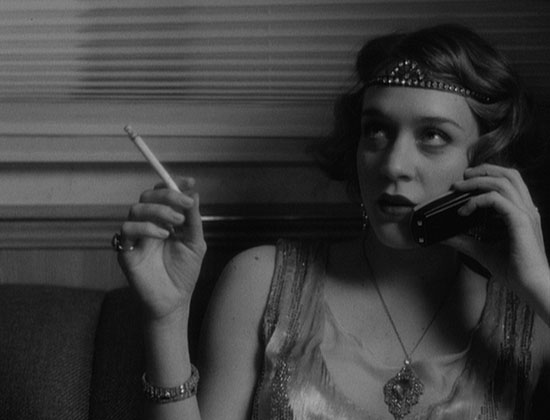
Chloe Sevigny tries to unwind in her trailer on a film shoot for ten minutes. There are interruptions. It’s pretty, but what else is it?

Wim Wenders – Twelve Miles to Trona
image
Wenders manages to make a ten-minute desert road movie. This is kinda hilarious actually… straight guy accidentally overdoses on unknown hallucinogenic drug, has to drive himself to the hospital in another town ten minutes away. He doesn’t make it, but a passerby gets him there and he’s okay. Looked a bit like one of those Masters of Horror episodes where they mess with the camera to make things look trippy, but it pulled me in pretty well. They played two loud Eels songs from the Souljacker album.

Spike Lee – We Wuz Robbed
image
A compressed mini-doc about Bush II stealing the 2000 presidential election from Gore (with help from the mass media and supreme court), snappy and nicely done, using all interviews and TV news graphics.

Chen Kaige – 100 Flowers Hidden Deep
image
Crazy guy brings a moving company to a dirt lot to move his furniture. Finally they pretend like they’re moving furniture to appease the guy, until one mover “drops” a “vase” and breaks it. Not great, but cute. Wish it didn’t end with an awful, sub-2046 wireframe 3D animation though.


The Cello

Three of the seven Trumpet shorts made me tear up with emotion (hint: Spike Lee yes, Wim Wenders no), but most of the Cello disc left me sad, tired or bored. Huge difference there, but I’d rather have it that way than have the crap diluting the good stuff over both discs. If only the Michael Radford short had been on the Trumpet disc, I could’ve just sold Cello.

Bernardo Bertolucci – Histoire d’eaux
image
I kinda liked this, but it still gave me a sort of “uh oh” feeling about The Cello when it started. Foreigner (Indian?) is in Italy with a pile of other foreigners, confused thinks he’s in Germany. Old guy wanders away from the group asks our man for a drink of water. Our man finds a girl, fixes her motorcycle, marries her, has kids, gets a nice job, buys a car, crashes the car, wanders off from the car crash site and sees the old man still waiting for his water.

Claire Denis – Vers Nancy
image
A dry, academic conversation on a train about outsiders & foreigners, with the writer and one of the actors of Denis’ 2004 feature The Intruder. I haven’t seen Intruder, but this is obviously a companion piece, prequel or commentary on it. It almost put me to sleep, and I wasn’t even tired.

Mike Figgis – About Time 2
image
Figgis was the oscar-nom director of Leaving Las Vegas, but I don’t think the producers of Ten Minutes Older realized that in 2002 his career was on the verge of death after Timecode and the critically bashed Hotel (it would die for real the following year with Cold Creek Manor). This is a nonsense short, shot Timecode-style. So far, it is the least-bearable ten minutes I have watched this year… I was itching to fast-forward.

Jean-Luc Godard – Dans le noir du temps
image
In collaboration with Anne-Marie Miéville, I think this was actually a trailer for Histoire(s) du Cinema. They’re definitely related. The most unfortunate similarity to Histoire(s) is that this was only partially translated – none of the onscreen French text has subtitles.

Jirí Menzel – One Moment
image
A very nice tribute (using archive footage) to Czech actor Rudolf Hrusínský who acted in more than ten of Menzel’s movies and died in 1994.

Michael Radford – Addicted to the Stars
image
Guy travels 80 light years in suspended animation in a space capsule, gets back to earth and doctors say he has only aged ten minutes. Goes to visit his son, who was a young boy when he went away, now a very old man. Movie has an awesome sci-fi look to it, and I liked the story and atmosphere – a very nice short, my favorite of the Cello bunch. Fresh off Lara Croft Tomb Raider, Daniel Craig starred as the astronaut.

Volker Schlöndorff – The Enlightenment
image
Camera zooms around an outdoor party while unseen narrator ponders the nature of time. At end camera flies into a bug light and dies. It turns out we have been a mosquito. Har!

István Szabó – Ten Minutes After
image
Szabó is the Hungarian director of Lovefilm and Sunshine – I haven’t seen anything else of his. A husband comes home extremely drunk and angry, starts storming around the house while his wife watches upset, “what’s wrong? you never drink!”, finally he tries to strangle her, she stabs him, emergency crew arrives in like fifteen seconds, cops question her, the end. Why? I thought it was gonna be all one long shot, but then I saw a cut towards the end, so there were probably a couple others.