Jimmy Page plays air guitar to his record collection, The Edge shows off his 10,000 pedals, and Jack White shows a young version of himself how to get girls. What’s not to like?

Jimmy Page plays air guitar to his record collection, The Edge shows off his 10,000 pedals, and Jack White shows a young version of himself how to get girls. What’s not to like?

The Auteur Completion Project rolls on. I never knew how to see Permanent Vacation until Criterion put it out a few years ago, and now that I’ve finally watched it, I might as well also finally see this Neil Young/Crazy Horse doc that I bought a decade ago. I have a weird attraction to buying concert DVDs and a weird aversion to watching them. Anyway, now I’ve seen every Jim Jarmusch film that I know of, and I feel good about that. Now to move to New York and see them all on 35mm instead of DVD.
Jim and Neil on the bus:

As far as behind-the-scenes musician docs go, this one is top-notch, not for any particular visual superiority (in fact, it was purposely shot on cheap film and video cameras) but because it lets the songs play out in full – even the long jammy ones – without impatiently cutting to some famous person telling us how great Crazy Horse is. If there’s anyone who can be counted on for patience, it’s Jarmusch.
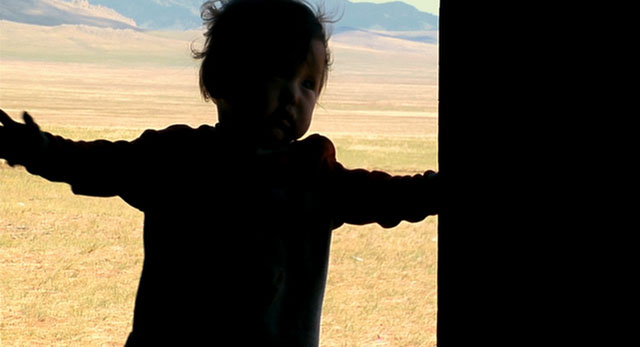
It’s like Sweetgrass, only instead of sheep there are babies. And there aren’t so many of them. And the camerawork is better. That was surprising, that a doc about babies (from just-been-born to just-learning-to-stand) looked better than the Cinema Scope-acclaimed doc about sheep herding. But neither movie transcended expectations. If you are into sheep (or, in this case, babies), we’ve got your movie here. Bonus feature of the movie: pretty vistas of Mongolia.
Baby in his Searchers pose:

Interesting guy – besides the shorts I’ve seen, he made so many scientific research films, capturing and studying animals and behavior previously unknown. This was probably the best way to see those, in short excerpts with explanations of their significance, instead of trying to watch them through (not that they’re available to do so). This was a TV series, going chronologically through Painleve’s career, stopping at each film to discuss its creation and reception.
“You underprivileged bastard!”
Iconic Hopper, slightly blurry:
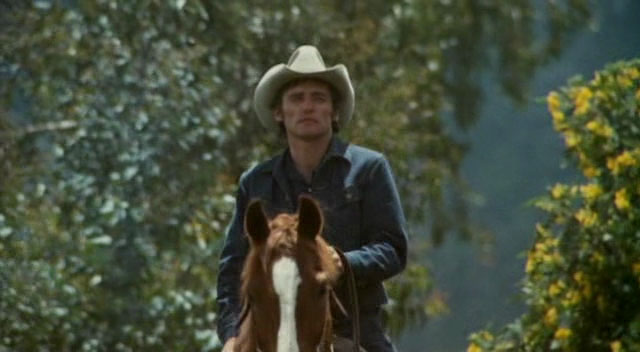
A strange movie in many ways. For instance, no opening credits then after 12 minutes it says “a film by Dennis Hopper”… then after 12 more minutes we get the title. Hopper plays a different sort of hippie drifter loner. He’d like to get married and have a steady job, but on his terms. He worked as a stunt man on a film about Billy the Kid (under director Sam Fuller, in a cameo) in Peru, but seems alienated at the wrap party, only comfortable in smaller groups.
When the production leaves, he stays behind with local girl Maria, idyllic until a priest tries to get Hopper’s help when locals pretend to be making their own movie, with real violence, not understanding the Hollywood fakery. Maria also starts getting him down – turns out she’s not satisfied with the natural paradise that Hollywood Dennis had envisioned. She wants all the American conveniences, which an out-of-work stuntman can’t afford. He turns to the elusive fast-buck by helping his shady friend Don Gordon (Bullitt) try to strike gold, but that ends in failure and embarrassment.
Don Gordon and Donna Baccala, whose only other film was Brainscan:

From what I’d heard I was expecting a rambling incoherent mess of a film, a drugged-up slog making no real sense. But it’s a right proper movie, and a good one. There’s much more to it though; more plot and characters than I’ve mentioned, events sliding out of order, flash-backs-and-forwards. Reference to someone who died during the film shoot. At the end there are “scene missing” cards and a slate onscreen, we see a retake of a scene we just watched, and people start breaking character as the movie winds itself down.

Nice garfunkly folk music throughout. Maybe they’re pushing it when they play a Jesus song while Dennis is dazed and wounded. After the gold mine idea goes bad he rampages through the old movie set and is imprisoned by the local “filmmakers” with their wicker camera. “They want me to die in the movie like Dean did” – so he named his dead friend Dean. “That’s what’s wrong is we brought the movies – that’s where we made our mistake.”
The priest: “They didn’t want to come to my church anymore. They got carried away by that game. So I just wanted to show them that the same moralities that exist in the real church can exist here in the movie church. I hope that after this game is over, morality can be born again.”
Priest Tomas Milian of Traffic, also starred in an Antonioni film and a Django movie:

Mubi explains it all:
The success of Hopper’s Easy Rider gave many young filmmakers the opportunity to work in Hollywood under the studio system. In 1970, Universal hired five “young genius” directors to make pictures for them. Hopper was one of these and developed a script with Steward Stern, the writer for Rebel Without a Cause, about the process of moviemaking and its effect on the natives of a remote and primitive village in Peru where it is being shot.
The Last Movie was the result – an amazing milieu of cinema and the decade it was created in. Hopper is a stunt man and wrangler on a big budget western, with which Hopper infused the presence of Sam Fuller, Sylvia Miles, Toni Basil, Henry Fonda, Kris Kristofferson, Michelle Phillips, Dean Stockwell and the cinematography of Laszlo Kovacs. After the production leaves town, Hopper’s life starts to get a little insane, torn between a new movie producer in town, a buddy (the great Don Gordon) and his quest for gold, and the incredible, ritualistic movie being “shot” by the locals using a wicker camera and boom mike. Under the surface bubbles the genius of the film, dealing with friendship, loyalty, the superstitious nature of filmmaking and the notion of film genre.
Although it received the only award given at the 1971 Venice Film Festival, Universal refused to distribute the film unless Hopper re-edited it. Hopper was intransigent, and Universal gave The Last Movie only token distribution and the picture was shelved.
Sam Fuller:

Only two user reviews on Mubi. One says “it’s wildly textured, emotionally intense, covers a lot of thematic ground, but its all of a piece-it works.” and the other, “a truly loathsome work of self-pity and self-aggrandizement, whose charms include smug, playful racism, and casually brutal misogyny.”
Peruvian “director” frames up a shot:

Wicker-cam:

MZ Seitz on Hopper’s filmmaking:
Although he directed just seven features, his style is quite distinctive. It’s ragged and intuitive, more sensual than logical, intoxicated by drugs, sex and music. And to greater or lesser degrees, all of his films address the individual’s struggle to survive within a machine without becoming a cog — the central narrative of Hopper’s long and strange career, with its youthful promise, adult madness and autumnal wisdom.

Z. Campbell:
The Last Movie is the only film I’ve seen that makes me think that it well and truly is an ‘anti-Western.’ (Though: this much-maligned genre that I love so much didn’t actually need ‘post’ or ‘neo’ updates–it had a strong critical component to it from the classical era onwards.) The Last Movie is quite possibly the only true and intentional avant-garde feature film I’ve seen from Hollywood. It shatters its own sense of fiction, of narrative illusion, it’s just celluloid material projected, and in so doing foregrounds the personal & cultural situations which constitute these fictions. Apocalypse Now? Child’s play–everything Coppola tried to do in his film on violence and imperialism and cinema, Hopper has already done–better–by 1971.
Maria and the city: Stella Garcia was also in a Clint Eastwood western called Joe Kidd.

Mrs. Anderson: Julie Adams was great in this. Hopper cast her in Catchfire twenty years later, and twenty years earlier she’d starred in Creature from the Black Lagoon.

–
The American Dreamer (1971)
“A camera is always a questioning instrument”
Also watched a washed-out old VHS of a truly ridiculous documentary on Hopper made during the editing of The Last Movie. Not about The Last Movie at all, just a portrait of a hippie for people fascinated by the Easy Rider freakshow. It’s everything that Lions Love was accused of being. Hopper gives his views on spirituality but mostly talks incessantly about sex. The movie takes up plenty of time showing him shooting guns and getting naked, and even writes him a theme song.

“There’s no honest men in the movie business except me.”
An hour in, the movie gets more interesting when Hopper starts to question and criticize the filmmakers methods, and to their great credit they left this in there. The doc is made by L.M. Kit Carson – David Holzman himself, who’d later write the terrible Texas Chainsaw Massacre 2 starring Hopper – and Larry Schiller, who later made not one but two JonBenet Ramsey movies. I’d heard that The Last Movie was a disaster and that this intrepid documentary shows why, but I found the opposite to be the case.
“I don’t need to have people make movies about me.”
“This movie, it’s a nice idea, whether it’s damaging or whether it isn’t,
it doesn’t really matter to me.”

Finally caught up with this. Katy and I both liked. Moore has returned to the concerns of Roger & Me, watches the problems of Flint spread to the entire country, but as usual with him (and unusual for political documentaries in general), does it in a way that makes me interested and excited, not depressed. A couple token scenes of Moore trying to talk his way into corporate offices and an ending where he wraps Wall Street in crime scene tape aside, he seems to have listened to criticism and kept himself mostly off-camera. We noticed he was awfully polite and attentive to religion, trying to expand his support base out of the godless-liberal camp. Winning coverage of a factory sit-in and an evicted family that refused to leave balance out the bummers of underpaid airline pilots, life insurance policies on corporate employees and bullying bank bailouts… well, not really, but he makes it feel that way.
Predictably, critical response was off the charts… some raves, many attacks, and still more highly-qualified minor praises – mostly accusing him of simplifying the issues. But they’re issues that needed simplifying, and the accusation is an easy way for a film reviewer to imply their superior knowledge and understanding to Moore without having to defend themselves with examples. Anyway, Cine File put my thoughts succinctly: “Basically the achievement of Capitalism is to spell out the facts in such a way that they’re impossible to ignore. Nobody does it better than Moore.”
Best of all, I found out that in my lifetime, U.S. Presidents used to say things like this:
In a nation that was proud of hard work, strong families, close-knit communities, and our faith in God, too many of us now tend to worship self-indulgence and consumption. Human identity is no longer defined by what one does, but by what one owns. But we’ve discovered that owning things and consuming things does not satisfy our longing for meaning. We’ve learned that piling up material goods cannot fill the emptiness of lives which have no confidence or purpose.
– Jimmy Carter, 1979-07-15
WonderRoot’s Generally Local, Mostly Independent Filmmakers’ Night
Atlanta, Day One (John Duke and Kris Valeriano)
I liked. KV wears a three-dollar suit, tours picturesque ruins of Atlanta before he starts breaking down. I dig the editing at the end, as it cuts between scenes where he’s in the same physical pose, giving the impression of one movement transporting across locations.
Mouth 2 Mouth (Patrick Coll and Chris Chambers)
Hilarious, very short animation.
Until Dust (Nathan Honnold)
I remember saying to Jimmy afterwards that it’s good to know I’m not the only Guy Maddin fan in Atlanta, but I don’t remember much else. Oh wait, here it is on Vimeo! Blurry-focus titles, one of which says “hairdressing school,” yep, I stand by my Maddin comparison. Too bad it’s one of the only pieces projected interlaced, since it was shot originally on super8 film.
Rex (Jackson McDonald)
A guy picks up girls to feed to his hungry dragon. Shot decently and colorfully, complete with flashbacks.
Breathe (Fletcher Holmes)
Clever special-effects demo, shot underwater and somehow keyed, breathing SFX added later prompting a “how’d you DO that?” from the crowd.
17 Degrees Ain’t Nothing (Carlton Mackey and Dane Jefferson)
Two dudes got a camera, but what to film? They chose to interview some homeless people for an hour – and that hour changed their lives (the lives of the two dudes, not of the homeless people). A year later, footage is edited, theme songs are written, still photos are panned and zoomed, and lessons are learned.
The Charm and Rant of Charlotte Pomerate (Beth Malone)
The filmmaker has, what was it, a grandfather involved in “very far left” politics? And his wife wrote children’s books. And she was interviewed by her granddaughter, then the interview was turned into a claymation video… but it’s more “clay” than “mation”. Clay-still-life. Combines two styles I don’t like (documentaries about one’s relatives + animating audio conversations) but it was cute so I couldn’t stay mad.
Passion Seeker (Chris Chamber)
Video for a song by Little Tybee and Adron edited from 1930’s-90’s film clips. Played at around 2fps, and it’d be important to know whether that was intentional. If so, I’m not a big fan. If not, hey WonderRoot, I can give you advice on how to fix that. The song was nice.
Christmas and Hanukkah (Garry Bowden)
“Love is coming for us all,” says the description. A straight-faced romance soap-opera that inspired derisive laughter from the audience. Could Bowden be the Tommy Wiseau of Atlanta? Could he even be of Atlanta? I didn’t recognize any of the scenery, and it’s mostly shot outdoors. Story follows two people who find each other after sour breakups, shot by a man with a handicam but without a plan.
Heaven (Chris Sailor)
Heaven is a parking lot where echoes both precede and follow your words. You should be quiet, according to the man behind you in a creepy mask, but you are not. Also, you’d like a cigarette.
One Minute Fluid Toons on Paper (Brett W. Thompson)
Finally, the long-awaited return of Fluid Toons! Less narrative (and without the awesome sound effects) than the last installment, but any Fluid Toons is good Fluid Toons.
Godamsterdam: Yellow Fever (Ben Cohen)
Part of a web series celebrating political incorrectness. It’s no Sarah Silverman Program but it made me chuckle. Probably the most ambitious project here, setting up a regular cast of characters and a whole series of shorts, with higher than usual production values.
An early blast against the Vietnam war. Well, not TOO early – made at a time when the war had dragged on and people were already enraged about it, but when the mass media hadn’t yet jumped on the anti-war bandwagon. Uses all the stock footage we’ve been seeing for years – guy shot in the head, napalm-burned children running down the street, aerial footage of beautifully-colored bombs destroying the lives of people below – and adds incriminating interviews with soldiers (inside a brothel!), politicians (a general is quoted as saying that “orientals” value human life less than we do) and disillusioned veterans, many of whom are gradually revealed to be amputees.
My favorite bit is when a government source (I can’t remember who, actually) speaks about the origin of the war. North Vietnam was being occupied by France, and shortly after WWII, Ho Chi Minh wrote letters to the U.S. asking for its support in his fight against the evil colonialist French, little guessing that we’d replace the French as his country’s main oppressor twenty years later. Not that I’m taking his side – he sounds like a really crappy guy. Movie won the oscar for best documentary, but the golden globe went to the far safer choice Animals Are Beautiful People.
RK Brigham:
When the film first appeared in 1974, its sympathetic and complicated treatment of average Vietnamese created a sensation. For years, the news media and policymakers had given Americans their only view into the lives of Vietnamese peasants, and that presentation was crude. … Few stories of the war had included such moral statements about the impact of high altitude bombing on civilians. Fewer still had shown that U.S. aerial assaults targeted both North and South Vietnam, that all Vietnamese citizens lived in fear of attacks.
The energy crisis, inflation, rising unemployment, and Watergate led to an almost narcissistic obsession with what the war had done to us. Hearts and Minds challenged that predilection by forcing viewers to consider what the war had done to the Vietnamese. As uncomfortable as it may have been for many Americans, it now seems clear that Hearts and Minds was the first step in coming to terms with a conflict that threatened to destroy the social fabric of the country.
Touches on food problems I’ve heard (and read) before in Fast Food Nation and The Future of Food, then adds more. Food seems terribly dangerous! We celebrating by eating at Farm Burger afterwards.
Eric Schlosser steals the movie – he’s an impressively engaging speaker – although depressed farmers get more screen time. If only Farmer John had been invited to lighten things up. High production values and well paced, a good documentary all around. No oscar though, thanks to The Cove. Featured speaker Michael Pollan supposedly showed the movie to secretary of agriculture Tom Vilsack, “a screening that Mr. Pollan described as uncomfortable” (NY Times) – wish there were more details on that.
The Times:
Because Food, Inc. was produced by Participant Media (among others), the company that backed An Inconvenient Truth, comparisons are inevitable. But there’s a big difference. After watching Al Gore explain the horrors of climate change, moviegoers can turn off a few lights, think about a Prius and call it a day. People who leave Food, Inc. still have to eat.
Indiewire:
Food Inc. is important in scope if not discovery, and the large territory it surveys allows it to make crucial connections between the act of buying groceries and illegal immigration, corporate patented seed, and tainted food.
The party poopers at Bright Lights call it “political pornography for environmentalists, vegans, socialists, and others already predisposed to agreeing with its argument and following its advice, while others are likely to interpret it as patronizing propaganda and get mad at the filmmakers instead of the corporations that are ruining the food supply.”