As I said, reading the Canyon Cinema book just made me want to see more of their films, and so I held a solo screening of some video reproductions of films from their archives.

Notes on the Circus (1966, Jonas Mekas)

Doc footage from his seat at the Ringling Bros. circus, edited to a pulp after the fact, divided into four sections.

1. nervous, jittery views of circus acts: trapeze, clowns, animal acts.
2. more of the same, but towards the end of this section the editing goes hyper and adds superimpositions.
3. picks up where the end of 2 left off. This is likely more fun than an actual circus.
4. all energy, focus be damned.

The guitar/harmonica folk music worked pretty well alongside the images. Mekas repeats songs just as he repeats shots (the same woman doffs her white coat and ascends the trapeze at least three times).
Canyon claims “no post-editing of opticals,” so was he rewinding and re-exposing the film while sitting at the circus?

Here I Am (1962, Bruce Baillie)

A pre-Wiseman verite doc on a local school for mentally disturbed children. Why is the caretaker giving the kids cigarettes?!? Non-sync sound (no narration) with added cello. Nicely paced, and very well preserved. Canyon called it “never before released,” but before when? The DVD notes say it was part of a homegrown newsreel program. “Like the school itself, the camera gives the kids center stage and moves at their pace.”

Fake Fruit Factory (1986, Chick Strand)

Shaky, handheld doc of women who work at the titular factory, talking about sex and food and work, interrupted in the middle by their annual picnic. Non-sync sound, I think – hard to tell since close-ups of hands and bodies and fake fruit are favored over faces. Canyon gets the title wrong on their website and botches the description. Wasn’t Strand one of their founders?

SSS (1988, Henry Hills)

Oh wonderful, a dance film. Many dancers in many locations, all wearing hilarious clothes, rapidly edited in a pleasing way, punctuated by a few seconds of black every once in a while. Best part is the music, orchestral then cartoonish, sounds like a DJ with some electronics, all by Tom Cora, Christian Marclay and Zeena Parkins (and recorded by Kramer). Canyon says “filmed on the streets of the East Village and edited over three years.”

Money (1985, Henry Hills)

No music this time, but lots of musicians and some dancers. Seems like a hundred people on the street were interviewed about money (some were given scripts to read) then their every word was chopped out of context and edited against everyone else, sometimes forming new sentences or patterns from different sources, sometimes just spazzing out all over, interspersed with the musician and dancer clips. Somewhere in there were John Zorn, Fred Frith, Tom Cora, Eugene Chadbourne, Ikue Mori, Bill Laswell, Christian Marclay and Derek Bailey. I’ll bet they play this at every Tzadik party. Hills would seem to have a love for music, a sense of humor and tons of patience. Canyon: “thematically centered around a discussion of economic problems facing avant-garde artists in the Reagan era. Discussion, however, is fragmented into words and phrases and reassembled into writing. Musical and movement phrases are woven through this conversation to create an almost operatic composition.” Good poster quote by J. Hoberman: “If time is money, this 15-minute film is a bargain.”

( ) (2003, Morgan Fisher)

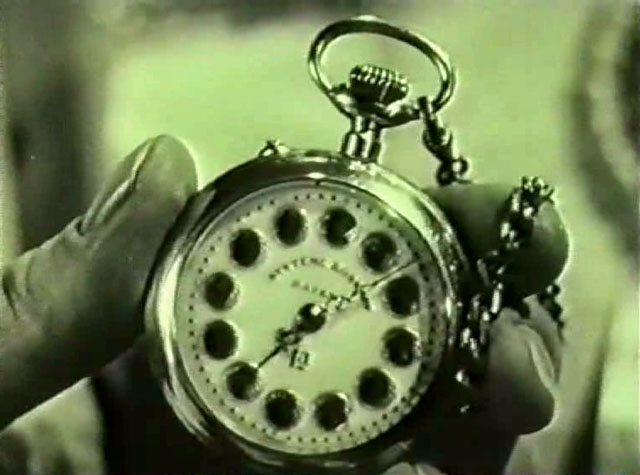
Composed entirely of insert shots from other films. Could be the most intricate murder/conspiracy film of all time, what with all the plots and notes and watches and gambling and guns and knives and secret goings-on. I wish it’d had music. Didn’t recognize a single film, and I couldn’t even find any of the sources by searching character names spotted on notes and letters with IMDB. Shadowplay would be ashamed of my b-movie image-recognition prowess. I really want to do a remake, but the logistics and time involved would be hefty. Fisher is only glancingly mentioned in the Canyon book, but I had this and wanted to watch it.

Thom Andersen:

Fisher appreciates inserts because they perform the “self-effacing… drudge-work” of narrative cinema, showing “significant details that have to be included for the sake of clarity in telling a story,” and he made ( ) to liberate them… to raise them from the realm of Necessity to the realm of Freedom,” to reveal their hidden beauty.

Oh Dem Watermelons (1965, Robert Nelson)

Much talk about this one in the book. A silent, still shot of a watermelon lasts an age, then a singalong with an old racist song – or is it an ironically racist new song? – then some melon smashing with pioneering use of the shaky-cam. The song starts repeating and becomes irritating, as must all avant-garde film soundtracks. This time, Steve Reich is to blame. There’s stop-motion and Gilliam-style cut-out animation. My favorite bits are the dog that appears to poop out a watermelon, and the melon slowly crushed by construction equipment. Made as an intermission film for a theatrical racial satire, Nelson claims to have been inspired by Louis Feuillade.

Samadhi (1967, Jordan Belson)

Eclipses and auroras, perhaps the eyeball of a wizard, five spherical minutes with a blowing, groaning soundtrack.


Samadhi (c) Jordan Belson

The Way To Shadow Garden (1954, Stan Brakhage)

The camera stalks creepily around an empty room. A clean-cut young man comes home, struggles with a glass of water and the bed, dances, reads a book. The camera continues its subtly creepy assault, lingering on light bulbs, but otherwise I’m thinking this is Brakhage’s most performance-based film that I’ve seen, a wordless narrative episode. But then the man claws his eyes out, the film stock reverses, and he seems to find the shadow garden, all blind light and shubberies. The first half makes me think Brakhage could’ve made some killer Sirkian dramas if he’d had the urge.

The Potted Psalm (1947, Sidney Peterson & James Broughton)

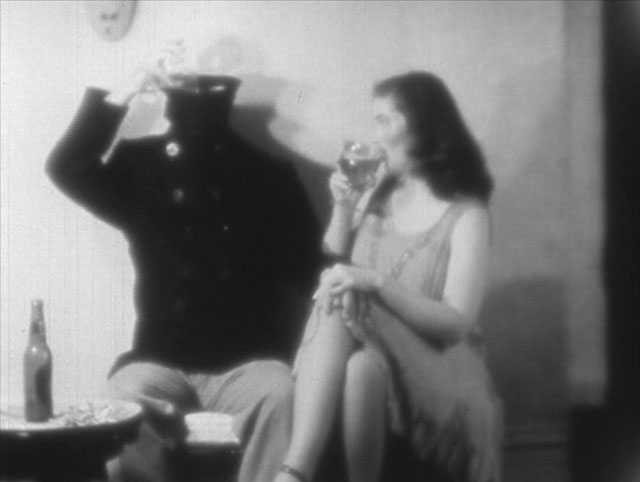
Shots of people and things. A graveyard. A snail. An accordion. A funhouse mirror. Dolls suicide. A woman eats a leaf. The cameraman has a beer and a cigarette.

Not the first Sidney Peterson movie I’ve watched, and I still don’t get what he is on about. Kino made an interlaced transfer, hired a woman whose Casio can make neat sounds to record a horrible score.

I had a bunch more in mind to watch, but I suppose I’ll get to them another day.

Soderbergh made a sort of Spalding Gray autobiography, stitching together monologues and interviews from across Gray’s career into a new monologue – not one Gray would have scripted himself in precisely this way, but thoroughly captivating. The picture is nothing special, lots of 4:3 video sources – Gray’s story is everything.

The open is perfect, revealing the out-take nature of the film, a rough videotape of Spalding sitting down, attaching his microphone and beginning a story. Lots of talk about death – maybe that was always present in his stories, but you really notice it now.

Topics: childhood, christian science, his parents, his mother’s suicide, beginnings in acting, sex, conversations with audience members, his movies (three of them anyway – nobody ever mentions Terrors of Pleasure), his two wives and his children, and the car accident a couple years before he died, with mentions of R.D. Laing, Gray’s work in pornographic film, “poetic journalism,” dancing to Tubthumping and the meaning of life. It’s like the best Inside the Actor’s Studio episode, with no interviewer.

I don’t know why, but for a whole segment he is holding up a Playboy.

Plastic Bag (2009, Ramin Bahrani)

An American Beauty plastic bag, dancing with me for twenty minutes. Only this bag’s journey is very well filmed and the bag has the voice of Werner Herzog – two innovations that would have greatly helped the last plastic bag movie I saw, The Green Bag. A blatant environmentalism screed, but I really enjoyed it. I thought it’d have the same ending as Children of Men, but it had the same ending as AI: Artificial Intelligence instead.

The Dirk Diggler Story (1988, PT Anderson)

An actual fake doc, but not a polished one. I thought it was rigged to look amateurish until I read online that it was actually edited on two VCRs by young Anderson. Narrated by PT’s father Ernie Anderson, a big-time TV announcer. It’s nice that he was willing to participate in his 18-year-old son’s movie about pornography, homosexuality and drug addiction. The most fun part of the movie is hearing this straightlaced announcer pronounce titles like “White Sandy Bitches” and “Bone To Be Wild”.

Dirk is explicitly bisexual in this one, but otherwise it hits some familiar plot points from Boogie Nights: Dirk’s drug addiction, his ill-advised recording career, his buddy Reed. There’s less nudity in the short, and it ends with an on-set fatal overdose for Dirk. My favorite bit that didn’t make the feature was a group prayer for God to protect us against premature ejaculation.

Horner (Burt’s character) is played by The Colonel in Boogie Nights, the only actor who returned. Well, Michael “Diggler” Stein had a cameo as “stereo customer”. He turned writer/director after that – his last film starred Andy Dick and Coolio.

Las Hurdes/Land Without Bread (1933, Luis Buñuel)

A half-hour documentary that has been discussed to death – how much of it is real? Can it be considered surrealist? Etc. Taken at face value as a portrait of an extremely poor mountain community, it’s well made, interesting, and too vibrant (and even humorous) to blend in with your average educational short. I still can’t believe they had a donkey killed by bees, and shot a mountain goat then hurled its body off a cliff, all to make points about the difficulty of life in this place. At least they didn’t kill any people on camera, although the narrator may have exaggerated (or undersold, who knows?) their conditions. Was released in ’33, had a French voiceover added in ’35 then a newsreel-toned English voiceover in ’37 – I saw the French version. I assume the bombastic music was on all three versions.

Senses of Cinema calls it “a documentary that posits the impossibility of the documentary, placing the viewer in the uneasy situation of complicity with a cruel camera probing the miseries of the urdanos for our benefit.”

The Old Lady and the Pigeons (1998, Sylvain Chomet)

This 20-minute movie gives me inexpressible joy. It’s a good antidote to the world-weary realism of The Illusionist, back way past the anything-goes surrealism of Triplets of Belleville into a pure comic cartoon world. A starving policeman dresses as a pigeon, barges into a bird-feeding old woman’s house and demands a meal, then does the same all year until she tries to eat him for Christmas dinner. Full of delightful little details (and at least one sad bird death).

The Italian Machine (1976, David Cronenberg)

“Let’s figure it out, Gestapo-style.”
A series of betrayals leading to an obsessed mechanic gaining ownership over a unique motorcycle. Made for TV, so people call each other “meathead” and “turkey”.

Beardy Lionel (Gary McKeehan of The Brood) hears that a collector’s-item motorcycle is in the hands of a collector. This will not stand, so he grabs his buddies (Frank Moore, second-billed in Rabid, and Hardee Lineham who had a cameo in The Dead Zone) and heads over posing as reporters to figure out how to free the bike from the boring rich guy (played by Guy Maddin’s buddy Louis Negin). Lionel sucks at pretending, though, so they’d be screwed if not for Ricardo, a dull cokehead hanger-on at Negin’s house who helps them out. Cronie’s fascination with automotive machinery peaked early with this and Fast Company, then came back with a brief vengeance with Crash.

Our beardy hero first meets Louis Negin:

Bottle Rocket (1992, Wes Anderson)

Cute sketch, with the Wilson brothers and Bob from the Bottle Rocket feature, plus the gun demo scene shot exactly the same way (just in black and white). They’re budding criminals, robbing Luke’s house then a book/video store, taking one guy’s wallet. No Inez, Futureman, Kumar or James Caan.

Something Happened (1987, Roy Andersson)

An AIDS lesson with didactic narration, illustrated with Andersson’s expertly composed setups of depressed-looking white people. One particular pale balding guy is seen a few times. It ends up less depressing than World of Glory, at least. Commissioned as an educational short but cancelled for being too dark

Within The Woods (1978, Sam Raimi)

Ah, the ol’ Indian burial ground. “Don’t worry about it,” says Bruce Campbell, “You’re only cursed by the evil spirits if you violate the graves of the dead. We’re just gonna be eating hot dogs.” Then he immediately violates a grave of the dead. Nice test run for The Evil Dead, with many elements already in place, like the the famous monster’s-pov long running shot, girls being attacked by trees, evil lurking in the cellar, knifing your friend as he walks in the door because you thought he was a demon, and of course, “JOIN US”. Hard to make out the finer points of the film since this was the grossest, fuzziest, lowest-ass-quality bootleg video I’ve ever seen.

Clockwork (1978, Sam Raimi)

Woman at home is stalked by jittery creeper (Scott Spiegel, director of From Dusk Till Dawn 2). He sticks his hands through her crepe-paper bedroom door, stabs her to death, but she stabs him back, also to death. It’s not much in the way of a story, but Raimi already has a good grip on the editing and camera skills for making decent horror. How did 19-year-old Raimi get his lead actress to take her clothes off in his 8mm movie?

Sonata For Hitler (1979, Aleksandr Sokurov)

Music video of stock footage from pre-WWII Germany stuck inside a ragged-edged frame surrounded by numbers and sprocket holes. Halfway through, the music mostly fades away, replaced with foreboding sound effects.

Music for One Apartment and Six Drummers (2001, Simonsson & Nilsson)

Drummers break into an apartment, play catchy beats in the kitchen and bathroom, with a slow bedroom number in between, then a destructive romp through the living room. But just as they finish, the inhabitants return. Clever and fun, and just the thing that probably should not have been extended into a two-hour feature.

War doc, watched with Katy because co-director Tim was just killed. Less explanation than usual in these sorts of things, and more combat than usual. The cameraman likes to be right there in the action during firing and bombing – which makes for good footage, but is probably why he’s dead now. Movie makes a good argument for the futility of war, pointing out that another unit failed because it didn’t build a forward outpost like these guys do (named after killed comrade Restrepo), then dealing obliquely with civilian deaths and disappearances, finally noting that this outpost was abandoned soon after filming. More impressive than the movie was a gallery of Tim’s still photographs which the NY Times showed online this week.

Very nicely assembled space doc, a tribute to the Apollo missions. Some 16 years after we stopped going to the moon, Reinert montaged audio interviews and film records from the flights into a concise movie with some familiar imagery (still good to see it in well-restored HD) but plenty of new stuff for a space novice like myself.

Lots of anti-gravity play, and talk about music. I was impressed that one astronaut took the 2001: A Space Odyssey soundtrack into space, forgetting that the film predated the first moon landing. And speaking of music, I liked the documentary’s music without paying much attention, didn’t realize until the end credits that it’s all by Brian Eno. Nor did it really occur to me until more than halfway through the short feature that multiple missions were being shuffled without comment. These are two things I’ll have to focus on next time. Turns out Reinert cowrote that Final Fantasy movie I hated, but I can’t hold that against him now.

T. Rafferty:

What he does in this project, editing millions of feet of film and hundreds of hours of audio recordings into an eighty-minute feature, is treat the whole Apollo adventure as a single, epic trip to the moon, peopled by a crew so anonymous that it seems to represent, well, all mankind. … [Nobody] is identified by name. The film simply proceeds, with serene inevitability, from one fiery liftoff to one gentle splashdown, not troubling itself to distinguish any individual mission from any other and never interrupting the hypnotic flow of otherworldly imagery with a shot of a talking head. At first, when one of the offscreen voices says something unusually poetic, or funny, you wonder whose voice it is, but after a while you stop wondering. It doesn’t seem to matter. It’s everybody’s voice.

Reinert:

I began interviewing the Apollo astronauts in 1976. They were mostly retired astronauts by then, changed men. Over the years I taped nearly 80 hours of interviews with those original extraterrestrial humans, and excerpts from the tapes constitute the major part of the soundtrack of For All Mankind. The movie thus speaks with the intimate voice of personal experience.

For All Mankind is the firsthand story of a great mythic adventure. Touching the Moon was by definition a work of inspired imagination and high art, and scarcely requires further embellishment. It speaks for itself more eloquently than it can ever be interpreted: an age-old dream that at long last was fulfilled.

Rafferty again:

It takes enormous daring to make an avant-garde movie about people as determinedly square as the scientists, technicians, and pilots of the Apollo team; where this journalist, who had never directed a movie before, found the inspiration for that unlikely project is—like so much in the film—unfathomable. … In the late nineties, HBO aired a twelve-part docudrama series called From the Earth to the Moon, to which Reinert contributed two scripts. (The series is less exciting than it should have been—it tries too hard to be stirring—but its history is pretty reliable.) Reinert also had a hand in writing Ron Howard’s Apollo 13, which effectively (if, again, a bit too strenuously) dramatizes the 1970 mission … But For All Mankind is irreplaceable: one of a kind and likely to remain so. It is, formally, among the most radical American films of the past quarter century and, emotionally, among the most powerfully affecting.

Very good doc on the film Clouzot almost made between La Vérité and La Prisonnière, starring Romy Schneider (of Welles’ The Trial) and Serge Reggiani (just off Le Doulos and The Leopard). The couple is on their honeymoon, or maybe just on vacation, in a small town shot in black-and-white, and Reggiani becomes increasingly wildly jealous of everyone his wife has contact with, his state of mind represented with color fantasy sequences and optical-illusion effects. Decades after the film fell apart (mainly because the writer/producer/director’s overreaching ambition clashed with his own perfectionism for details, wasting time and money and tiring the cast and crew) the script was filmed in the 90’s by Claude Chabrol, which I believe was the first of Chabrol’s movies I ever watched, too long ago for me to compare the finished movie with the Clouzot fragments.

Clouzot got some great cinematographers and effects people, including Claude Renoir, Rudolph Maté (The Passion of Joan of Arc) and Andreas Winding (Play Time). It was also the first credited film work by William Lubtchansky, who is one of the main interview subjects. The documentary is very excellent, showing much of the never-finished film (the color footage in particular looks amazingly vibrant, like it was shot yesterday), and not getting into irrelevant sidetrack stories. Interiors (and therefore most of the dialogue scenes) were never shot, and there’s no surviving sound recording from set, so two actors read from the script on a black stage, providing missing context.

It’s Political Documentary Month! We will see how long that lasts. Katy asked if all Errol Morris’s films are about death (as far as I know they are) and commented that the square photos within a widescreen strip within our square TV across the room made her feel blind, so I brought up stylistic differences between Morris and Ken Burns, figuring we’re being punished for watching a theatrical feature in the same way we’d watch a television program. Afterwards, I showed her In The Loop, which I thought worked much better than S.O.P. on the TV screen. I was psyched to revisit it but she didn’t like at all, since it doesn’t count as satire on government if it’s exactly the way she imagines government works, and anyway it’s not funny.

S.O.P. was surprisingly tame. As one of the former prison guards points out, it’s not like they were beating prisoners or killing them, although that happens when the CIA bring in their own prisoner, a guy who they’re told “was never here.” Unfortunately for the CIA, photos of that incident leaked along with the rest – the ones with prisoners tied up in “stress positions” with panties on their heads, handcuffed into simulated sex scenarios and stacked in naked pyramids, all with Lynndie England flashing a thumbs-up in front. The prison holds a confusing number of military and government groups and private organizations – it would’ve taken a whole other movie to get it all straight. The guards certainly weren’t clear about it themselves. A side-effect of Morris’s technique here is that he’s made the opposite of The Road to Guantanamo, which was told from the prisoners’ point of view. This movie is an analysis of the photographs, of the circumstances behind them, but only from the guards’ points of view. The nameless prisoners, degraded and objectified in those photographs, remain anonymously dehumanized in the film, enigmatic vessels of suspicion (they are, after all, “enemy combatants”) and sympathy (for the torture/s.o.p. depicted).

Marker’s most traditional, talking-head-style documentary since Le Joli Mai still has its fanciful Marker-moments, such as an intermission called “Cat listening to music,” which I believe is the same as the segment in his Petit Bestiare, and some graphics created in HyperStudio on his Apple IIGS

Guillaume-en-Egypte, dreaming images from Japanese television:

Computer camel:

Even though it’s mostly interviews on the topic of Alexander Medvedkin, and not Marker’s missive narration, the film is still structured with chapter headings “first letter, second letter,” etc. Aelita (the Queen of Mars) is shown watching scenes from Happiness. Marker visits Medvedkin’s grave, notes that he was born in 1900 and so his life can be used as a measuring stick for the century. But the metaphor is underused since his recorded life largely consists of the flurry of activity around the cine-train and Happiness, then a long silence until his rediscovery in France in the 70’s.

A.M.’s daughter:

Marker met Medvedkin while in Russia with Costa-Gavras and Yves Montand for The Confession, then Marker made The Train Rolls On, which he excerpts here. “He wouldn’t give people films; he would give them cinema.” The cine-train was fascinating, even if it didn’t ultimately lead to more efficient production and a communist worker’s utopian cinema of the people.

A camera that is aimed like a rifle – I WANT one:

“When Vertov was using studio lights on the extras he mixed with real mourners at Lenin’s funerals it was said he betrayed kino-pravda, film truth. But once you see the same kind of lights in the courtroom, you realize that life itself has become a fiction film, a film noir, filled with suspense, where some actors applaud their own condemnation in advance.”

Insight on Vertov and Eisenstein, giving context to Medvedkin’s work. He says Battleship Potemkin was not successful in its own country. “While European film buffs reveled in the sight of the Potemkin sailors, Russian audiences were dreaming of Mary Pickford and Douglas Fairbanks.” An interviewee tells us that Stalin used to watch every movie made in the country – impressive if true. Best of all is when Marker watches long-lost films from the 1920’s cine-train and finds the birth of moments in the 1932 Happiness – images and editing techniques discovered or invented on the train reused in the feature.

I wonder if interviewee Viktor Diomen was coached when he said A.M. is “outside time. On the one hand, his own time has left very distinct marks on him. He’s like a big tree with its growth rings and its bark marked by the carvings of passers-by.” One thinks of the Vertigo reference in La Jetee, the woman pointing off the edge of the tree, “outside time.”

“Only later did I understand his tragedy – the tragedy of a pure communist in a world of would-be communists.”

The movie gets increasingly interesting and freeform as Marker sets his rifle sights on Russia’s recent past – a very good final chapter, leading to the greatest final paragraph/shot of any Marker film.

A catalog-style entry for…

Initiated by Shadowplay

Not just a late film, but a whole compendium of late films: a catalogue of works by Orson Welles during his last twenty years, assembled with stylish fun by Silovic and Oja Kodar, very entertaining and informative. All these years I’ve read Jonathan Rosenbaum championing the late, unreleased works of Welles, I still haven’t been clamoring to see them – I figured I’ve got enough things to watch. But now that I’ve had a taste, the clamoring begins.

It starts, naturally, with magic and stage shows – this wonderful bit of duck hypnosis which I played again and again.

Then Orson’s 1975 acceptance speech for his AFI lifetime achievement award, at which he presented scenes from The Other Side of the Wind.

P. Bog as actor:

Oja introduces herself, says she wants to combat the public opinion that Orson idly spent his time doing voiceovers and liquor commercials, but she only fuels the opinion that he couldn’t finish projects at the end because he was easily distracted by newer, shinier projects. Sure, some of it was sheer bad luck, mostly finance-related, but also the negatives of Merchant of Venice going missing.

That unlabeled can holds the original cut of Ambersons:

Scenes from Filming The Trial are shown, a good opportunity for Welles to speak for himself out of character (or, more accurately, in character as himself).

Oja discusses the great trailer for F For Fake (his final completed feature) and shows half of the trailer, then rifles through paintings and sketches he made.

Monologue readings from Moby Dick: filmed solo performance of select scenes before water-shadowed backdrops. Supposedly the rushes have been edited together and screened in Germany and New York. Please feel free to send them here next.

Don Quixote, which he spent 30 years trying to complete. I haven’t seen Jesus Franco’s version, but despite all the public whining about it, it’s probably better than nothing. Franco had no access to some of the footage, which has since aired on television (and therefore on youtube).

A Winston Churchill-related comedy sketch piece in silhouette, and an embarrassing bit at a hammy tailor shop – these are possibly part of the compilation piece known as London, also edited in Germany. I wonder if the Germans would care to release a DVD.

With tailors Charles Gray (of Dearden’s Man in the Moon and a couple of Bond movies) and Jonathan Lynn (director of Clue, My Cousin Vinny):

A trailer for The Deep, a thriller set on a couple of boats in the middle of the ocean, featuring Jeanne Moreau.

Footage shot for Merchant of Venice. The film was almost completed when part of it went missing.

A desperately lonely-looking Welles performing the missing monologue outdoors on a windy evening.

“I think acting is like sculpture, in other words it’s what you take away from yourself to reveal the truth of what you’re doing that makes a performance … There is no such thing as becoming another character by putting on a lot of makeup.” – spoken by Welles, but similar to what Renoir says in that short with Gisele Braunberger.

More projects: The Orson Welles Show (featuring The Muppets, and available on video):

The Dreamers, which I know little about:

Overall a very useful little doc, which unsurprisingly got me fired up to watch more Welles movies (and to finally read that recent Welles book by Rosenbaum). Unfortunately my follow-up feature, Linklater’s Me and Orson Welles, was much less enlightening.

Afterwards I scouted around online, having a Late-Welles scavenger hunt. I came up with a couple interesting bits. First, a piece of Vienna, as it aired on the Arte channel – a segment of the 1969 One Man Band project. Seems like an unexceptional travelogue, featuring a man who feeds birds, a montage of quick zoom-ins on different cakes (also shown in the Silovic/Kodar doc). A caped and hatted Orson walks through the city scenery, visits a ferris wheel and comments on the Third Man soundtrack, then he and Mickey Rooney perform a magic trick with Senta Berger (of Major Dundee, The Terror of Dr. Mabuse).

Ten minutes of silent screen tests and still photography in preparation for Merchant of Venice, compiled by the Italians – not especially enlightening except to get another look at those long-nosed Eyes Wide Shut masks. I wonder how these tests got out while the film itself remains under wraps: