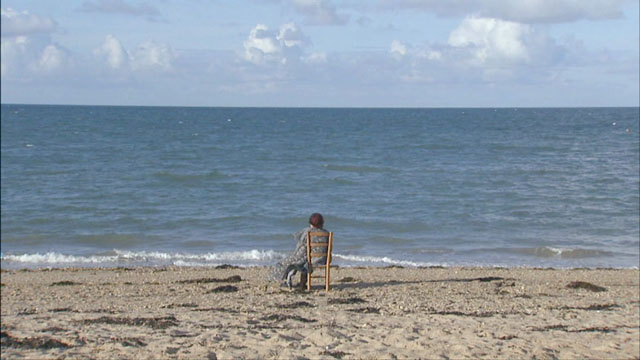
Varda films her own travels for a year or so, as she visits old friends and new, goes to lots and lots of art exhibits and museums, and attends retrospectives of her work. “Now that I’m old, everyone tends to give me awards and trophies.”

I didn’t get tired of the framing story: a tree at her offices is severely pruned, all shot in still photographs. And speaking of photographs, the main excitement in episode one is that she visits Chris Marker at his studio. She shoots the cables behind his computers, “the secret threads of the labyrinth of his art.” A Demy-fest celebrating the 50th anniversary of Lola, featuring Aimee, Piccoli and Varda’s children. Lots of exciting artwork.

Manuel de Oliveira attends Varda’s screening in Lisbon. Somebody explains Oliveira’s cinema: “He says reality is merely the result of certain conventions. It’s very important in Manoel’s films to understand that society becomes the artifice. Cinema is not the artifice. Manoel’s films help us get some distance from this reality imposed on us, so we can interpret it in another way.” Then Oliveira clowns around for Varda, doing his Chaplin impression and miming a fencing match, and my understanding of him changes. When he was a piece of trivia, The Oldest Working Filmmaker, it always seemed like he had very little time left, that each film might be his last (a review I found of Non, over two decades and thirty films ago, suggested that it would be his last), but seeing him in action I suddenly realize that he may live forever.

Varda chills in Marker’s world:

Oliveira:

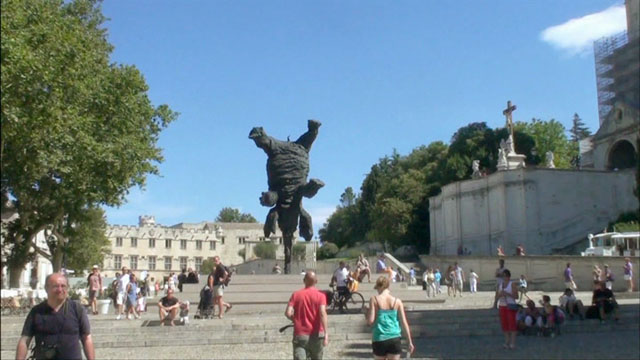
Ep. Two, she goes to Brazil and meets Glauber Rocha’s daughter and Jeanne Moreau for the Rio film festival. A chair in a gallery prompts a montage of chairs Varda has photographed. Stockholm, and an Ingmar Bergman auction. Agnes is so fascinated by her interviewer, they end up swapping jobs. She calls gallery director Hans Ulrich a “contemporary art detector.” Varda meets Jonas Mekas and Yoko Ono while dressed as a potato. Flashbacks to Vagabond and Beaches. An elephant upon its trunk announces an exibition.

Agnes Potato with Mekas:

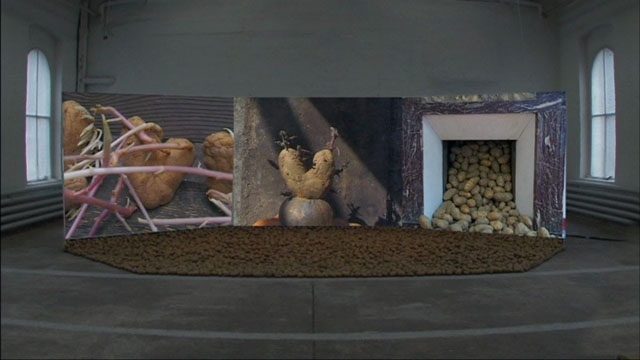
Ep. Three: igloos in Basel. Varda’s installation film Patatutopia is a triptych of potato images. Another installation of interviews, each one playing on its own television in front of its own easy chair. “A piece by George Segal attracts my attention. I didn’t know how to film my distress when Jacques died. So I wrapped myself in white, like plaster, and imitated Alice. I listened to music we both loved. Artists invent ways for us to express our emotions.” At the Alliance Francaise she attends a presentation of Beaches and a photo exhibit, including portraits she took of filmmakers (Demy, Visconti, a superb shot of Fellini). She visits the Hermitage and flashes back to Russian Ark, then back in Paris has a fascinating chat with artists Annette Messager and Christian Boltanski.

the Segal piece:

Patatutopia:

Boltanski’s holocaust-metaphor used-clothing installation:

Ep. Four: setting up a Beaches installation, with sand and her shack made of filmstrips. Some visitors to the shack: “Their interpreter murmurs ‘New Wave'”. Digital beaches, a man who collects buttons (and button stories), then a return to La Pointe Courte, where she films the 2010 version of the same jousting tournament she shot in 1954 for her first feature. A Marker grinning cat leads to more museums, including an exhibit by a painter who works only in black. I liked how he displays his paintings, suspended in the middle of a room instead of upon the walls, so you can look past one to compare it with another in 3D. Jean-Louis Trintignant recites poetry in the park – this kind of thing never happens where I live.

Varda street on la pointe courte:

Trintignant:

Ep. Five: a visit to her buddy Zalman King, Richard Pryor’s costar. Towers built by a “hero of outsider art.” Interview with a reluctant participant at the gang violence memorial. She talks about Jim Morrison and visits her old beach house, presumably during the Lions Love era, then toys with blue screens on the beach. Some 15th century angel/Jesus paintings then, more fun, skeletons in Mexico City. Agnes gets her interpreter to play piano and her assistant to pose nude for a photograph. Interview, with clips of Japon, with Carlos Reygadas, before visiting Frida Kahlo’s house. A juice factory that also houses a massive collection of modern art. Matthew Barney, Marina, Abramovic, and the best molé in town.

Zalman:

Agnes and Mexico interpreter Elodie, not nude:

And the series ends with no grand sweeping statement on the travels, just a series of sketches accumulated over a year or two, the time it took for the tree in her courtyard to completely re-grow.

Right after I read about his trilogy, a Glawogger film opens in my neighborhood, so the wife and I went on a date to see his whore movie. There are interviews with the participants, but mostly it’s an immersive thing, you figure out how the whoring works in each region by fly-on-the-walling it. But M.G.’s great innovation is to produce a verite/interview doc with killer camerawork and sound design. You sometimes get curious framing or a decent music score in a doc, but usually the serious documentarian’s stylistic presence is felt through editing. Not anymore, as the weird vibes of CocoRosie swirl through a surprisingly elegant movie about prostitutes in increasingly desperate conditions.

First Thailand: the girls have home lives and ideas about what they’d like to do post-prostitution. Their brothel advertises, accepts credit cards and employs a woman who acts like a den mother. Then Bangladesh, a sharp step down in living conditions, as kids are sold to live and work in a complex they’ll never afford to leave. Finally Mexico, where it’s every girl for herself, with no supervision, a desperate, dangerous-seeming atmosphere, and enough of a who-gives-a-fuck attitude that the filmmaker is allowed inside to watch some whoring in action: sadness for everyone involved.

Katy and I discussed the movie for like ninety minutes, but that was a month ago, so I cannot provide a summary.

C. Huber in Cinema Scope:

Thriving on contradiction and observational curiosity as usual, Glawogger still resolutely rejects social cause-pandering, but scratches for something deeper by contrasting the rituals of love (for sale) in three different cultures, religions and economies: a look not just at prostitution, but the relationships between men and women in contemporary society that yields telling and ambivalent insights.

“the illusion of movement, like frames in an animated film”

Cave drawings from 25k to 40k years ago, during the last ice age, including drawings of extinct animals. The earliest recorded human artworks. Somewhat ecstatic movie, between the cave camerawork and the string/choral music, with notes of Herzogian strangeness (a master perfumer speaks of trying to sniff out hidden caves). The first half suffers from having to use a subpar camera, without the time or equipment needed to set up perfect shots, but the crew gets to return with better stuff later, slowly moving a light source while the camera remains still to expose the rock’s textures. Herzog faithfully edits their two journeys separately instead of just using images from the second trip and pretending like they got it perfect the first time.

Cave sniffer:

Sidetrack interviews with cave explorers, engineers plotting the cave with laser imagery, a historian who demonstrates statuettes, ornaments and musical instruments from the ice age, carved from mammoth tusks. Then an unexpected poetic epilogue about albino alligators in a steamy greenhouse warmed by runoff waters from a nuclear plant.

Herzog in Cinema Scope:

There’s not much room for intentionality. You have one week. You have four hours a day to shoot. You have to build your cameras and then reconfigure your cameras on a 60 centimetre-wide walkway. You’re allowed only three people with you. You’re allowed only three small panels of light. So intentionality is reduced to having to film like crazy and deliver.

Of course there was a very clear idea about why 3-D was necessary, and clear ideas about music. There was a clear idea about not trying to define what things represent… because we do not know. There are a number of hypotheses made by scientists, but what’s construed to be a ceremonial site could just as easily have been the traces of children playing. I think we have to keep possibilities open if we want to understand what can look to us like the sudden awakening of the modern human soul.

DEC 2021: Watched again with Katy, who liked it enough that she’s taking an interest in other Herzog movies – this could be good.

Ode to the Dawn of Man (2011, Werner Herzog)

Also on the DVD, Herzog takes a camera to the recording of the film’s score by really amazing cellist Ernst Reijseger. I could watch this a bunch more times. Probably I should just buy the soundtrack.

I found out about this due to the Greenaway short (also called Act of God, also about people’s experiences with lightning) included on the DVD, then was intrigued to discover that the feature is Baichwal’s follow-up to the great Manufactured Landscapes. Landscapes got to piggyback off its photographer subject’s artworks and visual ideas. This one is an interview documentary, so Baichwal and her cinematographer/husband were on their own to create meaningful enough images to justify the film, and I think they succeeded. And the storytelling definitely succeeded. I’ve never been afraid of lightning before, and now it’s all I think about.

A man in Ontario tells of a camping trip years ago, everyone stunned and scattered by a lightning strike, one kid had his insides burned right out. A man in France who won’t show himself on camera built a museum of lightning-struck objects. An ex-soldier in Vegas had his life changed by a strike through the telephone, opened a clinic for dying veterans. Three kids killed and others injured from a hilltop strike in Mexico. And, connecting these stories of powerful electricity hitting the human body, musician Fred Frith improvs while being hooked to brainwave machines, measuring the electrical impulses he uses when creating. He invents some wonderful storm-music at the end. Baichwal and husband filmed most of the lightning in the movie (and there’s a ton of it), set out to make a film about randomness and meaning, hence the Frith bookends.

Act of God (1980, Peter Greenaway)

Baichwal said she tried cross-cutting between segments but it didn’t work, so she lets each story stand on its own. Greenaway, of course, does not – he breaks up the questions and lightning-strike descriptions into categories (time of day/year, height of subject, etc), sorts them, and interrupts with bursts of Michael Nyman music. He’s also less natururalistic, arranging interview subjects into amusing compositions, including one person struck through the phone line who tells her story through a handset. Unless IMDB is messing with me, his DP later directed Surf Nazis Must Die. The short makes efficient use of its 25 minutes, but it wouldn’t have made much of an impact had I not watched the longer, calmly frightening feature beforehand.

A few annoyances – Cousins’s lilting voice makes me laugh for a few minutes at the start of each episode (I never get used to it), and all the statements that the well-known film classics aren’t really the great films (as opposed to Rosenbaum’s distinction between acknowledged greats and personal favorites). I tried to keep my ears sharp for factual errors after reading an early account on Shadowplay, but by the five minute mark I’d completely melted, just enjoying the hell out of the clips on display, the cinematic history lesson and its clever organization. Also, I couldn’t believe he mentioned Samira Makhmalbaf in his introduction.

Part 1: 1895-1918, Thrill Becomes Story

From the earliest works through DW Griffith’s Intolerance in 1916, with spotlights on Lumiere and Melies, Billy Bitzer, Edwin Porter (his Life of an American Fireman gets the most play), Alice Guy, Victor Sjostrom and Griffith.

Part 2: 1918-1928, The Triumph of American film and the first of its rebels

About the industrialization of Hollywood, then the breakout comic stars of Keaton, Chaplin and Lloyd, the beginning of documentary with Nanook of the North (with a shout out to The Five Obstructions) and realism in fiction film. More rebels: first The Crowd, then Aelita and Yevgeni Bauer, then a spotlight on Carl Dreyer and The Passion of Joan of Arc.

Part 3: 1918-1932, Great Rebel Filmmakers around the world

Focuses on challenges to the dominant Hollywood romanticism in the 1920’s and 30’s. Lubitsch’s style and innuendo, French impressionism (Abel Gance), German expressionism (Caligari, Metropolis, Sunrise), experimentalists (Walter Ruttmann, Entr’acte, Alberto Cavalcanti, Un Chien Andalou and L’age d’or), Soviet montage (Potemkin and Arsenal), Ozu’s humanism and compositional innovations, Mizoguchi’s feminine miserablism and the realistic acting of Ruan Lingyu.

I see that Mark Cousins doesn’t have a better copy of A Page of Madness than I do – a shame. I hope a decent print of it exists somewhere. Five years before that one, he calls Souls on the Road the first great Japanese film.

Part 4: The 1930’s, Great American movie genres and the brilliance of European film

Sound film in hollywood and europe: Love Me Tonight as example.
The genres: horror, gangster, western, comedy, musical, cartoon
Europeans who push boundaries: Cocteau, Vigo, Carne/Prevert, Renoir
in South America: Limite (looks great)
in Poland: The Adventures of a Good Citizen (whoa, looks just like Polanski’s Two Men and a Wardrobe)
in Germany: Leni Riefenstahl (way to go, Germany)
Back in Hollywood, reasons why Hitchcock was “the greatest image maker of the 20th century” then a run through the women of Ninotchka, Wizard of Oz and Gone with the Wind

Part 5: 1939-1952, The Devastation of War and a new movie language

On to neorealism, but wait – first Ford’s and Welles’s use of deep space and wide lenses – okay, back to neorealism, then film noir (Gun Crazy looks amazing). He calls the Hollywood blacklist “the single greatest trauma in american cinema.” A chat with Stanley Donen, then onto Britain for Powell and Pressburger, Humphrey Jennings and The Third Man (“a compendium of 40’s cinema”). I like how he keeps flashing-forward to Martin Scorsese films influenced by the clips he’s showing.

Part 6: 1953-1957, The Swollen Story: world cinema bursting at the seams

Another world cinema round-up: Youssef Chahine – “the founding father of creative african cinema” for Cairo Station – is the original James Dean. Indian realism in the mid-30’s to Pather Panchali to Mother India. A melodrama called Two Stage Sisters by Xie Jin. A few by Kurosawa. Rio 40 degrees by Dos Santos in Brazil. In Mexico, Dona Barbara and La Perla and the return of Bunuel with Los Olvidados. Then on to Sirk, attacking Hollywood melodrama from within, along with Kenneth Anger and Nick Ray. The rise of television, Marty, and method acting. Checking in with old friends Welles, Ford, Hawks and Hitchcock, then in Britain, David Lean vs. Lindsay Anderson. A sign of sexy things to come: Brigitte Bardot.

Lars Von Trier:

Part 7: 1957-1964, The Shock of the New: Modern Filmmaking in Western Europe

Bergman, Bresson, Tati and Fellini led the way in making European films personal – a couple examples of each. Then enter the French New Wave, beginning not with Breathless and The 400 Blows but, happily, with Cleo from 5 to 7 and Last Year at Marienbad. New waves everywhere: in Italy you’ve got Pasolini’s Accatone and The Gospel According to St. Matthew plus Visconti and Sergio Leone. Nice how he talks about each filmmaker’s specific innovations, instead of just listing them out like I’m doing. In Spain, Marco Ferreri (The Wheelchair) and the return (briefly) of Bunuel. In Sweden, I Am Curious, Yellow. And then back to France, where The Mother and the Whore knocked the wind out of the new wave.

Part 8: 1965-1969, New Waves sweep around the world

In Poland, Wajda and Polanski (again with his wardrobe short). Czech: Jiri Trnka, Milos Forman and Vera Chytilova. Hungary: Jancso. Soviet: Tarkovsky and Parajanov. Japan: Oshima, Imamura. India: Ghatak (I interrupted his Ajantrik to watch this show, and Cousins gave away the bloody ending) and Mani Kaul. Brazil: Glauber Rocha. I Am Cuba. Iran: The House Is Black. Senegal: Black Girl (by the “founding father of black african cinema” – note the extra word). Britain: Karel Reisz, Ken Loach and Richard Lester. And in the USA, a curious list of titles I would not have come up with: Primary, Shadows, Psycho, Blow Job, Medium Cool, Easy Rider and 2001: A Space Odyssey.

Part 9: 1967-1979, New American Cinema

Unlike Adam Curtis, Cousins doesn’t seem to have enough footage to go around. His pillow shots of city streets in between interviews and film clips start to feel repetitive. Anyway, he divides New American Cinema into three categories. 1. Satirical Movies (Buck Henry, Frank Tashlin, Robert Altman, Milos Forman). He brings up some of the great, subversive stuff Buck Henry wrote in The Graduate and Catch-22, then in his interview Henry points out that these come straight from the source novels. Good stuff on Altman though, and always nice to see Artists & Models get some credit. 2. Dissident Movies (Charles Burnett, Dennis Hopper). Nice, but where are Robert Downey and Frank Zappa? 3. Assimilationist Movies (Paul Schrader, Robert Towne, P-Bog, Sam Peckinpah, Terence Malick, Bob Fosse, F.F. Coppola, Martin Scorsese). Shout out to Woody Allen for bringing the Jewish experience onto the screen. A bit about how Schrader’s solution to the emptiness of his protagonists was “astonishing” – he stole from Pickpocket. Then he stole the ending of Pickpocket AGAIN in another movie (the two being American Gigolo and Light Sleeper). I guess that is pretty astonishing, but I wouldn’t go bragging about it in TV interviews.

I don’t know who was responsible for this, but in a corner of the screen during the closing credits, over a picture of Paul Schrader they throw up the words PAUL SHRADER. Perhaps an unhappy Bresson fan at the studio?

Charles Burnett:

Part 10: 1969-1979, Radical Director in the 70’s make state of the nation films.

A globetrotting look at films about identity in the 70’s. I’ve only seen a few films discussed in this segment but need to watch them all – they look stupendous. In Germany: Fassbinder, Wenders (Alice in the Cities), Margarethe von Trotta and Herzog. Italy: Pasolini again (Arabian Nights) and Bertolucci. Ken Russell and Nic Roeg and Gillian Armstrong. Documentaries in Japan: Minamata, The Victims and Their World and The Emperor’s Naked Army Marches On with an interview with Kazuo Hara. On to Africa with La Nouba, Xala, Kaddu Beykat, Harvest: 3000 Years and Mambety. Yilmaz Guney with Hope and Yol. The Battle of Chile and finally, The Holy Mountain.

Part 11: The 1970’s and onwards, Innovation in popular culture around the world

“Cinema of sensation rather than contemplation”

In Hong Kong with Bruce Lee, John Woo and Yuen Woo-ping, with special notice given to King Hu as innovator and Tsui Hark for producing every 80’s and 90’s movie he didn’t direct. In India with insanely popular actors Sharmila Tagore (who started in Satyajit Ray’s Devi and The World of Apu) and Amitabh Bachchan, scenes from Mughal e Azam and a long segment on Sholay, which looks like a Western. On to Arab countries with The Message and The Sparrow, and Cousins seems to have gotten Youssef Chahine incensed by calling Egypt a developing country. Then back to Hollywood for the rise of the blockbuster, more “sensation,” with Jaws, The Exorcist and Star Wars.

Part 12: The 1980’s, Moviemaking and Protest around the world

“Speaking truth to power” is the theme of the episode – he uses that phrase about thirty times. Another globetrotting decade-roundup. The Chinese “fifth generation” filmmakers like Zhang Yimou, Tian Zhuangzhuang (Horse Thief) and Chen Kaige (Yellow Earth) are discussed with Stanley Kwan. In Spain, “protest had a sex-change” with Almodovar, who he pits against Victor Erice. Cousins declares Come and See the greatest war film ever made, Kira Muratova one of the most underrated filmmakers, Yeelen “one of cinema’s most complex works of art,” Distant Voices, Still Lives the greatest British film of the 1980’s, and John Sayles & Maggie Renzi “America’s state-of-the-nation filmmakers.” I like how he demonstrates different filmmakers’ techniques with his own camera, training us to watch for specific techniques in the following clips.

Part 13: 1990-1998, The Last Days of Celluloid before the coming of digital

A great round-up of self-reflexive Iranian cinema starting with Samira Makhmalbaf, then her dad, then Kiarostami’s Friend’s Home trilogy. I showed this section to Katy, since she suffered through Where is the Friend’s Home with me, not understanding the fascination. Though his mantra is “the last days of celluloid,” the point in this episode isn’t film itself but the filmmakers who are still making personal art in new ways as multiplex fare gets ever more glittery and disconnected from reality. So there’s Wong Kar Wai and Irma Vep, an interview with Tsai Ming-liang who discusses Hou Hsiao-hsien. Miles away from their cinema is Shinya Tsukamoto with Tetsuo, then Ring and Audition (what, no Pulse?). Interview with Lars Von Trier, discussion of La Haine, L’Humanite, Rosetta. Claire Denis says she was greatly influenced by Touki Bouki. Crows, Wednesday and Haneke.

Part 14: The 1990’s, the first days of digital, reality losing its realness in America and Australia

Discussion of the possibilities of digital with Gladiator and Terminator 2. The opposite ends of the digital spectrum with Toy Story and Blair Witch, then asian innovation in House of Flying Daggers. Referential postmodernism in Goodfellas and the movies of Tarantino and the Coens. An interview with Gus Van Sant. “No movies in the 90’s was more complexly connected to film history” than Elephant – I wouldn’t have guessed that one. I love when Gus reveals his utter cluelessness about video games. Cousins is such an auteurist that he puts the name of Tomb Raider’s lead designer over the footage. Matthew Barney with Cremaster 3. Robocop and Starship Troopers mixed sci-fi, comedy and politics. Jane Campion talks about the unconscious and subjectivity in An Angel at My Table and The Piano, and we close on a good interview with Baz Luhrmann.

Part 15: 2000 onwards, film moves full circle and the future of movies

“The clash between reality and dreaming.” A hilarious metaphor, referring to innovation as “the gorilla.” Post-2001, documentaries got big: Fahrenheit 9/11, To Be and To Have, Zidane. Reality in fiction photography with The Assassination of Jesse James, Climates, Mr. Lazarescu, The Headless Woman, Battle in Heaven. In Korea: Oasis, Memories of Murder and Oldboy. American dream films: Mulholland Dr., Requiem for a Dream. Then the combination of reality and dreams with Songs from the Second Floor, and digitally screwing with perception with The Rules of Attraction and Avatar. The boldness of Tropical Malady (he pronounces the director’s name Vair-suh-THACK-ull). Cousins ends the series in the present, not with some hot young filmmaker who may be the voice of the future, but with sixty-year-old Aleksandr Sokurov: Mother and Son, Russian Ark (“perhaps the most inventive film ever made”). But wait, here it is, an epilogue set in the future: Inception, Eternal Sunshine and a lovely post-cinema roundup closing in Burkina Faso.

Of course, while watching The Story of Film I kept seeing clips and hearing mention of great films that I never got around to watching, and so I hereby declare The Story of Film Festival, during which I’m watching one never-seen film from each episode. Lineup below – will update as I go.

1. Intolerance
2. The Crowd
3. Nothing But Time & Entr’acte
4. Daybreak
5. Gun Crazy
6. Rio 40 Degrees or Cairo Station or Mother India
7. Curious Yellow
8. Daisies
9. The Last Picture Show
10. ?
11. A Touch of Zen, Dragon Inn or Chahine’s The Sparrow
12. The Horse Thief
13. Beau Travail
14. Gerry or An Angel at My Table
15. Mother and Son

What a thrill – Morris’s most energetic movie yet. The story of a certain litigious woman (let’s call her J) and her exploits – in her own words, and from the perspective of a couple insiders (a pilot she hired, a dog-cloning scientist) and outsiders (two tabloid journalists and an ex-mormon radio host). The result is what Morris calls a “Looney Tunes Rashomon,” in which you can never quite be sure of the true events because each side is enthusiastically, entertainingly promoting their own version.

The events in question: in 1977 J’s boyfriend/crush went away on a mission (or was kidnapped by the Mormon church). She assembled a militant team to rescue/kidnap and deprogram/rape him, depending whose story you buy. When the story came out, the tabloids hit her hard, finding and publishing supposed evidence that she’d been a sex worker. Towards the end of the movie as we’re running out of details and stories regarding the 70’s incidents, J lives alone with her dog, still pining after her now-married Mormon boy, when the dog dies – so she has him cloned in South Korea, and now lives with five perfect replicas of her former dog. The events in J’s life would be notable in themselves, but the genius of the movie is all in the telling. The editing is a little jittery and jumpcutty for my liking, but the welcome absence of the Mr. Death-style re-enactments and the wealth of valuable stock photos and the cool tabloid-headline graphics make up for that.

Morris:

I like this new film because it’s a return to a kind of absurdist version of what I do. I love the oddities of how people express themselves. Take [tabloid journalist] Peter Tory’s affection for the phrase “spread-eagled.” Every time he says “spread-eagled,” and he says it again and again and again, I ask myself, “Is he making this up? Is this tabloid journalism in its essence?” At one point, he’s talking about the “sex in chains” headline, and he says, “I think it was ropes, but chains sounds better.” Tabloid’s a story about narrative, about how stories are constructed as they’re being told. I wanted to achieve that effect in a movie, and I hope it’s there.

Quoth a banker: “We must shift America from a needs- to a desires-culture. People must be trained to desire, to want new things, even before the old have been entirely consumed.”

Another Adam Curtis miracle. Katy and I are pleased as punch by the film’s research, structure and presentation, while being terrified by its content.

Curtis tells how Freud’s theories were pitched in the States by his nephew Edward Bernays, who thought to use his uncle’s psychological techniques in advertising and public relations, a field he effectively started. Freud’s theories are thought to explain the rise of naziism, so the American power elite looks to his daughter Anna for ideas on how to control the peoples’ minds. Former Freud student Wilhelm Reich who became a sex hippie (see also W.R.: Mysteries of the Organism), is the godfather of the opposite side: freeing your mind from conformity, and while Reich himself is imprisoned, his work destroyed by the U.S. government, his ideas inspire industry to promote self-identity through spending. Still later, Tony Blair and Bill Clinton (so apparently well-meaning, yet so deflated by the Adam Curtis docs) use focus groups to turn government and politics into a kind of marketing. And Curtis uses the same language that he’d return to in The Trap: what our leaders and big business presented as a new form of freedom became instead a form of control.

When we watched this in college (same day as Basquiat, or was it Suburbia), it got boring so we turned it off. Years later someone told me we must’ve stopped the movie right before R. Crumb’s brother dies, because it gets really gripping after that. Years after that I watch Zwigoff’s Art School Confidential and lose all interest in him. But with the Criterion release of his early stuff I give in, cuz I’m a Criterion fanboy, and give this one another shot. And WTF, his brother dies in the closing credits, so I must’ve been pranked.

Anyway, I’m more interested in Crumb now than I was in college, and it’s a worthwhile doc. You have to wonder about the parents that produced these three sons: a bed-of-nails-sitting street beggar, an unemployable avid reader who barely leaves his room, and the world’s most acclaimed sexually perverse underground comic artist.

Mark was badly beaten, and after therapy, becomes a different person, with little memory of his previous self (a drunk, an artist, a navy officer). Almost the only thing that remains is his penchant for cross-dressing (shoes and stockings). He creates a world of action figures for therapy, puts himself and his friends (plus crushes, fictional characters, his attackers, the filmmaker) in there, and takes gorgeous photographs which become celebrated in the art world.

That’s definitely an interesting subject, worthy of a documentary, and the movie lives up to its potential. Malmberg befriended Mark over the four year shoot, got him to open up about his feelings, his life and his little town, so it feels much deeper than a tabloid news story. And Mark is aware of what he’s doing, conscious that he’s a grown man playing with dolls, that he suffers from anxiety since the attack and that he’s created his own therapy through his Marwencol, but still able to lose himself in the stories he creates, then to step back and stage these photographs.

Unbelievable ending – Mark’s character inside Marwencol (I thought he looked like Daniel Craig, but the internet suggests Nicolas Cage), having been savagely beaten by nazi S.S. soldiers, creates a tiny model town of his own.

Won a whole pile of awards. Shot over four years on DV and super-8. The director and producer had previously worked together on Paris Hilton’s Razzie-award-winning The Hottie and the Nottie.