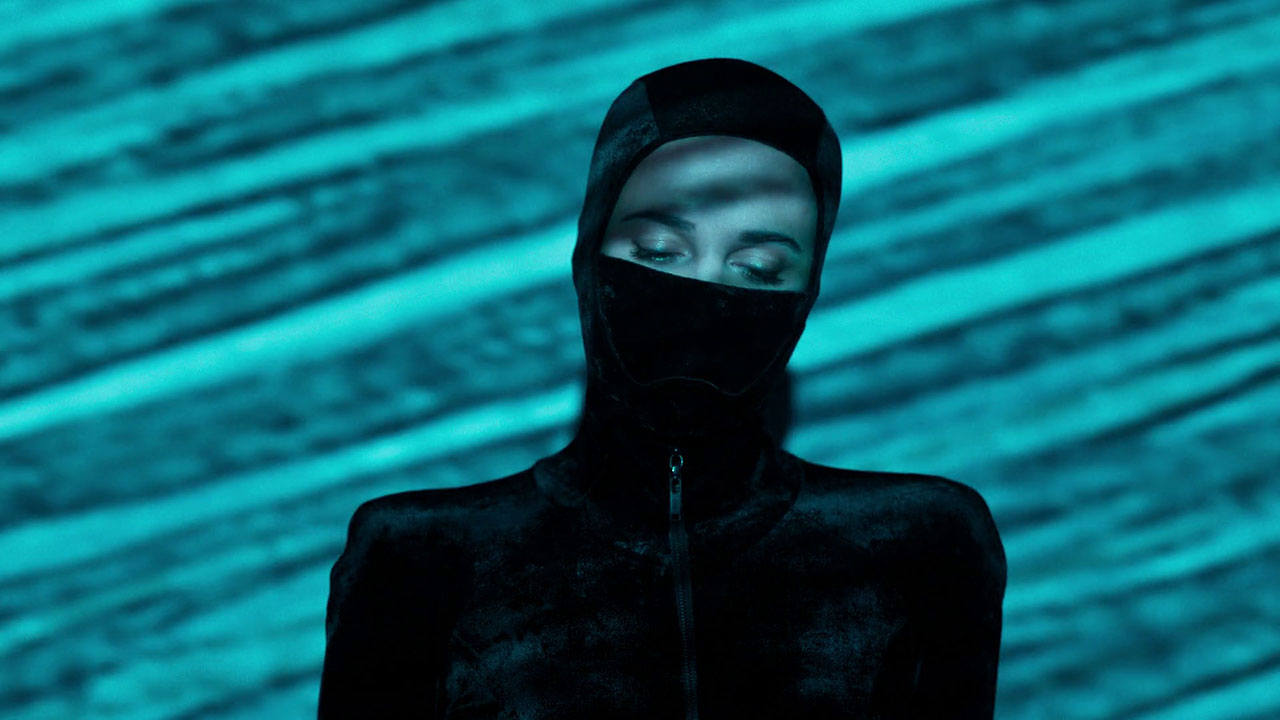
Stereo sound hard-panning left and right, songs cutting in and out, incomplete subtitles, footage warped and effected, recolored, switching to the wrong aspect ratios on purpose, speed-adjusted and frame-by-framed, interlacing, watermarks. He’s taking the “I invented the jump-cut” thing a little far, with an entire movie of technical errors.

Vertigo, Salo, L’Atalante, Alphaville, The Flowers of St. Francis, Freaks. Testament of Orpheus matched with Die Nibelungen. The Rules of the Game rabbit hunt. Paintings and late-era Scott Walker.

Doc footage of horrors to people and animals. Obviously there’s a point to distorting and mutating the film footage and in flipping between fictional and actual atrocities. “This is the law of destruction of the living. Every being must be sacrificed,” says gravel-voiced JLG, or at least that’s what the subtitles tell us he’s saying.

The nature of art and war are covered, briefly. Focus on Russia, trains, physical film apparatus, the Muslim world. Named/numbered chapters, but I’m not sure they help anything. Politically, he seems to be in a terrible mood.

You do eventually drift into its rhythm, or its lack of rhythm. Towards the end it feels like he might start telling us a coherent story about a would-be conqueror named Sheik Ben Kadem (“but the world wasn’t as simple as his dream” sounds like Adam Curtis) illustrated by the jumble of sources he’s been establishing… alas, JLG is just reading scraps from a 1980’s novel, and the subtitles lose interest in following him.

It’s such a homemade UFO, I’d believe you if you told me he made it alone in a weekend, or that it took many years with a team of researchers.

Blake Williams:

These are films that ignite every interpretative impulse in our brains without satisfying our desires to be passive, unproductive viewers; they do not give clarity or any obvious avenues through the deluge of information, even if they make us feel as though, were we smarter, more knowledgable, bilingual cinephiles, we would be able to do just that. It’s in this way that Godard’s films also invite us to improve ourselves, something I think very few other artists achieve.

Will Sloan:

Many years ago, Godard attempted to create a style of cinema that could inspire revolutionary change. At this point, he seems to not only regard such a thing as impossible, but also regards cinema as a tool of violence and colonialism. In the film’s longest and most lucid section, he argues for the Arab World as a lost paradise hurt by western intervention, and cinema as a tool of oppression (in his narration, he says something along the lines of “all representation is violence”). He doesn’t seem to draw a distinction between classical Hollywood cinema, news footage, Blu-Rays, and amateur cell phone video — he suggests they have all basically been flattened into the same thing.

Michael Sicinski:

In his comparison of war footage and fictional violence, Godard posits the old problem: which representation is the original, and what inspired what? The connections are pre-cognitive and deeply intuitive, posed as questions, and (like so much in late Godard) recall Aby Warburg’s Mnemosyne Atlas. How have images — both “cursed” and “blessed,” in the current parlance — dipped and ducked into the unconscious across the ages, forming something like a universal art history?

Lawrence Garcia:

If, as Godard intones early on, pledging allegiance to the ideas of Swiss cultural theorist Denis de Rougemont, man’s condition is indeed “to think with hands,” then what happens when cinema subverts or displaces that tactile state? When a hand becomes, as in Godard’s famed aphorism, “not a just image, but just an image”? When real violence becomes conflated with the violence of representation? In a choice that will strike some as crass at best, and exploitative at worst, Godard continually rhymes the two, in one instance placing gruesome footage of ISIS throwing bloodied bodies into the water against the scene in Vertigo (1958) in which Scottie rescues Madeleine from the San Francisco Bay. The ultimate point that Godard arrives at here, though, is fairly direct: which is that cinema—even revolutionary, politically minded cinema—has not clarified, but obscured the reality of the Holocaust and other attendant horrors, and instead contributed to a larger confusion, an effective “flattening” of reality. (That the clenched fist of revolution is here traded in for a raised index finger is instructive.)

Sam C. Mac:

The Image Book ends with another display of madness that would be a more than appropriate sendoff for the French New Wave figurehead’s restless career. Taken from Max Ophüls’s Le Plaisir, it’s a sequence of a man dancing and spinning around furiously until, finally, he falls down. This moment also serves as a canny reminder that, whatever effort it takes to understand the exact nature of the work that Godard is doing here, he’s also exerting that effort with us—and he seems to mind not at all if he collapses in the process.


As a memorial screening, I watched one JLG short film per decade…


Une Femme Coquette (1955)

Agnès writes a letter to a friend to confess cheating on her husband, having witnessed a discreet prostitute picking up men from the street and wondering if she’d have the courage to do the same. The woman is portrayed as complicated, and the men (including JLG himself) as impulsive dickbrains. The filmmakers bring Guy de Maupassant’s apartment-balcony story outdoors, showing off Geneva parks, bridges and birds. Ten years later, Masculin Féminin was sold as an adaptation of the same story before being completely rewritten.


Montparnasse-Levallois (1965)

From the Paris vu par anthology, which people say is quite good overall but I’ll watch the rest some other time. In very mobile long takes, Monica comes to her bf’s metalworking studio to tell him about a delicate mixup: she’s sent two telegrams to her two men and mixed up the addresses. He doesn’t buy it and kicks her out, so she runs to her other metalworker bf’s place. Both guys are caught up in their work and don’t stop to listen to her. Seems she didn’t mix up the addresses after all, and Roger also kicks her out. Some tech issues here, a bad post-dub, but cute.


Schick (1971)

Brief, noisy apartment scene, filmed mostly from behind the actors, to sell aftershave. You can’t tell a whole lot from my unsubbed copy but apparently that’s Juliet Berto and they’re arguing about Palestine, haha. Don’t know whether this aired, but it made some quick cash for the Dziga-Vertov Group.


Puissance de la parole (1988)

The Power of Speech is the opposite of Goodbye to Language. Filmmaking apparatus, overlapping hypnotized dialogue, a bitter post-breakup conversation transmitted through 1980’s phones and satellites. Leonard Cohen and Bob Dylan songs, used less abruptly than in the later features.

Strobing edits (cutting between sky/water/volcano looks cool) and space-age philosophy. I’ve always liked movies where two people speak abstractly at the shore. A couple of Rivettian ghosts on the beach: Warok and a Gang of Four lead. “No thought can perish, so no act is without infinite result.”


L’enfance de l’Art (1993, w/ Mieville)

A woman reads to a boy, a book about revolt and revolution, while violent battles and children’s games go on around them. Nice string music, an action scene, a bazooka.


Liberty and Homeland (2002, w/ Miéville)

I did not realize Godard had a 9/11 film, or that he ever used dub music in his work. Male and female narrators go off about France and art, finally settling on a story of a (fictional) painter. Blending sources with different aspect ratios, extremely enhancing the colors – it was all there 20 years ago.


Remerciements de JLG (2015)

Godard totters home muttering in scraps and quotes, falls down, and delivers a speech from the floor about cinema and the lack of it, gets up to his desk and talks politics and poetry – all this in five minutes.

Miguel’s covid-era meta-movie, the days edited in reverse order, the title a reversal of an earlier feature. The movie starts as a light threesome drama, then begins to be about the complications around its own making. For all its formal games, it has a time-killing feeling of “no other movies being made during lockdown, so we made one” – there’s time-lapse and slow-mo and Gomes all but admitting he doesn’t know what happens in the film.

Robert Koehler in Cinema Scope:

Within the context of a playfully narrative feature, The Tsugua Diaries comes close to capturing what moviemaking actually feels like—at least moviemaking as practiced in the free-and-easy manner of Fazendeiro and Gomes. When the actors convey to the filmmakers their worries that the scenes aren’t working, Gomes’ response highlights a fact of life that auteurist critics in particular ignore at their peril: he informs the cast that he, Fazendeiro, and Ricardo are “finding that, overall, it’s been a good performance.” Gomes here demonstrates that he knows that actors drive the action, not directors—a notion that he takes all the way on Day 7, when he must accompany Fazendeiro to a prenatal exam, and tells his actors to direct themselves. How, they ask? “Work it out,” says Gomes—which could be the slogan for every film set.

Most importantly, there are two parrots, and baby peacocks:

Both the movie and its lead dude Cooper Hoffman move fast. He gets Alana Haim to be his chaperone on a promotional trip for his acting career, then things escalate, until he’s arrested for murder while selling waterbeds at a teenage fair, and flooding the house of Barbra Streisand’s boyfriend. She directs the ads for aspiring politician Benny Safdie, he opens a successful pinball palace. Haim gets to run a lot. The final scene, I dunno, but hey, why not.

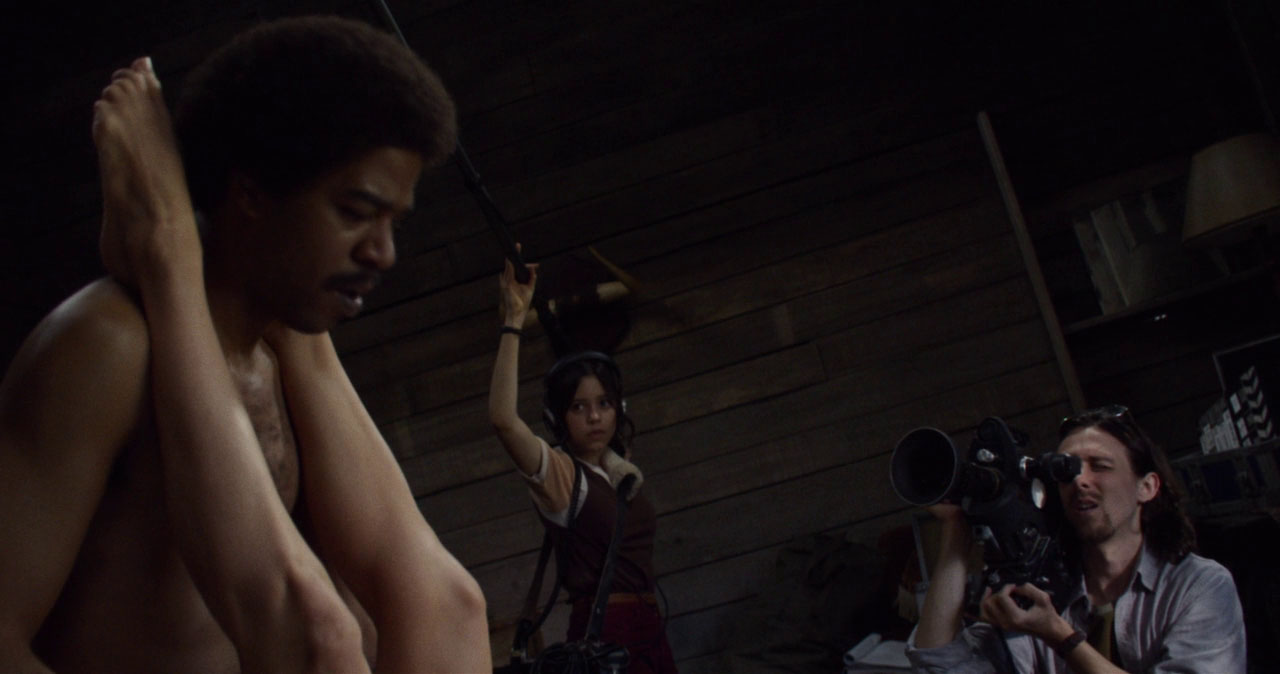
I keep getting Eli Roth (Cabin Fever) and Ti West (Cabin Fever 2) confused. I suppose the closest I’ve ever come to liking a Ti West movie was House of the Devil, and if I’d looked him up first I might’ve skipped this one, but a well-regarded horror about a bootstrap porno movie filming on the property of elderly murderers was too good to pass up. The camerawork is on point, and when changing scenes the editing will flip back and forth between the old and the new, a certain sense of the avant-garde like they’re doin’ in France.

Mia Goth is our entry point character, and also plays the old woman, loves to play in movies where the lead actress plays multiple roles from different generations. Cameraman Owen Campbell (paranoid main kid from Super Dark Times) dies first, stabbed in the throat for refusing the old woman’s advances, and the cowboy in charge (Martin Henderson of The Ring Remake) comes next, unwisely putting his eye up to a suspicious hole. The old man just shoots porn actor Kid Cudi (recently great in Bill & Ted Face the Music) in the swamp, actress Brittany Snow (Prom Night Remake) is pushed into the gator pond, and soundgirl Jenna Ortega (Scream Reboot) is shot escaping. The movie-in-the-movie is called Farmer’s Daughter, and they sing “Landslide” after shooting, it’s all very Fleetwood-inspired. Oh no, they’re making a prequel.

Found another movie from the director of the Maiku Hama series. Silent-ish – no sync dialogue or music score, but we hear sfx and voices on tape. A detective whose thing is that he’s always eating eggs (Shirô Sano of Violent Cop) takes on the case of a kidnapped daughter named Bellflower and is sent on the usual goose chase, but with riddles and gyroscopes. In the end the whole adventure and kidnapping was a ploy to complete a silent film fifty years in the making.

Played Critics Week at Venice along with Assayas’s debut. Relaxed pace and lack of dialogue makes it hazy and dreamy – per the title, it’s not one to watch late at night. Funny that a few hours after watching this, I read: “it made me wonder what it’d be like to see, for once, a cinephilic film that isn’t in any way about cinephilia.”

José is a drug-addict filmmaker editing a vampire movie (Law of Desire star Eusebio Poncela). He meets Pedro, an extreme cinema obsessive (Will More of Dark Habits). The two are maybe not great for each other, or maybe that’s the drugs talking – movie jumps back in time to when Pedro was alive, while in the present tense, José gets high with Ana (All About My Mother star Cecilia Roth) and investigates letters, tapes and films sent to him.

José’s inspirational posters also include Viridiana wearing a Spider-Man mask.

Pedro is a super-creepy young man who only loves cinema and silly putty. He gets a stop-motion time-lapse gizmo and films himself sleeping, becoming obsessed with some hidden change that is happening. His camera apparently becomes sentient and starts killing people, beginning with Pedro’s large-eyed cousin Marta, while Pedro becomes hoarse-voiced, weak and withdrawn. José finally arrives, performs a blindfold ritual before the killer camera, and becomes pure cinema.

I prioritized watching this after Nick Pinkerton’s writeup – some of his best work.

Pedro’s address to José, dictated from the edge of oblivion in an unrecognizable rasp suggestive of lycanthropic transformation, structures what narrative Arrebato can be said to have … In Arrebato’s last act, which finds José totally absorbed in Pedro’s film and his strange quest, it becomes a movie about one run-down sybarite who’s coming apart at the seams bearing witness to the spectacle of another run-down sybarite who has come apart at the seams, both “reunited” on celluloid in the film’s inspired and singularly unnerving closing scene. If you watch the movie and aren’t keeping it together particularly well yourself – and who is these days? – this can all add up to a disquieting hall-of-mirrors effect.

I kept holding onto these until I watched more TV, then I didn’t watch more TV… can’t seem to get to episode two of Underground Railroad or the second half of Only Murders or to start the new seasons of any of my current faves, just chilling with old movies for now.


Voir (2021)

I thought these would be Story of Film clip shows, but the first episode is mostly original photography. It’s about the summer of Jaws, with a reference to the spider eggs in Bubble Yum. 2: Tony Zhou on Lady Vengeance and the revenge film formulas – this one’s a total clip show with guest speakers, and is really nice. 3: we see the narrator, Drew McWeeny on lead-character likeability, from Lawrence of Arabia through The Godfather to Taxi Driver. Funny that he’s talking about the rise of obnoxious lead characters in the late 60s/early 70s the night after I watched Performance. 4: no film critic monologue here, it’s a special on the art of animated character design, featuring Glen Keane and artists from Brave and The Lego Movie. 5: Movies vs. TV, ehhh. 6: Simply about race in the movie 48 Hrs., but well thought-out and easily better than the last couple, which were more technical. This series was David Prior’s follow-up to The Empty Man, weirdly enough.


Travel Man season 1 (2015)

Tempted to watch The Souvenir Part II for a few sweet glimpses of Richard Ayoade, instead I discovered he spent eight years hosting reality TV shows, so I dug one up. Season one covers Barcelona with Kathy Burke… Istanbul with Adam Hills… Iceland with Jessica Hynes (Spaced), the best episode yet, and the place I most want to visit… and Marrakesh w Stephen Mangan (“The beauty is largely offset by fear”). More, please.

I watched Dragon Inn (1967) at home Friday night. On Saturday I was the only person who bought a ticket to Goodbye, Dragon Inn which is entirely set in a nearly-empty movie theater that is playing Dragon Inn… then I was the only person at West Side Story (2021), which is of course a remake of the 1961 movie. So, both of the newer movies are resurrecting the 60’s in their own way, both feature people watching their younger selves (actors from Dragon Inn are in the Goodbye audience, and 2021 Rita Moreno has a big scene with Anita, Rita Moreno’s 1961 role)… and both feature coin-operated fortune-telling machines.

Goodbye was my first Tsai film, watched originally on a blurry DVD, which inspired my first pre-blog web writeup. This week I’ve seen it twice – or, one a a half times, the second being a Metrograph stream in the background while I read Nick Pinkerton’s book on the film (and on so many related topics). Reading while the movie plays feels like a good idea, not only with the other Fireflies/Decadent books, but with books in general, which I should maybe always be reading with a Tsai film playing behind them. This movie seemed so slow and empty twenty years ago, and now it seems very full – and I wrote “so many cuts” in my notes, so my definition of “slow” is obviously very different now.

Apichatpong is a big fan, and I thought of his actress Jen when the crippled ticket taker was making her way around the theater. The first words aren’t spoken until halfway through, and they’re about ghosts. Later, our Japanese cruiser encounters a seed-chewing woman who may be a ghost, and he runs straight out of the movie. On the same day I watched this movie where a guy is confronted by a loud eater, a Florida cop was acquitted for killing a guy who threw popcorn during a movie argument.

“No one comes to the movies anymore.” Surprised at how small Lee Kang-sheng’s projectionist role is here, and how much of the movie takes place not in the screening room but the surrounding hallways. Despite being set in the back alleys of a haunted crumbling building, it’s at least as gorgeous as the King Hu film, probably more so.

Begonia opened with a big voice and a full band on keyboards and drum pads. An Issues Doc, invaders killing the indigenous people and the rain forest. Brief time is spent with the invaders themselves, poor misunderstood white supremacists who feel entitled to the land because it’s “undeveloped,” very easy to root against them even though they’re victims of the same government/capitalist system that has repressed the others. The main story follows the young new leader of a Brazilian indigenous community, educated and tech savvy, using cameras and drones to document the destruction and fight back, leading missions to peacefully arrest the invaders and destroy their settlements. A woman in the nearby city is a supporter who has fought alongside them for decades. Marvelous extreme close-ups on local creatures. Our screening got a rare burst of mid-film applause: after covid hits, the local media wants to come film the native community, breaking quarantine – but they say we have our own camera equipment, just send us your shot list.