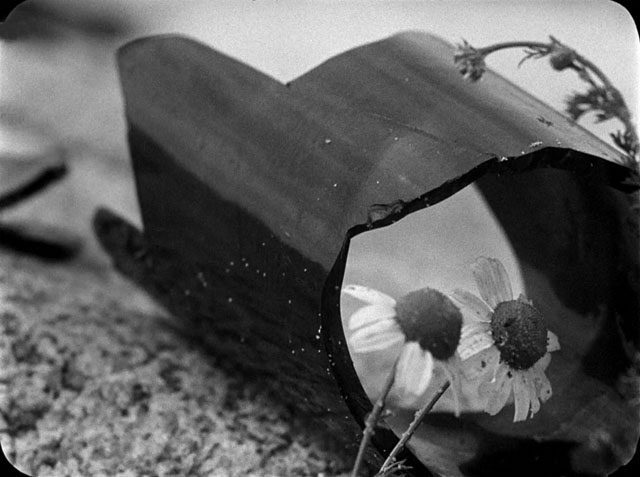
Very good doc on the film Clouzot almost made between La Vérité and La Prisonnière, starring Romy Schneider (of Welles’ The Trial) and Serge Reggiani (just off Le Doulos and The Leopard). The couple is on their honeymoon, or maybe just on vacation, in a small town shot in black-and-white, and Reggiani becomes increasingly wildly jealous of everyone his wife has contact with, his state of mind represented with color fantasy sequences and optical-illusion effects. Decades after the film fell apart (mainly because the writer/producer/director’s overreaching ambition clashed with his own perfectionism for details, wasting time and money and tiring the cast and crew) the script was filmed in the 90’s by Claude Chabrol, which I believe was the first of Chabrol’s movies I ever watched, too long ago for me to compare the finished movie with the Clouzot fragments.

Clouzot got some great cinematographers and effects people, including Claude Renoir, Rudolph Maté (The Passion of Joan of Arc) and Andreas Winding (Play Time). It was also the first credited film work by William Lubtchansky, who is one of the main interview subjects. The documentary is very excellent, showing much of the never-finished film (the color footage in particular looks amazingly vibrant, like it was shot yesterday), and not getting into irrelevant sidetrack stories. Interiors (and therefore most of the dialogue scenes) were never shot, and there’s no surviving sound recording from set, so two actors read from the script on a black stage, providing missing context.

When someone in the film world dies I don’t always run out and watch one of their movies – only when it’s someone meaningful to me, like Claude Chabrol, Dennis Hopper and Eric Rohmer. I once considered holding a monthly “death of cinema” screening, inviting people over to watch the work of whoever had died that month (there’s always someone), but as with all my plans to watch movies in groups, it fell through – nobody liked Rohmer’s final film, so Katy suggested I not do that anymore. But Maria Schneider warrants a memorial screening because she starred in one of the few Jacques Rivette films I haven’t yet seen, and I happen to have a nice subtitled copy of it handy.

Maria Schneider at dinner:

Schneider was allegedly exploited in Last Tango in Paris, backed out of Caligula, fired from That Obscure Object of Desire, and not up to the task of leading a Rivette picture, which probably explains her replacement in certain sequences by a different actress. But she’s still revered for her part in The Passenger and for being so naked in the early 70’s. This was actually Schneider’s second movie titled Merry-Go-Round – the first was in 1973, a (West) German remake of La Ronde.

Schneider’s costar is Warhol actor Joe Dallesandro, the houseboy/lover in Blood For Dracula. Yes, this is weird casting for a Rivette movie. But production-wise we’re in familiar territory, with the Out 1/Duelle team of Schiffman, de Gregorio, Tchalgadjieff and Lubtchansky (X2). By the end we’ve got triple-cross conspiracies, psychics, secret weapons, assassinations and meetings in the park, so the Rivette touchstones are all there. It’s also surprisingly good-looking (if not up to Duelle/Noroit standards) for such a reputedly troubled film.

Joe and Maria:

The story goes that Maria’s father is presumed dead and some four million dollars left in his care are unaccounted for. Maria’s elusive sister Liz (Danièle Gegauff, a producer on Out 1 and star of a single Chabrol film) summons Maria and Joe (Liz’s boyfriend) but fails to show up herself, so these two meet and go on an adventure together. Liz shows up briefly, along with a bunch more characters, each of whom want to help either Maria or her possibly-alive father, or more likely, want a share of the money. Most suspicious is Shirley (Sylvie Matton, whose husband directed her and Udo Kier in his adult horror Spermula), who is possibly either Liz’s best friend, the father’s ex-lover, Joe’s sister or none of the above,

Maria’s sister Liz with Suspicious Shirley:

The movie seems to fits neatly in the Rivette filmography, with on-camera musicians like predecessor Duelle, and a couple of characters chasing around the country trying to solve a possibly imagined mystery a la follow-up Pont du Nord. But there are some wrinkles. The grasp on the mystery is soon lost and Joe and Maria ramble, their relationship growing increasingly unpleasant, then the plot returns with a puzzling vengeance in the last half hour. Plus there are unexplained fantasy scenes, with Joe and a suspiciously Maria-like girl (played by Hermine Karagheuz, Marie in Out 1) chasing each other through forests and deserts, with appearances by snakes, rifles and a mounted armored knight.

Marie/Karagheuz:

Jean-Francois Stevenin (“Max” in Le Pont du Nord) is in an early scene with the two sisters, and seems to kidnap Liz (cue Walter: “the girl kidnapped herself”). Seemingly trustworthy lawyer-type Renée (Francoise Prevost of Vadim’s segment in Spirits of the Dead) and the mysterious Shirley put our duo up to collecting the key and combination/location of the father’s safe in order to retrieve the money (this is never done, as far as I could tell). Psychic Mr. Danvers (Maurice Garrel, Philippe Garrel’s father, played Emmanuelle Devos’s dying father in Kings and Queen, also amusingly in a movie called Noli Me Tangere) pretends to be the post-plastic-surgery father of the sisters. Liz is rescued (or “rescued”, depending if we believe Walter) by Maria with Renée’s associate Jerome (Michel Berto, Honeymoon in Out 1, also in a Robbe-Grillet film) armed only with a pipe. In the end it either all goes wrong, or all goes according to plan, as Liz is shot by a sniper and Maria unloads a pistol into poor Mr. Danvers.

Mr. Danvers, we hardly knew thee

Whenever the movie just doesn’t know where to go, it cuts to either the live musicians or the fantasy scenes. I wasn’t sure what to make of them, but they grew on me. I liked the bass-and-clarinet soundtrack, the colorful, mobile cinematography. The physical action, fist-fighting and such, were pretty inept, especially coming right after Duelle starring the sprightly Jean Babilée. Movie was made to fulfill contractual obligations after the collapse of the proposed four-part series that yielded Duelle and Noroit, but then was a huge failure itself, so I’ll bet the exec producers wished they’d just left Rivette alone.

The musicians: Barre Phillips at left worked on the Naked Lunch soundtrack with Ornette Coleman, and John Surman at right has put out 20+ albums and hopefully changed his hairstyle:

Cinema-Talk:

It just has the right amount of disregard for plot that nothing seems remotely forced. This is almost unheard of in Rivette’s world. For as great as his other films are, they (almost) all seemed to be dragged down by unnecessary elements that were thrown in at the last minute. Here, everything is so completely natural (one cannot stress this enough!) that the 150-minute running time feels fairly short.

The two sisters, plus friendly assistant Jerome:

Rivette:

We started work with the two actors, and after 8 days, things were going very badly. It was like a machine that, once set in motion, must continue running despite changing regimes, forced or arbitrary accelerations, until the energy was all burned up, exhausted. That’s not at all how we filmed L’Amour fou, even if there too, the spectator feels he’s witnessing an encounter. … It’s an exaggeration to say that we placed Maria and Joe together in front of the camera and waited to see what would happen. We had a starting point of course, and then we made up the beginning of a story, with a father who had disappeared, but all along we told ourselves, this is just a pretext for Maria and Joe to get to know each other. I like that idea: two people get together because a third, who has arranged to meet them, does not show up. There have no choice but to get to know each other. It’s a situation I imagined in the context of the Resistance. Thinking about it again later, I think it was the subject of Robert Hossein’s Nuit des espions. And since I didn’t feel like making a film about the Resistance or the terrorist underground, it became that more banal situation, two people convoked by a third who is only the sister of the one and the girlfriend of the other. But since the relationship between Maria and Joe rapidly became hostile, we were forced to develop the story-line; from a mere pretext it took on a disproportionate importance. Maybe that gives the film a certain vagabond charm, I don’t know, but it really is a film with a first half-hour that’s quite coherent, and then it searches for itself three times, three times searches for a way out.”

Renée:

E. Howard:

The bulk of the film consists of Ben and Léo wandering around the French countryside, ostensibly searching for clues to Elisabeth’s disappearance or the safe combination needed to get their hands on the missing money. What they actually do is mope around a lot, wander through abandoned houses, and joke and fight and patter, improvising goofy bits like the one where Ben mocks the conspiratorial obsession with the number three by counting off increasingly lengthy numbers consisting entirely of threes. In the film’s best scene, the duo takes a break for dinner at an abandoned house whose refrigerator is improbably well-stocked: they crack open cans of sardines and make salads and drink the juice from jars of cherries, sitting across from one another at a long table with candelabras in the center. Léo jokes that it’s a bourgeois meal, and the two of them have fun playing hide and seek from behind the candle flames, and soon the conversation turns into a lighthearted seduction where it’s obvious that the actors are having as much fun as the characters.

Our heroes, looking tired and frumpy in the morning light:

Rivette again:

I like a film to be an adventure: for those who make it, and for those who see it. The adventure of this filming, I must admit, was a bit fitful: the course which was established at the outset was corrected many times, in response to contrary winds, lulls, or gentle breezes. I only hope that the finished film, with all its detours, keeps something of the dangers of the crossing, of its uncertainties, of its unclouded moments-even if, at the end, one notices that perhaps the voyage has been circular: like a “merry-go-round.”

When I realized there is a movie called Finis Terrae from 1929 and another called Finisterrae from eighty years later, I set out to watch them both. Sometimes it’s as simple as that. The latin phrase means “ends of the earth.” There’s a place in Spain (where the 2010 film is set) called Finisterra, and a university in Chile called Finis Terrae (how wonderful), but this Epstein film was set on Ouessant, a small island off the coast of France (today home to an airline called Finistair), and on the even smaller island of Bannec. As the opening titles tell us, “on an island where winter storms wipe out all forms of life, four men come in two teams to spend the summer collecting seaweed in total isolation…”

A gorgeous film, made on location with nearly as many credited cinematographers (one of whom would later work on Vampyr and Hotel du Nord) as actors. Very simple story, a bit too poetically-paced at times, but it worked – I found it very affecting by the end. Apparently not much is known about the film on the web. I’ve seen it listed as a documentary – it’s clearly not, though Epstein seems to have cast local workers instead of film actors.

Strange that the team leaders look to be about sixteen, and their barely-named assistants are large middle-aged men with mustaches – why not the other way around? Ambroise, one of the two young men cuts himself on a broken bottle of liquor belonging to the other, Jean-Marie, causing both a grudge between the men and an infected sore on Ambroise’s finger that gets worse over the next few days, preventing him from working and finally threatening his life … “during a becalmed period making it impossible to cross the waters without the requisite wind in the sails. Cue a rescue mission launched from the mother island, Ouessant, to get them back to at least a semblance of civilisation.” (A. Fish)

D. Cairns:

When the sick boy starts to hallucinate, the movie almost oversteps its stylistic bounds by trying to evoke a state the audience is already in: Epstein snap-cuts a jangling montage of looming ECUs and what look like off-cuts and deleted scenes into an abstract nightmare that threatens to turn the whole experience into abstraction and dissonance, with no way out save the declaration of a cinematic Year Zero from which we can start afresh. Seriously, the movie feels like it was made tomorrow, or at any rate made in 1929 by time-travelers.

A. Fish again:

It would be Epstein’s parting glory; oh, other films would follow in its wake, but they weren’t worthy of him and he’d disappear, a fossil, a megalith one might say, of a silent era, not yet put out to pasture but with the fires not so much raging as flickering in the hearth. He wasn’t alone, one could add Gance, l’Herbier and de Gastyne to that list of exiles, yet his is a name that should stand tall in French film history, but instead often merits at best a paragraph in conventional histories.

It’s hard for me to write about Jacques Tati movies, since mostly what I do is recount a movie’s story and actors I’ve seen before, and Tati films have almost no story and no actors I’ve seen before. Watched this one because I’d just seen M. Hulot’s Holiday when I found out The Illusionist would be playing theaters here, and thought I’d keep the Tati ball rolling.

Tati himself stars as a town postman inspired by an American newsreel and by his taunting neighbors to deliver the mail faster and more efficiently. So at least it has more of a story than M. Hulot’s Holiday (its story: “everyone is on vacation”) but really it’s the same type of movie as Holiday, gently introducing a bunch of characters and setting up unassuming comic situations which overlap in time and place, as Tati’s character guides us around town. This time I had even less sense than usual of who’s who in the cast, possibly because we watched the roughly-restored color version (first French film to be shot in color) on our TV, and in the wide shots (most of the film seems to be wide shots) faces looked blurry.

Funny that while he was breaking technological barriers, experimenting with color in this film and with scale in Playtime, he made such backward-looking movies. This may as well have been a silent film, and The Illusionist looks wistfully back from the late 50’s towards the heyday of vaudeville. Parade was his final anachronism, being one of the first-ever features shot on video and featuring mime performances in a circus tent. I can’t say I fell in love with Jour de fete, just found it to be a pleasant good time, but something about Tati’s movies and his career always keeps me fascinated, so I’m sure I’ll come back to watch it again.

I saw this ages ago and didn’t get it. Now that I’ve enjoyed Mon Oncle and seen Playtime a few times, I wasn’t thrown by Tati’s Buster Keatonesque style – series of gags setting up the next series of gags, with funny sound effects but almost no dialogue. Other notable similarities to Playtime: jokes about malfunctioning technology (mostly automobiles, but also an indecipherable train station announcement speaker) and an extended delay before the first appearance of our hero Tati/Hulot.

It’s a weirdly understated gag movie – some big slapstick scenes like when Hulot sets off a box full of fireworks, but mostly more subtle. There are enough unnamed characters intersecting in different ways in each scene to make Altman proud (I especially noticed a young woman with a Princess Leia hairdo).

I watched the original full-length version – most DVDs only have Tati’s own re-edit from the 70’s. I’m sure that by the time I rent the Criterion and watch the shorter version I won’t be able to precisely recall the differences. Half of Tati’s movies exist in multiple versions – Jour de fete is in black and white and color, Mon Oncle is in French and English and Playtime had a bunch of different edits.

Leia with an insufferable leftist who insists on talking politics while everyone is on vacation:

Hulot annoying a hotel worker:

Another freewheeling Rivette film, with its 16mm look and protagonists running throughout the city of Paris in the midst of a game with ill-defined rules, seeking to unveil a conspiracy, like a scaled-down Out 1.

Two girls meet on the street, run around a Paris that seems to be populated only by themselves and various conspirators, and get caught in a game, possibly of their own making. There’s more energized music than usual for Rivette, with drums and accordion and strings. Whirling camera, 360-degree pans, many shots of local monuments also recall Out 1, specifically its final shot. But this film has a lighter touch, also bringing to mind Celine & Julie Go Boating, with its playfulness and our heroines’ mysterious bond to each other. The dialogue is a bit new-age, the actions are somewhat improv-theater, it seems to have been shot entirely in real locations, and perhaps in a hurry, since I caught the boom mic a few times.

Films in the film:

Knife-wielding Pascale vs. Kurosawa’s Kagemusha:

The Silent Scream, a spooky mansion flick:

The Big Country with Gregory Peck – in French it’s called “Wide Open Spaces”, as Pascale leads the claustrophobic Bulle into the theater for the night, to sleep close enough to the screen that she can’t see the walls

And on the way out of the theater…

Bulle Ogier stars in her fifth Rivette film along with Pascale Ogier, Bulle’s daughter, who also starred in a Rohmer movie and something called Ghost Dance before dying of a heart attack at age 26. Bulle, just out of prison, has a crippling claustrophobia and cannot step indoors, not even into a glass-enclosed phone booth, without feeling ill. Pascale, apparently homeless, hears Bulle’s story of getting caught up with the wrong crowd and sets out to keep it from happening again, tailing Bulle’s boyfriend Julien (Pierre Clementi of The Conformist, The Inner Scar).

Pascale seems to be on to something – they steal Julien’s briefcase and discover all sorts of newspaper articles about kidnappings and killings, and also a map of Paris that has been sectioned off in a spiral pattern which reminds Bulle of a “very frightening game” she used to play called the Goose game. They find a sort of key to the map on a murdered man in a cemetery and start to identify the “trap squares” in the game, beginning with places they’ve already been: Prison and the Tomb, then they proceed to play Paris like a game, hoping to survive all the trap squares and win the game.

Besides Julien, they keep running into a balding man (Jean-Francois Stevenin, the teacher in Small Change), who sometimes seems to be a companion of Julien’s and sometimes schemes with the girls independently of Julien, warning Bulle that the people responsible for sending her to prison are after her again. Pascale calls this man Max, her name for all the city’s conspirators. For example, when Bulle wonders about the explanation for the dead map-carrier in the cemetery, Pascale responds “The Max had a bullet in his guts – that’s the explanation.”

Discovering the murdered, bewigged Max

Each “trap” location presents a new challenge. At one, Pascale, who has a compulsion to carve the eyes out of advertising posters, is faced with a whole wall of those. At another, Pascale is in a fight with a white-haired Max who leaves her in a giant cobweb until rescued by Bulle, and at a third Pascale has to defeat a giant dragon, played by some sort of amusement-park ride with an added flamethrower.

While Pascale lives in this fantasy Paris, Bulle’s adventure seems more real and dangerous – she’s given a gun by Julien and keeps having to figure out whose side she’s on. Of course once a gun is introduced into the movie, someone has to get shot. Pascale kills a Max and seems unrepentant, and then Julien kills Bulle, telling her “I loved you.” But the movie’s sympathies have turned towards the inner life of Pascale – she meets Max on a bridge over the river, and they spar together, appropriately practicing “Katta – a combat against imaginary enemies.”

I was tempted to see the sparring scene above as evidence that Pascale was working alongside the Maxes all along, but no, I think she’s just an erratic character. Anyway, it wouldn’t have taken a city-wide conspiracy including Pascale to defeat the fragile Bulle.

Good one by F. Ziolkowski:

Marie’s belief in a great love with Julien, the real at the end of her quest, will eventually be fatal for her. It is Baptiste’s ability to “roll with the punches” which will perhaps save her, but at what cost? As one of the Maxes puts her through a karate exercise and tells her to fend off “imaginary enemies,” the cross-hairs of a surveillance device (a rifle scope? a camera?) appear on the screen. “They” are now being watched by others, perhaps simply by us. That is, it may be that the answer to the riddle of the labyrinth — its last door — is simply the screen on which the actors’ shadows appear.

The movie got a hateful review in the Times, and was even dismissed by Senses of Cinema. Fortunately it’s not my job to analyze its quality in relation to other Rivette films, or even other films in general – I was just along for the ride, which I enjoyed.

Insight from J. Rosenbaum:

The file of clippings concerns specific scandals of the Giscard d’Estaing regime, and the locations refer to various municipal corruptions associated with that period (e.g., the ruins of slaughterhouses in La Villette which were built and then demolished before they could be used, due to safety hazards). Rivette has indicated that the film was made prior to the French elections and with the pessimistic expectations that the same regime would remain in power; so the unexpected election of Francois Mitterand obscured and blunted part of the film’s intended impact. Rivette conceived of Marie as a continuation of the anarchist character played by Bulle Ogier in Fassbinder’s The Third Generation (1979), after she gets out of prison. Her claustrophobia was occasioned by the film’s cut-rate budget, which led to the decision to shoot the film exclusively in exteriors.

Ziolkowski again:

[Paris] for the Surrealists was not only a magical place, it also became a living organism, a protagonist in its own right, complete with motivations, deaths, rebirths, etc. … The group’s fascination with the myth of the labyrinth led them to name their most prestigious and influential review Le Minotaure. … All the elements of Surrealism are here once again: the double, the lions of the Place Denfert-Rochereau which seem ready to spring to life at any moment, the mysterious stranger who crosses one’s path in the middle of the night.

Follow the gun.

From Julien…

… to Bulle …

… to Pascale

Julien again (different gun)

Rivette: “The idea was to refer to Don Quixote and Sancho Panza. Passing from the Parisian quartiers outward to the peripheral areas, within those zones that are slightly uncertain, but without ever leaving Paris. We also wanted to show everything that was in the process of being transformed, under construction.”

Bulle and Julien atop the Arc:


Paris s’en va (1981)

“Paris Goes Away,” a half-hour movie made from scenes and outtakes from Le Pont du Nord. A narrator tells us about the Goose Game, often repeating as the images also double back on themselves. It’s a mini-Spectre version of the feature, more lightweight, with more lingering shots of monuments and less danger and conspiracy. The narration seems to imply that Bulle’s flask is her game token. Rivette’s only other short that I’ve seen, Le Coup du berger, also referenced games, if that means anything.

Le Lion Volatil:

Pascale:

Bulle:


Jacques Rivette, Le Veilleur (1990, Claire Denis)

“Artists have a portion of basic villainy, even the greatest of them.”

Agnes Godard (still Denis’s cinematographer two decades later on 35 Shots of Rum) shoots critic Serge Daney (he took over Cahiers after the Bazin/Rohmer era) in conversation with Rivette, in Parisian cafes and fields. Divided into two parts, “I – Day” and “II – Night.”

“Do we see his painting or not?” Jacques discusses preliminary thoughts on Le Belle Noiseuse before he had worked out the story or approach. Le Pont du Nord gets the most discussion time, strange, since he’d made three movies since then (Love on the Ground doesn’t get a single mention). I wasn’t crazy about the music in Le Pont du Nord so I’m glad to hear that he spent very little time selecting it.

Rivette with Serge Daney:

I wouldn’t call it a great film (sorry, Claire Denis) but it’s a great interview/conversation, worth watching again, not like a throwaway DVD extra. Loooong shots include the silences between questions, perhaps in deference to Rivette’s own long-take style. He tells of his early years, first arriving in Paris, meeting up with Rohmer, Truffaut and Godard and going to work for Cahiers with Bazin. He discusses duration in a “post-Antonioni world,” saying movies used to have pre-determined beginnings and endings and filmmakers were free to fill the middle with events, but now it seems there are fewer rules and everything takes longer to say. When asked what he’s enjoyed lately in theaters he highly recommends a Sandrine Bonnaire film called Peau de Vache.

“I don’t want to separate, to split things up. I know a lot of filmmakers, whether consciously or not, who have this notion of splitting the body into bits. Not just the face, it can be the hand or any part of the body. I always want to see the body in its entirety. I don’t have the temperment, the taste or the talent to make heavily edited films. My films focus more on the continuity of events taken as a whole.”

Time out for an interview with Le Pont du Nord’s Max, Jean-Francois Stévenin, including his entire scene as Marlon in Out 1.

Rivette again: “My feeling is these people who have been affected [by his films], and who have these individual ways of showing that, they constitute a kind of widespread secret society. We’re obviously not talking about lots of people, unfortunately for the film producers!” He talks with his hands, striking wonderful poses.

In part 2, Bulle Ogier is along for the ride, interjecting a word or two, only getting the camera to herself for a few minutes.

Serge: “When you came back to earth with Pont du Nord in the early 80’s, it was with the feeling that we adapt to things as they are, we stop tempting fate or playing Prometheus and we come back to the real world. And we remember that the beginning of the 80’s were roaring, euphoric, entertaining – very explosive, in fact. And your film takes that on board. We can feel something quite intentional in the processes which make up Le Pond du Nord and allow you to tackle the 80’s.”

Rivette’s vogue poses:

Rivette:

It’s a time when we feel such a decision has been taken. Just as Bulle said at the end, ‘I’m alive.’ As far as I’m concerned, and I have the impression that, strangely, it concerns – I won’t say everyone, there are always exceptions – many filmmakers of my generation and subsequent generations. After Out, it seemed impossible in my films to talk about the contemporary world, what we call the real world, and at that time I wanted more than anything to work on fiction, fantasy fiction films. I didn’t shoot them all because the first project was, after Out and Celine & Julie, was a film we wanted to do with Jeanne Moreau [Bulle: “Phoenix.”] and Juliet Berto and Michel Lonsdale, which was a story based on the Sarah Bernhardt myth loosely mixed up with Gaston Leroux’s Phantom of the Opera. And what came next were stories that were all different with one thing in common: the total refusal of France in the seventies. It was something I suddenly didn’t want to see anymore. And after a series of events, more or less successful films – some were far from being completely successful, unfortunate films, at least Noroit and Merry Go Round were, that were hardly seen anywhere. They were shaky films, it’s true. When I went to see Bulle and said ‘We have to do another film together and I want to do it with you,’ it was the idea that we hadn’t put these bad times behind us, that they may well continue, and we had to come to terms with it but in order to do that we had to turn it into fiction, to put it in a film. And that’s why, in Pont de Nord there’s this insistence – that may appear anecdotal ten years after – on the affairs or scandals at the end of the seventies, such as the Debreuil affair or the suicide or non-suicide of Boulin or the killing of Mesrine, that sort of stuff. As symptoms, but strong symptoms. And we shot the film, at least from my point of view I began the film, not in this atmosphere of eighties euphoria we mentioned but with the impression of being in a country – France – that was stuck. Stuck, because of a lot of things we won’t go into here – everyone remembers. But it so happened that this feeling of being stuck was so strong that it brought about a certain unblocking.

Such a joy, and such a well-executed feel-good multi-lingual message movie that I’m surprised it didn’t win an oscar. Guess it’s tough to beat a redemptive picture about African slum violence.

Based vaguely on a true story: on a Christmas eve during WWI, officers from the German, French and Scottish trenches meet up in dead-man’s land and negotiate a temporary truce, talking, drinking and celebrating together. The bummer ending (first poor Dany Boon is shot by a vengeful Scot, then when word gets out about the truce, their superiors are embarrassed and punish everyone involved) can’t completely spoil the mood.

I should know who Lucas Belvaux and Daniel Brühl are, but really only recognized priest-turned-medic Gary Lewis (of Gangs of New York and Yes) and Inglorious Basterds star Diane Kruger. Playing her opera-singing husband was Benno Fürmann, who has an awesome face. I hope to see it again in Speed Racer, Jerichow and Carion’s follow-up, Farewell.

J. Reichert in Reverse Shot described it best: “The characters’ constant behavioral irrationality makes the first half of Wild Grass a frustrating watch, but these rougher waters, in which Resnais schizophrenically navigates through genres (thriller, romance, comedy), eventually calm somewhat and the film enters into a groove where possibilities become expansive and the discontinuity becomes the subject in itself.”

Halfway through the movie, it became definitely better than Private Fears and even Not on the Lips. Maybe it’s because Resnais deviated from the novel here, allowed improvisation to shape the script, and reportedly based his humor on Curb Your Enthusiasm. It felt a hundred times more free than those previous two movies – especially over Not on the Lips, which felt like it was being performed by ancient ghosts locked in the same performance for eons (hence the fading-out as they walked offstage). Not sure that I approve of the plane crash idea, and I already know I was paying attention to some of the wrong things so will have to watch it again, but that point halfway through when I realized that the irrationality of the lead characters has spread virus-like into the rest of the movie was my most thrilling moment in theaters this year.

Jeunet has made his brownest film since Delicatessen. Surely City of Lost Children and A Very Long Engagement were very brown indeed, but this one wins the brownness prize of the decade. I was very pleased with this overall – nevermind the haters, it’s more mad Jeunet fun, junkyard contraptions and insane plot contrivances help one obsessed individual win out, yay. Until the minute after it ended… then the whole thing felt kind of empty. I guess Dany Boom (My Best Friend, The Valet) had a valid reason for going after the two big arms companies in town (run by Nicolas Marié, who I’ll only recognize again if he wears those same glasses, and the great André Dussollier of Coeurs and Wild Grass) and I guess the junkyard denizens can help him out, because that’s the sort of thing that happens in movies, and I suppose he sort of succeeds (one CEO goes to jail and the other disappears). But it feels like all the thought went into the mechanisms and mannerisms, and not enough was put into the big picture. If I sound like a cranky newspaper critic, so be it – I felt like one. Maybe it’ll improve on repeat viewing – Engagement did.

More cast. Marie-Julie Baup plays Calculator, a diminutive, bespectacled number cruncher who reminds of the female lead in Delicatessen (and in case you weren’t thinking of Delicatessen, Jeunet drops a non-sequitur reference to that film in the middle of a spy sequence, just like he drops references via highway billboard to Micmacs itself). Michel Crémadès is a junk artist with a smiling, elfin face that seems like it should have appeared in Jeunet movies past, yet somehow hasn’t. Dominique Pinon gets to be his merry self. Omar Sy has a thing for turns-of-phrase sayings that doesn’t really translate (or just isn’t funny, don’t know which). Then you got cutie contortionist Julie Ferrier and parental figures Jean-Pierre Marielle (Coup de torchon, The Da Vinci Code) and chef Yolande Moreau (Amelie, Vagabond).