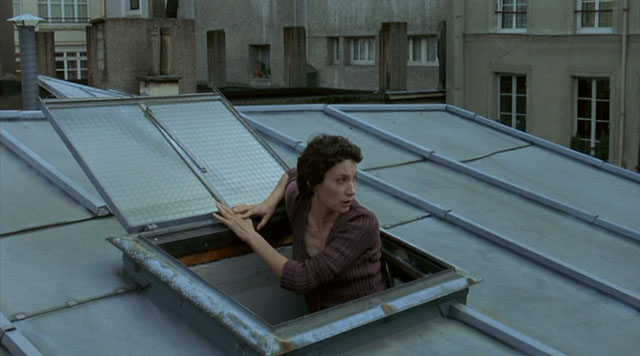
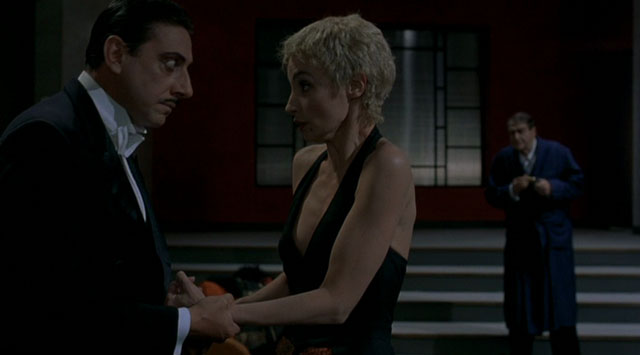
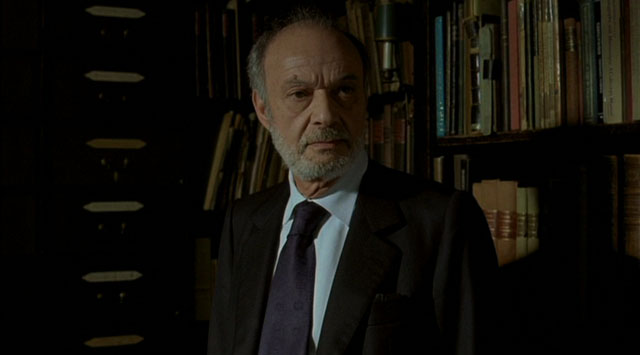
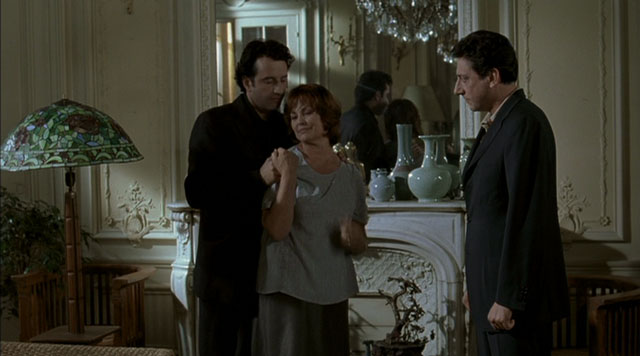
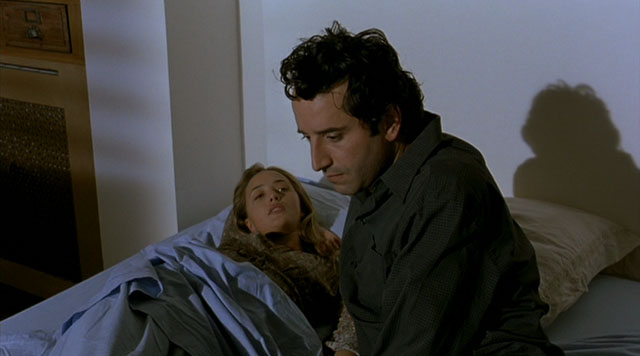
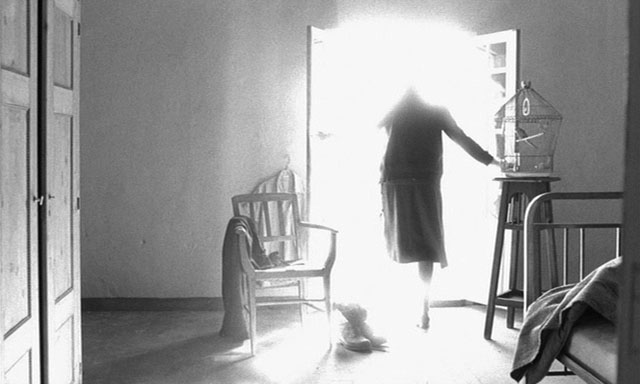
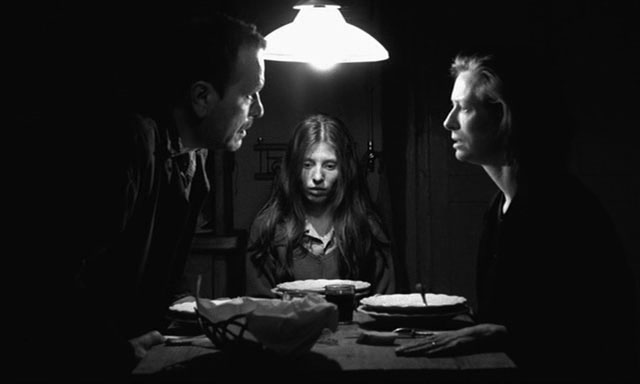
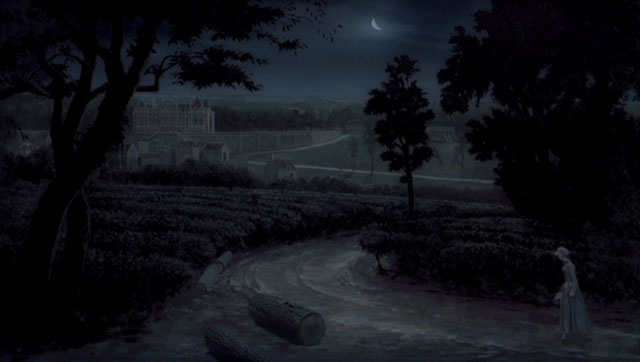
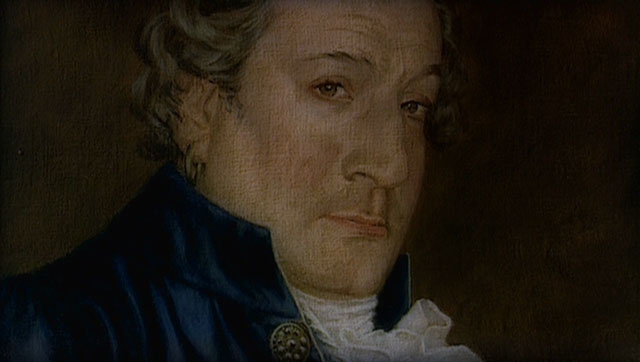
Astree loves Celadon and vice versa, with the kind of suicide-pact love that mainly exists among 17-year-olds in tragi-romantic plays. His parents don’t approve so the young lovers make a public show of dating other people… but Astree believes the show, feels betrayed and tells Celadon to piss off, so he goes and drowns himself in the river. Not quite dead, he’s rescued by nymph Galathée and her gang. Gal wants hunky Cel for herself but he escapes and hides away in the forest, eating berries, refusing to approach his beloved because, after all, she ordered him away. Meanwhile, Astree and Cel’s brother alternate (“he must be dead!” “he must be alive!”).

I guess I see the Rohmer moral theme at work here. Cel loves his girl so he must remain faithful to her and do as she says, staying away even if she doesn’t know he’s alive. But as Jimmy said, breaking into a giggling fit after hearing Celadon echo his simple emotions for the thousandth time, “he’s SO dumb!” It’s hard to disagree… they are all so dumb, and the movie is so straightforward and simple that it gets frustrating. Some nice imagery though, I thought (Katy said it looked made-for-public-television). Best not to get into the ending, in which Celadon pretends (not convincingly) to be a girl in order to get closer to his beloved.

Astree is Stephanie Crayencour and Celadon is Andy Gillet, neither of whom have shown up elsewhere yet. Jocelyn Quivrin who played Celadon’s brother died in a car crash two months ago. Nominated for the golden lion in Venice along with six movies I’ve loved (and also Sukiyaki Western Django) but they all lost to Lust, Caution, which I thought didn’t get good reviews.

M.J. Anderson:

Adapting Honoré d’Urfé’s novel of 5th century Gaul life, The Romance of Astree and Celadon claims to reproduce less the period depicted than its 17th century readers’ imagination of the earlier period. Commensurate with this goal, the director features canvases painted in the seventeenth century, a castle built well after the novel’s setting and importantly a grafting of the Christian faith onto the Druid-themed source material.

“You’ll be your own downfall.”

The Lady of the title is Grace Elliott, a Brit in France during the 1789-93 French Revolution. Actually the French title is L’anglaise et la duc but Grace is Scottish, claiming English nationality for simplicity when it’s suddenly very dangerous to be a French aristocrat in France. The movie’s intertitles and much dialogue are taken directly from her diaries.

image

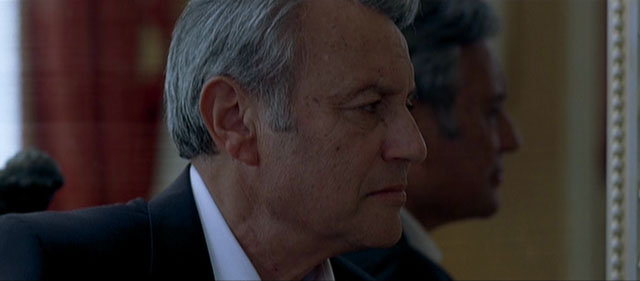
The Duke is one of my favorite Jean-Pierre Jeunet actors, but I didn’t recognize anyone else. Star Lucy Russell has failed to break into the Hollywood mainstream (landing such roles as “female restaurant guest” and “classy shopper #3” in recent big films). Ach, I missed Alain Libolt (Renaud in Out 1) as the Duke of Biron.

Renaud plus 30 years:
image

Grace is pure aristocracy, the very target of the revolution, and her sympathies lie with her friends whom she sees being rounded up and killed by the brutish masses. Steadfast in her devotions (though lying to stay alive), she’s contrasted with her friend the Duke, who changes with the times and ends up voting for the execution of the king. Plays like one of Rohmer’s Moral Tales only with more action, more heads on stakes, and more awesome digital backdrops of period Paris standing in for the usual stifling production design and avoidance of outdoor shots (except by filmmakers with Scorsese-budgets). Slant, in fact, called it an “economical antidote to the bloated costume drama.” Grace tries to negotiate the changing world without compromising her belief in the class system, while the Duke either adapts his morals or never had any to begin with. The main thing this movie has over the other Rohmers I’ve seen is historical interest… I delighted in the details of the revolution, about which I know very little. I thought the movie rather anti-revolution, which seems shockingly out of fashion, and one “Grunes” confirms that this was a problem:

Rohmer pitches the action from Elliott’s perspective, with which his own Roman Catholic penchant for order prompts him to identify—hence, the controversy the film engendered in France. Thus the street mobs are unwashed, grisly, barbaric, obscene; poor Louis XVI!

image

It’s hard to know what to make of the movie’s politics. There’s also a long scene where she successfully hides a Marquis from the police. We don’t get to know the guy very well, but he’s not made out as a man who deserves to die, so bravo, I guess. When Grace is finally arrested and held for two days for possession of a letter from an Englishman, the letter ironically turns out to praise the French revolution to the heavens. These examples and the duality in the title make it seem relatively even-handed, despite being adapted from Grace’s own horrified writings.

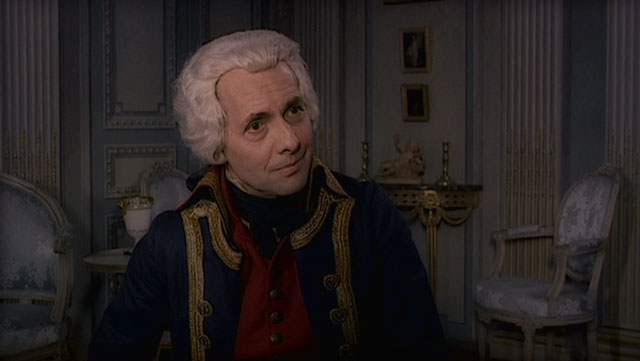
Duke Jean-Claude Dreyfus:
image

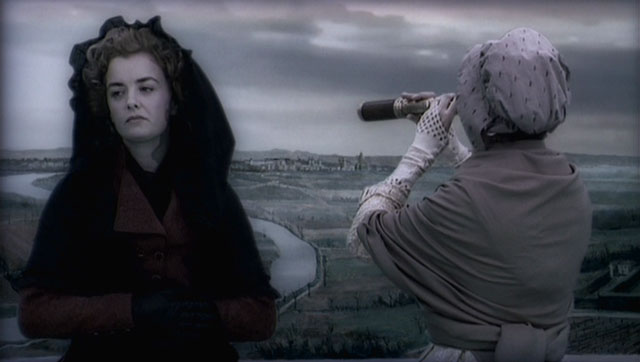
Watched this the night the director died. It got mentions on decade-end lists, with some screenshots that got stuck in my head (like the one below, peering into a painting with a telescope), so I’d planned to watch it soon anyway. I didn’t hear much when it came out, probably because of the timing (sept-oct, 2001). Beaten out for its only two César nominations by Amelie and Brotherhood of the Wolf.

image

NY Times:

The moral dilemmas that Grace and the Duke face are diagrammed, in Mr. Rohmer’s inimitable fashion, with equal measures of clarity and complexity. The director manages to evade both the stuffy antiquarianism and the pandering anachronism that subvert so many cinematic attempts at historical inquiry. His characters are neither costumed moderns, just like us only with better furniture, nor quaint curiosities whose odd customs we observe with smug condescension. They seem at once entirely real and utterly of their time. And the time itself feels not so much reconstructed as witnessed.

image

I’ll close by outright stealing an entire blog post by from Glenn Kenny, only because I want to always be able to find this Rohmer quote.

My films, you say, are literary: The things I say could be said in a novel. Yes, but what do I say? My characters’ discourse is not necessarily my film’s discourse.

There is certainly literary material in my tales, a preestablished novelistic plot that could be developed in writing and that is, in fact, sometimes developed in the form of a commentary. But neither the text of these commentaries, nor that of my dialogues, is my film: Rather, they are things that I film, just like the landscapes, faces, behavior, and gestures. And if you say that speech is an impure element, I no longer agree with you. Like images, it is a part of the life I film.

What I say, I do not say with words. I do not say it with images, either, with all due respect to partisans of pure cinema, who would speak with images as a deaf-mute does with his hands. After all, I do not say, I show. I show people who move and speak. That is all I know how to do, but that is my true subject. The rest, I agree, is literature.
—From “Letter to a critic [concerning my Contes moraux]”

Forbak is going to build a pleasure palace but WWI interferes and his girl marries another guy. When he opens his castle, diminished from its original plan, he invites all his friends to stay locked inside and drink a potion of forgetfulness, awakening to blissful ignorance and holding a chastely sensual orgy. For some reason Forbak’s sinister, wheelchair-bound father is pleased by all this. Forbak’s lost love Livia agrees to stay out of curiosity but doesn’t drink the potion, spying on the goings-on afterward, while her naive husband Raoul drinks and dies for reasons unknown halfway through the experiment.

Forbak casts a spell:
image

Sounds like another oddball movie along the lines of Je t’aime, je t’aime – but wait, there’s more! Decades later, present-day, the castle is being used as a progressive (read: new-agey) school under crabby headmistress Holberg, and the site of an educators’ conference. Local guy Robert throws toys around and acts like Natalie Portman when she’s doing something nobody has ever done before in Garden State, visitor Elizabeth acts the uptight moralist who believes in true love, Nora the confident modern woman and Walter the elder celebrity. The conference devolves into squabbling and the importance and methods of education becomes secondary to guessing who will hook up with whom (Nora bets Elizabeth falls for Robert, but Liz rides off with Walter in the end).

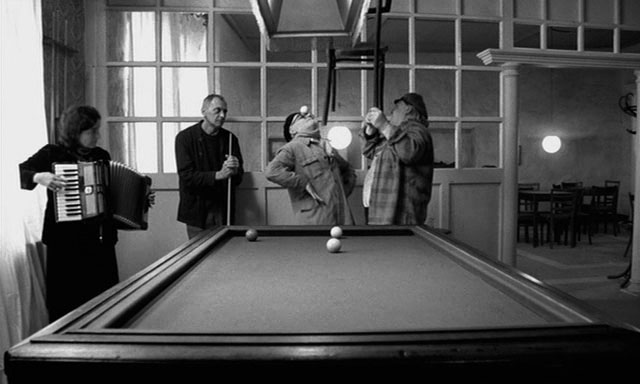
Robert and his son… and who’s that guy on the left? Big head, stiff hair… looks familiar.
image

Scenes alternate, with a wildcard movie thrown into the middle… Melies-tribute tableaux fantasy shots involving kings and monsters and children and swords, dwarfs and damsels in distress.

The king orders more people beheaded… note stingray at bottom. The same plaster stingrays are staggered up the walls in the present-day scenes within the castle.
image

Weird movie, puzzling but fully enjoyable. Possibly the turning-point movie where Resnais went from anguished memory-obsessed time-traveling Muriel mode to stagey comedic ensemble Not On The Lips mode. The musical thing started here for sure – there are singsongy intros and everyone seems about to burst into song, but they do not… and then finally Elizabeth relieves the musical tension with a couple full songs. For me it recalled Rivette’s Love on the Ground more than any Resnais movie. Maybe it was the wacky architecture, the castle in which grown-ups perform a childish drama.

“The age of happiness is beginning,” they tell us, “Love! Happiness!” chanted forever. English title was “Life is a Bed of Roses” but the subtitles tell us “Life is a Fairy Tale” and the strict translation seems to be “Life is a Novel.” Closing lines: kids saying “as my father said, life isn’t a fairy tale.” Resnais’ only time with cinematographer Bruno Nuytten (who worked with Marguerite Duras and Claude Berri) and his second of three with writer Jean Gruault.

Bonheur:
image

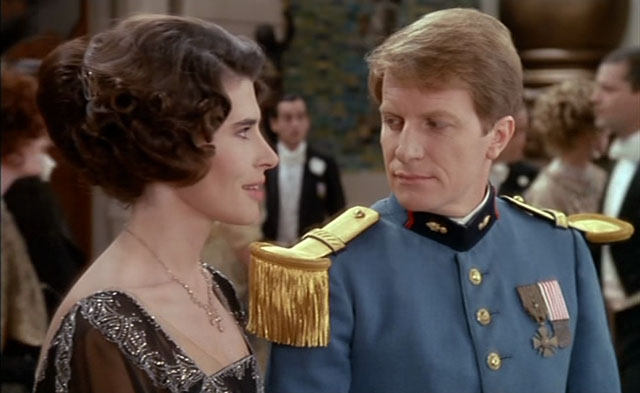
Lots of familiar faces in this one! In the WWI-era scenes, idealist Ruggero Raimondi (so he’s not familiar, an opera singer) vies with Andre Dussollier (another link with Love on the Ground, later in Coeurs) for the hand of Fanny Ardant (star of two then-current Truffaut films).

Fanny Ardant and Andre Dussollier:
image

In present-day, Vittorio Gassman (then of a couple by Robert Altman, before that a hundred Italian films) is the bearded celeb Walter, Geraldine Chaplin (another Rivette/Altman connection), funny with her falsely “bad” French is Nora, Sabine Azéma (married redhead in Not On The Lips, caretaker/realtor in Coeurs) is timid Elizabeth, Pierre Arditi is the charming/ridiculous Robert and Robert Manuel (in Rififi back in the day) is the group organizer.

Walter… and there’s that guy again on the left:
image

Resnais:

The theme of the film is “Can we create happiness for ourselves without hurting others?” It isn’t easy. The second theme, even though it’s bad to have two in a story, is “Are there really any grown-ups?”

Dying mother in demonland performs one last song:
image

Stylus:

vacillates between three superficially unrelated vignettes, one set in medieval times, one in 1914, and one in the present day. The first has operatic tableaux in the place of a narrative; the second is a Poe-esque cautionary tale on the spiritual rebirth of high society, and the third an airy romantic farce. This is no Three Times: the three are linked by the locale of a castle, but otherwise thematic parallels are unclear—“love and happiness,” the casts in all three chant, but isn’t this a rather dime-store way of threading segments together?

Eager to discover why Resnais had employed such seemingly arbitrary affectations, I rushed home and googled the film, and was giddy upon the realization that the three parts were tributes to three of Resnais’ favorite French filmmakers: Georges Méliès, Marcel L’Herbier, and Eric Rohmer.

Fanny decides not to drink the kool-aid:
image

D. Ehrenstein:
“Rather than a novelist as was his practice in the past, Resnais worked with veteran scriptwriter Jean Grualt, whose credits include Jules and Jim, Les Carabiniers, The Story of Adele H, The Rise of Louis XIV and Paris Belongs to Us.”

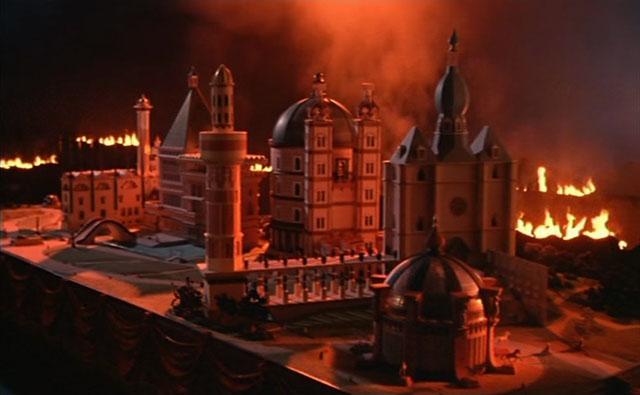
Scale model vs. World War One:
image

Resnais at a film fest press conference:
“I never had the idea that the audience should go out of the theater scratching its head and asking questions about the meaning of the film … The important thing for us is that we wanted to make a comedy.” Also says the film expresses “‘variations on the theme of dominance.”

Robert’s springheaded son and his cronies:
image

NY Times

Although ”Life Is a Bed of Roses” has a deliberately distancing, non-realistic style, and although its uniquely skewed logic effectively prevents the audience from trying to regard it rationally, the film winds up more purely confounding than can have been intended. Arch little asides, like the abundant choral flourishes, cannot help but feel pointless without a clear sense of what they are departures from.

About the title, Mr. Resnais explained that ”Life Is a Novel” is its French equivalent. French parents, he said, often tell their children that ”life is not a novel,” in the same way that American parents declare ”life is not a bed of roses.”

Sabine Azéma as Elizabeth:
image

Cineaste calls it a “fascinating misfire” and says “it would take as long to summarize the plot(s) as it takes to watch the movie.”

DVD Talk (unless they’re quoting Kino) guesses at intentions:
“Through parody and “civilized” snobbism the French director also critiques the foundations of modern intellectualism, those who thrive on it.”

Pleasure blanket:
image

Films de France:
“Both Forbek and the seminar’s organisers are striving for similar things, the creation of a better world. Both are doomed to failure.”

Precautions Against Fanatics (1969, Werner Herzog)
“Have you ever seen a dishonest man with a chest like this?”
Said to Werner’s cameraman by a one-armed man in a suit: “What are you doing here? Go away!” It’s not clear who is supposed to be here where they’re filming, in the training area of a horse racetrack. Some guy is repeating himself and karate-chopping flat stones. This cannot actually be happening! It is all pretty wonderful, a parody of a behind-the-scenes documentary. Made in between Signs of Life and Even Dwarfs Started Small, both of which I need to catch some day.
image

Organism (1975, Hilary Harris)
Time-lapse footage and readings from biological textbooks portray a large city (New York, of course) as a living organism. The dated 70’s sound design is unfortunate but otherwise it’s completely wonderful. Makes me wish I had a classroom of kids to show it to. He worked on this for years, inventing a time-lapse camera in the 60’s for the purpose. Bits from Scott MacDonald “As late as 1975, Harris apparently felt that time-lapsing imagery was unusual and high-tech enough to justify his frequent use of science-fictionish electronic sounds as an accompaniment. … Hilary Harris shot some of the New York City traffic shots used in Koyaanisqatsi, though apparently Reggio didn’t see Organism until after his film was well under way.”
image

L’Opéra-mouffe (1958, Agnes Varda)
Somehow I missed this during Varda Month – one of her earliest shorts hidden amongst the copious features on a Criterion DVD. Varda films either herself or another pregnant nude women, then goes on a rampage through the marketplace, mostly capturing the faces of people shopping there, with interludes featuring actors (incl. Varda regular Dorothée Blank, as nude here as she is in Cleo) clowning around. Sections highlight public drunkenness, anxiety and affection. I want to say this is my favorite of her shorts so far, but then I remember they’re all so good. Delightfully scored by a not-yet-famous Georges Delerue.
image

“I was pregnant. I felt the contradiction of expecting a child, being full of hope, and circulating in this world of poor, drunken people without hope, who seemed so unhappy. I felt tenderness toward them, especially the elderly. I imagined them as babies, when their mothers kissed their tummies.”
image

Silent Snow, Secret Snow (1966, Gene Kearney)
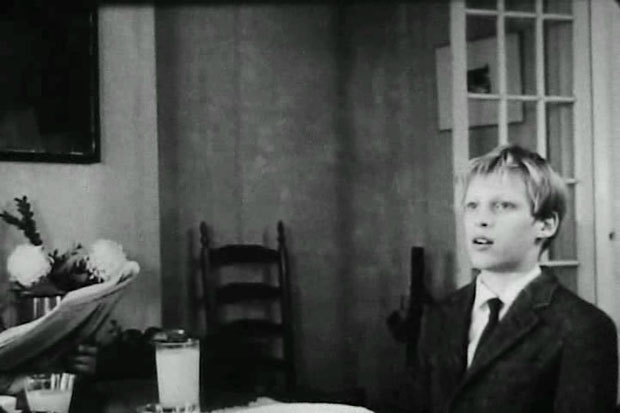
A boy named Paul starts to obsess over snow, allowing the snow in his mind to filter him from reality. Creepy and well shot. Later remade as a Night Gallery episode with Orson Welles narrating. Makes me think of the Handsome Family song “Don’t Be Scared,” with its line “when Paul thinks of snow, soft winds blow ’round his head,” except it’s one of their very few comforting, happy songs and the movie is anything but.
image

Une histoire d’eau (1961, Truffaut & Godard)
A girl wakes up and the whole town is flooded from melting snow. She meets a guy (a young Jean-Claude Brialy) who offers to drive her to Paris before nightfall. Music is weird – gentle flute or horns punctuated with bursts of percussion. Ooh, a Duchess of Langeais reference… in fact there are a ton of references in her quick monologue narration, which ends with spoken credits.
image

The Forgotten Faces (1960, Peter Watkins)
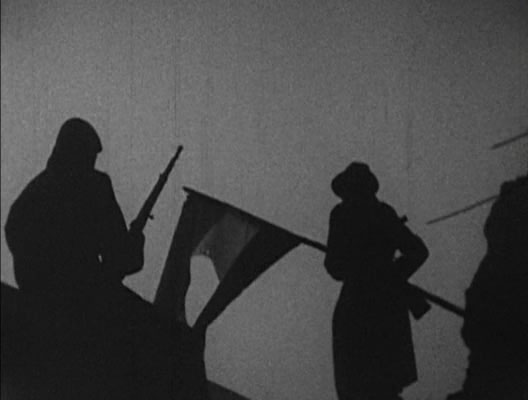
Revolution in Budapest. Nice reconstruction, convincingly documentary-like – where’d Watkins get all those guns? No sync sound, a TV-sounding narrator. One part, the reading of a communist speech turns briefly into a dramatic propaganda montage – don’t see that happen much in Watkins’ films.
image

image

The Perfect Human (1967, Jorgen Leth)
“Today I experienced something I hope to understand in a few days.”
image

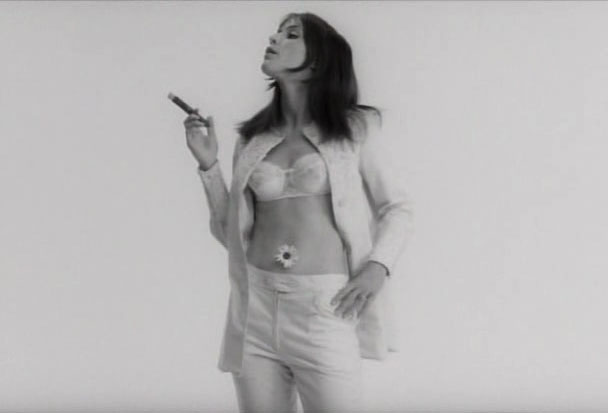
I like the British narrator. “What does he want? Why does he move like that? How does he move like that? Look at him. Look at him now. And now. Look at him all the time.” There’s no diegetic sound, but if this was dubbed in a studio, why does there have to be so much tape hiss? A fake documentary and a stark white delight, with slow zooms in and out, gentle string music, and a general sense of serious absurdity. Only saw, what, a third of this in The Five Obstructions.
image

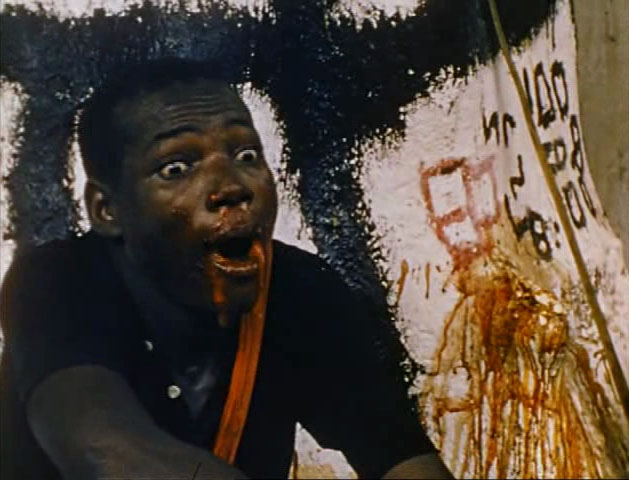
Les Maître fous (1955, Jean Rouch)
Document of a group in Ghana called the Hauka doing something involving wooden toy guns, red ribbons, chicken sacrifice, dog-blood-drinkin’ and having lurchy foaming-at-the-mouth fits. I’m not ever quite sure, because the French narration has been auto-subtitled by google – whatever they’re doing, the subs call it “having.” After they’ve had, the film crew catches up with them at their day jobs, not freaked-out cultists anymore, just working hard, smiling at the camera. This is one African film that Katy didn’t want to watch, because Rouch is an exoticizing anthropologist. So what’s going on that this film makes the best-ever lists? A Rouch tribute page says he popularized direct cinema/cinema verite, that he was known for rethinking ethnography, and a documentary surrealism (sounds like Jean Painleve). Ian Mundell says the film “drew plaudits from the Nouvelle Vague, in particular from Jean-Luc Godard. They liked the fact that Rouch’s fiction emerged from an encounter between the actor (professional or non-professional) and the camera, and his willingness to break the rules of cinema.” Paul Stoller says Rouch crisscrossed “the boundaries between documentary and fiction, observer and participant,” but I take it that’s more about his later films, which I’m thinking I would like better. So it’s seeming like this film gets awarded because it’s one of the most-seen of his films and because of its influence, not because it’s Rouch’s best work.
image

Nicky’s Film (1971, Abel Ferrara)
A mysteriously silent possibly gangster-related 6-minute film. I can’t imagine even a Ferrara scholar gets much out of this.

The Hold Up (1972, Abel Ferrara)
Super-8 production made when Abel was 21, seven years before Driller Killer. A few minutes in, I realized it’d be much better with the director commentary turned on. “And away we go. Wait, it’s the other way. Which way is she looking?” Um, some guys get fired from factory jobs, hold up a gas station, get caught. The song “Working on a Building” is heard.
image

Brooding designer Coco Chanel meets visionary Igor Stravinsky, and sparks fly in this fictionalized bio-romance… oh wait, no that’s a different movie entirely. So what happens in this one? Coco (Audrey Tautou) is a young seamstress in a song-and-dance routine with her sister (Marie Gillain, the girl from My Father The Hero), but dreams of independence. Shacks up with an older, thin-mustached guy Etienne (Benoît Poelvoorde, Belgian star of Man Bites Dog) then falls for young thick-mustached guy Boy (Bostonian Alessandro Nivola of Junebug and Jurassic Park III). After she’s made enough money selling hats with help of actress friend Emmanuelle Devos (star of Resnais’s new Wild Grass, Mathieu Amalric’s girlfriend in A Christmas Tale), she leaves them both, becomes a solitary superstar and never loves again (except, assuming either movie is true, Igor Stravinsky).

Seemed slightly better than your average “famous historical person in love” kinda movie. They pull off a bit of drama, and one memorable image (postscript-Audrey sitting on a mirrored staircase as very modern-looking models descend, applauding). But remove Coco Chanel from the title/script and replace her with a nameless fictional character and this never would’ve made it into theaters. It’s supposedly exploring the mystique of this famous designer, but never really does so, barely touching on the design elements she is known for, just throwing together (or making up) biographical details. Katy didn’t love it either, or I’d try to be nicer.

Vincent Gallo is on a plane to Paris with his lovely new bride June (Tricia Vessey, the girl who witnesses a hit in Ghost Dog), but he has dark dreams of blood.

image

Leo (Alex Descas of Irma Vep and plenty of Claire Denis movies) is cleaning up a dead body left by his wife Coré (Béatrice Dalle, Isaach De Bankolé’s blind passenger in Night On Earth).

image

Turns out Vincent and his ex-lover Coré are vampire/cannibals, and Vince is in town looking for Leo, a doctor who was working on a cure. It’s not much a honeymoon for June, nor much of a marriage for Leo – the vampires feel strong lustful urges, but always resulting in the death of their sexual partner, so June stays frustrated, Leo works in his labs, Coré sucks dry a kid who breaks into her house and Vincent rapes/eats the maid beneath his hotel.

image

That’s already an unusually juicy plot for a vampire flick, but this is also no vampire flick, it’s a Euro-Art-Film with long wordless sections and gorgeous images, my favorite Claire Denis movie so far.

image

Surprisingly, the day after I watched this it was notcoming.com’s horror movie of the day. They say:

Claire Denis seems at once unlikely and ideal as the director for a horror film. On the one hand, she seems incapable of making a purely genre film; on the other, no film director in the world more gracefully explores the physical, more pointedly employs cinema to trace the ambiguities of body, persona, and landscape. In this way, a vampire film, with its themes of metamorphosis and the alien nature of appetites is perfectly suited to her abilities as a filmmaker, even if she is unlikely to satisfy our own appetites for genre pleasure. … There are few genre signifiers to reassure us of the presence of that strong moral center so (paradoxically) common to horror films, and the narration of events is characteristically obtuse, reliant on gesture rather than dialogue. …

The metaphor is not finally about a vampire’s exertion of will or power over his victim, but more about the inadvertent draining that happens in a relationship. Shane fears that he will hurt June, that he will tear her apart, that his sexual desire will destroy his wife. It is a metaphor for intimacy and its dangers…

Gallo acts like Frankenstein for his wife’s amusement:
image

image

And a few days later the movie was the subject of a discussion on The House Next Door. It is unbelievably long and I haven’t read the whole thing yet… excerpts:

JB:

If I’m properly connecting the film’s vague dots (and I might not be), Coré and Shane are essentially infected. They are diseased. Without this infection, they wouldn’t have these perverse needs and thus wouldn’t act this way, and without the mysterious drug that caused this whole mess they wouldn’t be infected. As a result, I don’t look at Coré and Shane as portals to our dormant demons. I see nothing that reflects my own soul. What I do see in Trouble Every Day is a chilling portrait of addiction. Coré and Shane aren’t addicted to the drug that made them want blood but to the blood itself. Same difference. Now infected, they want to do nothing but “use.” Coré’s husband looks out for her, tries to protect her from herself, hopes to cure her and over and over again gets stuck cleaning up her messes. Shane, meanwhile, sleepwalks through his daily life, unable to connect with anyone outside of his addiction. If I wanted to pick a film that would exemplify the disease model for addiction, it would be hard to do better than Trouble Every Day, which shows how chemical imbalances in the brain obliterate normal rational thought so that ethics are meaningless.

image

EH:

Scenes like this make the film at least partly about the damaging cycle of an unhealthy love affair, about a man who knows he’s no good for the woman he loves but keeps trying to convince himself that he’s going to do better, that he’s not going to hurt her anymore. But we always hurt the ones we love, right? In some ways the film is about an abusive and often absent spouse, perhaps in contrast to the perverse loyalty of the marriage between Coré and Léo (Alex Descas). We feel June’s confusion and pain when she waits out in the rain, desperate for some sign of her missing man, or when she goes to visit one of his old friends, hoping for some explanation for his inconstant behavior but getting only nostalgia and vague comforting words.

image

So we can agree that the movie is about lots of things, but not necessarily that it’s a horror film. I, for one, think it’s a definite horror film, and the only reason I can think for anyone to feel otherwise is that it towers above the kinds of movies that “horror” usually brings to mind (see my upcoming writeup on the Puppet Master series for an example). I’m glad that among the direct-to-video Clive Barker junk, I stumbled across two modern horror masterpieces (see also: Pontypool) this SHOCKtober.

“The world has come to a point that there are only victims left. Martyrs are rare.”

Where we left off last year, I’d been exploring new French horror with Frontier(s), Calvaire and Ils, which plainly made the point that it is dangerous in the countryside. This one also promotes the idea of random, senseless, brutal violence, but unlike the others it pretends to be making a point.

Young Lucie escapes from a Hostel torture factory but leaves behind another. She grows up in a school for abused kids, becomes best friends with Anna. 15 years later Lucie busts into a suburban house and intensely kills mother, father, daughter and son with a shotgun, believing they’re the ones who captured and tortured her when she was little. Anna catches up, attempts damage control by burying the bodies in the back yard, but Lucie loses her damn mind, and delusionally cuts her own throat.

Anna is cleaning up, burying her friend’s body, wondering whether these regular people in this ordinary house could be responsible for Lucie’s trauma – and that’s when she finds the giant lockdown basement and the girl with a metal blindfold stapled to her head. Kindly attempts to help the girl. Then a crew flies into the house, kills the staple girl and locks up Anna in the subterranean chamber.

Up to now the movie has been nonstop action and energy, with lots and lots of screaming and bleeding, nervously shot, with an air of WTF but not the tiresome kind that dragged down last year’s batch of horrific Frenchies. Here it slows way down as Anna is strapped down and shaved and beaten and held for months to break her spirit before all her skin is removed. The idea is that there’s a rich cult of sadists who aim to give young girls ultra-traumatic death experiences so they will narrate the afterlife. Movie sets up an interesting premise then cops out when the group leader listens to Anna’s skinless report and blows herself away before divulging her secrets. Better luck next year, France.

“Blue… blue is very important.”

I’ve mostly been giving Chabrol a pass in favor of other French filmmakers who seem more interesting, but I checked this out as part of Shadowplay’s Film Club. It has already received the proper attention there, so I’ll just skip through…

image

Wild intro and last 15 minutes, not much heated activity in between. Hélène Régnier (Stéphane Audran, star of Babette’s Feast, lead girl’s mom in Thieves After Dark, also Coup de torchon, Discreet Charm, Dead Pigeon and numerous other Chabrol pictures) is our lead, and she’s pretty great. Her drug-addict husband Charles (Jean-Claude Drouot, playing the opposite of his overjoyed husband in La Bonheur) frankensteins out of his room one morning, attacks her, then clubs his son’s head into the corner of a dresser. She spends the rest of the movie dealing with the repercussions and gathering her wits. The kid is practically forgotten – total plot device.

image

Everyone turns out to be pretty well decent except for the husband’s rich dad (Michel Bouquet of The Bride Wore Black) who wants to use this incident to kick lowly Helene out of the family, and Paul, the two-faced creep he hires (Jean-Pierre Cassel, above, fresh from Army of Shadows and previously star of Renoir’s Elusive Corporal).

image

Helene stays at a boarding house near the hospital populated by nice, handsome Dr. Blanchard (Angelo Infanti, who experienced death-by-montage in The Godfather), a crazily-bearded hammy actor, three card-playing old women (“the Fates,” screams the DVD commentary), landlady Mrs. Pinelli, her drunk husband and their movie-fakey impaired daughter.

image

Intrigue: Paul, in collaboration with his always-nude sex-fiend girlfriend Sonia (Catherine Rouvel: Black and White in Color, Va Savoir), gets the loony idea to kidnap the landlady’s daughter, show her satanic sex films and pin it on Helene. But she’s not as dumb as Paul thought, and knows the difference between our Helene and Sonia in a wig. Paul then drugs Helene to keep his plan from crumbling – meanwhile Drouot is on the rampage, having killed his poor, sympathetic mother, runs into Paul who panics and stabs D. to death while a tripping Helene and the three card-playing women space out in the park watching balloons.

image

Funny to me: Marguerite Cassan plays the mother of Jean-Claude Drouot. She was in Renoir’s Picnic on the Grass which inspired Le Bonheur, which starred Drouot.

Movie is more musically interesting than visually. The commentary agrees: “It’s music that announces itself as music – it’s not to be forgotten, it’s to be paid attention to… an element of the filmmaking.”

image

English title was The Break-Up.

More hits from the commentary:
“Things in Chabrol’s universe do not happen for a reason.”
“The tension… is between civilization… and the beast within.”
“I’d say if the film has a flaw, she is a saint.”

image

“This is almost a caricature of a retarded girl. This has no basis in naturalism whatsoever. The existence inside this house is an existence on a different plane in a different style. This is a horror movie, it’s just a very strange, muted…” Comment makes me think of Celine & Julie Go Boating, but the movie doesn’t. The other common comparison is Sunrise because of a train ride scene. I think people are stretching.

image

“We’re alone and we stay alone. But what counts is to want something… no matter what the cost. There’s a bit of happiness in simply wanting happiness.”

Oops, we were supposed to end Agnes Varda Month with Jacquot de Nantes but I couldn’t get the subtitles to work, so we watched Jacquot’s own Nantes-set first feature. Not a musical like we’d hoped, but a gorgeous widescreen black and white, slightly melancholic drama with a lovely Young Girls of Rochefort-reminiscent ending.

Our listless hero is Roland (Marc Michel of Le Trou), who just wants to get out of town until he meets his crush from a decade ago, dancer Lola (Anouk Aimée). He sticks around to see if anything will happen between them, but she’s not interested, waiting for her long-lost love (and father of her child), messing around with an American soldier (New Jersey native Alan Scott who speaks hilariously horrid French) in the meantime.

Separately, Roland and the soldier also meet a young teen girl named Cécile, and Roland meets her lovesick mother (Elina Labourdette of Bresson’s Les dames du Bois de Boulogne) who tries in vain to distract him from Lola. Roland kills time at his favorite cafe with a woman in her 60’s (one of the card players in La Rupture) who talks about her son who has been away for too long. Everyone turns out to be connected – she’s the mother of Lola’s missing boyfriend who returns home to them in the final scene – giving Nantes a small-town feel, but it’s made small through the characters, not by the crane shots which make Rochefort look like a stage set.

Demy’s cinema is interconnected: Lola returned in Model Shop and Roland is the guy who marries Catherine Deneuve in The Umbrellas of Cherbourg.

NY Times: “Cécile, it’s worth mentioning, is Lola’s real name. All these people are to some degree reflections of Lola or her vanished lover, and part of the pleasure of the movie lies in watching Demy choreograph this intricate play of mirror images as the characters flicker past one another – sometimes recognizing themselves, fleetingly, but more often not.”

R. Bergan: “Its circular construction, frothiness, and long tracking shots are reminiscent of Max Ophüls, the film’s dedicatee.”

Summer 2015: Watched again from the new blu-ray, replaced screenshots.