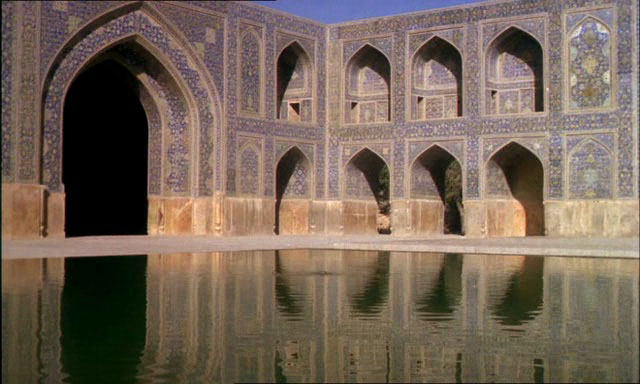
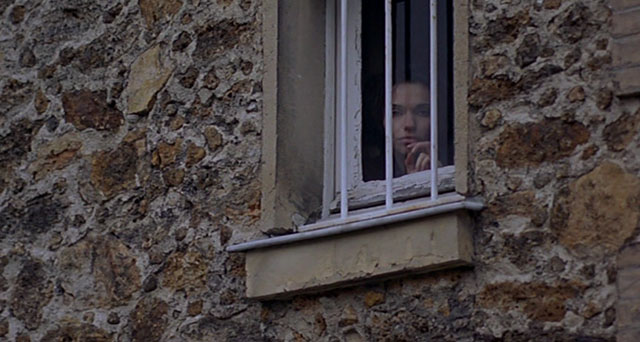
Plaisir d’amour en Iran (1976)
An expanded version of Pauline and Darius’s trip to Iran in L’Une chante, l’autre pas. Pauline and a narrator comment on the sensuality of Persian architecture. I would’ve liked it if the feature had been edited more rhythmically like this short (or if the picture quality had been as good).
image

image

Du Coté de la Côte (1958)
Fun, half-hour exploration of tourism along the coast, more gentle than Vigo’s À propos de Nice and simpler than a Marker travelogue.

image

“These parks, overpopulated with merry people attracted by the Latin shore, foreshadow the dead people seeking eternal rest there. In both cases, space is limited because of its good quality. It is a well-rated coast.”
image

image

Les Fiances du pont Mac Donald (1961)
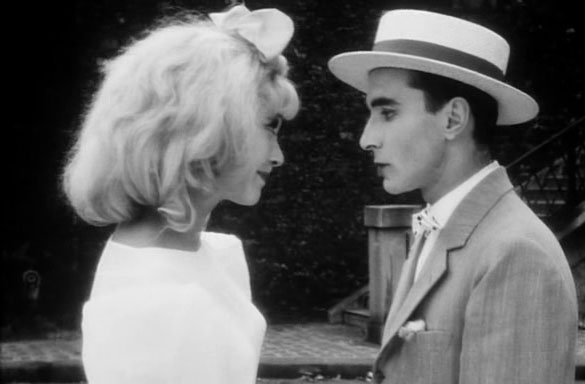
The short within Cleo from 5 to 7 is apparently considered its own little film. “I wanted to provide a little relief for Cleo. … So I thought at the beginning of the third part of the film, where films often have a lull, a weakness, a slow-down … I would introduce something uplifting. My other goal was to show Jean-Luc Godard’s eyes. At the time, he wore very dark glasses. We were friends, and he agreed to this little story about glasses in which he must take them off and reveal his big, beautiful eyes, like Buster Keaton’s.”
image

Ulysse (1982)
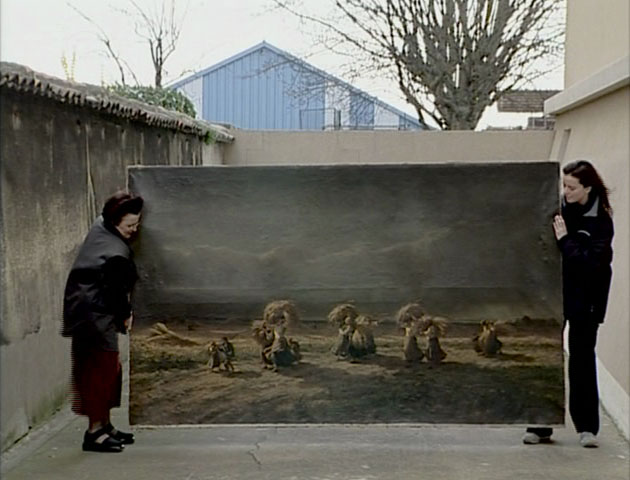
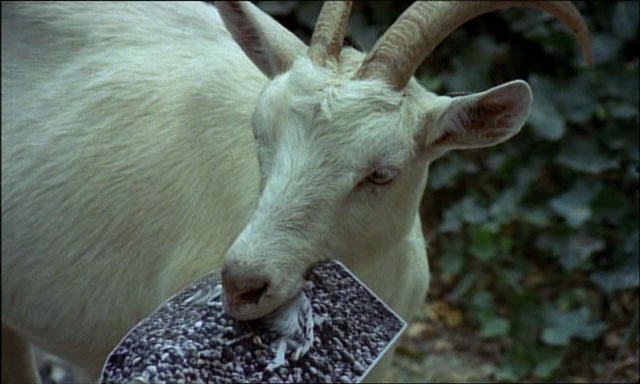
This was fantastic. Varda finds an old photo of hers, taken in 1954, and investigates. What was she thinking about at the time? What were the models in the photo thinking? She looks them up and asks. Agnes: “This almost painful investigation taught me so much about what an image says, what it says to each of us, and what it cannot say. It merely represents.”
image

AV: “How does she see her own goat image? Without making animals talk, like in American cartoons, or defining memory as a rumination of mental images, may I suggest that there is an animal ‘eatingmagination,’ a self-predatory imagination?”
image

Salut les cubains (1963)
Months after Cleo from 5 to 7 opened, Varda went to Cuba to photograph the country’s inhabitants for an exhibit which opened in Havana (introduced by Raul Castro!) before it moved to Paris. She also made this film out of the photos, narrated by Michel Piccoli. Subjects include the Castros, famous national artists, workers, dancers, posters and drawings and artworks. She creates action sequences, animating the photos, best of all with this guy dancing for the camera.
image

Mentions Marker’s Cuba Si, which came out a couple years before. In her introduction, Varda says twice that “we must place it in the context of 1962,” since the Cuban dream society didn’t turn out the way the French leftists hoped it would. Interesting that she made such a happy, idealist film as this, then her next feature would be the happiness-breakdown of Le Bonheur.
image

These last two were reissued in the 2004 collection Cinevardaphoto with a third, current short about a teddy bear collector, but somehow I didn’t have subtitles for that one. If Cleo from 5 to 7 and L’Une chante, l’autre pas revealed Varda’s kinship with the filmmaking of husband Jacques Demy, these shorts represent a definite (and oft-mentioned) kinship with Chris Marker, and either of them could stand alongside his best documentaries. The commentaries are more personal, less consciously witty. The images are wonderful, and the sense of investigation, of images and memory, the psychology of the films puts them on the Marienbad and La Jetee side of the new wave fence… my favorite side.
image

Elsa la rose (1965)
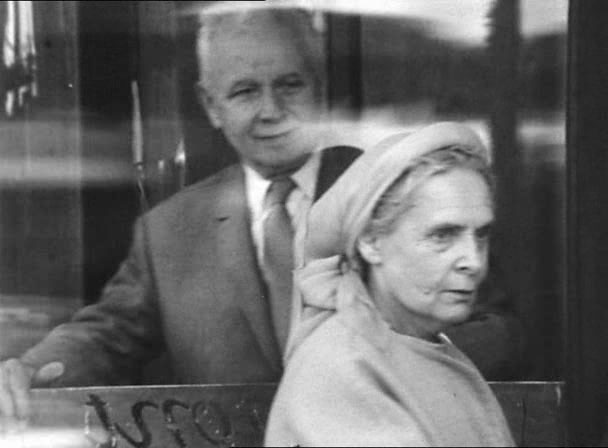
A portrait of Elsa in the words of her husband Aragon, who has spent their entire relationship writing and publishing poems about her. Varda calls them a “famous couple and fervent communists.” Elsa is filmed as Aragon imagines and remembers her, says she repeated the exercise with her own husband for Jacquot de Nantes. In voiceover, Piccoli reads the poems as fast as he can, a hilarious idea. First movie Lubtchansky and Kurant shot for Varda.
image

Elsa: “The readers of these poems expect me to be 20 years old forever. As I cannot satisfy this need for beauty and youth that the readers have, I feel guilty and it makes me unhappy. That’s what’s terrible, they’re not just for me.”

Réponse de femmes (1975)

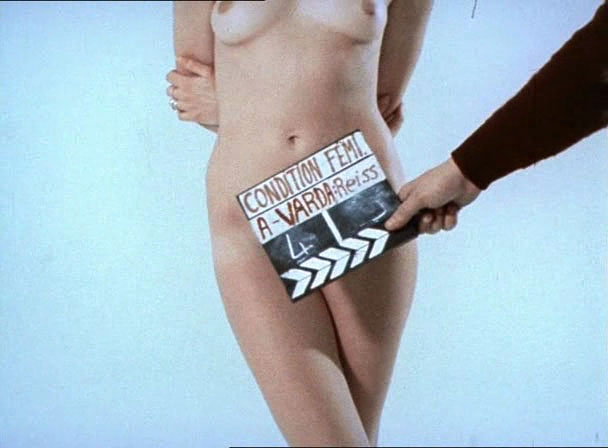
“Women must be reinvented.”
image

Agnes has a few minutes to state the case of all women, socially and politically. Lots of nudity, which she points out is not exploitative unless used to sell a product or titillate viewers.

Coming attractions (when I’ve got subtitles): Black Panthers (1968)
image

I think these might be time-lapse shots of the tide going out, but the picture quality is too poor to be sure. This is gonna be a rough one…

image

Opens with a closeup of Catherine Deneuve smiling, a good sign, but soon she and husband Michel Piccoli are in a car crash. Afterwards, she can’t speak anymore and he has a harry potter scar on his forehead. Some eerie, powerful string music and many close-ups of crabs later, we’re at a seaside town where the couple have come to recuperate. Apparently they don’t talk with the locals much because there’s plenty of gossip going around.

Sheet salesmen:
image

Doesn’t take long for things to get weird. Small hands drop buttons into pockets. Piccoli (whose character name is also Piccoli) gets scammed by traveling sheet salesmen. Fishermen provide La Pointe-courte flashbacks for the viewer. Piccoli beats a chef with a dead cat. But it’s not a comedy! Something dark and eerie is definitely going on.

Piccoli talks with a horse. The horse talks back.

Piccoli is a writer working on a story, and when we see him writing the dialogue being spoken by a woman across town, I’m never sure afterwards what is really happening and what’s part of his meta-movie.

horse: “What is your story about?”
MP: “It’s about a man who knows how to control people by remote control. … but it wouldn’t last very long, a minute at most. This guy would be a bad person, with an evil mind. He wouldn’t be human or animal anymore.”

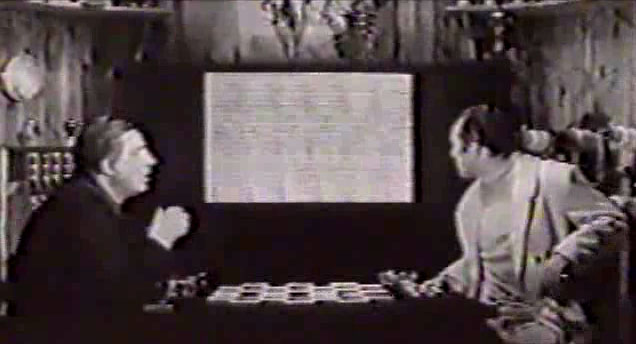
Soon Michel meets a bad man with an evil mind, Mr. Ducasse, who lives in a tower. He’s hired kids to drop magic discs into townspeople’s pockets which enable their wills to be controlled by his super computer. Ducasse calls the townfolk his “creatures”, gets Piccoli to play a game of Battle Chess with him over the fate of the town and of MP’s wife. MP is losing, but decides he doesn’t have to take Ducasse’s crazy misanthropic shit anymore, destroys the computer and tosses Ducasse from the tower. I’ll let NY Times give away the ending below.

image

Other notes I took while watching:

Catherine writes him messages, which I can’t read from the poor picture quality, and even if I could read them, they’d be in French. I have nice DVDs of Varda and Demy movies here, but I choose to watch a junk bootleg instead. Odd priorities.

The dead cat came with a piece of iron that makes the lights go out and causes people to act strange.

He just told a rabbit that his wife is pregnant.

Thief Max burns money, puts on diving suit, gets shot by partner.

You can’t tell much about the camerawork from my lo-res letterboxed videotape, but it’s one of the first films shot by William Lubtchansky (a decade before he began his 30+ year relationship with Jacques Rivette) along with two others. Interesting that all of her films until 1977 had multiple credited cinematographers.

Village Voice calls it “really botched” in their roundup for this year’s retrospective… “If it’s about anything, it’s about the creative process in action and stars that fine actor Michel Piccoli as a novelist who bases the characters in his story on friends and acquaintances.”

Ebert: “a complex and nearly hypnotic study of the way fact is made into fiction. It seems to operate on many levels, but in fact it operates on only one, illustrating how fantasy, reality and style are simultaneously kept suspended in the mind of a creative writer.”

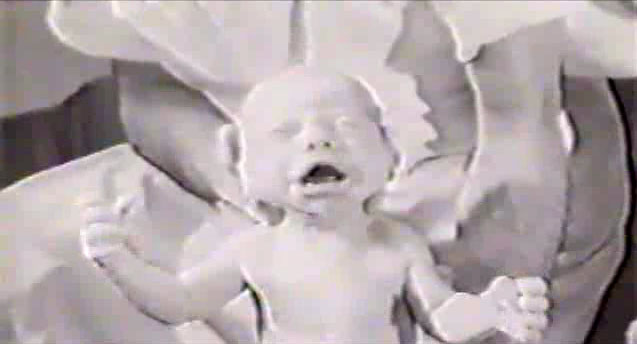
NY Times: “Then love conquers all. The survivors of the seven subplots make happy arrangements — for example, the statuesque hotel keeper (Eva Dahlbeck) gives up mistressing for the town doctor and begins with an underage busboy. The writer almost completes his novel. The wife gets her voice back, pronounces her husband’s name (“Edgar”), and has her baby — a bawling creature who at the end fills up the screen precisely to balance (and somewhat to resemble) a crab creature that fills it at the beginning.”

image

image

The movie’s studied anthropology and attack on human behavior reminds me of Resnais’ Mon oncle d’Amerique. And also of Bjork’s “Human Behavior.” There’s definitely, definitely… definitely no logic.

2025: Rewatched this in modern HD quality and replaced half the screenshots.

I am not a number – I am a free man:

Good to see this again. Funny that all I really remembered is one of the first scenes with Agnes asking a couple reluctant women about gleaning, and Agnes talking about her own hands.

image

I’m feeling uninspired, so we’ll let Senses of Cinema do the talking:

The official subject of this film is gleaning, the act of gathering remnants of crops from a field after the harvest. As Varda demonstrates, people can be discovered throughout the French countryside gleaning everything from potatoes to grapes, apples to oysters, much as they did hundreds of years ago (though no longer in organised groups). More figuratively, there are also urban gleaners who salvage scraps from bins, appliances from the side of the road, or vegetables from stalls after the markets have closed. And then there’s Varda herself, a gleaner of images, driving around France with a digital camera and a tiny crew (at times, she wields a smaller camera herself, permitting an even greater degree of intimacy).

image

Varda has a (sometimes contested) reputation as a feminist, left-wing artist, and this is very much a political film, though it offers a series of poetic metaphors and concrete encounters in lieu of an explicit, closely reasoned argument. My guess (based mainly on anecdotal evidence) is that the political outlook of The Gleaners And I has a lot to do with its popular success – even if Varda herself, who began filming back in 1999, wasn’t fully aware how thoroughly she was tapping into the zeitgeist. Without specifically referring to political movements or events, the film embodies a quasi-anarchist ethos now in the air in all sorts of ways – a resistance to consumerism, a suspicion of authority, and a desire to reconnect politics with everyday life.

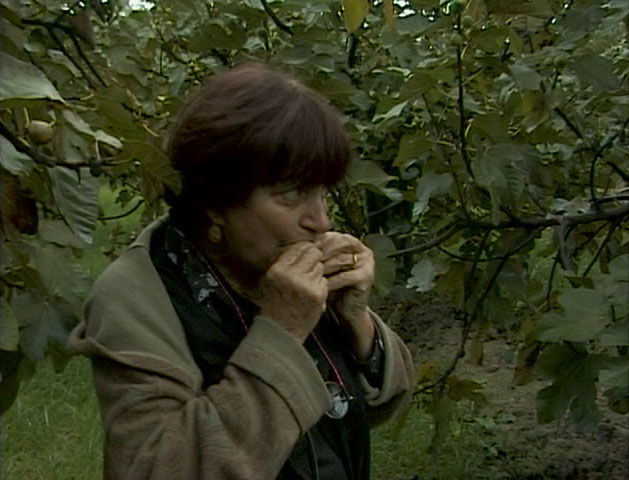
Agnès enjoys a pilfered fig:
image

Katy liked the movie, and the next day she felt like going out to pick figs. Shot on a handheld digital videocamera. The picture/framing isn’t always beautiful, but she keeps things quirky enough to stay interesting amongst all the talking heads.

image

As with Le Bonheur, Varda has taken over the DVD’s special features section herself with a whole hour-long follow-up film entitled Gleaners & I: Two Years Later (2002) Gleaners was her most locally popular and globally well-distributed films in decades, and she racked up awards and fan mail, so here she addresses concerns and gaps in the previous film and catches up with some of its stars.

image

Killer finale, the heart potatoes, symbol of the Gleaners film, old and wrinkled as it sprouts new life. As the credits roll, sudden cutaways to closeups of the potatoes, exactly as in the opening credits with the sunflower in Le Bonheur.

image

Camille: “Can I come during the day, from 5 to 7?”
Marcello: “The magic hour for lovers.”

image

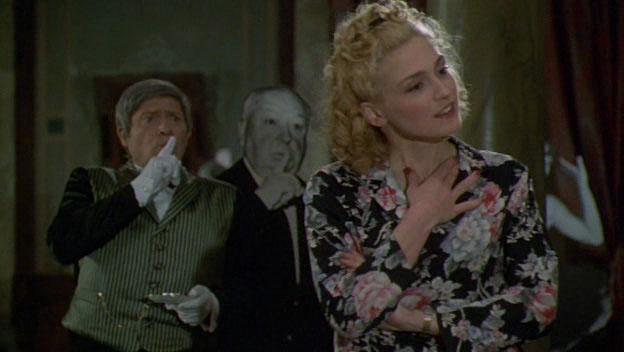
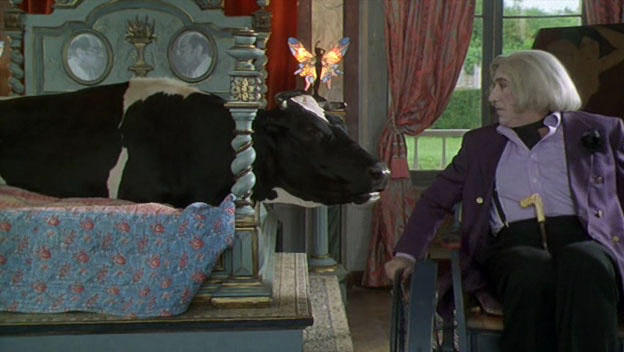
Simon Cinema (Michel Piccoli) isn’t doing too well, confined to his mansion-museum with his butler (Truffaut/Duras vet Henri Garcin) and best friend Marcello Mastroianni (as himself, sort of). Film student Camille (Julie Gayet, the girl with the giant gag vase in My Best Friend) is hired to talk with Simon about movies for 101 nights, and her boyfriend (Mathieu Demy) takes advantage of her position to cast the legendary Mr. Cinema in his student film.

Michel and Marcello:
image

Garcin and Gayet:
image

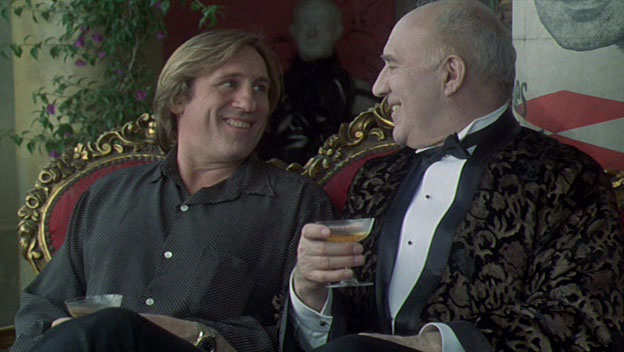
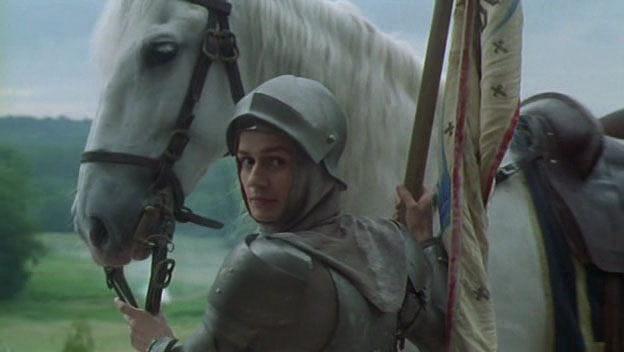
But the plot is just an excuse for some fun. Every star of French cinema shows up, major films are mentioned (nothing is discussed in any depth – no time). Anouk “Lola” Aimée, Catherine Deneuve and Robert De Niro take a boat ride. Sandrine Bonnaire appears as both her Vagabond self and Joan of Arc. Piccoli drops the Simon shtick and the white wig for a minute and compares cinematic death scenes with Gérard Depardieu (“that old devil Demy!”) before a poster of their co-starring Seven Deaths film…

Gerard and Michel:
image

Sandrine d’Arc:
image

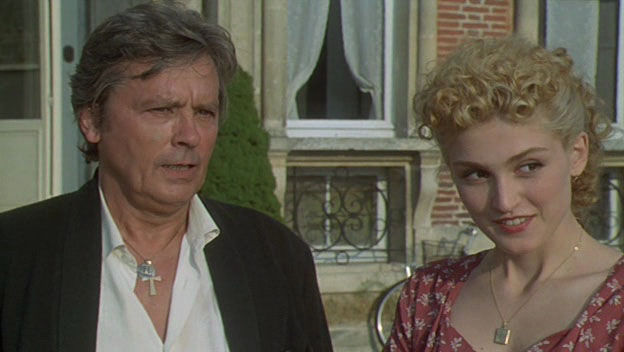
Hanna Schygulla (Fassbinder films, Passion) and Jeanne Moreau (Jules and Jim, The Lovers) play Simon’s ex-wives. There are seven dwarfs. There’s a conspiciously Bonheur-looking sunflower shot. Alain Delon arrives by helicopter (reminiscent, though it maybe shouldn’t be, of the out-of-place helicopter in Donkey Skin).

Gayet with Alain Delon:
image

Jeanne and Hanna:
image

It’s all very light and playful. I’m sure I missed a thousand references, but it keeps many of them obvious enough to remain accessible (if you didn’t catch the meaning when a bicycle is stolen outside the mansion, someone cries “italian neorealism strikes again!”).

Mathieu Demy meets Fanny Ardant:
image

The credits list how many seconds and frames were used from each featured film – impressive – and also all the stolen music cues.

image

tour bus guy: “Glad to see you on form.”
Simon: “Form of what?”
“Why, you seem content.”
“Form and content, a debate even older than I am.”

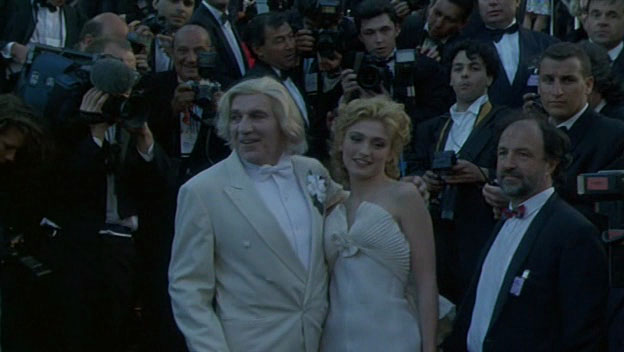
At Cannes:
image

NY Times: “While covering so many bases, Ms. Varda never makes more than a glancing allusion to anything, and at times the film is such an overloaded grab bag that it grows exasperating. Or even baffling; for unknown reasons, Stephen Dorff turns up in a pantheon of great Hollywood stars.”

image

LA Times: “Michel Piccoli plays Monsieur Cinema, who embodies the history and spirit of film, and in particular, that Fabulous Invalid, the French motion picture industry itself. (Since Varda is such a playful director, Piccoli is sometimes simply himself.) Monsieur Cinema may have been inspired by the director of the landmark Napoleon, the late Abel Gance, whom Piccoli resembles when he puts on a long silver-white wig.”

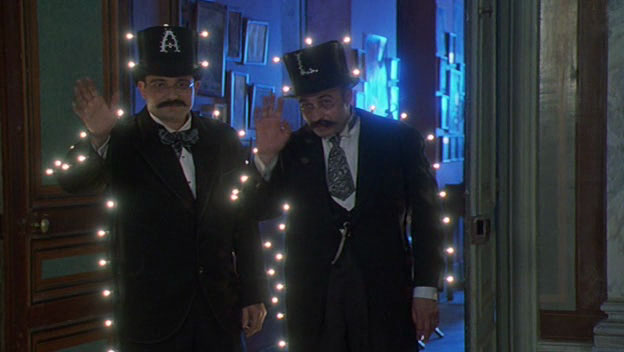
Lumiere brothers:
image

Doctor Belmondo and Jack Nance:
image

image

image

“I have enough joy for both of you. Happiness works by addition.”

image

Francois is so happy, because he has a wife (Therese) who cares only for him and their two lovely kids. He has a rewarding job as a carpenter, and a good relationship with his brother. One day he meets lovely postal worker Emilie and starts an affair with her, and now he’s even happier. Francois has so much joy that he can’t contain it all, so he tells his wife how happy he is to have two lovely women in his life, and an hour later she goes off and drowns herself. A few months pass before Emilie moves smoothly into the role of wife/mother, and Francois’ happiness continues as before.

Explaining the situation to the wife:
image

The movie, with its bright colors, prominent music, and unsettling focus and editing tricks, is amazing – probably my favorite Varda movie so far. I’d heard it was a deeply ironic, very unhappy movie but I don’t think that’s true, despite the death (not explicitly a suicide). Varda’s got happiness (in feeling and appearance) on her mind, but isn’t cutting it down or saying it doesn’t exist.

Fade to red:
image

Varda: “I imagined a summer peach with its perfect colors, and inside there is a worm. And impressionist paintings, which emanate such melancholy though they depict scenes of everyday happiness. I listened to Mozart, I thought of death’s preponderance. I wrote the film fast, and shot it fast, like the vivid brightness of our short-lived summers. At the time, it provoked much commentary. I said: ‘In a world full of prefabricated images of happiness, it’s interesting to take apart the cliches.'”

Agnes says at the time she hadn’t seen another film called Happiness and she liked the word. I guess Marker didn’t get the Medvedkin reissued until a few years later.

image

Lead actor Jean-Claude Drouot would go on to appear in Chabrol’s La Rupture and Klein’s Mr. Freedom, and his wife would continue not to be an actress, never appearing in another film. Marie-France Boyer (Emilie) had a couple starring roles after this, but fades away after 1970.

A few film references: they go to see a Louis Malle comedy (not giving the title or director, so it took some sleuthing), and watch a scene from Renoir’s Picnic on the Grass (an appropriate title, and another impressionism reference) on television. Then there’s the poster below, advertising Wilder’s Irma la Douche, John Wayne in McLintock, and is that Wyler’s 12-year-old Detective Story?
image

Movie got a silver consolation prize in Berlin after being beaten to the gold by Alphaville.

The New York Times didn’t get it (and called it Varda’s second feature – I guess if La Pointe Courte didn’t play NYC it doesn’t exist).

image

I want to quote the entire Amy Taubin essay because it’s great, but I’ll restrict myself to this bit about the final shot: “When we return in the last scene to this same patch of countryside, it is already late autumn. All that’s left of the sunflowers is their dry stalks. Just as François has replaced one wife with another, Varda replaces the late woodwind quintet with an even later and darker Mozart chamber work—a transcription for strings of the melodic themes of the original piece. The dirgelike sound suggests that as the family, holding hands, walks away from the camera, into the shadowy recesses of the forest, it is already entombed.”

image

The DVD extras are all by Varda herself – only other director I can think of who does that is Peter Jackson. Includes an interview between the two lead actresses and Varda’s daughter, which looks like it was edited by a crazy person. Short interviews with the people of Fontenay about their ideas of happiness. Writers’ quotes on happiness (“He who speaks of happiness always has sad eyes” – Aragon), interviews with two people with the last name Bonheur, a doc of lead actor Jean-Claude Drouot visiting the town of Fontenay and talking with locals about their memories of the film shoot, a 1964 documentary of Agnes on the film shoot (below, with husband Demy)
image

And four intellectuals discuss the film and its ideas of happiness, from which the following:

Michele Manceaux:
“If [the death] was an accident, it was psychosomatic. I think we can say it’s suicide. But it’s hard to fathom how something as serious as suicide could be treated in a story which is like a fairy tale.”

Frederic Bonnaud:
“Max Ophuls made a wonderful film called Pleasure, not Happiness. And the last line is ‘Happiness is not gay.’ That’s it, someone says, ‘But sir, happiness is not gay.’ And I think Agnes’ film is pretty much an analysis of that line.”

I. The Battles begins with Jeanne having had her angel visitations already, trying to convince local government to take her to the king, and halfway through the film gets to the battles she led against the English. II. The Prisons is half battles (which is good; we didn’t get enough battles in part 1) and half British prisons (with hardly any of the trial/execution scenes that Dreyer would focus on). All set 1429-1431, except for an odd intro in 1455, with Jeanne’s aged mother, a nun, telling of her daughter’s unjust execution.

image

It’s a Rivette film, all right. Long shots with medium natural lighting, deliberate camera movement, same typeface as always on the titles, brief blackouts between scenes, same list of collatorators in the credits. Quite a follow-up to La Belle noiseuse… I’ll bet nobody saw this coming. It works very well to Rivette’s strengths, though, and stays focused on Jeanne and her quest without gimmicks and without getting caught up in the scale of the story and the hundreds of side characters.

image

Sandrine Bonnaire, a decade after Vagabond and a year before The Ceremony. I didn’t recognize anyone else besides a cameo by Edith Scob. IMDB says Jean de Metz, the guy who leads her to the king’s court, was in Hurlevent, King Charles (André Marcon) is appearing in Rivette’s new film, and Quentin from Out 1 played Pierre Baillot (who was that?).

with Edith Scob:
image

Joan is charismatic and persuasive, but acts realistic. Her supernatural visions aren’t shown – we know Rivette isn’t above showing supernatural visions, but here he has Jeanne speak of them regularly without portraying them as a reality to the audience.

Unfortunately, this four-hour film has another two hours which I can’t see at the moment. Looks like Artificial Eye has released it on DVD. You know, my birthday is coming up…

image

J. Rosenbaum:

…this is a materialist version of a story that offers no miracles, though it does offer a pertinent attentiveness to gender issues (such as the nervousness and sexual braggadocio of the soldiers who sleep beside Joan) and a Joan who’s girlish as well as devout, capable of giggling as well as experiencing pain; when she wins over the dauphin the scene is pointedly kept offscreen, and when she’s interrogated by priests about her faith she could almost be a graduate student defending a dissertation.

with the king/dauphin:
image

C. Fujiwara:

As Rivette and Bonnaire present her, Joan suggests a novice movie director protected by a seasoned crew that humors her as much as obeys her. (Army life in this film is more sitting around than fighting; in this respect it’s like a film shoot.) She doesn’t do miracles; she just uses common sense and takes the initiative.

“Don’t worry, I won’t steal your memories.”

Based on the behaviorist survival theories of Henri Laborit, playing himself, and written by Jean Gruault (who wrote for Truffaut and Rivette, including Paris nous appartient). One of the strangest, most off-putting movies I’ve seen by Resnais. It takes you through the lives and relationships of three characters, but without the subjective view of Providence or the single perspective of Je t’aime, je t’aime, and using the scientific mind theories to distance us from the characters, to think of them as lab animals (one recalls the white mouse from Je t’aime), like the Coens’ Burn After Reading but, of course, better. We’re back to the associative memory-editing of Muriel and Marienbad, appropriately as the narration explicitly tells us how memory works with our survival instincts.

Odd attempt to combine scientific thought with an entertaining story. Despite the lab comparisons breaking down our characters’ behavior, I didn’t feel completely detached from them or unsympathetic. In fact, maybe I was even more sympathetic, watching them fail and hurt each other while our scientist tells us their own lower instincts are responsible for the hurt. Besides the lab flashbacks, each main character has a favorite film actor, and when they’re having a mood, Resnais cuts in a short, dialogue-less associative clip of their hero portraying the same emotion.

image

Apparently this was supposed to be a documentary on Laborit, who said the only person who could make a successful documentary on his work would be Alain Resnais, who surprisingly agreed to do it, hiring Gruault to write the story around the theories. I would love to check out the half-hour interview with Gruault on the foreign DVD sometime.

Starts out by sketching the three protagonists’ life stories using stills a la La Jetee or Dog’s Dialogue, from birth through their career, then backs up to an earlier career stage and picks up with the story proper.

Janine Garnier (Nicole Garcia of Duelle) had communist parents, defied them to become a stage actress. After starring in a successful play for a year, she started an affair with radio news reporter Jean Le Gall and started work at a textile company, eventually becoming a manager.

image

Jean (Roger Pierre), also a historian and a struggling author, had children with his wife Arlette (Truffaut star Nelly Borgeaud, the mysterious married woman in The Man Who Loved Women). He was born on a private island, to which he returns to clear his head or to impress girls.

image

René (Gerard Depardieu, who has come a long way since his Stavisky cameo) left his family farm to become an accountant. He works at the textile plant until there is a merger and he’s pitted against another accountant, an intimidating hyper-efficient guy (Gerard Darrieu, three shots down, who had small parts in Elevator to the Gallows, Z and The Elusive Corporal). Depardieu loses his post, is sent to a faraway town to manage another office, which separates him from his wife Thérèse (Marie Dubois, lead girl in Shoot the Piano Player, also in Malle’s The Thief) and makes him nervous all the time, not really being the managing type.

image

Jean has “kidney attacks,” lashing out at whoever is near him when he’s in pain. His wife Arlette visits Janine in secret and tells Janine she is dying as a (successful) scheme to get Jean back. Gerard can’t take the pressure of his new job and after a meeting with management (Janine herself) attempts suicide. All this is compared to studies of rats subjected to electric shocks, how they behave when escape is possible (escape!), when no escape is possible (depression) and when another rat is present (meaningless fighting). The movie’s scientist announces that the movie aims to show us how our brains work and cause negative behaviors so we can better understand ourselves and others. Ambitious movie!

image

Human behavioral analysis (and/or Gerard Depardieu) must’ve been in vogue in ’80 because this won major critics awards and a Cannes jury prize. Lost all six of its Cesar nominations to The Last Metro (also starring Gepardieu), and lost its writing oscar to Melvin and Howard.

image

I’m not clear who Zambeaux was, but he’s played by Pierre Arditi, Rossellini’s Blaise Pascal, who became a Resnais fave (he was the silver-haired main man on Not on the Lips and the bartender in Coeurs). Jean’s family friend Michel (who helps Jean lose his job) is Philippe Laudenbach, below, who played the war-scarred young man’s buddy in Muriel, later in Truffaut’s Confidentially Yours.

image

from Emma Wilson’s Resnais book:

Mon oncle d’Amérique seeks to set up mirroring patterns between art and science through its own internal reflections. The manner of presentation of Laborit mirrors that of the protagonists, despite his different status with relation to the film’s drama. Fusing fiction and documentary, Resnais opens space in the film for Laborit to offer short discourses on human behavior. We see him talking to camera, presenting his ideas as if he were in a documentary. The experimental basis of his work is reflected as Resnais illustrates Laborit’s ideas with close-up scenarios showing laboratory rats. The relation of these scenarios, and of Laborit’s discourses, to the action in the film as a whole is further suggested as in its late stages we see both Le Gall and Ragueneau in rat form, with rat faces, acting out their own dilemmas.

image

Houston, quoted by Wilson:

Not since Muriel, perhaps, has Resnais made a film structured for such precise, delicate and sympathetic effects; and it may not be coincidental that this is also the first film he has made for many years, really since Muriel, which is wholly French and of the present.

image

Grunes:

The title refers to an illusory ideal of happiness. What one of the characters says: “America doesn’t exist. I know; I lived there.”

image

The liner notes say that Cleo’s real-time progression through Paris is very accurate, and that the only cheat is that the 90-minute film wasn’t titled Cleo from 5 to 6:30. This was more documentary-like than I’d remembered. Somehow I’d turned it into a Godard film in my mind (possibly because of his appearance in the film-within, or maybe because I saw Breathless the same week), but it’s really quite naturalistic, the long travel segments in buses and cars reminding me more of Rivette than Godard.

image

Katy actually liked it – the first French movie she has liked in a year and a half (Amelie doesn’t count). She was especially happy about the guy Cleo ends up with at the end – an army guy on leave about to return to Algeria. They share a sense of foreboding in the park. He listens to her (unlike Cleo’s rushed boyfriend who visits her apartment) and accompanies her to the hospital, where her diagnosis is not so serious. Katy thinks the two of them will meet again, or at least that he will write.

image

I haven’t seen Cleo (Corinne Marchand) in anything else, though she’s in Demy’s Lola. I loved the scene where her composer (Michel Legrand!) and lyricist come to her apartment to try out some new songs – Cleo sings one and gets lost in a close-up.

Trapped inside the song (where the nights are so long):
image

Shut up, Michel Legrand:
image

Cleo’s maid Dominique Davray had small parts in Any Number Can Win and Casque d’or, and her nude model friend Dorothée Blank is still acting today, appearing in Resnais’ new Wild Grass. Her boyfriend/lover José Luis de Villalonga was in Malle’s The Lovers. Varda (along with Antonioni with L’Eclisse and Bunuel with The Exterminating Angel) lost the golden palm to a Brazilian realist movie about a sick donkey.

Cleo with maid in awesome apartment:
image

Dorothée Blank’s backside:
image

Cleo with Villalonga:
image

The movie dares you to stay awake, like a french Archangel.

Tried to watch this with Katy back in the apartment, but something went wrong. I remember her getting tired then mad, and I never tried to finish it. Then finally I watched again – then took a trip right afterwards and didn’t write anything until now, a month later. There’s not much to remember, plot-wise. A girl is packing her apartment preparing to move in with her fiancee. Stuck on the road during a transportation strike, she offers a ride to a guy (star of La Moustache). He plays it cool and eventually she’s chasing after him. Will they end up in a hotel bed together? Why yes, it’s shown there on the DVD menu, nice. Some computer animation and an iris-shot imagination scene weirdly spice up what’s otherwise a dreamy-distracted natural film. It needs its own sense of time though, maybe its own week, and I don’t give movies that sort of personal space, so I have a feeling this one’s sensitivity will get swallowed up by whatever Takashi Miike flick I watch next. Maybe I’ll try again with Katy sometime.

From E. Hynes’s just-published article in Reverse Shot:

Many films foreground, and take full advantage of, the fact that we like to watch. Rare is the film that considers and satisfies these desires equally. Rarer still is one that doesn’t make us feel guilty for our desires or their satisfaction. Friday Night is aware of guilt as an emotional response but doesn’t make it a moral imperative. … It carves out a space where desires and curiosities can be explored without corrective regret. If only for a night we’re set free to touch and feel and immerse ourselves in the moment. And our conduit—our eyes, ears, and hands—is a woman. As are our director, authors (Denis and Emmanuèle Bernheim, adapting her novel), and cinematographer (Agnès Godard). Denis’s film is radical not just for being so casually yet utterly feminist, but also for forwarding a feminine point of view as frankly universal.