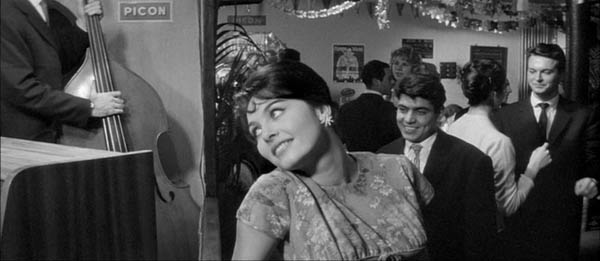
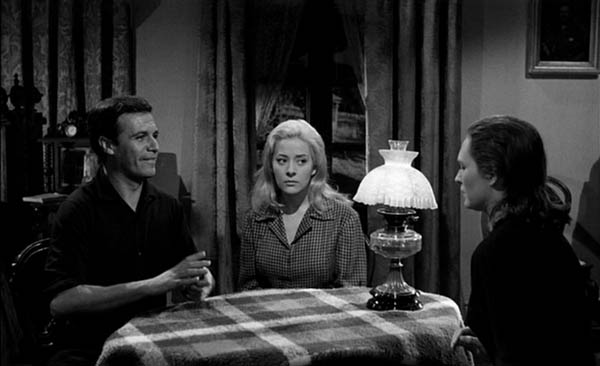
I think the title Hurlevent means something about the wind.

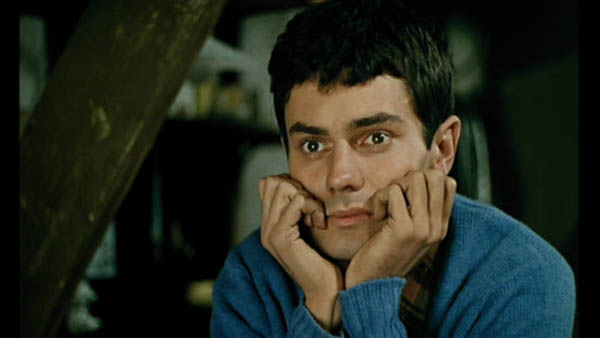
Well-bred Catherine loves Roch, an orphan her family has raised from a young kid with the help of servant Helene. Catherine’s brother William has taken over their estate and wants to get rid of Roch. Cat meets Olivier by chance and stays at his estate, gets to know him and his sister Isabelle, he eventually proposes. Roch disappears after overhearing a conversation about his being below Cat’s social class, comes back rich three years later, Cat and Olivier are now engaged and William is a drunken gambling addict. Roch wins the estate from William and hangs around until Catherine dies from illness.

image

Movie opens with a great looking dream scene of Catherine and Roch on a rocky hill while William watches, hidden. Has a few interesting parts like that, but mostly just a good-looking literary adaptation of a dreary story. Rivette’s not especially proud of it either… I think we can mostly ignore this one.

Interesting soundtrack, only used in a few scenes. Valérie Hazette in her Senses of Cinema article says: “The only concession to lyricism can be found in the magical accents of Le mystère des voix bulgares, a Bulgarian choir’s album.”

image

Rivette says about the adaptation: “I had decided not to re-read it: I asked Pascal to summarise it for me. I only wanted to have the outline of the story and of the characters, that’s all. And from the start, I told him: “Only the first part”, because I knew about the second part. I had a very strong memory of the Wyler movie – because I hate it – and of the Buñuel movie because, as you know, I find it very beautiful. The characters are 40, but still, the movie remains very, very powerful.”

image

Francois Truffaut died a few days after the shoot. “For the whole length of the shoot, every single day, we were expecting to receive the phone call that would tell us ‘François has died…’ it was a truly harrowing situation.”

“Since it was necessary to condense quite a lot, by force of circumstance, I believe that it is indeed the most elliptical of all my movies. Otherwise I might have made a three or three-and-a-half hour movie, like I usually do. But there, we were obliged to simplify, to keep to the essentials. It might have given a more vigorous and energetic feel to it …”

image

The charactors (actors) and their relationships seem more important than plot/storyline, so I’ve made a page for the characters first, then a story summary page, separated into day one and day two, totalling my most complex journal entry to date!

I spent all this time on plot and character description, not necessarily because the story elements are so important, but because I may not get to see this again and I want to be able to remember it.

Thankfully, I have a downloaded copy of the movie from Raitre Italian TV, so I can get lots of screen shots.

But what of the movie, overall? Worth the trip to New York to see it, for sure. A total experience of a film, from the dedicated audience to the live subtitles to the 16mm presentation to the museum theater that hosted it to the sheer length and intermissions to the Jean-Michel Frodon (Cahiers du Cinema editor) introduction to the content, with its very long wide shots and very gradually developing story… many scenes that only form a complete big-picure scenario if you’re paying close attention for most of its runtime.

Dennis Lim of the NY Times called it “the cinephile’s holy grail” and says:

In the annals of monumental cinema there are few objects more sacred than Mr. Rivette’s 12 1/2-hour OUT 1. Shot in the spring of 1970, this fabled colossus owes its stature not just to its immodest duration but also to its rarity. Commissioned and then rejected by French television, the film had its premiere on Sept. 9 and 10, 1971, at the Maison de la Culture in Le Havre before receding into obscurity . . . has become a true phantom film whose reputation rests on its unattainability . . . Mr. Rivette worked without a script, relying instead on a diagram that mapped the junctures at which members of his large ensemble cast would intersect. The actors came up with their dialogue; the only thing Mr. Rivette actually wrote were the enigmatic notes Mr. Léaud’s character receives . . . With OUT 1 he found the perfect match of form and content, an outsize canvas for a narrative too vast to apprehend. In a 1973 interview Mr. Rivette described the film’s creep from quasi-documentary to drama in ominous terms: the fiction ‘swallows everything up and finally auto-destructs’.

I love it – not just a legendary museum curiosity that people pretend to like to impress other cinephiles, but actually an amazing film worthy of its reputation. Of course, mostly its reputation is that of an unattainable film (we were told this was the eighth-ever public screening), not of a great masterwork… but I guess it’s worthy of both of those.

The experimental theater exercises get very long, even too long, but not tedious. If a scene lasts “too long” in a regular movie, maybe you could’ve trimmed two minutes to make it feel right. But the theater scenes aren’t necessary at all, from a story point of view, so there’s no telling how long they need to be. When it hits me that I’ve been watching the same theater scene for twenty minutes, it’s not annoyance but awe that hits me. It’s hard to say what exactly is necessary in this movie… once you start cutting or shortening scenes, tying up loose ends and clarifying character connections and histories, you’re talking about a different movie (and not SPECTRE, but a different movie entirely). Best leave it the unwieldy beast it is, and appreciate it as that.

Dennis Lim’s article is a good one… here’s more:

“Out 1” now seems a relic of a bohemian heyday, a time when you could spend your days rehearsing ancient Greek plays or making 12-hour films. But even in 1970 that hazy idyll was already fading. The film takes its shape, as Mr. Rosenbaum has noted, from “the successive building and shattering of utopian dreams.” An epic meditation on the relationship between the individual and the collective, “Out 1” devotes its second half to fracture and dissolution. But it’s not a depressing film, perhaps because its implicit pessimism is refuted by its very existence. Experiential in the extreme, “Out 1” cannot help transforming the solitary act of moviegoing into a communal one.

And Lim says that Rivette’s 2007 movie Don’t Touch The Axe will be revisiting Balzac’s “History of the Thirteen”. “Does this represent a closing of the circle? An expansion of the master plan? If there’s one thing we know from Mr. Rivette’s films, it’s that the big picture will remain just outside our grasp.”

Ah ha: Rivette’s interview from Film Comment… he says shots of Paris’s landmarks “were inserted…frankly as empty spaces. As a kind of visual silence. . .” I had been wondering.

Reverse Shot says: “In Rivette there’s a sense, not just of watching or duration, both of which are passive ideas, but of actively being put through a process”.

Crawford in Reverse Shot:

Out 1 was made in the aftermath of the social uprising of May ’68, when a series of strikes by Parisian student unions devolved into a full-bore confrontation with the military. What once began as a hope to radically reinvent the mores of a stagnant and conservative society ended meekly, with the unions urging a peaceable return to work and De Gaulle’s party consolidating its power to a greater degree than ever. Out 1 taps into this post-May ’68 malaise, betraying an abiding mistrust in grand social movements, services organizations. Paris is turned into a disconnected amalgam of individual groups hermetically sealed off from one another. . .

Is it too simplistic to describe Colin as a spectator’s surrogate and leave it at that? What do we make of choice to pose as a deaf-mute and his return to that state at the end of the film? How, for that matter, do we take of the weird behavior of the male (Colin) and female (Frédérique) interlopers? Their logic and mode of behavior is vastly different from anyone else in the film; it’s like they’ve parachuted in from Céline and Julie Go Boating.

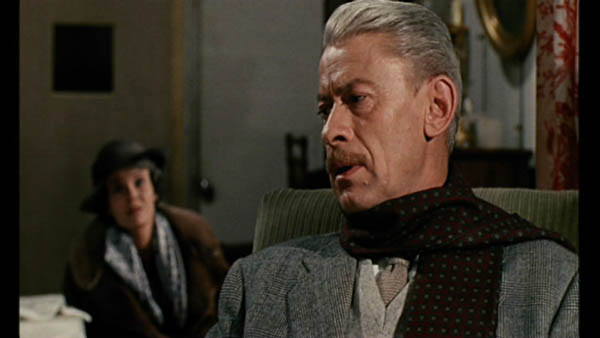
Rivette was working on this from 1957-1960. In ’57, Chris Marker did Letter From Siberia. In ’58 we had Le Beau Serge, Elevator to the Gallows and a couple shorts. ’59 brought Pickpocket, Hiroshima Mon Amour and The 400 Blows, then Breathless and Shoot the Piano Player were in 1960. So Rivette might have started everything, in a sense, but by the time he’d made his statement public (in ’61, along with Cleo From 5 to 7 and Last Year at Marienbad), the whole “new wave” was in full swing in the theaters.

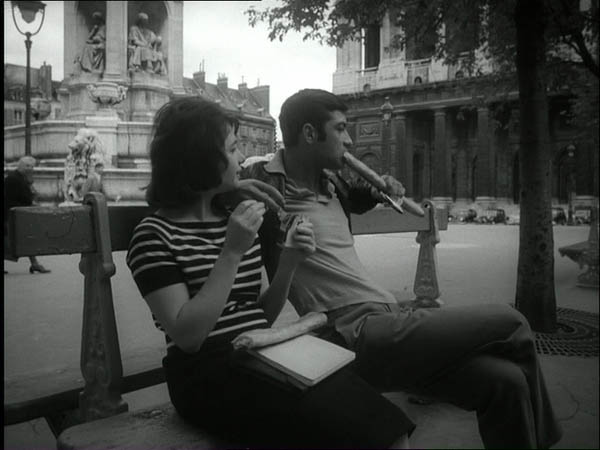
Betty Schneider (of Mon Oncle) is young innocent Anne with brother Pierre (Francois Maistre, later of a buncha Bunuel films). She meets theater director Gerard (Giani Esposito of French Cancan), paranoid American Philip (Daniel Crohem) and mystery woman Terry (Francoise Prevost of Rivette’s 1981 Merry-go-round). Movie gets more disturbed and paranoid (as well as loose and rambling) as it progresses, ending with the deaths of a buncha characters. Somewhat like The Dreamers. Incidentally, “Paris Belongs To Us” would’ve been a better title for that movie.

Interesting parallels with Out 1, both being about theater groups and city-wide conspiracies. In this one, we never find out if the conspiracy even exists, and in Out 1, the group does exist and is partially uncovered, but the group has no sinister purpose, never even did anything together and have been long dormant.

Much is made of the cameos by Godard, Chabrol, Rivette and Demy in the promo material, but I can’t say I noticed any of those.

Michael Rowin in Reverse Shot calls it “a fascinating disappointment”.

the calm:
image

the storm:
image

the intrigue:
image

First movie of my Rivette Fest, to get acquainted with his work before seeing Out 1 in March. But Sam just told me that his late movies, like this one, have little in common with the early batch. So maybe my efforts are misdirected, but whatever the case, I enjoyed this one.

Lab rat Sandrine Bonnaire (Rivette’s Joan of Arc, also starred in Vagabond, East/West, Intimate Strangers, and Chabrol’s The Ceremony) hears from her brother Paul (Grégoire Colin, young star of The Intruder and Dreamlife of Angels) that old family friend Walser (Jerzy Radziwilowicz: Rivette’s Julien, Godard’s director in Passion, star of Man of Iron and Man of Marble) may have killed their father.

it all starts with a photo:
image missing

angry brother:
image missing

Rounding out a star-studded cast is their mom Francoise Fabian (of 5×2, Belle de Jour, and the title role in My Night at Maud’s) and Walser’s girlfriend Laure Marsac (of nothing in particular).

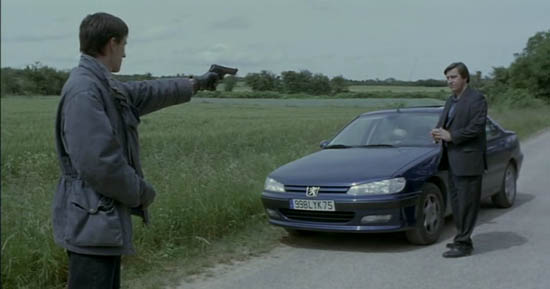
Sandrine confronts Walser and accidentally kills the girlfriend. Later, the gf’s twin sister (also Laure Marsac) shows up. Everyone is sleeping with Walser except for the brother, who’s still all hopping mad. Eventually the twin sister accidentally kills Sandrine (both deaths were caused by someone jumping in front of Walser).

dig the mobile:
image missing

dig the sexy girl:
image missing

Movie is usually captivating, but every time Sandrine rides the train in the first half, it shows us the entire train ride. Goes beyond “setting the mood” and starts to get boring. Much improved in the second half (unlike most movies). A twisty little mystery movie… liked it.

a long train ride:
image missing

final shot:
image missing

Came out in late 1960, after Breathless (which Truffaut wrote), 400 Blows and Les Mistons. Dawn doesn’t like it, and the Taschen book I’m reading on Truffaut says it was largely disliked, misunderstood and ignored (and even Jules & Jim did just well enough to break even, no big comeback).

image missing

Charlie plays piano at a small-time bar, running away from his old life as a concert pianist after his wife Therese killed herself. He’s friends with a prostitute (Clarisse) and a bartender (Lena). Charlie’s little brother Fido (a kid from 400 Blows) lives with him, and his other brothers are thieves who run into trouble after screwing over their two scary/clumsy accomplices, who chase everyone throughout the picture. In the end, Lena is killed and Charlie returns to work.

image missing

Great bits: Charlie’s inner-thoughts voiceover, the subtitled singer in his bar, the balance between ridiculous and dangerous maintained by the gangsters, the sudden shifts in tone, the beautiful girls surrounding Charlie.

image missing

The commentary points out all the mirrors, says Truffaut used lead actors who looked like himself (true of Jean-Pierre Leaud).

image missing

I enjoy the movie – it’s light and short and heartfelt. But I’m also still suffering from post Children of Men trauma, and this movie’s joyful subversion of genre doesn’t hit hard enough to make an impact. Maybe when I’m in a more delicate mood I can appreciate it more.

Katy thought Belle was dumb and the final scene looked crappy/fake and bits were stolen from Cinderella, but even she was impressed by the handheld candelabras.

One of the most beautiful movies ever, of course. Lighting, set design and costumes are completely perfect, acting and story and effects are all great. Probably not much needed to say since I’ve seen this a bunch of times now.

Learned from commentary: actor Jean Marais (Avenant, The Beast, The Prince) was Cocteau’s lover and suggested he make this film. René Clément (Forbidden Games, Purple Noon) co-directed. Beauty Josette Day starred in Cocteau’s Les Parents Terribles, which I barely remember. Given the post-WWII shortages, Cocteau’s illnesses and all the other problems involved in making this, it must be one of the biggest film triumphs in history.

Bunuel’s brief return to Franco-era Spain before escaping back to Mexico and then heading to France. Viridiana (Silvia Pinal, Simon of the Desert‘s devil) is about to be a nun, but her superiors say that first she must visit her benefactor, her widower uncle Don Jaime. The trip seems to be going fine so far.

image missing

But Viridiana is a crappy nun and gets tricked into wearing her aunt’s wedding gown, then gets drugged and put to bed. Don Jaime (Fernando Rey of That Obscure Object and Discreet Charm) tells her she was raped and now can’t return to the convent, but then confesses the truth… she flees and he kills himself.

image missing

Viridiana gets to split the estate with her handsome cousin Jorge (Francisco Rabal of L’Eclisse and Nazarin). She leaves the convent and attempts to make a home for a bunch of beggars. But she’s no good at that either… they take over the house and attack her.

image missing

Viridiana finally accepts her fate and sits down with Jorge and the housekeeper in a menage-a-trois-suggestive final scene.

image missing

Very interesting movie. Glad I played with all the DVD extras and read up a little on it. Not much to say about it, myself, except to repeat unimportant trivia I’ve learned (Sylvia and Juan Luis smuggled the film out of the country to Cannes, where it unexpectedly won).

Severine is the wife of Pierre (Jean Sorel), but is unhappy with him sexually. She’s got a rich fantasy life, though. Sleigh bells and cats and a horse-drawn carriage lead her into rape-fantasies with coachmen, dreams of being tied up and humiliated and made to play dead. Family friend Michel Piccoli (of The Milky Way, Contempt and Diabolik) tells Severine about a brothel, which she hesitantly joins. Hilarity ensues when a customer (Marcel) becomes dangerously infatuated with her, and Piccoli eventually visits the place again, sees Severine there and threatens to tell her husband. In a jealous fit, Marcel shoots Pierre then is killed by the cops. Piccoli sits alone with Pierre, now confined to a wheelchair (and blind?) and presumably tells him Severine’s secret. The coachmen float us away into fantasy once more.

Terrific looking movie and really great performances. It’s got that Bunuel-dream-crawl pacing. Maybe best watched very late at night. Doesn’t make me weary like most Bunuel movies… probably one of my faves. Not as sexy as I’d maybe promised, more bizarre… sense of danger over sensuality, mostly a tense movie. Katy sorta liked it I guess.

Katy didn’t see this one.

Fifth Bresson movie I’ve seen, and the one that tips the scales. I guess I like Bresson now. That’s so predictable of me.

IMDB says: “Michel takes up picking pockets as a hobby, and is arrested almost immediately, giving him the chance to reflect on the morality of crime. After his release, though, his mother dies, and he rejects the support of friends Jeanne and Jacques in favour of returning to pickpocketing (after taking lessons from an expert), because he realises that it’s the only way he can express himself.”

Good ending, with Michel in prison. A prequel to A Man Escaped? No, but I can dream. Felt really good to watch… but don’t know what to say. More later perhaps.