Second-and-a-halfth time I’ve seen this. Next time I’ll have to find the longer (miniseries?) version.

image

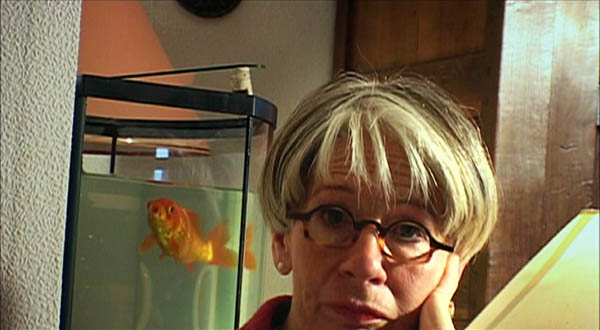
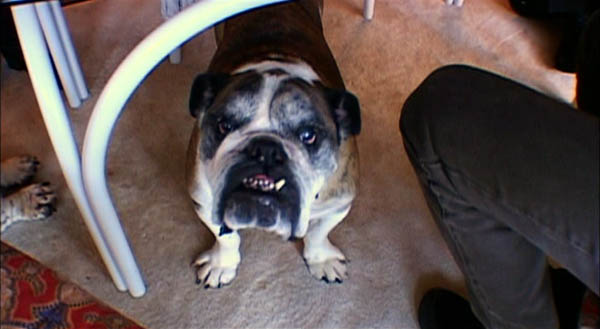
Still my favorite wine documentary. Unnervingly unsteady handheld digital camerawork, wandering obsession with wine people’s pets, sudden shifts from one country to another, and interviews that give subjects plenty time to make their views clear or to make fools of themselves.

image

Movie starts (but does not end) in Brazil, which is apparently a difficult place to make wine. For the most part, the ol’ stickler traditionalists come out looking good (Mondille family, the guy below), the big-money company owners come out looking not so good (Michel Rolland, Mondavi, Antinori), and some other characters add flavor and remain neutral (critic Robert Parker, new york distributor Neal Rosenthal).

image

I read a great magazine interview with Jonathan Nossiter – was it in Cinema Scope? Will have to find that again. I love how idiosyncratic the movie is – the way the camera restlessly looks around instead of watching the interview subjects, the inclusion of scenes and dialogue that the subjects probably thought (knew!) would be thrown out, the rich v. poor, worker v. owner and globalization arguments stated or implied in every scene.

Katy liked the movie, I think.

image

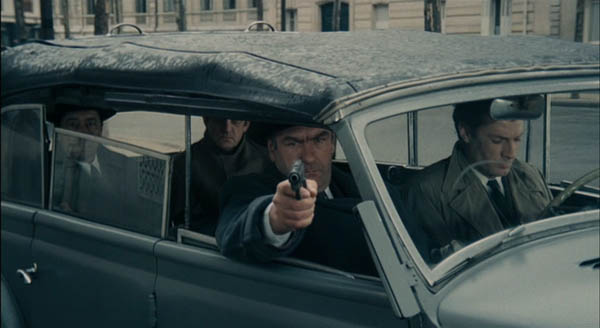
Sooooo bleak. Not the normal kind of resistance movie. Their struggle is necessary but hopeless. Movie opens with our main guy escaping from a camp, then having the guy who ratted on him killed. Many small triumphs and large defeats later, we end with the gang shooting one of their own then driving away as the titles tell us how each of them later got killed in the struggle.

image

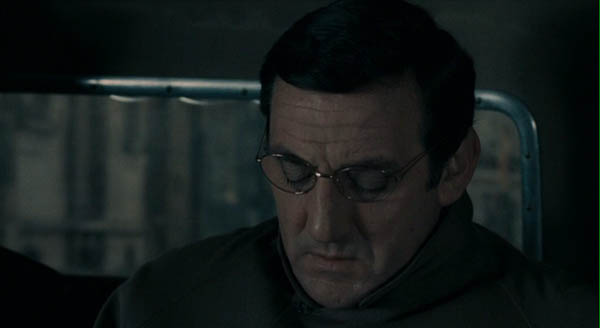
Hardly any non-diegetic music, superbly shot, dark and dreary but not in a tiring way, more of a matter-of-fact “this is how things are” straightforward way.

image

These are not heroes in the regular movie sense of the word. Theirs is not a glorious fight… it’s hardly a fight at all, more a struggle for survival. The problem is that it would be easier to survive by living ordinary lives, by cooperating with the nazi regime, by ratting on their fellows, by doing any of a number of things they refuse to do, by giving in. The movie is about how much it can suck to be moral, to stick to your convictions. While those in the resistance who survived the war can’t have much to be proud of… unlike most residents of their country, they also can’t have much to be ashamed of. A great, great movie. Nice contrast to the portrait of resistance to nazi occupation in Black Book this year.

image

Still shocked that I liked this, after the awful cheesy trailer. It’s well-played light comedy, a story of little consequence, but kept on a high enough level that I even recommended it to people. The director is well known for quality (The Dinner Game), but I’d so grown to dislike that trailer that my enjoyment of the movie was as surprising as if I’d ended up liking The Italian or the last two Pirates of the Carribean films.

Anyway, valet is standing next to fabulously rich dude arguing with his supermodel girlfriend when a photo is shot by tabloid journalist. In order to keep his fortune from a wife who’d love to catch him cheating, the rich guy has to pretend the supermodel wasn’t with him at all, but with the other guy, the valet. So he and the wife hire competing teams of spies to follow the two around, one group trying to prove the valet and supermodel are not together and the other trying to make it look like they are. Fun premise, and it’s carried through well. Valet ends up with his childhood girlfriend after they get plenty jealous of each other’s new lovers, and model gets her revenge on rich guy, with the closing shot having the same photographer catch him in a trap standing next to a transsexual.

The Farrelly brothers are supposed to helm the U.S. remake in 2008.

Wow, this is one of my favorite movies now. I was right about watching it in the theater (on film)… really helped see everything properly. More important, possibly, was seeing it for a second time, already knowing the pace and the organization of story (such as there is a story), being able to sit back and enjoy.

First third (?) of the movie is an architectural dream, all buildings and structure and angles, beautiful and disorienting. Whole movie is concerned with structure and glass.

Funny, but not punchline-funny so much as enjoyable and light, building up towards the end of the crazy restaurant sequence when suddenly humor’s flying from all directions.

I feel like I “got it” this time, but also feel like I missed a lot. Not in a bad way, more in a “could see this again and again” way.

I’d thought Mr. Hulot wasn’t in this one but of course he is. What was I thinking of… Parade?

Katy, Jimmy, Misty, even Adam liked it.

Resnais at the Venice Film Festival described the movie as “recording the anger of a so-called happy civilization. A new world is shaping. My characters are scared of it and can’t deal with it. We witness a real impregnation of the world. Muriel invites us. The movie grows like a plant. The characters start to live away from us. Imagine a letter on a piece of blotting paper. The movie is this blotting paper. The audience is that mirror that allows the image to be seen. Muriel appeared in the middle of the ink stains.”

Helene to Alphonse: “Well, did we love each other or not?”

Bernard is the nephew, Marie-do is his girlfriend, Robert is his war buddy.

Italian movie Hands Over The City beat this one at Venice, along with Marker’s Le Joli Mai, Kurosawa’s High & Low, a Louis Malle, Billy Liar and Hud.

image

image

image

I think the title Hurlevent means something about the wind.

Well-bred Catherine loves Roch, an orphan her family has raised from a young kid with the help of servant Helene. Catherine’s brother William has taken over their estate and wants to get rid of Roch. Cat meets Olivier by chance and stays at his estate, gets to know him and his sister Isabelle, he eventually proposes. Roch disappears after overhearing a conversation about his being below Cat’s social class, comes back rich three years later, Cat and Olivier are now engaged and William is a drunken gambling addict. Roch wins the estate from William and hangs around until Catherine dies from illness.

image

Movie opens with a great looking dream scene of Catherine and Roch on a rocky hill while William watches, hidden. Has a few interesting parts like that, but mostly just a good-looking literary adaptation of a dreary story. Rivette’s not especially proud of it either… I think we can mostly ignore this one.

Interesting soundtrack, only used in a few scenes. Valérie Hazette in her Senses of Cinema article says: “The only concession to lyricism can be found in the magical accents of Le mystère des voix bulgares, a Bulgarian choir’s album.”

image

Rivette says about the adaptation: “I had decided not to re-read it: I asked Pascal to summarise it for me. I only wanted to have the outline of the story and of the characters, that’s all. And from the start, I told him: “Only the first part”, because I knew about the second part. I had a very strong memory of the Wyler movie – because I hate it – and of the Buñuel movie because, as you know, I find it very beautiful. The characters are 40, but still, the movie remains very, very powerful.”

image

Francois Truffaut died a few days after the shoot. “For the whole length of the shoot, every single day, we were expecting to receive the phone call that would tell us ‘François has died…’ it was a truly harrowing situation.”

“Since it was necessary to condense quite a lot, by force of circumstance, I believe that it is indeed the most elliptical of all my movies. Otherwise I might have made a three or three-and-a-half hour movie, like I usually do. But there, we were obliged to simplify, to keep to the essentials. It might have given a more vigorous and energetic feel to it …”

image

The charactors (actors) and their relationships seem more important than plot/storyline, so I’ve made a page for the characters first, then a story summary page, separated into day one and day two, totalling my most complex journal entry to date!

I spent all this time on plot and character description, not necessarily because the story elements are so important, but because I may not get to see this again and I want to be able to remember it.

Thankfully, I have a downloaded copy of the movie from Raitre Italian TV, so I can get lots of screen shots.

But what of the movie, overall? Worth the trip to New York to see it, for sure. A total experience of a film, from the dedicated audience to the live subtitles to the 16mm presentation to the museum theater that hosted it to the sheer length and intermissions to the Jean-Michel Frodon (Cahiers du Cinema editor) introduction to the content, with its very long wide shots and very gradually developing story… many scenes that only form a complete big-picure scenario if you’re paying close attention for most of its runtime.

Dennis Lim of the NY Times called it “the cinephile’s holy grail” and says:

In the annals of monumental cinema there are few objects more sacred than Mr. Rivette’s 12 1/2-hour OUT 1. Shot in the spring of 1970, this fabled colossus owes its stature not just to its immodest duration but also to its rarity. Commissioned and then rejected by French television, the film had its premiere on Sept. 9 and 10, 1971, at the Maison de la Culture in Le Havre before receding into obscurity . . . has become a true phantom film whose reputation rests on its unattainability . . . Mr. Rivette worked without a script, relying instead on a diagram that mapped the junctures at which members of his large ensemble cast would intersect. The actors came up with their dialogue; the only thing Mr. Rivette actually wrote were the enigmatic notes Mr. Léaud’s character receives . . . With OUT 1 he found the perfect match of form and content, an outsize canvas for a narrative too vast to apprehend. In a 1973 interview Mr. Rivette described the film’s creep from quasi-documentary to drama in ominous terms: the fiction ‘swallows everything up and finally auto-destructs’.

I love it – not just a legendary museum curiosity that people pretend to like to impress other cinephiles, but actually an amazing film worthy of its reputation. Of course, mostly its reputation is that of an unattainable film (we were told this was the eighth-ever public screening), not of a great masterwork… but I guess it’s worthy of both of those.

The experimental theater exercises get very long, even too long, but not tedious. If a scene lasts “too long” in a regular movie, maybe you could’ve trimmed two minutes to make it feel right. But the theater scenes aren’t necessary at all, from a story point of view, so there’s no telling how long they need to be. When it hits me that I’ve been watching the same theater scene for twenty minutes, it’s not annoyance but awe that hits me. It’s hard to say what exactly is necessary in this movie… once you start cutting or shortening scenes, tying up loose ends and clarifying character connections and histories, you’re talking about a different movie (and not SPECTRE, but a different movie entirely). Best leave it the unwieldy beast it is, and appreciate it as that.

Dennis Lim’s article is a good one… here’s more:

“Out 1” now seems a relic of a bohemian heyday, a time when you could spend your days rehearsing ancient Greek plays or making 12-hour films. But even in 1970 that hazy idyll was already fading. The film takes its shape, as Mr. Rosenbaum has noted, from “the successive building and shattering of utopian dreams.” An epic meditation on the relationship between the individual and the collective, “Out 1” devotes its second half to fracture and dissolution. But it’s not a depressing film, perhaps because its implicit pessimism is refuted by its very existence. Experiential in the extreme, “Out 1” cannot help transforming the solitary act of moviegoing into a communal one.

And Lim says that Rivette’s 2007 movie Don’t Touch The Axe will be revisiting Balzac’s “History of the Thirteen”. “Does this represent a closing of the circle? An expansion of the master plan? If there’s one thing we know from Mr. Rivette’s films, it’s that the big picture will remain just outside our grasp.”

Ah ha: Rivette’s interview from Film Comment… he says shots of Paris’s landmarks “were inserted…frankly as empty spaces. As a kind of visual silence. . .” I had been wondering.

Reverse Shot says: “In Rivette there’s a sense, not just of watching or duration, both of which are passive ideas, but of actively being put through a process”.

Crawford in Reverse Shot:

Out 1 was made in the aftermath of the social uprising of May ’68, when a series of strikes by Parisian student unions devolved into a full-bore confrontation with the military. What once began as a hope to radically reinvent the mores of a stagnant and conservative society ended meekly, with the unions urging a peaceable return to work and De Gaulle’s party consolidating its power to a greater degree than ever. Out 1 taps into this post-May ’68 malaise, betraying an abiding mistrust in grand social movements, services organizations. Paris is turned into a disconnected amalgam of individual groups hermetically sealed off from one another. . .

Is it too simplistic to describe Colin as a spectator’s surrogate and leave it at that? What do we make of choice to pose as a deaf-mute and his return to that state at the end of the film? How, for that matter, do we take of the weird behavior of the male (Colin) and female (Frédérique) interlopers? Their logic and mode of behavior is vastly different from anyone else in the film; it’s like they’ve parachuted in from Céline and Julie Go Boating.

Rivette was working on this from 1957-1960. In ’57, Chris Marker did Letter From Siberia. In ’58 we had Le Beau Serge, Elevator to the Gallows and a couple shorts. ’59 brought Pickpocket, Hiroshima Mon Amour and The 400 Blows, then Breathless and Shoot the Piano Player were in 1960. So Rivette might have started everything, in a sense, but by the time he’d made his statement public (in ’61, along with Cleo From 5 to 7 and Last Year at Marienbad), the whole “new wave” was in full swing in the theaters.

Betty Schneider (of Mon Oncle) is young innocent Anne with brother Pierre (Francois Maistre, later of a buncha Bunuel films). She meets theater director Gerard (Giani Esposito of French Cancan), paranoid American Philip (Daniel Crohem) and mystery woman Terry (Francoise Prevost of Rivette’s 1981 Merry-go-round). Movie gets more disturbed and paranoid (as well as loose and rambling) as it progresses, ending with the deaths of a buncha characters. Somewhat like The Dreamers. Incidentally, “Paris Belongs To Us” would’ve been a better title for that movie.

Interesting parallels with Out 1, both being about theater groups and city-wide conspiracies. In this one, we never find out if the conspiracy even exists, and in Out 1, the group does exist and is partially uncovered, but the group has no sinister purpose, never even did anything together and have been long dormant.

Much is made of the cameos by Godard, Chabrol, Rivette and Demy in the promo material, but I can’t say I noticed any of those.

Michael Rowin in Reverse Shot calls it “a fascinating disappointment”.

the calm:
image

the storm:
image

the intrigue:
image

First movie of my Rivette Fest, to get acquainted with his work before seeing Out 1 in March. But Sam just told me that his late movies, like this one, have little in common with the early batch. So maybe my efforts are misdirected, but whatever the case, I enjoyed this one.

Lab rat Sandrine Bonnaire (Rivette’s Joan of Arc, also starred in Vagabond, East/West, Intimate Strangers, and Chabrol’s The Ceremony) hears from her brother Paul (Grégoire Colin, young star of The Intruder and Dreamlife of Angels) that old family friend Walser (Jerzy Radziwilowicz: Rivette’s Julien, Godard’s director in Passion, star of Man of Iron and Man of Marble) may have killed their father.

it all starts with a photo:
image missing

angry brother:
image missing

Rounding out a star-studded cast is their mom Francoise Fabian (of 5×2, Belle de Jour, and the title role in My Night at Maud’s) and Walser’s girlfriend Laure Marsac (of nothing in particular).

Sandrine confronts Walser and accidentally kills the girlfriend. Later, the gf’s twin sister (also Laure Marsac) shows up. Everyone is sleeping with Walser except for the brother, who’s still all hopping mad. Eventually the twin sister accidentally kills Sandrine (both deaths were caused by someone jumping in front of Walser).

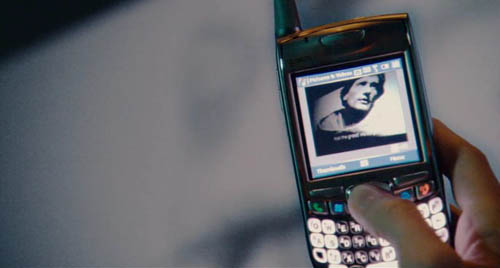
dig the mobile:
image missing

dig the sexy girl:
image missing

Movie is usually captivating, but every time Sandrine rides the train in the first half, it shows us the entire train ride. Goes beyond “setting the mood” and starts to get boring. Much improved in the second half (unlike most movies). A twisty little mystery movie… liked it.

a long train ride:
image missing

final shot:
image missing