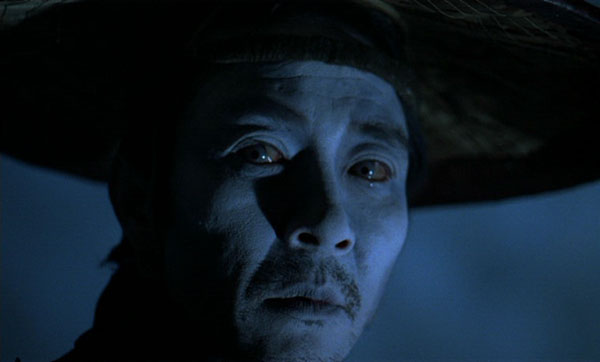
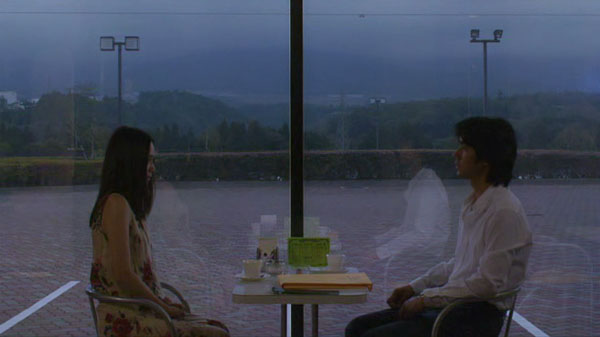
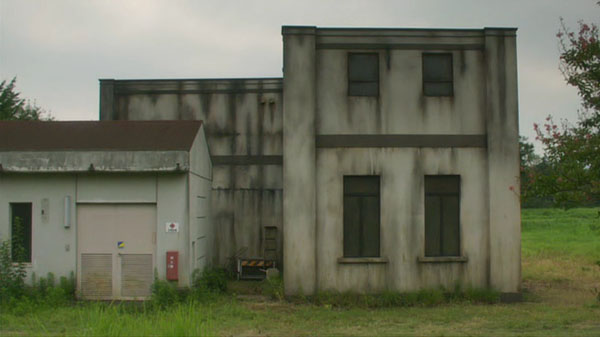
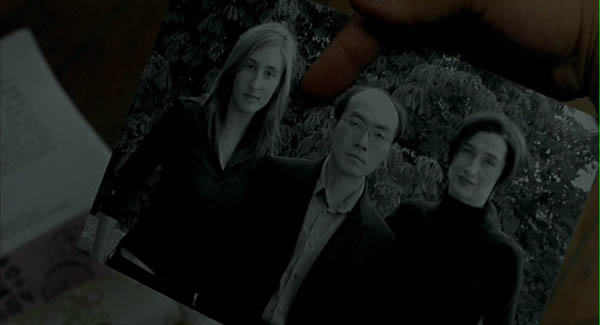
It’s been a pretty outstanding SHOCKtober over here. I did well to avoid the usual direct-to-video garbage of the last few years and watch stuff I’d actually heard would be good. So I figured I was due for a disappointment when I popped in Kwaidan, another period Japanese piece where everybody moves too slowly – another Ugetsu, in other words. But though it’s definitely true that everyone moves too slowly (and the more rich and upper-class, the slower they move) it’s an awesome looking movie, and even the stories I liked less were a pleasure to watch. I don’t know much about Kobayashi, but easily figured out that he had a background in painting. Watched the full-length version from Masters of Cinema.

1. The Black Hair
Rentaro Mikuni (The Burmese Harp, Vengeance Is Mine, Teshigahara’s Rikyu) is a samurai who has fallen on hard times. He has a good wife, Michiyo Aratama (Sword of Doom, The Human Condition, Ozu’s The End of Summer) but he “could not understand the value of love,” tells his wife “for men, advancement is the most important” and walks out on her, moves away and marries the daughter (Misako Watanabe of Youth of the Beast) of a rich man. But he finds himself unhappy, misses his first wife, so one day he throws it all away and returns to her, finding his property decrepit and run down, but her still sewing quietly in a corner. Or is she? After he pledges he’ll stay with her forever, she’s revealed to be a ghost. He ages about fifty years in the span of a minute, in a pretty awesome scene, then falls to the ground.

2. The Woman of the Snow
This one has the most remarkable images, which is good since I already know the story, first from Tales from the Darkside: The Movie but it also has similarities to The Crane Wife tale. A woodcutter (Tatsuya Nakadai, star of The Human Condition and The Face of Another, played the old king in Ran) is caught in a storm with an older man and witnesses a sort of Jack Frost woman freezing the man to death. She lets him live if he promises to never tell what he’s seen. Soon after, he meets a girl (Keiko Kishi of Early Spring, Sydney Pollack’s The Yakuza), falls in love, gets married, has kids, and one day laughingly tells her about that day in the snow, at which point his wife turns back into the snow demon and leaves him, saying if their children ever have reason to complain about his parenting she will return and kill him. The sky is a series of colorfully painted backdrops, often with an eye in the middle, always watching the woodcutter.

3. Hoichi, The Earless
I assumed for a while that the subtitles had missed a letter in “Fearless,” but no. This was the longest and best story. Set in a monastery near the site of an ancient sea battle, with head priest Takashi Shimura (the older detective in Stray Dog and star of Ikiru) and blind errand boy Hoichi (Katsuo Nakamura of Demons, Sad Vacation). Ghosts of the defeated army appear at a shrine and send a warrior to fetch Hoichi to sing them the story of the sea battle. He secretly performs for them all week, until the priest finds out, and tells him he’s in great danger. The priests write scripture across Hoichi’s skin – but miss his ears. The warrior comes and can’t find the singer, “I will take these ears to my lord to prove his commands have been obeyed.” The ghosts leave, and from then on, people come from all over and pay to hear the famed Hoichi the Earless play his music.
4. In a Cup of Tea
Kan’emon Nakamura (Mizoguchi’s 47 Ronin and Miyamoto Musashi) is a very serious warrior, a guard I think. He sees another man’s smiling reflection in a cup of tea, but drinks it anyway. The ghost (Noboru Nakaya, husband of the Woman in the dunes) appears “in person” with his retainers, challenging the warrior, who finds he cannot fight them since they can disappear at will. But all this is a story being written by an author (Osamu Takizawa of Fires on the Plain) who goes missing until his reflection is seen inside a pot of water – the weirdest of the four stories, and a good one to end on. Kobayashi made 20-some other movies, all of which I must see immediately.
This was to be the U.S. premiere with director in attendance until the stupid New York Film Festival stole him away. Still, third U.S. screening ever for a top-shelf auteur’s new Cannes-winning feature ain’t bad for Emory. Too bad they couldn’t drum up more interest – maybe 40 people in attendance. Too bad it played from DVD (in a room with a 35mm projector), also. Atlanta film culture sucks.

When I saw Tropical Malady I fell for the atmosphere (there wasn’t much else to that movie but atmosphere), the sounds, the magic and the jungle. Syndromes and a Century added slow, quizzical camera moves and characters with shifting identities. So this one was the best of both worlds, like a small set of Syndromes characters plopped into Malady’s magical forest, still feeling more like an original vision than a retread.

Boonmee runs a farm in the country, has a personal nurse (an immigrant, possibly illegal, from Laos) to tend to his kidney problems. Jen (sister of B’s late wife) and Tong (a young relative, maybe a nephew) come to visit from the city. It’s a peaceful tour around the farm until Boonmee’s wife Huay materializes at the dinner table, and then his son Boonsong emerges from the forest. Boonsong had been lost to the family for many years, having run into the forest to start a family with the monkey ghosts and apparently become one himself. Of course all this is strange, but only Boonmee realizes his family has returned because he is about to die, so the next day he tries convincing Jen to move to the farm. Finally Huay leads the three (Boonsong has left) into the jungle, and into a giant cave, where she drains her husband’s kidneys one final time. At the funeral Tong is made a temporary monk, but is uncomfortable so he visits Jen’s hotel room where she’s counting gift money with her daughter, and takes Jen out to get some food. But after they get up from the bed and start to leave the room, they also remain on the bed watching TV – a final bonkers scene in case the audience got too complacent after Boonmee’s death.

Unless it happened when I left to use the bathroom, Boonmee never vocally recalled his past lives, but there are unexplained scenes which might refer to them. The movie opens with a cow (NYFF says it’s a water buffalo) snapping its rope and lumbering into the forest, maybe glimpsing a monkey ghost before being retrieved by its keeper. Late in the film there’s a photo montage of soldiers who apparently capture a gorilla. And in the middle there’s a scene with a princess stopping at a waterfall on her way through the forest. She intends a tryst with one of her servants (seemingly not their first) but drives him away, accusing him of loving only her status, not her beauty. Then she peers into the lake and sees herself beautiful beneath the water, wades in, dropping all her jewelry, and has sex with a flattering catfish. Was Boonmee the catfish? Did his hookup with the princess provide the bad karma that led to his kidney ailment?

I knew I recognized Tong, but didn’t realize he played the monk in Syndromes and a Century. That’s interesting, since he’s play-acting as a monk in this movie. He was supposed to only stay a few days but ditched on the first night, showering and changing into his street clothes at Jen’s place. In Syndromes, the monk wanted to be a DJ, and denied another character’s story of reincarnation. Before that, the same actor played a character named Tong in Tropical Malady – a definite thread through Weerasethakul’s last three features, even if recognizing that thread doesn’t clear up any of their mysteries.

Watched again summer 2011 with Jimmy, this time on handsome 35mm at Cinefest – lovely! I’m sure that photo montage with the soldiers/gorilla and the incongruent voiceover is important, given that it comes right before (or during) Boonmee’s death, but still can’t figure what it means.

A.W. says that parts (the cheap gorilla suit?) were inspired by classic Thai TV and cinema, that his father died of kidney failure, and that there are plenty of deleted scenes with the princess that he hopes will be on the DVD.

Welcome to a special SHOCKtober edition of The Last Ten Minutes, in which I find horror movies on Netflix streaming which I may have actually been tempted to watch (because I am stupid and will watch any trash some days), and remove that temptation by seeing how they end.

Howling VII: New Moon Rising (1995, Clive Turner)
A made-for-TV inspector is clumsily explaining the entire movie to priest John with copious flashback scenes. Ted (played by the director, who was also a producer on Lawnmower Man 2: Beyond Cyberspace) is a longhair biker rebel suspected of killing all the townsfolk, but the inspector is saying it wasn’t Ted. Later, a girl named Cheryl is even more clumsily explaining to Ted that she’s the werewolf. Does the whole movie consist of long explanations by terrible actors? Oh no, here’s a heinous morphing effect, then the townsfolk shoot the Cheryl-wolf to bits, and a county band plays us out, first apologizing to Ted that the whole town thought he was a werewolf. The music was the best part, all extended guitar solos, doing its own thing in a way reminiscent of Rollergator. This is the last Howling movie to date, though I’m sure they’ll remake the original any day now, since they’ve already done Pirahna.

Ghost Ship (2002, Steve Beck)
Cool music. First words I heard: “Murphy’s dead.” Shit, Murphy was Gabriel Byrne, and he’s the only reason I’m watching this – not for Julianna Margulies, beach-blonde Ron “Deep Impact” Eldard or a possessed-by-evil Desmond Harrington. Yay, blondie shoots the evil guy… but evil cannot be killed with a shotgun, as proven by a dodgy computer morph. Boat explodes, Julianna escapes, but a metal song indicates the evil is still alive. Director Steve Beck (13 Ghosts remake) went on to make… nothing. Good.

Day of the Dead Remake (2008, Steve Miner)
A room full of attractive young people led by Mena Suvari (Stuck) are in a bunker. Wow, the zombies can dodge bullets in this one. “He’s smarter than the others.” Oops, Nick Cannon got eaten. Makeup budget must have been low because whenever they show zombies, the camera goes all freakity flop. A zombie shot a zombie, and the kids rig a giant flamethrower that infernoes the whole place except for their little room. Whatever, looks bad all over. From the director of House and Lake Placid and the writer of Final Destination.

Shrooms (2007, Paddy Breathnach)
Lindsey Haun, I suppose, prowls a spooky house with an axe. Now they’re in a forest. I know from the netflix description that they all took killer shrooms so maybe nothing that is happening is really happening. Ah indeed, in the hospital Haun realizes that she was the killer all along. She took shrooms and killed all her friends! Haute twist.

Machine Girl (2008, Noboru Iguchi)
Hoo, some silly-ass special effects. Serious-looking schoolgirl Ami with machine-gun arm and her friend Miki with chainsaw foot kill yakuzas in the woods. Ami is badly bloodied by ninja lady with steel drill bra, then bisects the heads of the baddies. Naturally from the writer/director of RoboGeisha.

American Psycho 2 (2002, Morgan Freeman)
Netflix say: “Patrick Bateman is dead, but his evil legacy continues with Rachael Newman, the only victim who managed to escape Bateman’s grasp. Rachael will get rid of anyone who threatens her chances of becoming teaching assistant to the infamous Dr. Daniels.” Hmm, Mila Kunis is telling William Shatner (via answering machine) that she loves him. In flashback, she steals some girl’s identity and talks to herself all the time. I think this is supposed to be a comedy. I wonder if Bret Easton Ellis got paid for this. She kills herself in a car… or does she!!… followed by a news montage, then the infamous Daniels (dude from a couple vampire TV series) giving a lecture and she shows up. Looks stupid, but it might’ve been less stupid if it hadn’t pretended to be an American Psycho sequel. Freeman is sadly not the great sad-voiced actor but some nobody with the same name, and the writers of this movie fortunately never worked again.

The Signal (2007, Bruckner/Bush/Gentry)
Bad guy is beating up good guy. IMDB calls it “A horror film told in three parts, from three perspectives,” so I guess this is the last ten minutes of the third perspective. Everyone’s face is awfully bloody. Bad guy, with a voice like Patton Oswalt’s, is having an argument with his wife-in-a-coma, then both guys have identity crises and Patton punches through one of many TVs showing “the signal,” electrocuting himself to death. Then I think there’s a fake epilogue but I don’t get it. I thought this one would actually be cool (I dig the premise) but the ending looks somewhat worse than Ghost Ship.

Subspecies (1991, Ted Nicolaou)
Two girls (the Demi Moore one and the Catatonic Blonde) break free from prison but oops, Catatonic Blonde is a vampire. The evil vampire (Radu?) is a terrible ham, and what’s with his fake plastic fingers? Ooh, a shotgun-toting vampire hunter and a quick spot of stop-motion. Your standard swordfight ensues, along with a falling chandelier and some beheadings and everyone’s a vampire in the end. I think the bad guy has been in some Lars Von Trier movies, and I’m not sure who the vampire hunter was but he looked like a wannabe-Toulon. I also checked out the first couple minutes because I ain’t watching Subspecies without seeing Angus Scrimm in a Ludwig Von wig. Looks better than most of the Puppet Master movies, if that’s saying anything.

Subspecies 2: Your Sister is a Vampire (1993, Ted Nicolaou)
Michelle “daughter of Kirk” Shatner has come to fetch another girl from the castle. An old man sloooowly tries to stab a vampire, and his lack of haste is repaid by getting stabbed by a puppet. Evil vampire Radu is alive again and hammier than ever, until he’s stabbed repeatedly by the imprisoned girl amongst some sub-Evil Dead (sub-Subspecies, for that matter) puppet creatures. The original looked grudgingly watchable, but obviously sequels yield diminishing returns. Nicolaou, who helmed the ridiculous TerrorVision, would make two more Subspecies sequels then Puppet Master vs. Demonic Toys, all for the sinister Charles Band and his Full Moon Pictures.

The Astro-Zombies (1968, Ted V. Mikels)
Ted V. Mikels is maybe the only filmmaker I’ve ever met, but the only movie of his I’d seen was on Mystery Science Theater. Yay, John Carradine! He and crony William Bagdad (The Black Sheik in Head) are working on astro-zombie (read: dudes staggering around wearing rubber skull masks) brain transplants when Tura Satana and some actor from Agent for H.A.R.M. interrupt. The sound, lighting and editing are uproariously bad. Oh, I learned that bullets cannot stop a machete-wielding astro-zombie. Some people in suits tell us the moral of the story, and all was quiet for thirty-four years until Mikels and Satana made a sequel.

“I thought you were my dead husband, but you’re just a little boy in my bathtub.”

The director is a different person from Jon Glaser, the stand-up comic I’ve seen a few times performing with Jon Benjamin. IMDB says Glazer directed Sexy Beast, which I rather liked even if I don’t understand its cult reputation, and Glaser cowrote Human Giant and performed in Baby Mama, The Toe Tactic and Pootie Tang. I’m gonna say Glaser is my favorite Jon(athan) Gla(s/z)er at the moment, but Glazer could definitely catch up.

Impossible to watch without thinking of Ruiz’s Comedy of Innocence, also dealing with a kid renouncing his parents and deciding he is someone else, inexplicably and with full conviction, leaving the adults wondering how to react. Very different styles and stories, though. This time the kid (Sean) thinks he is Nicole Kidman’s husband reincarnated, leading to serious problems since they both wish for this to be true but she can’t have a love affair with a ten-year-old.

Also unlike the Ruiz, this kid has an explanation. Anne Heche (electrifying in this – high-strung, cruel and beautiful) and Peter Stormare (kind of a lump) are old friends (I think Stormare might be the dead husband’s brother, and Heche his wife, but don’t hold me to that) coming to a party at which Heche is gonna give Kidman a box of love letters Kidman had sent her late husband, but Heche panics, runs outside and buries the box, which is found by the kid. The rest doesn’t exactly follow logically – movie still has an air of mystery, of spiritual possession – but it’s a partial explanation.

Hot-tempered rich guy Joseph (Danny “son of John” Huston) is to marry Kidman soon, so he doesn’t take well to the kid’s claims. He and gentle, logical Bob (must be someone’s brother, played by Arliss Howard: Cowboy in Full Metal Jacket) and Kidman’s pregnant sister Laura (Alison Elliott of Wings of the Dove) help her work with the kid (whose parents, completely at a loss, allow him to stay over unsupervised), trying to find holes in his story or understand his motives. I liked the movie very much, but the main problem I had was with its attempt to have it’s realism with its mysticism, sending first Nicole then Bob into a room to disprove the kid for two hours then show them bowled over by a couple correct anwers and elide whatever happens for the next hour and fifty-eight minutes, or making his parents total pushovers who stay away from Kidman’s house – always conveniently cutting to prolong the confusion, which contradicts the reality of all these suspicious adults who are supposed to be searching for the truth. If the movie isn’t going to take the approach of an airtight psychological mystery with a twist ending a la Shutter Island, I’d have preferred it head more towards the inexplicable Comedy of Innocence than straddle the line between them. But no matter, it’s an utterly enjoyable movie with awesome acting and unique enough filmmaking (shimmering, closeup-happy cinematography by Harris Savides: Zodiac, Elephant) to get me all excited.

The whole happy family – that’s Lauren Bacall in front of the cake:

I admit I was looking for the twist ending. Even though we know Heche buried something while the kid watched, I’m wondering which adult would have convinced the kid to concoct this lie. Not his parents, who seem very upset. Nicole’s mom Lauren Bacall doesn’t seem diabolical. Jimmy the doorman (played by cowriter Milo Addica) is friendly with the kid but would seem to lack enough information to plot this out convincingly. I stopped guessing when the kid strips and slides into the bath with Kidman – no adult could brainwash a 10-year-old into being so unlike a 10-year-old. Finally, in the weirdest scene of any movie I’ve seen this year, Sean is tested by a creepy Anne Heche, who it turns out had a long, intense affair with the dead man, unbeknownst to Sean since it wasn’t mentioned in the letters. She then confronts him, hissing, shattering his illusions of true love reborn. Mercifully, Kidman never learns of the affair and goes on to marry Joseph. In an otherwise unreal movie, Kidman spectacularly creates a very real sense of loss, and Glazer and his cowriters (Addica who wrote Monster’s Ball and Jean-Claude Carrière, a lead collaborator of Luis Buñuel, which makes perfect sense) must have realized it’d be too cruel to push her any further at the end.

Anne Heche:

Peter Stormare:

Birth was shat upon critically and commercially, which is how it landed at number eight on The Guardian’s list of the ten most underrated films of the decade (between Inland Empire and Songs from the Second Floor). Coincidentally at number eight of their outright best-of-decade list is Dogville, another Kidman/Bacall movie by a filmmaker who gleefully pushes everything over the edge, who would have had Heche gleefully destroy Kidman, the bastard.

Bob comforts Sean after Joseph goes on a rampage:

J. Anderson:

A brilliant score by Alexandre Desplat underlines Birth and completes it, causing it to slide slightly off-kilter with a tinkly music-box jingle and an ominous, nervous thumping heartbeat backdrop. This musical duality meshes perfectly with the fabric of Birth, in which Anna must choose between an impossible true love and a possible false one. It’s a brilliant film, but not a happy one. The filmmakers seem to have begun at the point in which love lives “happily ever after,” discovering only bitter disappointment and misled hope instead.

Seki (Kazuko Yoshiyuko of Lady Snowblood 2, Kikujiro) is married to a decent guy, the town’s rickshaw driver Gisaburo (Takahiro Tamura of 24 Eyes, Seisaku’s Wife), but young Toyoji (Tatsuya Fuji, the killer’s father in Bright Future) falls in love with her and ruins all that. One night, in an unexpectedly frank bit of sexuality (later note: not frank at ALL after watching In the Realm of the Senses), he’s going down on her and orders her to shave. A couple hours later he matter-of-factly tells her that since she’s shaved, her husband will suspect them, so they’d better kill him. So they do, strangling the guy and dropping him down a well. Three years later the townspeople haven’t seen their taxi driver around but his ghost has been spotted, Toyoji seems to spend an awful lot of time at Seki’s house and is seen lingering at the well, Seki’s daughter is asking questions and nobody doubts what’s going on… only a matter of time before the cops (led by Takuzo Kawatani of The Burmese Harp and Battles Without Honor & Humanity) catch up and hang ’em. But things get worse before that – Toyoji kills the young master of the property where he works and Seki goes blind.

As with Senses, this is based on a true murder from 1896. This one has more town life in it, more theatrically heightened colors, maybe more traditionally studio-looking shots. A very Japanese (pre-Ring) ghost, Gisaburo dressed as he was when he died with an all-white face, wordless. Some wonderful shots from inside the well, as seen on the box art. I failed to get screen shots, so I’ve stolen a couple from DVD Beaver. I liked the movie a whole lot… not a groundbreaking story, but well told with a nice visual style.

image

If I may quote heavily from Tony Rayns’ great essay:

What intrigued Oshima so much in the story of Gisaburo and Seki? First and foremost, the fact that it bore witness to an eruption of amour fou in a social setting where such passions were previously unrecorded. Western literature from the Middle Ages to the nineteenth century—from Geoffrey Chaucer to Émile Zola—had acknowledged and explored the sex lives of the rural peasant class, but there was no real Japanese equivalent; the bawdy fiction of the Edo period had dealt exclusively with the love lives of the samurai and merchant classes. Oshima responded to the factual account of a torrid affair between a married mother of two and a recently discharged soldier twenty-six years her junior. … He recognized the story as an interesting counterpoint to the one he had told in In the Realm of the Senses. Sada and Kichi had retreated from the increasingly militarized Japan of 1936 into a private world powered by their own sexual fantasies; Seki and her lover, Toyoji, lived out their adulterous passion in a world circumscribed by the laws of nature and the rural traditions of village life. For Oshima, the key element in the story was their defiance: the realization that their affair and their murder of Seki’s husband would be exposed rekindled their passion and made them recklessly indifferent to their punishment.

Oshima has said that he reads the tradition of vengeful spooks as a phenomenon related to the militarist code of Bushido—which he has always vehemently rejected. He sees Gisaburo’s ghost as coming from somewhere very different; he once told me, “The ghost in Empire of Passion is a farmer’s idea of a ghost, not a samurai’s.” Gisaburo, in fact, accepts his sad fate as passively as Kichi succumbed to Sada’s murderous fantasies in In the Realm of the Senses. He doesn’t return to the village as a ghost because he wants revenge but because he’s an unquiet spirit; he appears beside his old rickshaw because he wants to go on serving his wife and the villagers, and beside the hearth in his old home because he still wants the comforts of a pot of warmed shochu liquor. He represents, of course, the guilty conscience of his murderers, not assuaged by emptying dead leaves into the well where his body was dumped, and the collective disquiet of the community that a crime has gone unpunished.

Where is Oshima himself in all of this? … The figure he is closest to is the village’s young master, who also represents the author in Nagatsuka’s novel; he’s the most educated person in the community, the most clear-sighted, and the most ineffectual. First seen at his wedding ceremony, he’s played by Kawarazaki Kenzo, the same actor who stood in for Oshima in the tortured family saga The Ceremony. The young master stands for modernization and “progressive” ideas, but he’s fated to be silenced by an ex-soldier who can think no further than self-preservation. The character’s death suggests that the pessimism that led Oshima to abandon filmmaking in the early 1970s was undimmed.

image

Oshima:

The space in Senses was delineated by the different rooms of love. It was artificially created, completely designed for voluptuousness. On the other hand, in Passion it is all about nature. Seki has a house where she lives with her husband, and Toyoji a small hovel that he shares with his young brother. Neither of these places is artificial. The two lovers live in fear because they constantly feel threatened by nature. I am trying to depict the human condition in its primal stage. In that sense, my new film goes back to the roots of all life, much more deeply than Senses ever did. The lovers seem cast into hell because of their sexual urges, but in my opinion, the rumbling of the earth, the murmur of the wind, the rustling of the trees, the songs of the birds and insects, in short, all of nature, is guiding the couple into hell. And the ghost itself is part of nature. Neither sex nor love has any meaning. Life itself has no meaning. And if it doesn’t have meaning, isn’t it hell? All I can do is express and project before you this human life devoid of any meaning, this hell that for me is always beautiful.

I found, several years after directing my first films, that I was very attracted to these two topics, sex and crime. Subsequently, my films have addressed them in a very analytic way. Today, I’m at a stage where I simply like to project the naked reality of sex and crime before the spectator’s eyes.

I had to interrupt this movie the first night I watched it, and I finished it the next night. In between, I was at Acapella and picked up the book on K.K. by Jerry White and flipped to the back, where he calls this movie an utter failure of storytelling. I didn’t read any more, wanted no spoilers, but I hope White at least found something to like about this one, if not the story, because I liked it quite a lot, and thought it was better than Kurosawa’s follow-up Retribution.

Starring Miki Nakatani of the Ring series and Chaos, title star of Memories of Matsuko
image

It’s similar to Retribution… a ghost-revenge story with only a few characters set in old, run-down buildings with sudden shocks and supernatural occurrences in broad daylight. Atmosphere and cinematography (by the same guy as Retribution) are ace. Movie is horror, but it doesn’t seem to know that it’s horror. As with all of Kurosawa’s movies, the genre cliches aren’t there, the music and camera and lighting and characters don’t do what you’d expect. They do get panicked and frightened, but they’ll also walk knowingly into danger and stare at the ghosts, looking slightly sad or tired, not necessarily afraid. Very cool movie, not one of Kurosawa’s very best but it’s got me looking forward to Tokyo Sonata again.

At right, Reiko’s book editor Hidetoshi Nishijima, star of License to Live, Bug House and Kitano’s Dolls
image

The story is a little baffling, but KK also wrote Charisma, so baffling ain’t unusual. Reiko’s editor gets her a quiet place in the country where she can write her next book. She meets her neighbor Yoshioka, a university professor with a 1000-year-old mummy (which moves by itself occasionally) in his room. The professor isn’t sure if this is the same mummy that was dug up 80 years ago, but he watches a time-lapse film of that previous mummy just to confuse us a little more. We’re not sure if he’s dangerous or just a crappy professor, but he seems nice enough to Reiko.

The anthropologist is Etsushi Toyokawa of The Great Yokai War and Boiling Point
image

Besides the mummy moving about, Reiko is being haunted by the ghost of a young girl. Graves are dug, bodies are carried around, a foggy pier is discovered, Reiko is vomiting black mud (this was happening before she even moved into the house) and somehow Reiko gets her book written. Her editor shows up and terrorizes her for no clear purpose until it turns out he rented the same place to a previous writer (the young ghost-girl) and murdered her. Reiko would be next but the cops bust him just in time. She burns her book and Yoshioka burns the mummy. Then they go for a walk to the foggy pier, where the ghost knocks Yoshioka into the swampy water for some reason!

Spooky loft
image

The ghost/girl isn’t in every scene, she’s just somehow in all of my captures
image

“Something is going to happen.”

I enjoyed the movie a lot, more than the other post-breakdown Rivette films I’ve seen. Along the way, tried to draw connections to his other work and figure out what it all means. Might be difficult since I haven’t watched related works Duelle and Noroit yet, but this was supposed to be part one of the still-unfinished four-part series, so I thought it might work.

We’ve got such Rivette favorite themes as…

Performance and ritual:
image

…secrets hidden in an old house:
image

…and a sinister photograph:
image

We’ve got such late-period trademarks as the fade to black after each scene, the ordinary household details of daily life, and the minimal music score.

So yeah, I followed the story, tried to figure out what was happening and why, and guessed I had an alright grasp of things. Bopped around the web looking for opinions.

DVDverdict didn’t like it much:

Béart and Radzilowicz, improbably matched as lovers but fine as actors, go through their paces with all due seriousness, but in the end there’s little momentum, little of interest, and little reward. At the core of the story is forbidden love, and what we will do in its name, but Rivette’s proficient, clinically precise filmmaking refuses to embrace the one element of his story upon which even Marie and Julien’s personal tragedies hinge.

On a separate review on the same site, DVDverdict rather did like it:

One’s growing realization that the strange emotional affect of the characters, and dialogue that sometimes comes off as artificial and intellectually abstract, are both servants of plot and not merely pretentious art film conceits is a great source of delight.

Then I hit up Senses of Cinema, which proved that neither I nor DVDverdict had any idea what we were watching, and made me feel bad all week for not having thought of any of this stuff by myself.

Before getting into that, despite author Michael J. Anderson’s statement that “a traditional analysis which details the plot and characterisations utilised in the narrative is of little use in talking about Rivette’s film,” I’m gonna lay those out just so I don’t forget ’em later.

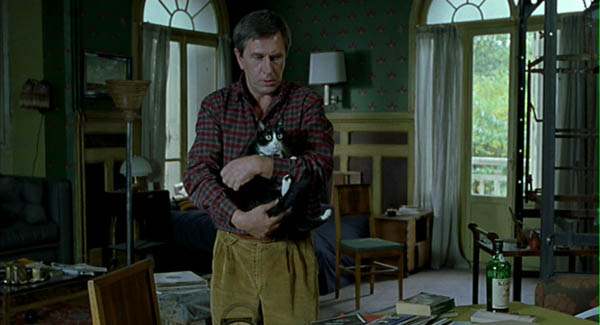
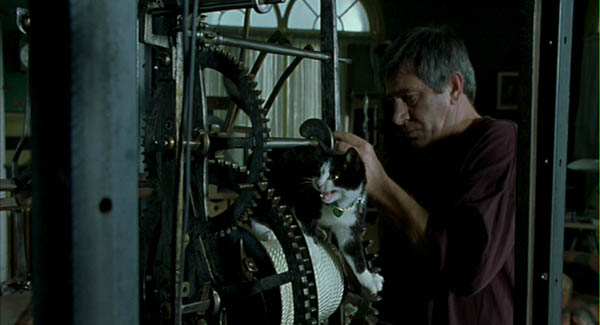
Julien (Jerzy Radziwilowicz, Walser in Secret Defense) works from home as a clock repairman, alone but for his cat.
image

He dreams of a chance encounter with Marie (who he met one time a year earlier) that ends with her trying to stab him. Goes out and has a chance encounter with Marie, who agrees to go out for coffee but never shows up. So he goes back to blackmailing Madame X (Anne Brochet, of Intimate Strangers and a 1992 French Phil K. Dick adaptation), who runs a phony business and may have killed her own sister.

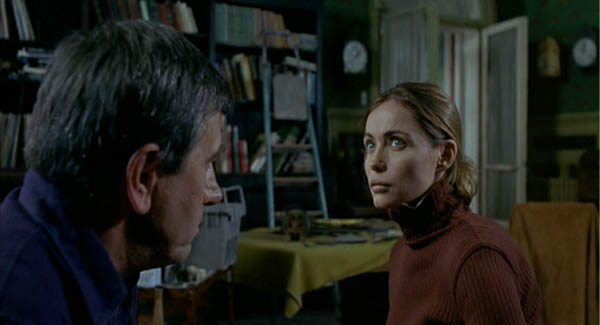
Finally Marie (Emmanuelle Béart, of La Belle noiseuse, Strayed, an Assayas, some Chabrols and Mission: Impossible) mysteriously reappears. They’re both lonely and attracted to each other, and he soon asks her to move in. Cue transition from part 1 (“Julien”) to part 2 (“Julien et Marie”).

Julien et Marie:
image

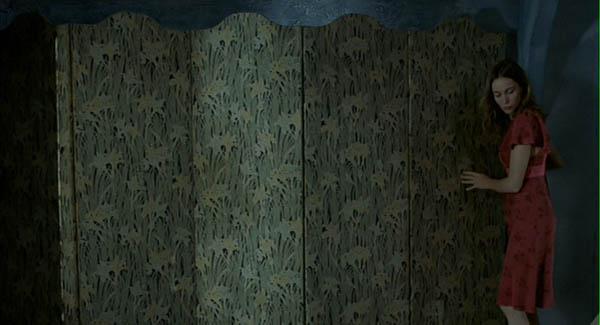
The two have hot role-playing sex together, finishing each other’s erotic stories. Marie moves in but remains mysterious, spends her free time secretly rearranging an upstairs room, and sometimes disappears to a hotel and has to be tracked down. She is let in on the blackmailing plot, but while Julien is meeting with Madame X, Marie appears to be meeting with X’s dead sister (Bettina Kee of Va savoir).

More dead than alive:
image

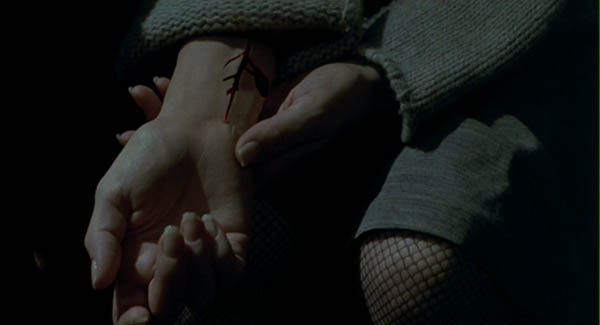
Things get more ghostly when Marie also appears to be dead, having killed herself months earlier after an argument with her then-boyfriend, as we move to parts 3 (“Marie et Julien”) and 4 (“Marie”). Keeping in mind the dream at the beginning and the unreal tone to the meeting pictured above, I start to wonder which parts of the story are actually happening.

Marie acts more strange, starts chanting in a foreign language, and remodels the upstairs room to look exactly like the one in which she hung herself, then is stopped by Julien when she tries to ritualistically repeat that action. The blackmail plot plays out, and the two sisters meet and work things out.

image

“Now I am yours. You are mine. Where I must go you will accompany me. For what I must do you will help me. Don’t fail me, or you will lose the very memory of me.”

Julien rebels and it happens. Marie disappears to him, though we still see her. This is where an ordinary ghost story would end… he broke the rules and the prophecy came true… but Marie becomes real again, her blood is restored and they get their happy ending.

image

Oh, and I’d read an article on Kino Slang a while back about this movie but had forgotten and thought it was referring to Duelle. Fun to watch the documentary moments in the film as Julien’s cat responds to the camera crew and boom mic offscreen.

Alas, 30 years on, Rivette gets reproached when in Histoire de Marie et Julien he crystalizes some of his former narrative terror and anti-illusionism into one brief shot of a cat on a man’s chest recoiling from the camera and the boom, the whole appartus bearing down on them in a tracking shot. A Bazinian anti-illusionism. Once the camera settles, the cat stares up at the boom mic. Perhaps the man is “covering” for the cat when he looks up too and says “nosing around upstairs again?

image

On to the great analysis from Senses of Cinema:

Rivette structures his film not as a dream or a series of dreams, but instead eviscerates any distinction between dream and reality, establishing a logic present only in fiction – there is no distinction between consciousness and subconsciousness, dream and reality, life and death, but rather, all is fiction.

With the opening “Julien” intertitle, Rivette suggests that this character may be constructing the narrative: for instance, there is simultaneous depiction of desire (that Marie needs him, that she is free, that they meet on the street; and more directly later in the film, a cut from Marie stroking Julien’s arm to the pair making love) and anxiety (the knife, the fact that she stands him up) woven throughout the opening section of the film. Yet, this evident focalisation – the narrative being told through Julien – does not last, as Marie quickly becomes a co-creator of the pursuant narrative. In a more directly self-aware moment of creation, for instance, Marie speculates about two sisters in a photo that she and Julien are examining: “one is dead, the other alive.” Likewise, Marie asks Julien to tell her about the “forest”, which leads into an erotic fantasy narrated first by Julien, and then by Marie herself. (At this point they are co-creators of the narrative, taking turns constructing the incident.) Moreover, there are also scenes in which Julien plays no part at all, such as a mysterious nocturnal meeting – that once again Rivette suggests may be a dream – between Marie and the dead woman from the photo, who imparts a fragment of information and gives her a secret hand signal. And then there are also the subsequent intertitles: “Julien and Marie”, “Marie and Julien” and “Marie”, which similarly denote shifting narrative perspectives.

Indeed, if anything, Marie seems to occupy a special place in the narrative, as it is she and not Julien who seems aware of the fact that they are in a narrative.

And there’s more about the theatricality of the film… stuff that I should’ve been able to catch. Ugh… next time I need to either try harder, or find articles to read BEFORE watching the movie. Maybe I’ll try that with Duelle then see if I can fend for myself with Don’t Touch The Axe.

image

“Washingtonians” may still be the stupidest episode of this “Masters of Horror” season so far, but this one is outright the worst. The others have been falling over themselves trying to find a new twist (“I know! george washington was a cannibal! oooh, killer ice cream man and if you eat his ice cream you TURN INTO ICE CREAM!”), but this one gives us no reason to watch, recycling three tired old horror concepts and adding no new style or twist or excellence:

1. guy is afraid of a thing [water] and must confront that thing [go on a boat ride with his boss and boss’s wife whom guy is secretly sleeping with].

2. guy and boss have killed people in the past [guy’s brother drowned, boss killed his ex-wife] who come back as ghosts to haunt them.

3. things keep happening that were just a dream… or were they???!???!??????!!!?

image

Guy’s dead brother wasn’t killed on purpose so in the end he helps take care of the malicious dead ex-wife. Still, guy and boss’s wife are left floating out in the ocean at night, and guy is bleeding from the leg, so I hope sharks eat them before morning.

image

I only half paid attention. Writer of Ring/Dark Water (who is starting to seem obsessive about drowning) and director of Scarecrow and Ring 0. The boss played the lead in “Audition” and the not-as-good white guy starred in “Captivity”.

image

Watched many times before, but never in dolby disney digital 3-D with cool polarized-lens non-headache-inducing glasses! The 3D effect was great, adding layers of depth (not pop-out-of-the-screen gimmicks) to an already gorgeous movie. Of course seeing the movie on a big screen again gives new appreciation to the intricate visual details, but why were some of the camera-panning motion scenes so blurry? Did the 3D effect do that, or have they always been that way?

fun fact: Chris Sarandon, lead actor in master-of-horror Tom Holland’s “Child’s Play” and “Fright Night”, voices the non-singing Jack Skellington.

Katy sorta likes it. Maria did not. Kids today… sigh.

FEB 2017: Watched at The Ross, followed by a Q&A with the great Danny Elfman.
I think Katy likes it more than she used to.

DEC 2024: Watched at home in nice HD. Katy is now fully obsessed.