All along I thought this was a remake, but it’s full of references to the events in the Bernard Rose movie, so it’s either part three or a rebooted part two (nobody remembers Farewell to the Flesh, which starred some girl from The Gate). Bookended with scenes of murderous cops, artist Morpheus (The Matrix 4) learns from Colman Domingo that he was the bonfire baby from the first movie, so he becomes the new Candyman, his girl Lysistrata (Chi-Raq) along for the ride. I guess every generation has its own Candyman, and somehow bees are involved. Victims include an art curator and his Joy Division girl, a new white lady reporter, and a bathroom full of high school girls. A real obvious movie, but so was the original, and I like this one’s look (and love the shadow puppetry) so I declare them both to be Pretty Good.

Yankee… hotel…

Virginia “V-Mad” Madsen (Highlander II: The Quickening) is researching urban legends with friend Kasi Lemmons (Vampire’s Kiss), who almost sinks the movie as the rational best friend trying to hold back V-Mad from her suicidal quest. Rose and his Roeg-ian DP get some good light and imagery, but between the Philip Glass score and Tony Todd’s voice, the soundtrack is the star. Movie seems to get going when she’s beaten up in the bathrooms by a fake Candyman, but soon afterwards she awakens in Vanessa Williams’s apartment with a dead dog, a missing baby, and a knife in her hand, she’s on her way towards becoming an urban legend herself, starting with her faithless husband Trevor (a cop in The Guardian). Much is made of this movie’s themes of racial violence and gentrification, but little is said about how the backstory murder scene has Ted Raimi in it.

Fake Candyman:

Real Candyman:

It’s All For You, Damien:

Something is up with mirrors, and mom realizes the woman in the yard is her own confused, chicken-murdering self, or rather her suicidal ideation incarnate, and that she’s trapped in the mirror world, like if Us was 100x less interesting and featured Nosferatuan shadow-snatching. Yard Woman never seems to do anything, but all the pets are dead and everyone’s hurt and she’s spreading family discord, letting the days go by. Her first words are “how did I get here?” Mom saves the day by time-tunnelling into the gun locker(?). Cameo appearances: before dad’s fatal car crash they park outside a movie theater showing The Mirror Has Two Faces… and was that a Uneeda Biscuit canister in their shed?

We have found another great Ruiz movie – the cinematography and music in this are not kidding around. Like La Flor, it opens with a diagram of the movie’s structure, then proceeds to blend some of Ruiz’s favorite things (pirates, painting, mirrors) into a meta-narrative folding in on itself. Death is extremely temporary here. Throw in some cannibalism and incest. And of course there’s a Ruiz film with morphing in it, why wouldn’t there be?

Guy Scarpetta in Rouge:

Here, the familiar features of Ruiz’s universe – parallel worlds, baroque uncertainties, telescoping of different times, co-presence of multiple spaces, deconstruction of characters, transgression of every parameter of classical narrative – are subject to an overflowing enthusiasm and gamesmanship … But we must not conclude that the film proceeds from the pure arbitrariness of an unbridled imagination. Quite the contrary, and this is the first great paradox to be emphasised: nothing, here, is left to chance … Nine narrative themes (in principle autonomous, heterogeneous) are posed as the raw material … the entire combinatory consists of making these cellular narratives cross each other’s paths, whether two by two or three by three, and also consecutively – each of these telescopings engendering, almost automatically, a specific narrative (one which logically implies that the characters can double or reincarnate themselves, leap time frames, and belong in several places at once).

Long, and feels long. Few living birds, glimpsed in the distance, two dead ones, some feathers, sounds of owls and peacocks. Life and death of parents and grandparents, becoming trees and birds. Imagery of water, using mirrors and photos, watching a photo develop, brings to mind Strong Island until I realized Oliveira must be an influence. Reversing (adding leaves to the trees), time-lapse (flowers opening). Dad reads the movie’s script and quibbles with the details. They burn their grandparents’ letters, she says they’re the private words of a couple who happens to be their grandparents, but we are free to imagine their words – and so we do. She asserts her right to imagine her own family stories, connects to historical artworks, seeing her family in an unrelated painting. Katy compares to Beaches of Agnes – ways to structure memory, using frames + mirrors, life as theater or frames artworks.

My favorite movie of the fest. Tortoise-lite trio Square Peg Round Hole opened, we both liked. The Butch Jones at Cafe Berlin combines their apples + sausage with pancake/egg/bacon, and is the best conceivable breakfast. Overall a good morning in Columbia.

Kaili Blues (2015)

Watched this on Criterion to see what this Bi Gan guy is about, since Long Day’s Journey had apparently bypassed our city… then it opened the following weekend and we ran out to see it. They’re both set in the same area – Kaili is southeast of Chengdu, halfway to Hong Kong. Both movies center around an epic long take, the camera traveling all over town following a protagonist in pursuit of something. And they both have a slow, dreamy atmosphere. I thought of Tarkovsky more than once, and in the Kaili Blues extras he says watching Stalker changed his feelings about filmmaking, and I thought yes, of course.

Mirrors, watches/timepieces, a “wild man”, and talk of being in a dream. It’s kind of a journey film, as Chen heads to Zhenyuan (a two hour drive, if Chen had a car) to find his nephew. Characters are named Crazy Face and Piss Head, Chen gets rides from a rock band and a bullied guy, fails to deliver a shirt given by his doctor friend, also fails to pick up the nephew, though we’re led to believe the kid is fine. But there are ghosts and doubles along the way, subtle suggestions that we’ve become unstuck in time and narrative, and Shelly Kraicer’s Cinema Scope article does a good job sorting them.


A Long Day’s Journey Into Night (2018)

Darker, more sumptuously dreamy, and certainly longer than its predecessor (with a longer and more apparently complicated single take at the end). The Tara didn’t care to show it in 3D, I guess. Its New Year premiere in China was controversial for supposedly tricking people into seeing a slow art movie that nobody understood, but the one person I talked with in China who’d watched it said it was great.

Luo wanders Kaili, haunted by the deaths of his father and a friend, searches for a lost love (Wei Tang, Thor’s girl in Blackhat), and runs into his friend’s mom (Sylvia Chang the boss of Office, which IMDB has decided to rename Design For Living). We also meet people who may exist in alternate or dreamed timelines, which is to say that Luo beats his own non-existent son at ping pong.

Blake Williams in Cinema Scope:

By car and by foot, Luo follows her, much to her concern, and then loses her, much to his recurrent perplexion. Unable to grab onto anything solid in the present, he dips into his memories with her, flashing back to their days of being wild (circa the turn of the millennium), when her materiality was less unstable. Crime and jealous boyfriends adorn the architecture of Luo’s memories, which are presented in murky enough vignettes that we’re never sure if he’s recalling an actual event or some movie he once saw; most likely, he’s fusing the two together … If Bi’s cinema has been clear about anything so far, it’s that he is completely unburdened by narrative cohesion.

Lance Henriksen is sent by a corporate board of sinister white men to date and impregnate Barbara, who is afraid of her own eight year old daughter Katy, who caused an explosion to win Atlanta a basketball game. But first: bald children, wicked clouds, John Huston in an Obi-Wan robe and an unhappy-looking Franco “Django” Nero, who I found out from the closing credits was supposed to be Jesus Christ and whose opening narration sounds an awful lot like Star Wars with the names replaced by Bible characters. This all sounds nuts, and it is – a lost classic of cheesy/weirdo horror cinema revived by Drafthouse Films.

Unhappy Jesus:

After the bonkers intro it’s back to the family scene, which is playing out like We Need To Talk About Katy. Soon Katy shoots her mom (Joanne Nail of Switchblade Sisters and Full Moon High), who is then confined to a wheelchair and hires Shelley Winters (of Bloody Mama and Tentacles) as a housekeeper who might be working for God/Huston. Shelley affects nothing in the household besides bugging everyone by singing “mammy’s little baby loves shortnin’ bread” and saying things like “A great philosopher said that our characters are our fates. And some scientists now believe that planets somehow understand this.”

Shelley introduces herself and her finches:

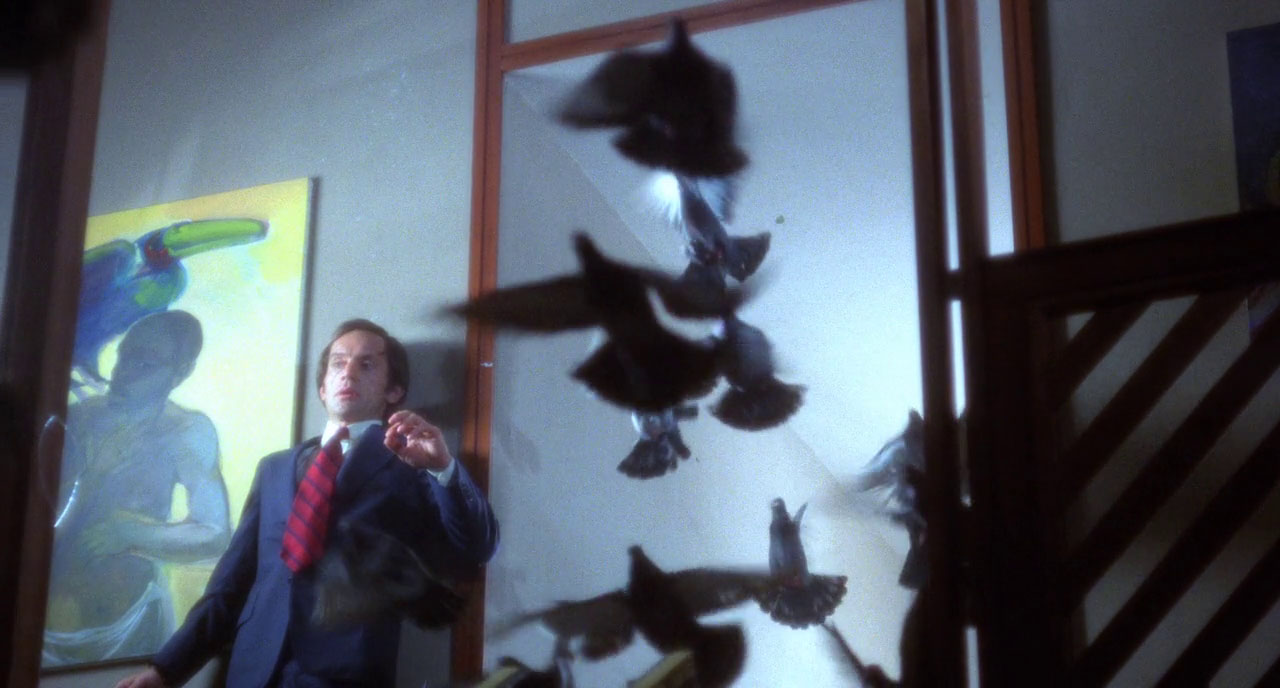
Huston (the same year he made Wise Blood) is God, who works in mysterious ways, allows Katy to kill the Atlanta cop (The Big Heat and Experiment In Terror star Glenn Ford) investigating her mom’s shooting, then after many scenes standing on Atlanta roofs frowning at the sky (and after playing Pong on a projection screen with Katy) he finally kills her and Lance with a flock of pigeons.

Playin’ Pong with God:

Huston looks surprised at what he’s done:

Have I mentioned that Katy’s Satan-Falcon kills a cop by messing with the street lights?

Or that between Pong and the pigeons, there’s a Lady From Shanghai funhouse scene?

Lance was just off The Omen 2, which this movie is ripping off. We’ve also got Sam Peckinpah (who I just saw in Invasion of the Body Snatchers) playing Barbara’s ex, and the leader of Lance’s white-man cabal is Mel Ferrer (of two unrelated films both called Eaten Alive). Director Paradisi had bit roles in some Fellini films, also made a movie called Spaghetti House, and cowriter Ovidio Assontis also produced Pirahna 2: The Spawning, as his IMDB bio mentions proudly. And have I mentioned this was shot in Atlanta?

The narratively-straightforward centerpiece of the Orphic Trilogy. Like Beauty and the Beast before it, it’s full of visual effects, mostly with easily identifiable techniques – reversing the film, tilting the camera, a mirror, rear projection – but so handsomely shot and elegantly presented as to seem fantastically unique. I don’t quite understand the point of the Orpheus myth, why his wife is taken away as if she’s a toy, but Cocteau redeems it with his “it was all a dream” ending, the couple back together (and expecting a child) while their now-forgotten underworld lovers are punished for meddling.

Jean Marais (Cocteau’s ex-boyfriend, returning from Beauty and the Beast) is the title poet, nationally famous, but hated by the locals. I suppose they consider him a sellout. Cocteau makes these kids out as an unthinking mob always looking for the next new thing – a response to his own audiences after he’d become famous himself? He’s married to the beautiful Eurydice (Marie Déa of Les Visiteurs du soir), but mostly ignores her, concentrating on his work. Meanwhile, the kids are swooning over young poet Cegeste (Edouard Dermithe, Cocteau’s current boyfriend, also lead in Les Enfants Terribles).

Orpheus and his death:

But Death comes for Cegeste – Death in the form of Princess Maria Casares (Children of Paradise), who runs him over in the middle of a crowd, then takes him away along with Orpheus. Since the townspeople have never seen her, her car or the two motorcyclists that accompany her, but they see Orpheus’s conspiratorial-seeming involvement, they come after him with weapons towards the end. But first, either the Princess or her buddy Heurtebise (Francois Perier of Stavisky and Gervaise) kills Eurydice out of jealousy, H. leads O. on a tour of the underworld, and the agents of Death fall in love with the poet and his wife, and vice versa. Cegeste, meanwhile, is happily writing messages for broadcast on Death’s private radio network, and back in the real world, Orpheus sits in Heurtebise’s Rolls all day, listening and transcribing the poetry from the airwaves – which only gets him in further trouble with the mob when they realize he’s ripping off the unpublished work of their missing hero.

Cegeste gets carried away:

Quoth IMDB: “Orphee’s obsession with deciphering hidden messages contained in random radio noise is a direct nod to the coded messages that the BBC concealed in their wartime transmissions for the French Resistance.”

And quoth Cocteau, “I have always liked the no man’s land of twilight where mysteries thrive. I have thought, too, that cinematography is superbly adapted to it, provided it takes the least possible advantage of what people call the supernatural. The closer you get to a mystery, the more important it is to be realistic. Radios in cars, coded messages, shortwave signals and power cuts are all familiar to everybody and allow me to keep my feet on the ground.”

My favorite stills from this movie have been on my PC screen saver for years, so I tried to get some different ones. This is from a great subjective shot which seems simple until you realize those can’t be Marais’s hands, nor his reflection:

Cocteau again:

Among the misconceptions which have been written about Orphée, I still see Heurtebise described as an angel and the Princess as Death. In the film, there is no Death and no angel. There can be none. Heurtebise is a young Death serving in one of the numerous sub-orders of Death, and the Princess is no more Death than an air hostess is an angel.

The way the French words “my death” are pronounced in this movie, in combination with seeing those words on the subtitles, “my death”, and pondering their meaning. Does everyone have his own death? And like Cocteau is saying above, the Princess isn’t “Death” in the way he appears in The Seventh Seal. She’s an employee of a system, subject to judgement, part of a bureaucracy so vast that someone mentions orders bouncing from place to place, with no identifiable origin. It’s details like this which lift the movie from a well-shot retelling of an ancient myth into something original and exciting.

Orpheus glimpses his wife in the car mirror:

A chronological romp through Varda’s life and work. Exciting and wonderful and gorgeous and traumatic and mischievous. More inter-intra-self-referential than even 101 Nights of Simon Cinéma, which of course this references more than once. The perfect summary and closer to Agnes Varda Month, and possibly to the great woman’s filmmaking career (we’ll see).

EDIT Aug 2019: Nope, she had at least three more features in her. Watched this with Katy, and it turns out it’s great no matter how many/few Varda movies you’ve seen previously.