I can tell this is a film that should be seen in a theater, no, that needs to be seen in a theater. It has no story, but unlike a Brakhage film which you may want to study at home and watch over and over, this is meant as an experience, more a ride than a movie. So I’ve done the movie great harm by watching it on my laptop, a reproduction of a reproduction of a TV screening, all low resolution with the corner of the image defaced by a station logo. One could already convincingly argue that I haven’t seen La Region Centrale at all, under those conditions – but wait, it gets worse. The experience builds (probably) over its three-hour running time, becomes (probably) more mesmerising and abstract as the third hour wears on. But I kept putting it on after midnight then falling asleep watching it, continuing the next night, as if picking up the story where I’d left off. And wait, there’s more. I thought for sure I could handle the last 45 minutes at a time without falling asleep again (wrong, lasted 35) but I soon got tired of the constant whirring sound effects (conforming to the strict rule that avant-garde films need always have annoying soundtracks) so I muted the movie and put on the latest Mogwai album instead.

All these crimes I committed against the movie, but I still liked it quite a lot, certainly better than Wavelength. Most of the Michael Snow movies I’ve been able to see have been interesting, but also more fun than tedious (again, all but Wavelength) which is exceptional in the avant-garde scene.

The writeup at Shooting Down Pictures is better than anything I could come up with:

Arguably the first feature filmed by a robot, Michael Snow’s three hour exploration of the possibilities of camera movement over a barren Arctic landscape suggests many things: sci-fi space probe footage more authentic than George Lucas; a rebuff to the romantic frontier landscapes of Hollywood Westerns; an avant-garde equivalent of an amusement park simulator ride. Lensed by a specially designed rotating camera mount pre-programmed to move with stunning variety, the film begins as a slow, soothing meditation on the otherworldly textures of the Canadian wilderness, but gradually morphs into a dizzying, terrifying freakout, a relentlessly spinning gaze that pummels the equilibrium of the human eye. The film pushes the boundaries not only of human sight but of the physical earth, destroying gravity and transforming a lifeless vista into a cosmic force of light and energy. Clinically scientific in its approach yet yielding an organic, even spiritual wonder, La region centrale does not merely vindicate the oft-neglected genre of experimental film, but thrusts itself into the center of cinema at its most vital.

My favorite motion is twenty minutes before the film’s end, the camera rotating while turning, but not in synch with each other, making the landscape look small and spherical but ever-changing.

Michael Snow:

The film will become a kind of absolute record of a piece of wilderness. Eventually the effect of the mechanized movement will be what I imagine the first rigorous filming of the moon surface. But this will feel like a record of the last wilderness on earth, a film to be taken into outer space as a souvenir of what nature once was. I want to convey a feeling of absolute aloneness, a kind of Goodbye to Earth which I believe we are living through. … It will preserve what will increasingly become an extreme rarity: wilderness. Perhaps aloneness will also become a rarity. At any rate the film will create a very special state of mind, and while I believe that it will have no precedent I also believe it will be possible for it to have a large audience.

Uncle Ali (2000, Cheick Oumar Sissoko)
Cheikh’s uncle is super sick from AIDS, comes to live with his family after the uncle’s neighbors boot him from his apartment. Cheikh learns a bit about STDs, prejudice and love. The kid is Alioune Ndiaye of The Price of Forgiveness and Uncle Ali is Guelwaar himself, Thierno Ndiaye (also of Karmen Gei and Africa Paradis).

The Heart of the Matter (2004, Mahamat-Saleh Haroun)
It’s all monologue voiceover, and the voice acting isn’t the best. Actually all these “Scenarios from Africa” shorts online have been dubbed into English. I also checked out a Sissako (Good Reasons) and an Idrissa Ouedraogo (The Shop) from this series and none are interesting at all except as educational tools. Anyway, this one stars the mute girl from Haroun’s Abouna. It’s twice as long as the others, so I figured it’d have time to develop into more of an actual movie than a flimsy PSA, but no luck.

I’m Here (2010, Spike Jonze)
Where did this half-hour love story come from? Maybe Spike felt the need to create something personal after working on Where The Wild Things Are for years of his life. Awkward, traditional boy robot falls in love with rule-breaking girl robot. The twist comes when she keep losing limbs and he gives her his own to replace them, until finally she’s in a wheelchair, and he’s nothing but a head. Played at Sundance – somehow supposed to be an ad for a vodka company, but I didn’t see that.

Letter From Hong Kong (2010, Jimmy Lo)
Comes complete with deleted scenes of food, family and kitties. I liked the camera on the spinning table. Don’t think I’ve ever seen a movie where the cameraman sneezes before.

A “live-action” children’s hyperactive candy cartoon full of dick and boob jokes. When you consider the American alternative (poop jokes) you stop minding so much. Ultra-energetic bright super-CG-assisted silliness, and mostly quite watchable (altogether better than Zombieland, or Miike’s own Sukiyaki Western Django).

Good guys standing in front of their underpants-looking symbol:

Baddies in disguise:

Based on a 70’s TV show, and flaunting it (a short TV-style credit open, dialogue referencing weekly occurrences). The titular team is #1 (pop star Sho Sakurai), his girlfriend #2 (Saki Fukuda) and their crew of robots, including a giant dog that gets beaten up more than it helps out. The baddies (more interesting than the bland heroes, as usual) are dazzling dominatrix leader Mistress Doronjo (Kyoko Fukuda of Kamikaze Girls, Dolls, Ring 2), pudgy pig-nosed Tonzra (Kendo Kobayashi), and carrot-nosed Boyacky (Katsuhisa Namase of the Japanese remake of Sideways) who is in love with his boss. It seems there’s a magic skull, and the two teams are scrambling to collect its pieces – team Yatterman by request of a sad girl, and team Doronjo by orders from “the god of thieves,” a skull-totem spirit which has possessed the girl’s father.

Spirit-possessed father: Sadao Abe, a Great Yokai War veteran:

Saki Fukuda busts up a split-screen:

Seems like a cross between Miike’s Great Yokai War, Pokemon, the Gundam/Robotech giant-robot series and all the other Japanese cartoons I don’t watch (plus rip-offs of Indiana Jones and who knows what else)… nothing too original, but it’s all so winningly performed, keeping a light tone despite the overpacked story, that originality hardly matters. There are musical numbers, dream sequences and increasingly absurd robots. Defeat comes accompanied by giant mushroom clouds. Not knowing the show, I have no idea how much of this pre-existed and how much is Miike’s contribution. The whole thing was well-shot and edited to make sense, which is not a given when it comes to hyper kids shows – would be interesting to see how it stacks up to the Wachowskis’ Speed Racer.

Pigman dream sequence:

Kitty sphinx head a’splode:

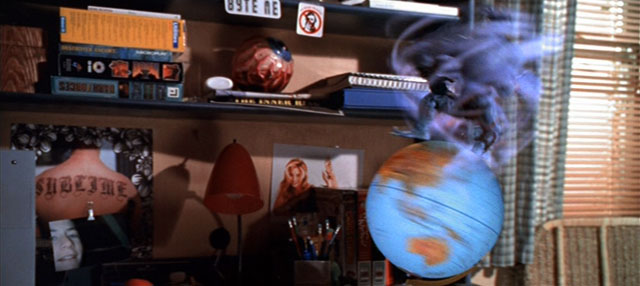
More of a kids movie than I’d expected, after Looney Tunes was more of an adult movie than I’d expected. Has the kids-in-charge feeling of Explorers, but the kids are more horny, troubled teens than young dreamers. The movie, with its innocent toy creatures threatening a whole town and all its makeshift inventions, references its own debt to Gremlins by throwing the word “gizmo” around as David Cross’s computer password.

Sets up a fight between the military-chip-implanted Commando Elite (voiced by Tommy Lee Jones, Bruce Dern and the cast of The Dirty Dozen) and the peaceful alien Gorgonites (Frank Langella and the cast of Spinal Tap), joined by a frankensteined group of mutant barbies (Sarah Michelle Gellar and Christina Ricci).

Purple whirling Gorgonite reminds of the Tazmanian Devil and one of the Twilight Zone creatures:
image

I admit the barbies were my favorites:
image

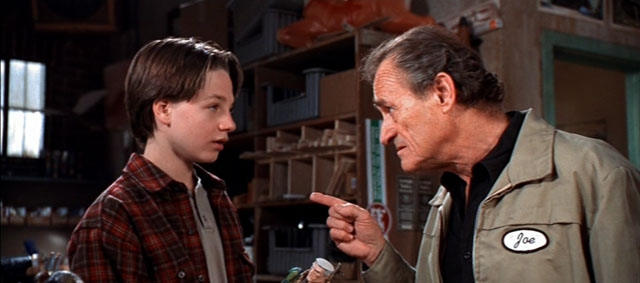
Dick Miller, making his umpteenth Dante film appearance, plays the twinkle-eyed adult who connects with our young protagonist (and gives him the devil toys).
image

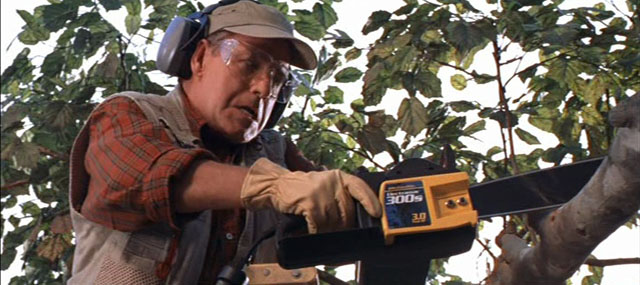
Robert Picardo doesn’t get mentioned enough in these pages. He’s appeared in nine Joe Dante movies, most memorably as the cowboy in Innerspace.
image

Apparently it got somewhat-screwed with its PG-13 rating but still made a tidy profit, and probably helped get Dante Looney Tunes: Back In Action, which probably killed his career for a few years. Dedicated to the great Phil Hartman, murdered a month and a half before its release.

image

“Sympathy is the worst of the seven deadly sins.”

image

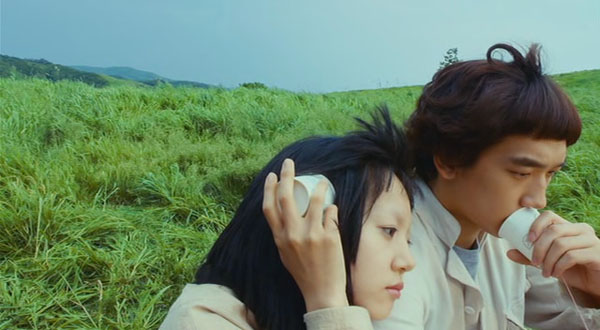
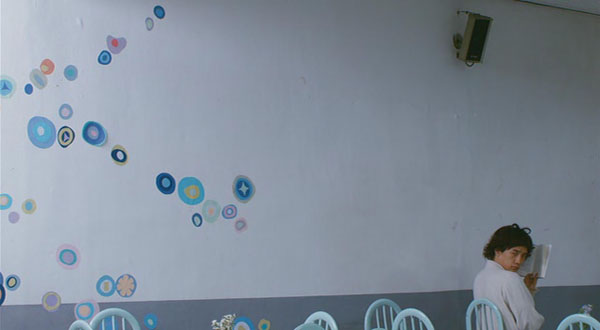
Title credits built into the opening scene shout: “I Know Where I’m Going!,” but the cartoonish situations, lively editing and bright colorful cinematography reply: “Amelie!” Maybe Park was afraid of being typecast as a grim downer of a filmmaker, a Korean David Fincher, and so like other grim young typecast filmmakers before him (Danny Boyle, Robert Rodriguez) he set out to make something light and lively to prove that he can – but maybe not as light as conceivably possible since it’s set in a mental institution.

image

Our girl Young-goon is a bit of a sociopath and likes to talk to machines. Cute boy Il-soon is a thief, but steals intangible things: a ping pong serve, someone’s appetite, Thursday. Other colorful patients include a fat girl obsessed with her skin, a super-polite guy who walks backwards and spends all day apologizing, a girl who only looks at her hand mirror.

image

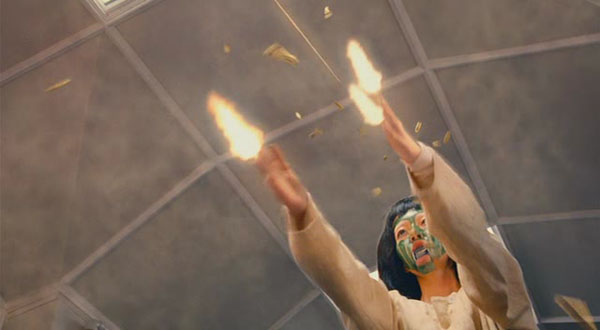
Park includes a violent kill-all-authority-figures fantasy into his light mental-illness comedy when the girl (who is, of course, a cyborg) fantasizes her hands becoming guns, blowing away all the nurses. She very nearly starves herself to death (cyborgs do not eat human food) but she’ll be okay in the end, thanks to the cute boy who truly understands her.

image

In true Amelie style this has got wonderful visuals so those who aren’t enchanted by the story and characters can delight in the cinematography (and accordian music, hmmm) – Park’s got all his bases covered. His filmmaking genre versatility proven, the typecast of dark sadistic violent films safely behind him, it sounds like Park has just turned in a dark sadistic violent vampire movie at Cannes 2009, heh.

image

Recommended listening: Become a Robot by They Might Be Giants

Checked out a nicely high-quality (if slightly trapezoidal) digital projection of the new edition, pleasingly crowded for a Thursday night. On one hand, Metropolis was plenty long enough, and each scene has always seemed to go on a bit too long (Jimmy didn’t come, saying “I’ve slept through Metropolis enough times, thanks”), but it’s still nice to have more of the film available for study. Half the cut scenes involve “the thin man,” hired by Mr. Frederson to spy on his little raised-consciousness son, who only makes a cameo in the pre-Argentina footage. And it’s easy to tell the footage apart, since the new stuff comes from a scratchy, shrunken 16mm print.

Wrote nothing special in August 2008:

Katy doesn’t want to participate in 2005 Month or in Shocktober, so there’s a semi-theme-multi-month going on with 1920’s Movies instead, beginning with this, one of the most famous and celebrated of the 1920’s Movies.

image

image

image

image

EDIT DEC 2020: watched a restoration of the Giorgio Moroder version, of all the crazy things. The narrative intertitles remain, but for dialogue they use subtitles over the person speaking, a nice touch. The music is fine… if not for the vocal songs! I didn’t know about these… what a bad idea. But even a bad soundtrack cannot ruin Metropolis, and I guess Moroder’s efforts helped preserve the film, so it’s fine, new wave forever.

Keith Phipps in AV Club:

Where Lang’s film still looks timeless, Moroder’s music remains grounded in the time of Reagan and early MTV. (That’s doubly true of the songs, which sound like castoffs even by the standards of, say, Loverboy.) The film feels quaint in a way other incarnations of Metropolis don’t.

IMDB: “What do an elderly topiary gardener, a retired lion tamer, a man fascinated by mole rats, and a cutting-edge robotics designer have in common?” That’s what I set to find out while watching this very fun, good-looking and well-edited movie. Katy got tired an hour in, liked it for the most part but didn’t enjoy my connection-drawing game.

Dave was a lion trainer who traveled with the circus. He seems ambivalent about his career, not talking it up as a great time with his beloved lions or an exhilarating and rewarding experience, mostly going over the reasons for first wanting to be involved (he idolized and eventually worked with Clyde Beatty, animal trainer and entertainer who once co-starred with Mickey Spillane in a weird-sounding mystery called Ring of Fear) and the procedures and dangers involved.

George is an elderly gardener who creates, trims and maintains the topiary sculptures in one estate garden. You get the feeling there used to be one old woman who oversaw the garden, and now there’s nobody, that he’s gardening for himself on someone else’s land. Unlike Dave, who is helping train newcomers, George has nobody following in his footsteps, and dislikes other gardeners’ methods (using electric hedge trimmers, for example).

Raymond studies and “wrangles” insects, and has become a specialist in the naked mole-rat, a mammal that exhibits insect-like behavior. He sets up a museum installation to put their society on display, and talks about their activity and relationships.

Rodney is a robot scientist trying to innovate robotic movement and behavior by putting together bunches of small robots or processes which try to solve common tasks, instead of attempting to control them with one larger intelligent system.

There are plenty of ways to link these four guys and their jobs/interests, not a large hidden theme which is the One True Key to unlocking the film. They all work with non-human life forms, trying to study and control behavior. Some offer insights into human behavior through the lens of their subjects. All but Dave work with arrays of smaller beings (robots/leaves/rats) which work together towards large tasks (or forms). I had more but I’ve forgotten half of them… IMDB commenters mention themes of growth and development, consciousness and death, or the guys as representative of different concepts of god’s existence.

I loved the editing, the music (by Caleb Sampson, who killed himself the following year), the use of stock footage (such as old Clyde Beatty films) instead of the Mr. Death re-enactments, the pacing. The movie’s got heart… these guys are really involved in what they’re doing, care about it, and each is able to express himself and his subject in an engaging, philosophic way. It’s not the connections and differences between these guys which are interesting in themselves, it’s the way Morris encourages the viewer to discover them. Wonderful.

Just spectacular… I loved every moment of it. The politics/message are a little heavy, but it was nervy to put such anti-consumerist, green, call-to-action messages into a non-talking robot-love movie in the first place (and to declare in interviews, as Stanton has, there there are no political messages in the film!), so I’m going to forgive. Twenty years ago, Pixar would’ve been shot down as commies for making this movie (and Mike Judge would’ve been quietly executed for Idiocracy). Hopefully I’m going to see this again soon, so no need to go into plot summary.

I caught the bunch of 2001: A Space Odyssey references (evil autopilot is very HAL, some of the same music is used) but I also found myself thinking of Children of Men. Future Earth is void of new life, new life is then discovered in the belly of a female-ish character, everyone freaks out and gets excited but a bunch of sinister characters want to manipulate the situation. It all checks out. Movie is also getting compared to Alien (sigourney weaver’s voice is the “mother” ship) and Silent Running (another post-earth outer-space plant-tending movie), but not Sunshine.

Peter Gabriel, who has a history of song contributions to films about sentient critters (Gremlins, Babe 2) scores the closing credits with an obvious-sounding number about being down in the ground.

Fred “Wha’happen” Willard plays a president stand-in, the CEO of Buy ‘n’ Large. He’s not even animated – just videos of Fred Willard. If he’s the first live actor in a Pixar animation, they picked the right actor.

The opening short was Presto by first-time writer/director but long-time Pixar animator/artist Doug Sweetland. Very good, funny, fast-paced comic short about a magician and his magic hats and rebellious hungry rabbit. More of that Looney Tunes gag-based anything-goes character humor than the usual style of Pixar short (think Geri’s Game, Boundin’).