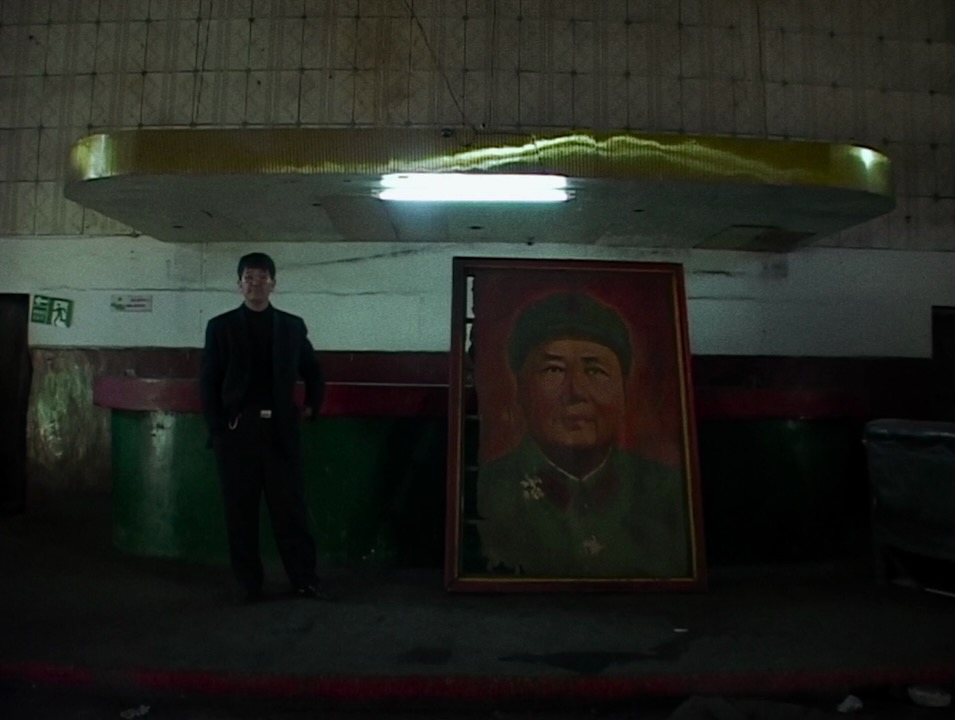
Both Bens Rivers & Bussell are in Cinema Scope’s 50 Under 50, and I’ve checked them both out before – Russell with Let Each One Go Where He May and Rivers with Two Years at Sea and some shorts.

Spell opens and closes with Russell’s shaky follow-cam, the camera behind the head of a walking person. I can see a theoretical point to his relentless follow-cams: regular movies are always showing people leaving and arriving in scenes, while his movies show them traveling to the scene realistically. Theory or no, they still annoy me, and maybe he needs to find a new thing.
In between we’ve got Rivers’s “man living alone in the woods” motif and his long still shots of nothing much happening (man in a slowly drifting fishing boat – think I’ve seen that one before).
Three parts:
Estonia: bunch of foreigners in a commune, including one Robert Aiki Aubrey Lowe, who is not the star of this section in any way but on whom I focus whenever he’s around, since I’ve seen his face in the promo photos.

Finland: just Rob Lowe alone, mountain climbing, fishing, cooking, hunting, slow-paced, no dialogue. Cutaways to the lake, a photograph of a lake, a magazine, etc. Then Rob is applying makeup, then his house burns down.

Norway: Long guitar intro over blackness, then we’re at a metal concert, interestingly shot up close by slow roving camera (this whole section is just a few long takes), with Rob as a guitarist and vocalist. They play a few songs, then he wastes no time getting backstage before the last one has ended, removing the makeup and walking into the night. I love the sound during this part, the club noise following him into the street and gradually getting louder.

M. Sicinski in Cinema Scope:
Russell and Rivers share an engagement with the history of ethnographic film, but only inasmuch as the critiques of its shortcomings and power relations have been fully internalized … Russell’s films have often favoured group dynamics, or at least individuals losing their identities in tandem; Rivers has more often than not worked within a mode of solo portraiture. The resulting collaboration is a dialectical meld of these tendencies. … The resulting film is a triptych fully reflective of Rivers’ and Russell’s longtime concerns: how does one remain a part of society while carving out a space that is, in Heidegger’s terms, true to one’s ownmost possibility?

Russell:
One of the most important realizations that I had through the making of this film was that cinema was, in fact, one of our best vehicles for realizing utopia. During a conversation about his experience in the Santiago de Compostela pilgrimage, Tuomo (he’s the Finn who tells the asshole story in the film, also the subject of our next collaboration) proposed that utopia only exists in the present, that it can only be realized in the now. Cinema is a medium that is likewise always arriving (as the future) and receding (as the past) simultaneously. It is only alive when we are alive with it, when we share our time and allow our space to be occupied. It can only happen as experience in the present, and its capacity to produce worlds unto itself positions cinema as a very real site for utopia. For Thomas More, Utopia was a no-place, a construct; taken positively, this is cinema defined.

Sicinski again, but for Fandor:
Although the makers of A Spell to Ward Off the Darkness have been most closely aligned with the avant-garde film world, they stake out a position somewhere between trance film, portraiture, and ethnography. Their films, then, identify and problematize certain dual aspects of realism that could be said to “haunt” both experimental film and anthropological documentary.