I can’t tell if the movie pulled a fast one on us when the kid on the poster loses the climactic governor race to a kid we’ve never even seen before by distracting us with the speeches and strategies of the competing campaign leaders. Pretty impressed that the lowest-common-denominator guy lost running on a platform of dick jokes and then confessed to having underestimated the group and turned himself around. Really professionally assembled doc, and for once I mean that in a good way. Ultimately wouldn’t vote for any of these gun-rights Texans for any office, but after avoiding politics-in-movies for the last year, this turned out to be more harmless than we’d feared.
Wolfwalkers (2020, Tomm Moore & Ross Stewart)
Okay, Soul had its moments, but it’s almost a shame that just a few days later we watched this movie which so thoroughly blew it away. Such intricate illustration and character design, fun perspective tricks, it all looks so handcrafted and amazing.

No shocker after Secret of Kells and Song of the Sea that the plot concerns Irish mythology, and as in Kells there’s a supernatural girl on the outskirts of a besieged town. This time the girl is leading the wolf army they’re all afraid of, and new girl Robyn’s dad is hired to trap and kill them, but Robyn (with her cool pet falcon, oh my heart) ventures into the woods, meets the red-haired wolf girl, and accidentally becomes a wolfwalker herself. Later her dad will become one, and they’ll turn on the wolf-hating tyrant who rules the town. Not a grim, doomsy movie at all – the baddie is the only death, and there’s nearly as much friendly romping as there is story.

L’Ange (1982, Patrick Bokanowski)
A swordsman attacks a doll hanging from a string… the motion freezes, stutters and repeats, and the music begins doing the same. A hand-less balding man seated at a table surrounded by inky blackness – his pitcher falls to the floor in a time-locked Brain Candy loop, then appears in a Muybridge time-lapse still, with dark, severe string music. I think we’re inside one of the houses from The Endless.
Librarian and his eagle:

There’s a silly bathtime romp, a scene shot in reverse, a busy library in which all the all the old men are wearing the same old-man mask, the masks and their clockwork motion giving the thing a sense of animation. Naked woman in a wasteland gets trapped in a box. After these unrelated(?) vignettes (DVD description says they’re “all connected by a central staircase”), the last 15 minutes bring something new – all angles and bright lights, TV-static-beings tearing through the screen, revealing perhaps l’titular ange.
Light:

Rotterdam says it “lies on the edge between optical and plastic art, in a gap of constant reinvention.” Bokanowski had another hourlong light-vs-darkness film a few years ago which almost nobody has seen, though those few said it’s great, and he’s been producing shorts regularly since the 70’s.
Bathed Man:

More Light:

The Cocoanuts (1929, Florey & Santley)
Let it be known, for future historians, that this was my final film watched in the year 2020, and L’Ange was the first to be viewed completely in 2021, though some slow-burn TV series and a certain miniseries-movie-object might span across the years.
Groucho runs a hotel in Florida, and the opening song tells us Florida is a paradise, so the movie is already suspect. The musical numbers are far between and absolutely unmemorable – this early-sound movie has enough trouble keeping up with its own dialog scenes. It puts a lot of effort into the central romantic drama, wasting 20 long minutes before Chico and Harpo finally show up, priorities all outta whack. Then most of the remaining minutes are wasted too, but the movie does give us Chico’s immortal lines: “Right now I’d do anything for money. I’d kill someone for it. I’d kill you for money. No, you’re my friend, I kill you for nothing.”

Shot on zero mm film through a camera obscura. Irving Berlin’s “Monkey Doodle Doo” is maybe no “White Christmas,” but it’s catchy. I guess Mary Eaton wants to marry hotel clerk Oscar Shaw, but her mom (the great Margaret Dumont) prefers mustache man Cyril Ring until she finds out he’s a jewel thief (working with Kay Francis, future jewel thief of Trouble in Paradise). IMDB says Zeppo played “Jamison,” I don’t think he was even in the movie.
L-R: Kay, Cyril, Oscar, Mary (not pictured: Zeppo)

Downhill Racer (1969, Michael Ritchie)
Maybe they really don’t make ’em like this anymore. Watched on a whim, dunno Michael Ritchie (two Fletch movies and Prime Cut) and this isn’t about anything of interest (Robert Redford is a hotshot replacement skier on the US olympic team coached by Gene Hackman), but visually it’s really well put together. Maybe not the undercranked-looking wide shots of ski races, but everywhere else the editing and movement is very alive. Redford likes a girl, of course: Swedish Camilla Sparv (of The Trouble with Angels), who is working for a ski manufacturer, and of course he has rivalries with his teammates, including good dude Jim McMullan (of a couple Joel Schumacher movies), who gets laid up and misses the olympics. Not running out and recommending this as an example of Pure Cinema, but more watchable than a late 60’s New Hollywood sports movie has any business being.
What skiing leads to:

Soul (2020, Pete Docter)
Another Pete Docter Pixar feature set in an imagined space that is about determining a girl’s destiny. This time she’s purgatorial soul Tina Fey (I spent all movie wishing she was Sarah Silverman) with teacher Jamie Foxx, a just-deceased jazz-pianist schoolteacher, who accidentally teaches Tina to treasure the material world while anxiously trying to return there himself. Longer and less inspiring than the God Baby scene in World of Tomorrow 3, but the abstract-shaped beings that oversee the soul realm are great, especially the Rachel House-voiced accountant who follows our heroes to earth and hides in 2D images within the 3D world.
The Three-Sided Mirror (1927, Jean Epstein)
Three women are into one guy – I’m not sure if he loves and leaves each one of them in series, or if he flits between each in his suicidally fast car. Pearl is a rich socialite, Athalia a rich artist, and Lucie an ordinary city girl, and he affects different personas around each: a strong tyrant type, a weaker type, and a caring type – until his reckless driving finally catches up with him.
Our dude, carefree:

I’d forgotten most of the plot by the next day, rewatching scenes now to remind myself, was just paying attention to style – Epstein bringing his great flair for composition and editing and overlapping images to the kind of melodrama he was making earlier in the decade. It feels like he wanted the climactic speed-and-death montage to go on forever.
Athalia worrying aloud to a friend:

Based on a novel by white supremacist Paul Morand, who also adapted Don Quixote for GW Pabst… Lucie appeared in Renoir’s The Sad Sack, and our main dude starred in a possibly-lost 30’s version of Judex.
Mangrove (2020, Steve McQueen)
Frank (Shaun Parkes of the current Lost in Space reboot) is the restaurant owner and social center who gets all the soulful closeups, Altheia (Letitia Wright) is the requisite movie star, a pregnant Black Panther, Darcus (Malachi Kirby of the latest Roots reboot) is a self-representing defendant who gets all the best speeches, and Barbara (Rochenda Sandall, who used to play a character named McQueen) has the best hair, and a spiel about how the children are our future. That leaves whiteys Jack Lowden (Dunkirk) as their lawyer who looks like Austin Powers’ buttoned-up brother, and Sam Spruell (Russian baddie of Taken 3) as the racist pig leader.
Kirby:

First half is in the streets and the restaurant, figuring out how to make a life without getting hassled by the pigs (impossible), second half has real based-on-a-true-court-case energy, as indeed it was. The lines aren’t as head-smacking as they were in Widows, and McQueen finds some evocative visuals every so often, but mostly powering through this to get to Lovers Rock.

TV/Q4/2020
TV roundup for the second half-ish of 2020
–
On Cinema at the Cinema seasons 1-? (201?)
On Labor Day, since I’d already seen Bisbee ’17 I watched season one of On Cinema on the Adult Swim roku app while repainting the furniture… then I drank some, and watched seasons two and three? Or maybe also season four… or just season two, I don’t know how to figure this out.
–
Search Party season 3 (2020)
Dory and the gang become absurd anti-celebrities during their murder trial. We know she is found guilty because of the flash-forward intro of the first episode, but this turns out to be a good fakeout – after being declared innocent, she’s kidnapped by a maniac. Not my favorite season – I’ve never loved court dramas, and the final episode is too Seinfeld, but I’m still here for whatever’s next.
Newbies: Dory’s rookie lawyer is Shalita Grant of the series You, and Drew’s lawyer is Louie Anderson. The all-business prosecutor is Groundling Michaela Watkins, lately of Brigsby Bear and Sword of Trust. Wallace Shawn is a shady businessman who gets Chantal arrested by the FBI.


–
Russian Doll season 1 (2019)
“This is like The Game. I’m Michael Douglas!” Writing this up is a lotta pressure because since finishing this I’ve watched time-loop movies Tenet and I’m Thinking of Ending Things and Bill & Ted Face the Music, and it seems like there are a lotta details in this four-hour existential comedy that I’ve forgotten. Natasha Lyonne keeps dying then waking up back at her birthday party hosted by Greta Lee (Inside Amy Schumer) with “Gotta Get Up” playing, and tries to discover why this is happening, then runs into fellow time-looper Alan (Charlie Barnett of TV’s You). I think it’s possible that everything gets fixed at the end, but maybe not since a second season is rumored.
The slimy-Cagney-lookin guy she goes home with is Yul Vazquez… her psychiatrist is Elizabeth Ashley of Treme… her drug dealer is Waris Ahluwalia (The Life Aquatic)… Tinfoil Kevin is a regular at the bodega run by Ritesh Rajan (Mowgli’s dad in the latest Jungle Book), and her mom in flashback is Chloe Sevigny. Co-created by Amy Poehler, directors include Leslye Headland (Terriers) and Jamie Babbit (But I’m a Cheerleader).


–
The Tick season “two” (2019)
“Destiny is on the phone. It’s a party line and we’re all invited!”
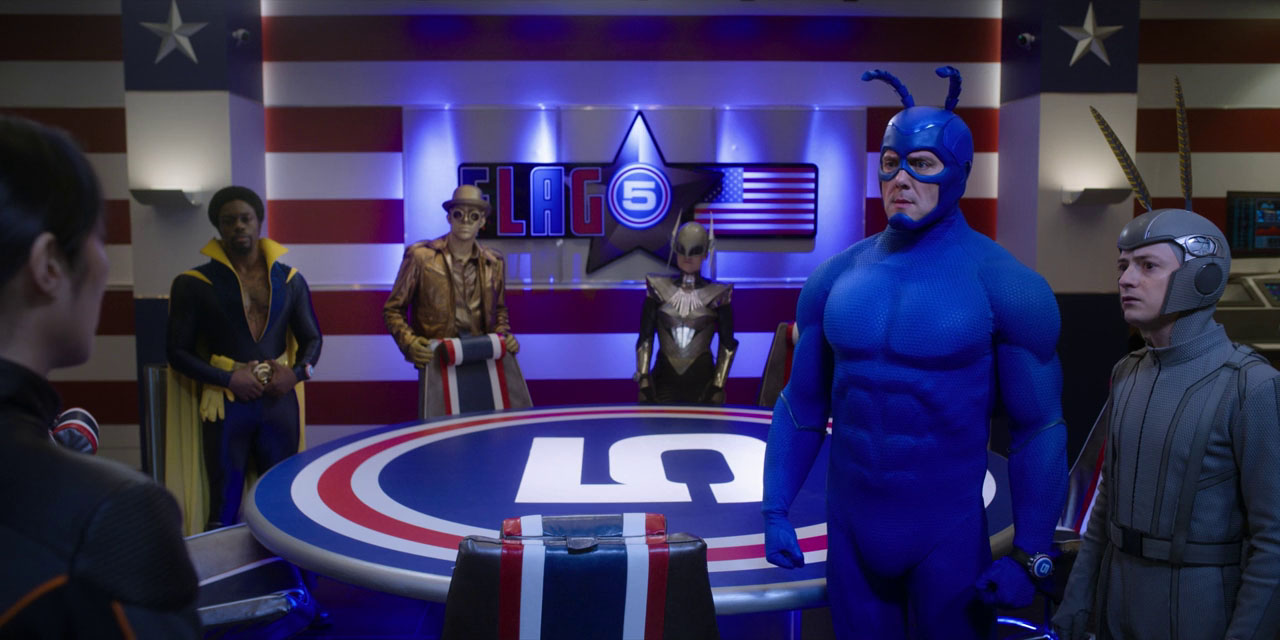
Such good writing – even if I saw some of the season-long story endings coming, each episode is full of pleasures. Dot discovers she has powers, can see the near future, and their father-in-law Walter has been an agent under deep cover. Tick’s new nemesis/partner is a bank-robbing lobster. Aegis Commander Ty Rathbone, who has a black-hole heart, recruits Arthur and Tick and Lint to the Flag Five, which is sabotaged by Dr. John Hodgman. Superion spends a few episodes depressed on the moon deciding whether to spin the earth backwards to reverse time. Lint’s sidekick is a computers/weapons whiz named Edgelord.
Writers include original Tick comics creator Ben Edlund, two Detective Pikachu writers, two writers of teen comedy On My Block, and Kit Boss (King of the Hill). Directors include a DP of Dexter and True Blood, a Brooklyn Nine-Nine and Black-ish director with over a hundred other credits, the script supervisor of Mallrats and Dogma, the editor of Roger & Me, and an AD on Buffalo Soldiers. Flexon is on the new Snowpiercer series, the Aegis paperwork twins are in The Assistant.

–
Documentary Now! season 2 (2016)
The Bunker is a War Room parody, Hader doing a southern accent.
Juan Likes Rice and Chicken is a celebrity-chef doc about a difficult little restaurant that makes a basic dish but with impossibly high standards.
Location Is Everything is a Spalding Gray parody! Lennon Parham (personal advisor to Veep) plays his girl Ramona, who is onstage refuting all his stories.
Globesman is of course Salesman, which I’ve still never seen, but I doubt the original involves a rival atlas salesman who stalks and torments our protagonists.
Final Transmission is a really specific Stop Making Sense parody with Armisen as Byrne, Hader as Tina, Maya Rudolph and Jon Wurster, I am in heaven. Why did they stick a Tom Waits parody into this?
“As a bald kid with a dead dad, movies became my refuge.” Double episode Mr. Runner Up is doing The Kid Stays in the Picture, which I didn’t realize, about an awards-obsessed movie producer who’s only constitutionally able to create schlock, mostly starring his unfunny Italian comic friend Enzo.


–
Primal season 1 (2019-2020)
Gruesome and lovely. Caveman and Dinosaur each saw their families eaten by predators, but found each other as friends and protectors. Perfect show, with one heck of a finale – introduction of a woman with metal implements and a spoken language, collapsing even more of history together. I think of Genndy as the Dexter’s Lab/Powerpuff guy, but everyone involved in this also worked on Samurai Jack, which I probably should not have skipped.


–
Barry season 2 (2019)
Maybe less fun than season one, but deeper, as Barry tries to control his rages and stop killing people, and leads the acting class in experimenting with telling personal truths. In the end, of course, he falls into a massive rage and kills many people, Fuches turns on him tragically and repeatedly, and the people who cop out on personal truth and tell lies are rewarded for it.
Noho Hank’s Chechen bestie Cristobal (Michael Irby of True Detective s2) forms an unstable alliance with Ester, head of a Burmese crime family (a deadpan Patricia Fa’asua). Sally’s abusive ex Sam (Joe Massingill of Die Hard 5) returns to stalk her. Gene tries to reconcile with his estranged son Leo (Andrew Leeds of Zoey’s Extraordinary Playlist), and is told that Barry killed his girlfriend Janice. Janice’s ex-partner Loach (John Pirruccello, a Twin Peaks s3 deputy) tracks down Barry and gets Fuches to wear a wire. And most wonderfully, the Loach plot ends in the one time Barry and Fuches work together all season, when Loach “hires” Barry to kill the guy sleeping with Loach’s wife, a stoned Tae Kwon Do master (stunt/action regular Daniel Bernhardt) with a feral daughter.


–
Also sampled quite a few shows:
– Star Trek Lower Decks seems bad
– Central Park seems good, going to see if Katy wants to watch it (we still haven’t returned to Crazy Ex-Girlfriend)
– Black Jesus is good but I dunno if it’s got a whole season in the tank.
– Infinity Train looks imaginative, but for kids, not for me.
– Los Espookys seems up my alley, would watch more.
–
And of course I watched a pile of concerts and livestreams and other things, including Nick Cave’s Idiot Prayer, which probably would’ve gone to theaters, had there been theaters.
Waco Brothers:

Robyn & Emma:

Cave:

Pigface:
