Two people with dissatisfying home lives meet via lunchbox misdelivery. The delivery service won’t correct the error because they insist their system is flawless, so the two communicate via lunch notes, while he (Irrfan Khan of The Namesake) deals with an overeager and underskilled accounting subordinate, and she (Nimrat Kaur of sci-fi series Wayward Pines) deals with an extremely inattentive husband. Heads in the obvious direction, but Khan is more crotchety than expected and the movie overall more finely made. The story didn’t linger in my mind after watching, but every minute of the movie was enjoyable, so it’s an Indian food-romance John Wick. Batra’s follow-ups were the Broadbent/Rampling Sense of an Ending (also about a grumpy old man) and the Redford/Fonda Our Souls at Night (also about lonely strangers making a connection).
Three Identical Strangers (2018, Tim Wardle)
Long-lost triplets become belated best friends, then gradually reveal their lifelong struggles with depression and frustrated attempts to discover the nature of the scientific study that tore them apart (shades of Wormwood). True/False 2018 selection, viewed this August at the Ross.
Yourself and Yours (2016, Hong Sang-soo)
“I’ve never seen a truly impressive man.”
Minjung (You-young Lee of a movie called Late Spring which is somehow not an Ozu remake) is breaking up with her deep-voiced boyfriend Youngsoo (Ju-hyuk Kim, who died last year). She’s spotted by some other dudes, chats with them in bars, dates at least one, but each time she’s someone else – or claiming to be. She’ll claim to be a twin sister, or just deny having ever been where they say they’ve seen her. I suppose her multiple identities are open to interpretation, but I assumed it’s just one woman who claims to be someone else when she’s bored with a guy.

We’ve also got an older (?) guy with cool hair and a folding bike (Hae-hyo Kwon of On the Beach at Night Alone), Youngsoo’s buddy (Eui-sung Kim, who hung around the main guy’s guesthouse in Hill of Freedom), and of course a film director (Joon-Sang Yoo, lead of The Day He Arrives, lifeguard of In Another Country). She ends up back with Youngsoo, which is slightly unsatisfying since he was such a dick in the opening scene, but I dunno, she’s also wearing the same t-shirt in the bookend scenes so maybe the parts in between never happened. This was supposed to be Katy’s first Hong movie but she fled after ten minutes, saying the style was weird and felt like the PBS show Degrassi.

John Wick (2015, Chad Stahelski)
Not trying to brag or nothin’, but I kept telling myself this movie felt like Atomic Blonde, only to find out later that it was secretly codirected by that movie’s David Leitch, so I guess I know my Russian secret-agent hit-man action thriller directors. I skipped this Keanu Reeves revenge flick when it came out, but I keep hearing good things about it and the sequel, so finally checked it out in between viewings of American Made.
The late Michael Nyqvist with Dennis Duffy:

Keanu is sad after his girl’s death from illness, left only with the dog she left him, an awesome car, a weapons arsenal, and intense murder skills, so when the local crime lord’s son kills the dog and steals the car, Keanu will not be persuaded to stop killing people (this one is more revenge-driven than the previous movie I watched, which was simply called Revenge).
Fun movie, with some interesting comic-booky elements (a hitman society with a safe-zone hotel headquarters), with appearances by Willem Dafoe, John Leguizamo, Jerry Horne, Lester Freamon and Cedric Daniels.
Revenge (2017, Coralie Fargeat)
Hot Vacant Rich Guy is on a desert hunting trip with his two dim buddies and his Hot Trophy Girlfriend Jen. She gets sexually abused by the dim buddies, threatens the rich guy in response, and so he murders her. But wait, Jen wakes up impaled on a tree, gets herself loose and defends herself against the rampaging hunters, dispatching the two then tracking Richard back to his fancy house for a showdown.

Fargeat’s debut feature is a stylin’ movie with some groove-ass music and a pretty incredible idea of how injuries work. Jen has a seemingly infinite blood supply (half the movie is people following trails of blood), takes peyote and cauterizes her stomach wound with a phoenix beer can. Jen is Matilda Lutz, who starred in the latest Ring sequel, her man is Kevin Janssens (this year’s Cannes flick To the Ends of the Earth), guy who gets stabbed in the eyes is Guillaume Bouchède of an upcoming Dominique Pinon movie, and guy who shoots her ear off and gets a foot full of glass is Vincent Colombe of 2010’s Point Blank.

Sorry to Bother You (2018, Boots Riley)
As cynical and absurd as Idiocracy (and even featuring Terry Crews). Lakeith Stanfield finds something he’s good at (selling awful things to rich people) and forsakes his awesome girl Tessa Thompson and his unionizing coworkers for a taste of fortune and power. He realizes the error of his ways, but also gets turned into a horse.
Innerspace (1987, Joe Dante)
It’s been thirty years, and I’ve got all but a few Joe Dante movies on the ol’ blog, so time for an Innerspace rewatch. I must’ve seen this more than once on cable – some scenes are clearly etched in my memory (The Cowboy singing “I’m an old cowhand from the rio grande,” for some reason) and most of the others felt awfully familiar as they unfolded. Besides the nostalgia value, it’s a tightly written, well-made studio comedy full of enjoyable performances and Bugs Bunny references.
The movie’s secret weapon: Robert Picardo as The Cowboy
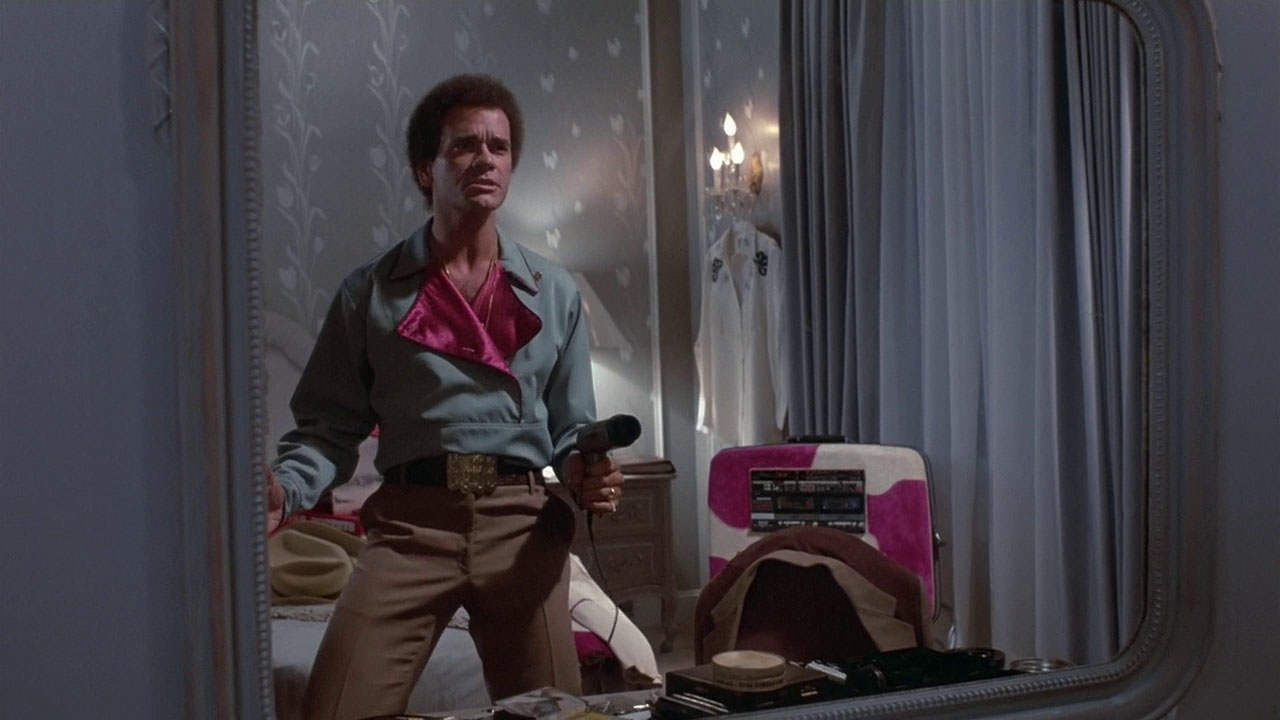
Kevin McCarthy in his henchman lair:

Are the opening titles, exploring light beams inside a drink glass, a goof on Stan Brakhage? Probably not. The murdered scientist in charge of Dennis Quaid’s miniaturization experiment is John Hora, better known as Dante’s cinematographer on six movies. Evil Dr. Margaret is Fiona Lewis, the maid in Fearless Vampire Killers, and her false-armed henchman is Vernon Wells, lead villain in Circuitry Man. One of the movie’s writers did an unfrozen caveman drama, the other wrote The Dead Zone screenplay.
Quaid meets his host body:

Meg, right as Martin Short is jumping out the back of a truck:

Hearts Beat Loud (2018, Brett Haley)
The one where Nick Offerman and his daughter (Kiersey Clemons of Flatliners Remake) start a band, and he takes it really seriously, wanting to take the act on tour, while she just wants to start college like a normal person. I am easily irritated by lightweight feelgood indie dramas and by auto-tune indiepop, and mostly didn’t mind this at all, except when Offerman’s record store had a going-out-of-business sale selling new vinyl at ridiculous low prices and the people who showed up only bought a few records each – that’s just unrealistic.
Mission: Impossible (1996, Brian De Palma)
Rewatched for the first time since theaters (?) in prep for M:I:6:Fallout, and it was much fun. I remembered Emilio Estevez’s elevator death, but not that it happens in the opening sequence and that he dies along with the entire team of Kristin Scott Thomas, Emmanuelle Béart (not really dead) and her husband and team leader Jon Voight (also not dead, and the secret double-agent mole who planned the whole thing to frame Tom Cruise and make off with the secret documents or whatever). On the side of evil Voight are Jean Reno, who dies in the preposterous helicopter-in-the-train-tunnel finale, and Vanessa Redgrave, who is just quietly arrested. I was impressed by the rubber-masks game, recalling the advanced digital trickery in M:I:4:Ghost:Protocol, and then happily, part six featured just as many rubber masks.

Dramatic camera angles, first-person shots and entire subjective scenes which play differently in flashback, because it’s still De Palma.
Team 1: Estevez (his last appearance in a theatrical film that he didn’t direct), Cruise (same year as Jerry Maguire), Béart (right between her two major Rivette films), and Burnt by the Sun star Ingeborga Dapkunaite:

Cruise and K.S.T., lurking:
