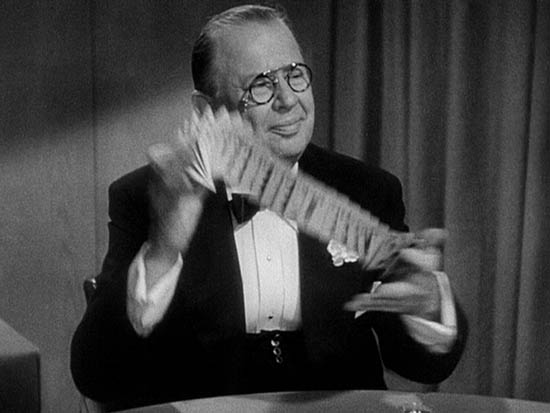
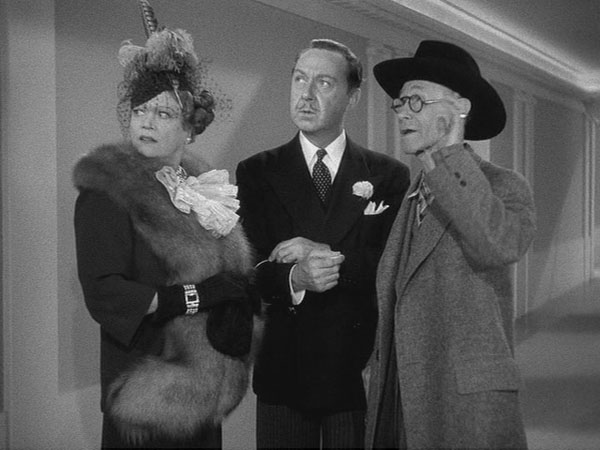
I saw this ages ago and didn’t get it. Now that I’ve enjoyed Mon Oncle and seen Playtime a few times, I wasn’t thrown by Tati’s Buster Keatonesque style – series of gags setting up the next series of gags, with funny sound effects but almost no dialogue. Other notable similarities to Playtime: jokes about malfunctioning technology (mostly automobiles, but also an indecipherable train station announcement speaker) and an extended delay before the first appearance of our hero Tati/Hulot.

It’s a weirdly understated gag movie – some big slapstick scenes like when Hulot sets off a box full of fireworks, but mostly more subtle. There are enough unnamed characters intersecting in different ways in each scene to make Altman proud (I especially noticed a young woman with a Princess Leia hairdo).

I watched the original full-length version – most DVDs only have Tati’s own re-edit from the 70’s. I’m sure that by the time I rent the Criterion and watch the shorter version I won’t be able to precisely recall the differences. Half of Tati’s movies exist in multiple versions – Jour de fete is in black and white and color, Mon Oncle is in French and English and Playtime had a bunch of different edits.

Leia with an insufferable leftist who insists on talking politics while everyone is on vacation:

Hulot annoying a hotel worker:

Surprisingly not my favorite Astaire movie so far, despite its lofty reputation. Katy was not wowed, either. Sure the dances are very light and graceful, but now I’m spoiled on the showy gimmick dance scenes from later films The Band Wagon and Royal Wedding.

Fred, a performer unashamed to wear blackface and call himself Mr. Bojangles, is engaged to Margaret (Betty Furness of the original Magnificent Obsession), but his friends know she’s not right for him and conspire to make him miss the wedding.

Glowering bojangles with his fiancee:

So Fred runs off to NYC with his gambling buddy Victor Moore (of Make Way For Tomorrow, which I coincidentally watched the next day), and they stumble across future Preston Sturges character Eric Blore.

But more importantly, they find Ginger Rogers, whom Fred would so love to love, if only he weren’t engaged. Ginger also becomes engaged, to boring bandleader Georges Metaxa.

While a comic-relief Victor Moore causes hijinks and gets to know Ginger’s dancing buddy Helen Broderick (also of Top Hat). The two of them were more fun than Fred and Ginger.

The presence of actual black person Floyd Shackelford doesn’t take the sting off the Bojangles scene.

compare to:

Stevens was a cinematographer since the silent era, shot some Laurel & Hardy movies, made big films like Giant and Shane in the 50’s. This came in the middle, among other musicals and romantic comedies.

The least Coeny of the Coens’ string of remakes and adaptations. It’s got their perfectly-timed dialogue, comic tone with brief bursts of violence, cinematography by the gifted Roger Deakins, and Dude Lebowski in a major role, but it doesn’t have their mark all over it. This isn’t a complaint – it’s an excellent Western, exciting and well-acted. Plus Matt Damon. He is kinda weird in it. The little girl who had to carry the whole movie, Hailee Steinfeld, got nominated for an oscar for her troubles. Her character is dedicated – shooting unrepentant daddy-killer Josh Brolin once when she first meets him, then again (to his death) at the end. Part of the film was set in my former family home of Ft. Smith, Arkansas. The place hasn’t changed.

March 2024: Watched on blu-ray, noting the excellent music by Carter Burwell. The 25-years-later coda is 1903, the girl now grown, one-armed from the snakebite she got after killing Brolin. Since this came out, the girl has been in Begin Again, then Spider-Men and Marvels and Transformers things.

In the title I accidentally typed “Frank Zappa” at first. Usually my sympathies lie more with Zappa than Capra, but I liked this one a lot. The version of the play that we did in high school did not give the male lead a homicidal maniac of a brother with a mad doctor and a dead body in tow. I remember it being all around more gentle. The play was a huge hit when this movie was shot, and the playwright permitted the film under two conditions: that Boris Karloff wouldn’t be allowed to participate (all the jokes about the brother looking like Karloff depended on him, but instead of changing the line for the film, they made Raymond Massey up to look like Karloff) and the movie couldn’t be released until the play closed. So it was shown to troops overseas, but didn’t make it into theaters until 1944, some six Cary Grant movies later.

Grant wasn’t wild about this movie – I thought he used his surprised screwball expression too many times but is otherwise just fine. He is to marry Priscilla Lane (of The Roaring Twenties and Saboteur), takes her home to meet his sweet old aunts but discovers that they’ve been murdering lonely men and having Cary’s insane Teddy Roosevelt-impersonating brother bury them in the basement. Then the other brother (Raymond Massey of a couple Powell and Pressburger films) with doctor Peter Lorre show up, and hijinks just never stop ensuing. In fact, the comedy and suspense don’t even let up long enough for Capra to inject any long, boring speeches espousing his patriotism or morals. Hooray for that! E. Everett Horton was in there as well, but I’ve already forgotten where.

Monsieur Fantomas (1937, Ernst Moerman)
This was the prize short of the month… good show, Moerman. Takes the dream-logic, intense crimes and crazy escapes of Feuillade and goes all-out surrealist with them. The master criminal lives in a room with no walls on the beach (much of the movie takes place on the beach), seeks out his true love Elvire. Chief Juve is roused from the bathtub, consults with some seashells and heads buried in the sand. A hundred delightful things happen then it closes with the title card “end of the 280,000th chapter.” Made in Belgium, and I’m very sorry that Moerman didn’t shoot any more films. There really needed to be more surrealist cinema.

The cops close in on Fantomas… but is it really him, or just a cello?

Dinner For One (1963)
Shot in Germany, and shown traditionally every year on television since, a beloved little sketch in which a butler sets the table for an old woman’s absent guests, drinking toasts in each of their places and getting roaring drunk as he continues to perform his duties.

May Warden and Freddie Frinton:

The Spine (2009, Chris Landreth)
Group marital counseling + codependency, slowly coheres into a story. I didn’t like it nearly as much as his short Ryan.


Three by Sally Potter
These shorts predate Thriller by almost a decade, early film experiments not having much in common with her features – well, perhaps slightly with The Gold Diggers, which I started watching but haven’t finished.

Hors d’oeuvres (1972)
Silent avant-garde film, a flickering light shines on still photographs, then slow, unstable film footage of one person at a time in a bare room. Dance movements, slowed down then paused, superimpositions, the light pulsating. Lasted about twice as long as my willingness to appreciate it.

Play (1970)
Also silent, two cameras high up at different angles capture the same scenes of children playing on the sidewalk, at first presented side-by-side simulatenously, then re-edited, slowed down and chopped up.

Jerk (1969)
Faces, sped up and extremely rapidly edited. This was my favorite. I wonder if Potter considered the film’s motion to be “jerky” or if she thought this guy was a jerk.

Father (1977, Shuji Terayama)
a one-take silent sex scene that turns into a pleasant slideshow, featuring video superimpositions of a hand and the back of a head. No audio on my copy.

La Chambre (1972, Chantal Akerman)
Four slow pans around a cramped apartment, fully silent. First the director flutters her eyes at us from bed, then she is wriggling around, then playing absently with an apple, then – change of camera direction! – eating the apple, as the camera finally realizes she’s the only thing of interest in the room and starts rocking back and forth, homing in on her bed.

Birds Anonymous (1957, Friz Freleng)
“Birds is strictly for the birds.”
Just an average tweety and sylvester short, some kind of parody of werewolf movies and alcoholics anonymous, as far as I can tell. Wonder why this was on my laptop. And what is alum?

Playback (1970, Pere Portabella)
Two cameras, and you can see each in the other’s shot as they circle a composer who is arranging his unconventional choir piece, chattering constantly in unsubtitled Catalan. It’s all kind of exciting. I don’t know anything about Portabella, but I like his shooting style so far.

From the filmmaker’s official site:

Playback is presented as a short rehearsal in a double sense. It is a satellite of the constellation of works that Portabella dedicates to the analysis of the “materiality” of aesthetic and cultural languages (Vampir-Cuadecuc and Miró l’Altre among others can also be understood in this manner). At the same time, he analyzes the rehearsals that Carles Santos carries out for the playback recording of a film on the work of Antoni Gaudi. The choir of the Gran Teatro del Liceu of Barcelona reads fragments from Wagner’s Tannhauser, Lohengrin and the Valkyries. The film was shot in the theater “Lluïsos de Gràcia”.

Two Portraits (1981, Peter Thompson)
The director narrates a series of one-sentence statements about his father, as we see consecutive film frames cross dissolving. “His oldest son died at age 31. The decision to have children was left to his wife, as were all decisions except those concerning money.”

Second portrait is of his mother, filmed sleeping outdoors, while on the audio she reads pages from her diary. The first half was far more illuminating and sympathetic. I’m not sure what to do with the second part, but as with all of Thompson’s films that I’ve seen, I’d be glad to watch it again.

First portrait:

From Chicago Magazine: “When Peter Thompson was 35, his father committed suicide. That tragedy 29 years ago sent the Columbia College professor searching for Super 8 film of his father. He found only 12 seconds’ worth, but stretched them out to 17 minutes and added narration. When he expanded it to include his mother, the resulting film, Two Portraits, moved audiences to tears.”

Second portrait:

This was the Sturges movie I’d watched long ago and was starting to forget. Our latest screening was accompanied by squeals of delight whenever we noticed a Sturges regular, or someone from Sullivan’s Travels anyway. The butlers and Snowflake were disappointingly absent, but we got Jimmy Conlin (little guy, glasses) as a judge, the vaguely-familiar Harry Hayden (I thought for a minute that he was Charles Coburn) as an upright politician, TWO women from Remember the Night playing best friends, and the vertically-stretched Franklin Pangborn as a fussy master of ceremonies. But best of all, this movie features St. Paul’s own William Muggsy Bildocker Ale-and-Quail Kockenlocker Demarest in his largest role yet, as the Marine sergeant who helps our hapless hero concoct his big lie.

foreground L-R: Sarge, Woodrow, Woodrow’s mother, a mother-obsessed marine:

And oh, just thinking of Franklin Pangborn’s attempt to control four different brass bands for Eddie Bracken’s homecoming ceremony reminds me, this is certainly Sturges’s loudest-ever film, as talky and noisy and shouty as they come. All the excitement gets poor Eddie so nervous – and he’s so good at acting nervous – I kept wanting to comment that he’s seeing THE SPOTS, but Katy doesn’t remember The Miracle of Morgan’s Creek well enough to get the reference. Even if we didn’t see the spots, the movie makes a more direct reference by outright showing us the poster for Morgan’s Creek as the Marines’ train pulls away during the final scene.

L-R: Mayor Noble, his wife, Libby, and Forrest (Bill Edwards):

The Mayor is Raymond Walburn – see also his Christmas In July screenshot standing alongside Franklin Pangborn, whose character in this movie wouldn’t settle down long enough for me to snap a picture of him – with wife Esther Howard (also wife to the Weenie King). Lead girl Ella Raines (no relation to Claude) seemed like a big nobody – but she starred in Siodmak’s Phantom Lady and appeared in Dassin’s Brute Force, so I guess she’s somebody. Edwards was cast because he’s a stiff, uninteresting fellow, something that didn’t help his film career elsewhere.

Eddie Bracken’s Woodrow has a family history in the Marines but was personally discharged for having hay fever (a less funny premise than THE SPOTS), so he’s sulking in a bar, too ashamed to come home, when he buys Sgt. Muggsy’s group some drinks and they coerce him into returning to his home town as a war hero. It all gets immediately out of hand, and a few days later Woodrow is about to be elected mayor – and about to be exposed as a fraud by his opponent – when he confesses all to the townsfolk… and… gets elected mayor anyway! I would elect Eddie Bracken mayor, no question. Also Woodrow’s girl before the war is now the fiancee of the new mayor’s son Forrest, but she delays telling Woodrow for so long that she finally just leaves Forrest.

The heroine’s aunt, Elizabeth Patterson below at right, appeared in Remember The Night, also as a kindly aunt. The hero’s mother, Georgia Caine below at left, also appeared in Remember the Night – but as Stanwyck’s bitter, terrible mother.

“You want to be happy. There are more important things.”

A woman (Domiziana Giordano of Godard’s Nouvelle Vague) is a faithless tourist in an italian church, cluttering its ancient traditions with her modern feminist ideas. An interesting, beautiful scene but I knew Tarkovsky wouldn’t have a female protagonist, so it turns out she’s the Italian translator for our Russian poet hero Andrei (Oleg Yankovskiy of The Mirror and The Man Who Cried). He’s visiting some ancient hot baths as research for a book he’ll write on an 18th-century Russian composer who spent some time there.

Andrei becomes fascinated with local madman Domenico (Erland Josephson of The Sacrifice and some eight Bergman films). Visits his rainy, ruined house and listens to his superstitions. Returns to the translator, who is leaving in a rage, says Andrei is so charmless and boring that he may not even exist. She acts like she’s breaking up their love affair, even though they didn’t have one. But later, safely back in Rome with her boyfriend (a humorless-looking businessman) she phones Andrei telling him to meet Domenico in Rome.

Instead, Andrei goes back to the baths and attempts to complete Domenico’s quest to walk from one side of the pool to the other holding a lighted candle, while Domenico himself gives a speech atop a statue then lights himself on fire. Andrei has two failed attempts and a single success in one mobile ten-minute shot, after which Andrei seems to collapse, leading to a long, crazy black-and-white shot of the poet with Domenico’s dog in front of a Russian house within an Italian cathedral.

Co-written with Antonioni/Fellini screenwriter Tonino Guerra, won three awards at Cannes. Can’t say I understood the movie’s intentions, but I enjoyed it for being a gorgeous bit of cinema. Some fun trick photography and lots of very long takes, plus imagery I recognized from other Tarkovsky movies, though it’s been a while since I’ve seen one – ruined houses in My Name Is Ivan and Stalker, plants waving underwater in Solaris.

Acquarello says he filmed it “in exile,” calls it a “symbolically obscure … cinematic abstract of spiritual hunger” that “mourns an irretrievable past and an uncertain future.”

Tarkovsky: “I do not harbor any particularly deep or profound thoughts about my own work. I simply have no idea what my symbols represent. The only thing I am after is for them to give birth to certain emotions.”

“I want to give expression to the impossibility of living in a divided world, a world torn to pieces.” In interviews, Tarkovsky says that his lead character is an architecture professor and Domenico a former math teacher. “Let us say that what I like the most in them is the confidence with which the madman acts and the tenacity of the traveler in his attempts at achieving a greater level of understanding. That tenacity could also be called hope.”

One more: Tarkovsky says he most values in this film “its almost unbearable sadness, which, however, reflects very well my need to immerse myself in spirituality. In any case, I can’t stand mirth. Cheerful people seem guilty to me, because they can’t comprehend the mournful value of existence. I accept happiness only in children and the elderly, with all others I am intolerant.” And when asked about his pessimism: “The true pessimists are those who continue to seek happiness. Wait for two or three years and then go and ask them what they have attained.”

Thanks very much to nostalghia.com for their collection of translated interviews and articles.

I get conflicting messages on Rossellini: either he can do no wrong or he did only wrong, either his early stuff was groundbreaking then he dried up or he did his best work late in his career, either he told the ultimate truths in cinema or he was a deceitful opportunist. Fortunately, the exhaustive Criterion box of his early “war trilogy” went on sale, so now I shall see for myself. I watched Germany Year Zero on Turner Classic a decade ago, and it stands out as one of the most affecting (depressing) movies I have ever seen, so I’m inclined to think I’ll like the trilogy – and so far, so good.

Not an incredibly “neorealistic” movie – as the DVD commentary ceaselessly points out, it’s “far closer to the traditional melodrama or suspense film than to any realistic documentary.” But RR shot (partially) on the streets and at real locations, with (some) non-actors, using borrowed and stolen film stock for a (somewhat) newsreel-like texture, and so a movement was born. Visconti’s Ossessione was shot earlier, but wasn’t distributed outside Italy and its story didn’t have Open City’s sense of post-war rebirth.

Pina (the great Anna Magnani of The Golden Coach) is to marry Francesco. After F’s friend Manfredi goes on the run, the resistance descends on Pina’s apartment. The sympathetic, somewhat comic priest who is to marry her, Don Pietro (Aldo Fabrizi, later in Flowers of St. Francis) volunteers to help. But the nazis are hot on Manfredi’s trail, with help from his poorly-chosen girlfriend, a drug-addicted dancer named Marina who betrays him. They round up Francesco before his wedding, leading to the famous scene where Magnani is gunned down chasing after the truck that holds him.

I’ve seen that scene a bunch of times out of context, never realized it’s not the end of the movie, just of the first half. In the second half, Francesco is immediately freed from the prison truck by resistance fighters (making his fiancee’s death that much more pointless, as the commentary points out), but in a subsequent raid the priest and Manfredi are arrested, along with an Austrian deserter who Don Pietro was helping. There’s some scripty business among the nazis to point out the general weakness of their cause. After the deserter kills himself in his cell and Manfredi dies under torture, having never revealed the resistance secrets, Don Pietro is shot in front of the children he used to play with, little resistance fighters themselves, who will survive the nazi occupation that had just barely ended when this movie went into production.

When the movie’s lead nazis invite the weak, drugged-up Marina to their palace, show off her tortured-to-death boyfriend then steal back the fur coat they’d given for her cooperation, I realized the nazis’ names are Ingrid and Bergman – crazy, since a few years later Rossellini would fall for Ingrid Bergman. Bergman (stage actor Harry Feist) is effeminate and Ingrid (Giovanna Galletti, later in Last Tango in Paris) is butch, lounging on a sofa with Marina in a sinful opium haze, say the commentary, “underline how closely audiences of Rossellini’s time associated sexual deviancy with evildoing.”

Bergman:

Written with veteran screenwriter Sergio Amidei and young Federico Fellini, this wasn’t Rossellini’s first movie, just the earliest one that anyone pays attention to. Earlier he’d worked directly with Vittorio Mussolini, son of the country’s dictator, who describes Rossellini in the DVD extras (he lived through the 1990’s) as neither fascist nor anti-fascist at the time, just an energetic filmmaker.

The commentary by Peter Bondanella spends much of its time explaining why the movie shouldn’t count as “realism” at all, and does not make a sharp break with fascist cinema styles. But while downplaying the movie’s groundbreaking status, he also praises its story and technique endlessly:
“Much of the dramatic force of Open City resides in the lessons of humanity the main characters learn from each other. As Manfredi the Marxist revolutionary discovers, a priest is not so different from a worker, or even a partisan leader. In Open City we are asked to examine the common humanity that always transcends idiological or confessional labels.”

Don Pietro:

RR: “I’ve always advocated finding this ease of expression and demythologizing the camera and filmmaking, tackling it in a much simpler way, without worrying too much about perfect shots and images. The important thing was to get your point across.”

Hmm, neorealism was said to be a “reaction to the films of the Fascist era dominated by ‘white telephone’ films, which depicted ladies of leisure lounging on satin sofas, telephoning their lovers.” But isn’t that a precise description of Cocteau’s Human Voice, filmed by Rossellini four years later?

Francois Truffaut: “Rohmer once said that Rossellini’s genius lay in his lack of imagination, and it’s true. He didn’t like fabrication or artifice, or flashbacks or any kind of clever trick. He left behind the personal and specific to move ever toward the general. His first postwar film is Rome Open City, about a city. The next is Paisan – six stories about Italy from south to north. After that comes Germany Year Zero and then Europa 51 – at that point he needed an entire continent. … He was a very intelligent man. I’m not saying filmmaking is for idiots, but fiction requires a certain naivete that he didn’t have, so he worked with larger concepts.”

“I was swimming with millions of babies in a rainbow, and they was naked, and then all of a sudden I turned into a perfect smile.”

A woman is singing a song about the virtue of virginity at the Palace when head honcho Greaser’s son Lamie Homo freaks out, getting himself shot dead for interrupting the entertainment. Soon “Jessy” parachutes into the Western movie, resurrects Homo, and goes about impressing everyone with his magic tricks such as walking on water and bleeding from his hands. Meanwhile, a woman wakes up finding her husband and son (cameo by six-year-old Robert Downey Jr.) dead, then loses all her worldly possessions and gets shot a bunch of times, crawling through the desert with no water. It all seems like it might be a metaphor for something.

The son and the holy ghost:

I didn’t get all the metaphors, though – Hervé “da plane” Villechaize is married to a bearded guy in a dress, Greaser has a constipation problem, Jessy’s entertainment agent walks around the desert as if underwater, characters are named Cholera, Coo Coo and Seaweedhead. On one hand it seems like a fun bit of anarchy – the movie can have a Monty Python-like comic sensibility – but if you check the web you’ll find articles willing to draw biblical connections to every last detail. Downey himself underplays it: “The idea of the trinity of the father and the son and the holy ghost parachuting into a western to get it right this time is all I went with.”

Jesse and Herve:

I’ve seen my share of mad westerns – Straight to Hell, The Last Movie, The Shooting – but this one played more like El Topo, seemed more desperate and dangerous than your usual movie, but never without a script and a plan. Unfamiliar cast – Allan Arbus (who’d later play director Gregory LaCava in a W.C. Fields bio-pic) as Jesus, Albert Henderson (of Serpico and Big Top Pee Wee) as Greaser, his main gal was Luana Anders, a Corman actress who followed Nicholson to Easy Rider and The Last Detail, and the Agent Morris was Don Calfa of Return of the Living Dead.

D. Carter:

Jessy is a meeker version of Christ, clear in his intentions but unsure how to accomplish them. … He is a showman, not a messiah or prophet. Walking on water and raising the dead are part of his “act,” and he only reluctantly offers the people advice after he is shown a picture of the Last Supper, calling into question whether Downey intended him to literally represent Christ or merely a Christ-like figure—though it’s most likely a cheeky attempt to obscure any deliberate meaning. Inspired by the image, Jessy comes up with the idea to tell the townspeople of a malevolent force called “Bingo Gas Station Motel Cheeseburger With A Side Of Aircraft Noise And You’ll Be Gary Indiana” living outside of the town, while reassuring them that he has interceded on their behalf because he believes them to be good people. It is a humorous analogue to the Christian belief of Christ’s intercession with God to save believers from Hell, but one that implies that belief is nothing but a parable intended to give people comfort.

“If ya feel, ya heal”