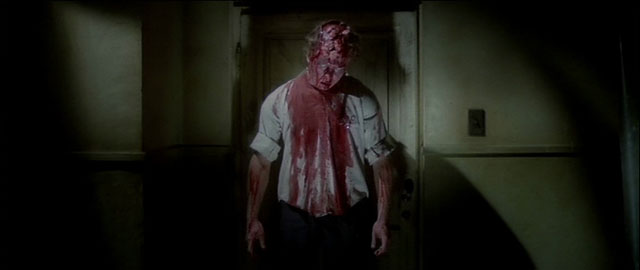
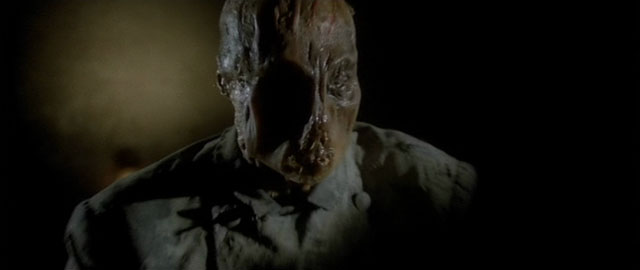
“Both books were non-fiction, Malcolm insisted… claims they were confessions.”

I like a movie that reminds me of In the Mouth of Madness. I also like 80’s children’s horror flick The Gate and its sequel, and this was made by the same team (though we have evidence that the director has since fallen straight off the quality charts). And it’s from the writer of Nightmare on Elm Street 2 (one of the good ones). So I should have loved this – and I did, even if I can see why it’s not enjoying the same reputation as Lost Boys and The Monster Squad these days.

Jenny Wright (the top-billed woman in Young Guns 2, which is to say she’s eighteenth-billed overall) plays scatterbrained bookseller Virginia, who is recently obsessed with obscure horror writer Malcolm Brand. She reads his first book, which features a murderous troll creature locked in a crate, losing herself in the book as creatively shown by the film – the transitions between real and fantasy are well done. I was more surprised that she seems to have a happy, comfortable relationship with her cop boyfriend Richard (Clayton Rohner of The Relic, April Fool’s Day), unusual for a movie.

Caught them both staring into space:

Things heat up when she finds the author’s second book, and the murders within spring to life as she reads. Randall Cook, an effects animator who worked on The Gate, The Thing, Ghostbusters, Puppet Masters 2 and 4 and other movies I used to watch on cable all the time, and therefore a major influence on my childhood dreams and the continued existence of SHOCKtober, plays the mad doctor/book author wearing a beret, a cape, some serious facial disfigurement makeup, and a mask that would please Leatherface during the last 15 minutes.

Virginia has some friends, who are, naturally, doomed to sacrified before Randy’s desire for reconstructive surgery – more Eyes Without a Face than Texas Chainsaw Massacre. An actress in her theater group loses her scalp and pretty long hair (I hadn’t thought of Randy’s baldness as a gruesome disfigurement), her friend Lenny loses his nice Italian nose, her patient bookshop coworker Mona loses her lips (a killer’s gotta have luscious lips) and I’m not sure what he wants from the pianist across the street from her apartment. Virginia skips ahead in the book to see who the next victims will be, but the cops dismiss her as a crank. When the predictable showdown between herself (with a late-arriving Richard) and Randy arrives, she unleashes the beastie from the first book (which looks suspiciously like The Gate goblins on a larger scale) for a few great minutes of stop-motion which justify everything that has come before. Brand finally turns into book pages and flutters away. Mick Garris totally ripped this off for his TV episode Valerie on the Stairs, figuring that nobody would notice – gotcha, Mick.

See also: Shadowplay

This was to be the U.S. premiere with director in attendance until the stupid New York Film Festival stole him away. Still, third U.S. screening ever for a top-shelf auteur’s new Cannes-winning feature ain’t bad for Emory. Too bad they couldn’t drum up more interest – maybe 40 people in attendance. Too bad it played from DVD (in a room with a 35mm projector), also. Atlanta film culture sucks.

When I saw Tropical Malady I fell for the atmosphere (there wasn’t much else to that movie but atmosphere), the sounds, the magic and the jungle. Syndromes and a Century added slow, quizzical camera moves and characters with shifting identities. So this one was the best of both worlds, like a small set of Syndromes characters plopped into Malady’s magical forest, still feeling more like an original vision than a retread.

Boonmee runs a farm in the country, has a personal nurse (an immigrant, possibly illegal, from Laos) to tend to his kidney problems. Jen (sister of B’s late wife) and Tong (a young relative, maybe a nephew) come to visit from the city. It’s a peaceful tour around the farm until Boonmee’s wife Huay materializes at the dinner table, and then his son Boonsong emerges from the forest. Boonsong had been lost to the family for many years, having run into the forest to start a family with the monkey ghosts and apparently become one himself. Of course all this is strange, but only Boonmee realizes his family has returned because he is about to die, so the next day he tries convincing Jen to move to the farm. Finally Huay leads the three (Boonsong has left) into the jungle, and into a giant cave, where she drains her husband’s kidneys one final time. At the funeral Tong is made a temporary monk, but is uncomfortable so he visits Jen’s hotel room where she’s counting gift money with her daughter, and takes Jen out to get some food. But after they get up from the bed and start to leave the room, they also remain on the bed watching TV – a final bonkers scene in case the audience got too complacent after Boonmee’s death.

Unless it happened when I left to use the bathroom, Boonmee never vocally recalled his past lives, but there are unexplained scenes which might refer to them. The movie opens with a cow (NYFF says it’s a water buffalo) snapping its rope and lumbering into the forest, maybe glimpsing a monkey ghost before being retrieved by its keeper. Late in the film there’s a photo montage of soldiers who apparently capture a gorilla. And in the middle there’s a scene with a princess stopping at a waterfall on her way through the forest. She intends a tryst with one of her servants (seemingly not their first) but drives him away, accusing him of loving only her status, not her beauty. Then she peers into the lake and sees herself beautiful beneath the water, wades in, dropping all her jewelry, and has sex with a flattering catfish. Was Boonmee the catfish? Did his hookup with the princess provide the bad karma that led to his kidney ailment?

I knew I recognized Tong, but didn’t realize he played the monk in Syndromes and a Century. That’s interesting, since he’s play-acting as a monk in this movie. He was supposed to only stay a few days but ditched on the first night, showering and changing into his street clothes at Jen’s place. In Syndromes, the monk wanted to be a DJ, and denied another character’s story of reincarnation. Before that, the same actor played a character named Tong in Tropical Malady – a definite thread through Weerasethakul’s last three features, even if recognizing that thread doesn’t clear up any of their mysteries.

Watched again summer 2011 with Jimmy, this time on handsome 35mm at Cinefest – lovely! I’m sure that photo montage with the soldiers/gorilla and the incongruent voiceover is important, given that it comes right before (or during) Boonmee’s death, but still can’t figure what it means.

A.W. says that parts (the cheap gorilla suit?) were inspired by classic Thai TV and cinema, that his father died of kidney failure, and that there are plenty of deleted scenes with the princess that he hopes will be on the DVD.

I didn’t set out to watch Brainiac: The Baron of Terror – nobody does. But these blog posts don’t write themselves. Sometimes when I’m sitting and writing about horror movies, I wish I was simply watching more horror movies, so I’ll half-watch some half-assed movie while writing. I doubt this one even makes it up to quarter-assed, so I’ll be brief.

Is this set in Spain, or did the Spanish Inquisition make it to Mexico? Very promising opening: in 1661 the Baron, who has magical powers to release himself from his chains (so, why doesn’t he simply escape the inquisitor?) is sentenced to burn, swears he’ll take his revenge in 300 years. Not a bad looking movie (except for a ludicrous optical effect of a comet) or story. But then comes the revenge, wherein the Baron puts on a silly hairy rubber mask with a long plastic tongue and puts his hands on his victims’ shoulders until they fall down. Supposedly he is sucking out their brains with the evil tongue, which he then stores in a canister and eats when needs some quick energy. At the end our hero discovers the canister, and I figure he’ll chuck it against a wall and the Baron will lose his magic, but instead two guys with flamethrowers bust in and torch the Baron – didn’t see that coming.

Heroes: Rubén Rojo of King of Kings and Rosa María Gallardo of Los secretos del sexo débil

A few translation problems: the grand inquisitor accuses the Baron of using spells “for clumsy and dishonest purposes,” and later an astronomer states “This is the most interesting thing about what I am telling you.” From the director of Blue Demon vs. The Infernal Brains (the guy had a thing for brains) and starring the movie’s own producer as the Baron.

Watched again with Katy, three years after buying the DVD intending to show it to her – and she liked it! Watched by myself April 2006, and wrote as my fifth entry for this blog: “Total children’s fantasy with brilliant colors except for the occasional harsh violence (beheading talk, arrows shot into the bad guys’ skulls). Nice to see a British/American movie set in Iraq with good guys named Ahmad and Abu who praise Allah every few scenes. Of course the effects are great and of course the princess falls in love way too easily. Our hero was sorta goofy, but Abu the thief is wonderful. Neat how it begins in the middle (blind Ahmad) then hits the full backstory before proceeding.”

Holy cow. Shot over two years. Remake of a Fairbanks movie. Shot like a silent film, conceptualized as a musical, and directed by six different people. Interrupted by the war, so it was put on hold to make propaganda piece The Lion Has Wings. Constant script revisions. Whole segments excised a few weeks before release. Early scenes with Sabu unusable because he grew so much during the hiatus. Shot in two countries with a relatively new color process and an unprecedented array of special effects. Could have ended up an unsalvagable mess instead of the beautiful-looking smoothly-edited story it is.

I love this giant foot. Of the stars, Sabu was Indian and genie Rex Ingram was black, “born on a riverboat on the Mississippi River,” making this an unusually multicultural film for 1940 Britain.

Young Sabu never gets to be a romantic hero, but the romantic hero is boring. Sabu shoots the villain in the forehead with a crossbow (Jaffar’s mechanical horse then falls to pieces mid-air, a startling scene) and escapes his appointed pink-clothed life as John Justin’s vizier, flying away on the magic carpet in search of adventure.

Princess June Duprez was in other Korda pictures The Four Feathers and The Lion Has Wings, and a Rene Clair movie.

Jaffar was Conrad Veidt. Good at playing a villain, he’d portray the chief nazi in Casablanca the year before he died, and in the silent era he starred in The Hands of Orlac and Cabinet of Dr. Caligari (as the somnambulist). Miles Malleson, the old toy-obsessed Sultan, wasn’t really so old – he acted for the next 25 years, including in Kind Hearts and Coronets, Stage Fright and Hammer’s Hound of the Baskervilles. Cheese-headed stage actor (obviously) John Justin became a Ken Russell regular in the 70’s.

Welcome to a special SHOCKtober edition of The Last Ten Minutes, in which I find horror movies on Netflix streaming which I may have actually been tempted to watch (because I am stupid and will watch any trash some days), and remove that temptation by seeing how they end.

Howling VII: New Moon Rising (1995, Clive Turner)
A made-for-TV inspector is clumsily explaining the entire movie to priest John with copious flashback scenes. Ted (played by the director, who was also a producer on Lawnmower Man 2: Beyond Cyberspace) is a longhair biker rebel suspected of killing all the townsfolk, but the inspector is saying it wasn’t Ted. Later, a girl named Cheryl is even more clumsily explaining to Ted that she’s the werewolf. Does the whole movie consist of long explanations by terrible actors? Oh no, here’s a heinous morphing effect, then the townsfolk shoot the Cheryl-wolf to bits, and a county band plays us out, first apologizing to Ted that the whole town thought he was a werewolf. The music was the best part, all extended guitar solos, doing its own thing in a way reminiscent of Rollergator. This is the last Howling movie to date, though I’m sure they’ll remake the original any day now, since they’ve already done Pirahna.

Ghost Ship (2002, Steve Beck)
Cool music. First words I heard: “Murphy’s dead.” Shit, Murphy was Gabriel Byrne, and he’s the only reason I’m watching this – not for Julianna Margulies, beach-blonde Ron “Deep Impact” Eldard or a possessed-by-evil Desmond Harrington. Yay, blondie shoots the evil guy… but evil cannot be killed with a shotgun, as proven by a dodgy computer morph. Boat explodes, Julianna escapes, but a metal song indicates the evil is still alive. Director Steve Beck (13 Ghosts remake) went on to make… nothing. Good.

Day of the Dead Remake (2008, Steve Miner)
A room full of attractive young people led by Mena Suvari (Stuck) are in a bunker. Wow, the zombies can dodge bullets in this one. “He’s smarter than the others.” Oops, Nick Cannon got eaten. Makeup budget must have been low because whenever they show zombies, the camera goes all freakity flop. A zombie shot a zombie, and the kids rig a giant flamethrower that infernoes the whole place except for their little room. Whatever, looks bad all over. From the director of House and Lake Placid and the writer of Final Destination.

Shrooms (2007, Paddy Breathnach)
Lindsey Haun, I suppose, prowls a spooky house with an axe. Now they’re in a forest. I know from the netflix description that they all took killer shrooms so maybe nothing that is happening is really happening. Ah indeed, in the hospital Haun realizes that she was the killer all along. She took shrooms and killed all her friends! Haute twist.

Machine Girl (2008, Noboru Iguchi)
Hoo, some silly-ass special effects. Serious-looking schoolgirl Ami with machine-gun arm and her friend Miki with chainsaw foot kill yakuzas in the woods. Ami is badly bloodied by ninja lady with steel drill bra, then bisects the heads of the baddies. Naturally from the writer/director of RoboGeisha.

American Psycho 2 (2002, Morgan Freeman)
Netflix say: “Patrick Bateman is dead, but his evil legacy continues with Rachael Newman, the only victim who managed to escape Bateman’s grasp. Rachael will get rid of anyone who threatens her chances of becoming teaching assistant to the infamous Dr. Daniels.” Hmm, Mila Kunis is telling William Shatner (via answering machine) that she loves him. In flashback, she steals some girl’s identity and talks to herself all the time. I think this is supposed to be a comedy. I wonder if Bret Easton Ellis got paid for this. She kills herself in a car… or does she!!… followed by a news montage, then the infamous Daniels (dude from a couple vampire TV series) giving a lecture and she shows up. Looks stupid, but it might’ve been less stupid if it hadn’t pretended to be an American Psycho sequel. Freeman is sadly not the great sad-voiced actor but some nobody with the same name, and the writers of this movie fortunately never worked again.

The Signal (2007, Bruckner/Bush/Gentry)
Bad guy is beating up good guy. IMDB calls it “A horror film told in three parts, from three perspectives,” so I guess this is the last ten minutes of the third perspective. Everyone’s face is awfully bloody. Bad guy, with a voice like Patton Oswalt’s, is having an argument with his wife-in-a-coma, then both guys have identity crises and Patton punches through one of many TVs showing “the signal,” electrocuting himself to death. Then I think there’s a fake epilogue but I don’t get it. I thought this one would actually be cool (I dig the premise) but the ending looks somewhat worse than Ghost Ship.

Subspecies (1991, Ted Nicolaou)
Two girls (the Demi Moore one and the Catatonic Blonde) break free from prison but oops, Catatonic Blonde is a vampire. The evil vampire (Radu?) is a terrible ham, and what’s with his fake plastic fingers? Ooh, a shotgun-toting vampire hunter and a quick spot of stop-motion. Your standard swordfight ensues, along with a falling chandelier and some beheadings and everyone’s a vampire in the end. I think the bad guy has been in some Lars Von Trier movies, and I’m not sure who the vampire hunter was but he looked like a wannabe-Toulon. I also checked out the first couple minutes because I ain’t watching Subspecies without seeing Angus Scrimm in a Ludwig Von wig. Looks better than most of the Puppet Master movies, if that’s saying anything.

Subspecies 2: Your Sister is a Vampire (1993, Ted Nicolaou)
Michelle “daughter of Kirk” Shatner has come to fetch another girl from the castle. An old man sloooowly tries to stab a vampire, and his lack of haste is repaid by getting stabbed by a puppet. Evil vampire Radu is alive again and hammier than ever, until he’s stabbed repeatedly by the imprisoned girl amongst some sub-Evil Dead (sub-Subspecies, for that matter) puppet creatures. The original looked grudgingly watchable, but obviously sequels yield diminishing returns. Nicolaou, who helmed the ridiculous TerrorVision, would make two more Subspecies sequels then Puppet Master vs. Demonic Toys, all for the sinister Charles Band and his Full Moon Pictures.

The Astro-Zombies (1968, Ted V. Mikels)
Ted V. Mikels is maybe the only filmmaker I’ve ever met, but the only movie of his I’d seen was on Mystery Science Theater. Yay, John Carradine! He and crony William Bagdad (The Black Sheik in Head) are working on astro-zombie (read: dudes staggering around wearing rubber skull masks) brain transplants when Tura Satana and some actor from Agent for H.A.R.M. interrupt. The sound, lighting and editing are uproariously bad. Oh, I learned that bullets cannot stop a machete-wielding astro-zombie. Some people in suits tell us the moral of the story, and all was quiet for thirty-four years until Mikels and Satana made a sequel.

Finally, a great horror movie set in Barcelona (Carriers was directed by Barcelonans but set in the U.S., a missed opportunity). Although, it takes place entirely inside one small apartment building, so it could have been set anywhere – which was Hollywood’s point when they remade it in English as Quarantine.

The most fun thing about this movie is that the cinematographer (Pablo Rosso) is also a lead character, a news cameraman following young reporter Angela (Manuela Velasco of the upcoming Spiderland, which I’m hoping is a Slint bio-pic). I’m not up-to-date on my Spanish horror viewing, so haven’t seen any of these actors before. IMDB says the leads return for [Rec] 2, but I don’t see how that’s possible since everybody dies at the end. I don’t get why a sequel (plus two more in development) would be desirable either – having flashbacks of the hilariously stupid Blair Witch 2.

Fluff reporter Angela is following fire fighters for a night when they’re called to an apartment to check on a disturbance. Said disturbance is the old woman upstairs eating one of her neighbors. They soon find out they’re being sealed inside the building by the Spanish CDC, and that people the old woman bites seem to become flesh-eating zombies.

Panic ensues. There’s a nervous, power-crazed cop who likes to draw his gun, a cute widdle girl and her mother, a young doctor, and some more zombie-fodder residents. The fireman and the reporter/cameraman nearly escape but he gets bitten. The news crew lock themselves in the penthouse, where a crazy (you can tell because there are newspaper clippings all over the walls) but organized (if the clippings weren’t enough of a plot device, there’s a tape machine) mad scientist was conducting experiments on a zombie… who is… STILL IN THE APARTMENT OH MY GOD AND it kills them both and that’s the end.

Katy found some rare free time to watch a movie (she was sick), so we watched another Fred Astaire musical (our sixth). SHOCKtober will resume shortly.

For once, Fred Astaire’s costar isn’t his romantic partner but his sister. Fred was in his 50’s, looking slightly rough in close-up but having lost no charm, and sister Jane Powell was only 32, of course. The two are dancing partners in a hit show in New York – he’s the consummate professional and she’s always out with a different guy. Their agent books them a gig in London (supposedly it’s the same show, but prefiguring The Band Wagon, none of the music numbers we see from it seem vaguely related to each other) and they each find true love. Jane Powell recognizes a kindred spirit in royal womanizer Peter Lawford (who costarred in Easter Parade with Astaire and Judy Garland in 1948, the same year Jane Powell starred in A Date With Judy), and Astaire meets pretty redhead Sarah Churchill (who wasn’t in a ton of movies, but guess whose daughter she was). And they live happily et cetera.

Of course the group/duo dances are very nice, but Astaire kills it in the solo segments. He does two of his most famous and elegant dances – one on the walls and ceiling (even after I explained, Katy still can’t figure how he did this), and one ingeniously with a coat rack as his partner, a clear influence on David Byrne in Stop Making Sense. For her own solo numbers, Powell sings. And I did not have to turn to IMDB to know that she’s a big fan of Jeanette MacDonald, the piercing Snow White soprano of Monte Carlo and Love Me Tonight. Powell isn’t as horribly shrill, and recording equipment was of higher quality in 1951, but it’s still not my favorite vocal style.

Young director Stanley Donen’s next musical would be Singin’ in the Rain, and this was the first movie by writer Alan Jay Lerner, who’d write Gigi and My Fair Lady. Sarah’s bartender dad is Irishman Albert Sharpe, who returned in Lerner’s Brigadoon. Keenan Wynn seemed awfully proud of himself, but was frankly stupid as both the couple’s New York agent Irving, and his twin brother in England, Edgar. He would improve into the 60’s, appearing in Dr. Strangelove and Point Blank, before falling to the depths of Laserblast and Parts: The Clonus Horror.

“The smell of the rooms… terrifies me.”

I should have known not to get too comfortable with Italian horror. After I unexpectedly loved City of the Living Dead, I ran out to get another Lucio Fulci movie. Can’t go wrong with this one, part of a trilogy with CotLD and The Beyond (which I remember enjoying a decade ago), right? Another bunch of nobodies getting inventively slaughtered by mysterious undead beings while all of humanity is threatened by something evil and inexplicable? But it was just a stupid haunted house movie full of detestable actors.

Opens on a mediocre note. A whiny, out-of-sync blond girl is yelling incessantly after her boyfriend Steve, until a knife through the head finally shuts her up. I didn’t hope this would set the pattern for the rest of the movie (people yelling someone else’s name incessantly for an hour then dying uneventfully) but it sure did.

Steve got killed:

I don’t think of five-year-old psychic creepy-eyed Scandinavian children as being named Bob, but this one is. Bob (Giovanni Frezza, who retired at age 12 after appearing in Demons) moves to a small town in Massachusetts (are all Italian horrors set in MA? See also CotLD and Ghosthouse) with his parents, beardy scholar Norman (Paolo Malco of New York Ripper, Escape 2000) and housewife Lucy (Catriona MacColl, lead screamer from the previous movie). Before they even get to the house, an also-creepy girl who may be a ghost tries to warn him not to go inside. But a five-year-old doesn’t have much authority within the family, so they do.

Shrill family:

Norman is picking up the research of a colleague who killed himself while staying in the house. So he’s a writer of some sort… in a house that drives people crazy… with a young psychic son. Very The Shining. But wait, there’s also an apparently evil babysitter straight out of The Omen – odd scene involving May and a decapitated mannequin warns us about her. But it turns out the babysitter (whom I immediately recognized from an early scene in Suspiria) never does anything evil and is eventually slaughtered by the leatherfaced monster in the basement.

Sexy babysitter:

There is some kind of plot intrigue which is never adequately explained. I like that about the Fulci and Argento movies of this era, that they suggest great mysteries and conspiracies of which we only learn small parts. The husband swears he’s never been to this town, but people recognize him. The girl who communicates with young Bob via the Shining roams around with her mom or somebody, staring at things and making vague warnings. And some realtors fret over whether they’ll be able to unload the Freudstein house (what an awesome name) in which the family is staying. I guess that one isn’t much of a conspiracy. Also there are zooms – lots of them. I don’t have a problem with that.

But the plot isn’t what’s important. What’s vital is that Bob seems to do most of the talking, and he is dubbed by an awful woman doing a shrill kid voice. And really, most of the movie is people walking slowly around calling somebody’s name. When anyone is evil, lying, or a ghost they act super obvious about it. And there are crying, whimpering sounds on the soundtrack all the time, even when Bob isn’t on screen. None of this is worth sitting through for a standard haunted-house movie. Admittedly it was still better than Ghosthouse, but if they’d lost Bob it could have been halfway decent instead of just not-altogether-terrible.

Freudstein:

There’s a cellar in the house, which is locked. And the lid to a tomb is in the hallway. “Wait a minute – if there’s a cellar, won’t that tomb just be sitting in the cellar under the hallway,” I thought, and sure enough the dead fellow (Dr. Freudstein: Giovanni de Nava, who played “Joe the Plumber” in Fulci’s The Beyond), looking somewhat like Baghead, is just lumbering around loose in the cellar. Stupid Norman goes on a goose chase to another town looking for Freudstein’s grave (didn’t CotLD also end with people looking for graves?) while the monster, having already stabbed a realtor (Dagmar Lassander, who went on to appear in Devil Fish) and beheaded the babysitter, threatens his family. But he makes it home just in time to prove totally ineffective, and I cheer as Bob gets permanent horrific psychological damage from watching his parents get killed by an undead maniac. Bob himself ends up in another dimension with the ghost girl, so maybe he got killed too, who knows?

Evil Dead connections: there is exposition via audio tape, and once while Lucy is alone, everything in the house starts making noise at once. Also: Bob calls his Curious George doll “Yogi” and someone says the line “I’ve lost all critical perspective!” Bob’s dad wastes some of our time in the library with Carlo De Mejo (surviving hero of City of the Living Dead – he was in Guardian of Hell this same year, which sounds like a better follow-up to CotLD than this turned out to be) and creepy librarian Gianpaolo Saccarola (who played “The gorilla” the next year in an Antonioni film – whether that was a character name or he was wearing a gorilla suit, it could only be a step up from this movie). Old Mary Freudstein (I assume that’s the woman with the little girl), Teresa Passante, had been in a Kirk Douglas flick called Holocaust 2000 which somehow never shows up on Turner Classic Movies.

With his pink gun and Curious Yogi, Bob prepares for battle:

“Some day you’ll wiggle that bottom of yours just once too often”

Aw, this wasn’t much of a horror movie. I guess the idea of surgery without anesthesia is pretty horrific, and the local innkeeper is killing homeless people for fun and profit, and it costars two Frankensteins (Boris Karloff and Christopher Lee), so you could definitely call it a horror movie, but it didn’t much feel like one – more of a dark medical drama. Preston Sturges’ The Great Moment comes to mind. I’ve never seen it, but I thought it was also an invention-of-anesthesia drama. IMDB’s summary makes it sound like more of a patent-infringement thriller, so maybe it’s Corridors of Blood meets Flash of Genius (that intermittent-windshield-wiper-invention drama). Of all the horror movies in the world, why did Criterion pick this one?

A tale of two Frankensteins:

Anyway, it wasn’t bad, for what it was. Lee, in only his third horror movie after Hammer’s earliest Frankenstein and Dracula movies, was deliciously sinister, and Karloff is a surprisingly great actor (guess I’d only seen him as Frankenstein before). Greatly enjoyed the scene where he invents laughing gas and goes on a rampage of hilarity, smashing up his lab. So he overdid it there, but usually he’s quite good.

Karloff is powerless before Black Ben:

While Karloff spends the whole movie experimenting on himself, being mocked by his peers and ultimately becoming a useless opium addict tricked into signing false death certificates for the evil innkeeper, the movie blows some time on our romantic young couple (every movie needs one!): his son Jonathan (Francis Matthews of Terence Fisher’s Revenge of Frankenstein and Dracula: Prince of Darkness) and the housekeeper Susan (Betta St. John of The Robe and Horror Hotel). A haughty white-haired fellow at the hospital (Finlay Currie, who played a man with unpronounceable name in I Know Where I’m Going!) mocks Karloff at every opportunity, with a pinched-mouth arched-eyebrow movie-villain expression on his face.

Finlay Currie to young Jonathan: “your tie is ridiculous.”

Karloff dies in the end (Lee might die also – someone threw “vitriol” in his face) but his son picks up his papers and proves him right, demonstrating the importance of anesthesia in a scene which was probably funnier in the Preston Sturges version. Additional players: the evil innkeeper Black Ben is Francis De Wolff (Hound of the Baskervilles, Under Capricorn) and his even-more-evil wife is Adrienne Corri, who went from playing the neighbor girl in Renoir’s The River to a gang-rape victim (not the one killed with a giant phallus) in A Clockwork Orange. As far as anyone knows the director is still alive. His last theatrical feature was 1980’s The Man With Bogart’s Face, which has a hilarious VHS cover.