It snowed in Atlanta so everything shut down for an entire week. As is now traditional, I celebrated by watching a pile of shorts I’d long been planning to see (some as part of the Auteur Completist Initiative).

The Dreamers (1982, Orson Welles)
Welles as an old man narrates the story of opera singer Pellegrina Leone (Oja Kodar), who lost her singing voice in a fire. It’s all Welles and Kodar doing monologues. Maybe all of Welles’ films come down to monologues. Constructed from fragments, with black screens where footage was missing, narration recorded with the sound of rustling script pages. Ooh look, a Don Quixote reference. Not the most exciting of the many late-career Welles fragment films… personally I’d like to see more of The Deep.

Orson in his magician hat:

Invocation of My Demon Brother (1969, Kenneth Anger)
Good camerawork, but ridiculous movie. I think with his images Anger is trying to say that the military is a death-obsessed homosexual cult. I think with his audio Mick Jagger is trying to declare the death of interesting music. I think with his performance, Anton LaVey is trying to expose himself as a silly clown.

That is a nazi flag, but what is he burning?

Le Lion Volatil (2003, Agnes Varda)
Julie Depardieu (Guillaume’s younger sister) works for a psychic, while an aspiring magician named Lazarus Combes (Anton LaVey would be pleased) works at a tourist-trap dungeon around the corner. Every day on their lunch breaks they meet in front of the Lion of Belfort memorial – the same one featured in Rivette’s Pont du Nord and Paris s’en va. Their brief almost-romance doesn’t pan out, but more interestingly, Julie starts hallucinating variations on the lion – first it has a giant bone in its mouth (as supposedly suggested by Andre Breton), then it vanishes and is replaced by a giant housecat. Special effects + Vardaian whimsy = happiness.

Les Dites Cariatides (1984, Agnes Varda)
A tour of caryatids – human statues used as building columns or ornamental facades – throughout Paris, with poems by Baudelaire. “The Peloponesian city of Karyate aided Persia in a war against other Greeks, but Persia lost. The Greeks took revenge on Karyatian collaborators, slaying all the men and enslaving the women. They were paraded as spoils of war. The noble women were triumphantly shown in their lovely gowns and finery. To illustrate their punishment, architects used these statues on public buildings instead of columns.”

The Calligrapher (1991, Bros. Quay)
Three short (15-sec?) segments rejected as BBC2 ident bumps. My favorite kind of Quay film – awesome stop-motion with no human actors, repetition or long-winded confusing mythological story.

Storytime (1968, Terry Gilliam)
This came out while the show Do Not Adjust Your Set (a precursor to Flying Circus) was in production. Opens as a poorly-animated (in Gilliam’s magazine-cutout style) story of a cockroach named Don, who is then stomped on by a man called Jeremy Trousercrease… and so on, each minute-long concept leading into another. Even features a “we apologize for the previous cartoon – the animator responsible has been sacked” disclaimer, which would be reused in Monty Python. Not exactly a lost masterpiece, but a fun little series of cartoon gags.

Pandoora (2002, Takashi Miike)
Just a cheesy samurai music video – does not count as a Miike movie. It ends with our hero about to face off against a giant mantis. What, were they expecting a sequel?

Male (1962, Osamu Tezuka)
Lots of play with frame sizes and positions as a male cat narrates, talking to the man of the house, about how sex should be simple and private and should not end in stabbing your partner to death.

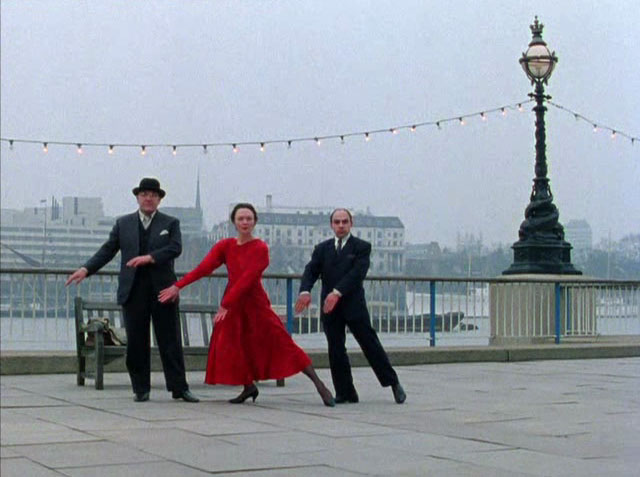
The London Story (1986, Sally Potter)
A woman conspires with a door opener and a retired photocopy machine operator, takes a government minister out to the theater and while he sleeps, replaces his speech about the future of Britain with a new one, causing panic in the media the next day as the conspirators enjoy a choreographed dance on a bridge. Delightful.
Reasons To Be Glad (1980, Jeff Scher)
More of Scher’s fanciful drawing and incredible editing based on rotoscoped (?) images and set to a Dinah Shore song.

The Bum Bandit (1931, Dave Fleischer)
Oh my. A Popeye-muttering train robber gets out-toughed by a passenger in the form of Proto-Betty Boop (still with the dog ears), the robber’s abandoned wife, who steals the locomotive and the bandit, closes the shades and makes with the sweet pre-code lovin’.

Betty and the Bum:

Negro passenger with stolen chickens:
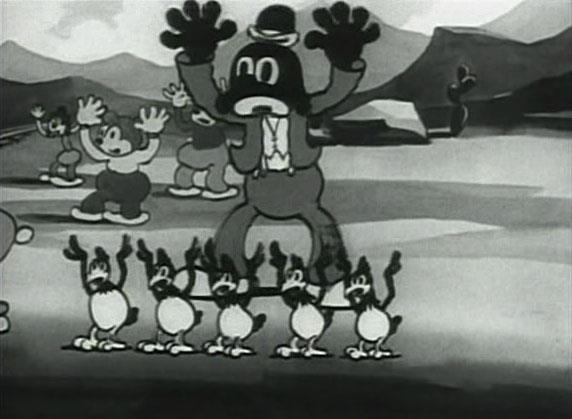
Russian Rhapsody (1944, Robert Clampett)
Watched this recently on the big screen but it never gets old. Hitler’s plane is taken out by gremlins from the kremlin. Why don’t we have wartime cartoons anymore? I want to see the Penguins of Madagascar take on Osama Bin Laden.

Vinyl (1965, Andy Warhol)
In the 60’s it was revolutionary to make slow, cheap movies with bad gay actors, but not anymore. There are probably three filming as I type this. This isn’t technically a short film, but I gave up after thirty minutes, having dozed for the previous ten. A dude recites Burgess and dances to pop music – and it’s all one shot. Wikipedia says it was filmed unrehearsed, which I don’t doubt, and says it’s one of the “1000 films to see before you die,” which I do.

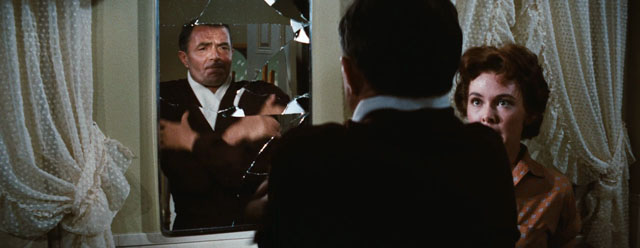
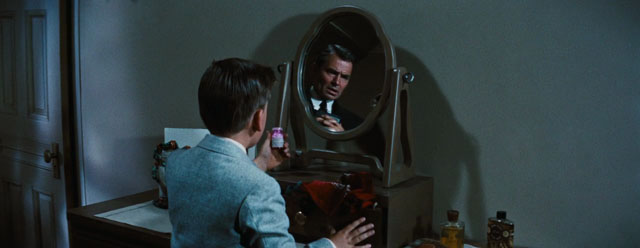
I enjoyed the crazily over-the-top performances of Ray’s Rebel Without a Cause and Johnny Guitar but didn’t get much of a sense for his filmmaking – unless his thing was casting unhinged actors and letting them loose within overly melodramatic stories. I suppose he also made extreme/sly comments on society with Johnny’s crusading zealot McCarthy figure and Rebel’s mixed messages on masculinity and family units. Well, this one brings it all together, with an extreme (but less “method”) performance by James Mason and a brutal attack on society and family and everything else. I don’t know if it’s that tying-together of the Ray threads or the movie itself, but I’m currently loving it more than the other two.

Good mirror:

Bad mirror:

Scary mirror:

Mason is a schoolteacher who starts experiencing massive pain. Doctor says the pain will get worse and he’ll be dead in months unless he takes miracle-drug cortisone (wikipedia: “a steroid hormone … suppresses the immune system, thus reducing inflammation and attendant pain”). So Mason pops some pills and all is well – he and loving wife Lou (!) and son Richie carry on with their movie-perfect 50’s lifestyle. But it’s not as perfect as all that… schoolteacher salaries were low even back then, so Mason holds a secret after-school job as a taxi dispatcher in order to keep up those perfect middle-class appearances. The cortisone is expensive, and worse, Mason is forgetful – misses some doses and doubles some others, until he’s taking twice the proper dosage and starting to go completely manic from the side-effects. He quits his cab job, tries to get fired from the school, berates everyone he comes across and finally, in a state of biblical delusion, conspires to kill his son. Last-minute rescue (in the form of a stairway fistfight with buddy Walter Matthau, which alone is worth the price of admission) returns Mason to the hospital, where the doctor straightens out his dosage and brings him back to his senses. Hoorah for modern medicine!

Pain chart:

Walter Matthau!

I guess this was the American Beauty of its time, allowing a white suburban dad to rebel against his status and say things that nice people should not say, attracting the attention of the neighbors, to the horror of his wife. Only this was so much better. The wife (as already contrasted with the wife in Close Encounters) is understanding and recognizably human, there’s a reason given for Mason’s outbursts (drug effects, vs. Spacey’s midlife crisis) and a more reasonable ending (it’s too easy to end your movie by having a sexually-frustrated neighbor shoot your lead character to death).

Good praying:

Bad praying:

One writer worked on three decades’ worth of James Bond movies and the other scripted Forbidden Planet which also came out in ’56 – sounds more like the kind of team that would’ve come up with Star Wars than this. Suppose I’ve seen James Mason in Lolita but he made more of an impression here, with his unexplained foreign accent in the California suburbs, his mad energy shaped (if not subdued) by his British schoolteacher’s intelligence. Barbara Rush (who had appropriately just appeared in a Douglas Sirk movie, as Jane Wyman’s meddling daughter in Magnificent Obsession) was just as good, and it’s always nice to see Walter Matthau, here in one of his first roles.

Cover shot:

Barbara Rush, one more time:

It’s Political Documentary Month! We will see how long that lasts. Katy asked if all Errol Morris’s films are about death (as far as I know they are) and commented that the square photos within a widescreen strip within our square TV across the room made her feel blind, so I brought up stylistic differences between Morris and Ken Burns, figuring we’re being punished for watching a theatrical feature in the same way we’d watch a television program. Afterwards, I showed her In The Loop, which I thought worked much better than S.O.P. on the TV screen. I was psyched to revisit it but she didn’t like at all, since it doesn’t count as satire on government if it’s exactly the way she imagines government works, and anyway it’s not funny.

S.O.P. was surprisingly tame. As one of the former prison guards points out, it’s not like they were beating prisoners or killing them, although that happens when the CIA bring in their own prisoner, a guy who they’re told “was never here.” Unfortunately for the CIA, photos of that incident leaked along with the rest – the ones with prisoners tied up in “stress positions” with panties on their heads, handcuffed into simulated sex scenarios and stacked in naked pyramids, all with Lynndie England flashing a thumbs-up in front. The prison holds a confusing number of military and government groups and private organizations – it would’ve taken a whole other movie to get it all straight. The guards certainly weren’t clear about it themselves. A side-effect of Morris’s technique here is that he’s made the opposite of The Road to Guantanamo, which was told from the prisoners’ point of view. This movie is an analysis of the photographs, of the circumstances behind them, but only from the guards’ points of view. The nameless prisoners, degraded and objectified in those photographs, remain anonymously dehumanized in the film, enigmatic vessels of suspicion (they are, after all, “enemy combatants”) and sympathy (for the torture/s.o.p. depicted).

Marker’s most traditional, talking-head-style documentary since Le Joli Mai still has its fanciful Marker-moments, such as an intermission called “Cat listening to music,” which I believe is the same as the segment in his Petit Bestiare, and some graphics created in HyperStudio on his Apple IIGS

Guillaume-en-Egypte, dreaming images from Japanese television:

Computer camel:

Even though it’s mostly interviews on the topic of Alexander Medvedkin, and not Marker’s missive narration, the film is still structured with chapter headings “first letter, second letter,” etc. Aelita (the Queen of Mars) is shown watching scenes from Happiness. Marker visits Medvedkin’s grave, notes that he was born in 1900 and so his life can be used as a measuring stick for the century. But the metaphor is underused since his recorded life largely consists of the flurry of activity around the cine-train and Happiness, then a long silence until his rediscovery in France in the 70’s.

A.M.’s daughter:

Marker met Medvedkin while in Russia with Costa-Gavras and Yves Montand for The Confession, then Marker made The Train Rolls On, which he excerpts here. “He wouldn’t give people films; he would give them cinema.” The cine-train was fascinating, even if it didn’t ultimately lead to more efficient production and a communist worker’s utopian cinema of the people.

A camera that is aimed like a rifle – I WANT one:

“When Vertov was using studio lights on the extras he mixed with real mourners at Lenin’s funerals it was said he betrayed kino-pravda, film truth. But once you see the same kind of lights in the courtroom, you realize that life itself has become a fiction film, a film noir, filled with suspense, where some actors applaud their own condemnation in advance.”

Insight on Vertov and Eisenstein, giving context to Medvedkin’s work. He says Battleship Potemkin was not successful in its own country. “While European film buffs reveled in the sight of the Potemkin sailors, Russian audiences were dreaming of Mary Pickford and Douglas Fairbanks.” An interviewee tells us that Stalin used to watch every movie made in the country – impressive if true. Best of all is when Marker watches long-lost films from the 1920’s cine-train and finds the birth of moments in the 1932 Happiness – images and editing techniques discovered or invented on the train reused in the feature.

I wonder if interviewee Viktor Diomen was coached when he said A.M. is “outside time. On the one hand, his own time has left very distinct marks on him. He’s like a big tree with its growth rings and its bark marked by the carvings of passers-by.” One thinks of the Vertigo reference in La Jetee, the woman pointing off the edge of the tree, “outside time.”

“Only later did I understand his tragedy – the tragedy of a pure communist in a world of would-be communists.”

The movie gets increasingly interesting and freeform as Marker sets his rifle sights on Russia’s recent past – a very good final chapter, leading to the greatest final paragraph/shot of any Marker film.

It has some drowning, and some numbers, but I guess Greenaway hadn’t ramped up to his full obsession with categorizing and enumerating things (or perhaps he was taking a break – I haven’t seen earlier feature The Falls yet). Fox Lorber did a lousy job with the DVD, but some of the nice candlelight photography and PG-esque controlled compositions came through. I enjoyed it, though it’s not as sneaky a mystery or as delightful a script as it thinks.

Neville with Mrs. Herbert:

Mr. Neville is the titular draughtsman, hired to draw architectural sketches of the Herbert gardens while the master is away. But will the master ever return, or has he met with misadventure? As part of Neville’s fee, he gets to have his way with Mrs. Herbert, while her daughter makes a separate sexual agreement with Neville, suspected by her snobbish German husband Mr. Talmann. Any sense of suspense fizzles out as everything becomes increasingly obvious (young Mrs. Talmann is trying to get Neville to father her child, since her husband is impotent – and yes, Mr. Herbert has been killed). Everyone is trying to frame everyone else, but the grand loser is Neville, set upon at the end by the society types, who cut out his eyes then drown him in the same pool where Herbert was found.

Mr. and Mrs. Talmann:

As usual with British period society comedies, most of the fun is in the bitchy cleverness of the sniping dialogue. Not the only movie Greenaway has made about finding murderous evidence in a painting – isn’t that what the recent Nightwatching & Rembrandt J’Accuse were about? Perhaps PG was traumatized by a youthful viewing of Blow-Up. I also liked the camoflaged naked guy creeping around the garden (doesn’t seem like a realistic occupation – maybe he is independently wealthy)

The director would go on to bigger and better things, but his cast would not. Neville was Anthony Higgins (Merchant/Ivory’s Quartet), currently in something called Malice in Wonderland. Mr. Talmann (my favorite for most naturally wearing the ludicrous period clothes/wigs) was Hugh Fraser, not German at all, appears in Agatha Christie TV series. His wife: Anne-Louise Lambert (Picnic at Hanging Rock), her mother: Janet Suzman (apartheid movie A Dry White Season), and the wicked estate lawyer who works out the contracts was Neil Cunningham of Jarman’s The Tempest.

A quality ending to the trilogy. I liked the timely references (waterboarding, gov’t using Echelon to track keywords spoken over cellphones) and new actors – David Strathairn (Good Night and Good Luck) as the new evil bureaucrat and Paddy Considine (same year as Hot Fuzz) as an intrepid reporter. Unfortunately, by Strathairn’s orders, Considine gets a bullet in the head.

Evil David Strathairn:

Julia Stiles and Joan Allen take Bourne’s side, and a wide-mouthed Albert Finney plays a haunting evil from Bourne’s past, proving that all women are friendly and craggy-faced old men are wicked.

Evil Albert Finney:

An informant in Madrid is blown up by a CIA hit man. Bourne fights two of those guys but only kills one, at most. He’s like Arnold in Terminator 2 now, a killing machine that doesn’t want to kill. The action is surprisingly comprehensible except for one hand-to-hand fight edited for maximum headache potential.

“This means something. This is important.”

Ever since I first saw Close Encounters (must’ve been on TV before I was ten) that line has come to mind whenever I see a big pile of mashed potatoes. But I got two things wrong. Firstly, Richard Dreyfuss doesn’t say that line during the mashed potato scene, but earlier. And second, I remembered the movie being a long, slow, boring build-up to a brief, awesome alien sequence, but it’s more of a medium, slightly boring buildup to a long, quite boring alien sequence. Either way, it’s safe to say it’s not my favorite Spielberg movie.

I’ve been meaning to watch more movies from 1977, the year I was born, to figure out what people were up to back then, but it only raises more questions. How was Richard Dreyfuss allowed to be a movie star? I wonder if Spielberg and Lucas (for Star Wars) being up for the same best-director oscar was the ’70’s equivalent of when Saving Private Ryan and The Thin Red Line were nominated for best picture, only back then Spielberg was the arthouse favorite and in ’98 his was the slam-bang commercial juggernaut to Malick’s more contemplative war movie. How did Francois Truffaut end up co-starring in a Hollywood movie, and did it help his later films get into American theaters?

F. Truffaut, and is that Bob Balaban?

Some thoughts:

Is the movie endorsing men having extra-marital affairs and abandoning their families? Dreyfuss has three kids, but when his wife doesn’t understand him he bonds with Melinda Dillon instead, then at the end he leaves not just his home but the planet.

The government is preparing some guys in Devo jumpsuits to go into space as earth ambassadors, but the only time we see them in training it’s at a last-call religious meeting. Gives the weird feeling that they’ve been selected for some kind of Christian mission to the aliens.

Jeez, but Teri Garr as Dreyfuss’s wife is shouty and has no patience at all. I mean admittedly he builds a full-on rock reconstruction of Wyoming’s Devil’s Tower in their living room, but she has already moved out by then, always having seemed more hysterical than sympathetic. Good contrast was Barbara Rush in Bigger Than Life, whose husband is losing his mind, but she never stops trying to help him. Compared to that, Garr is a one-dimensional bitch whom Dreyfuss was right to leave (though it means leaving the kids in her care, so there’s no winning this one).

Teri Garr is unhappy:

Some guy named Larry (Josef Sommer of Stepford Wives) shows up at the Devil’s Tower then falls behind and gets gassed (the visual effect of the gas shown with dazed little birds falling in front of the camera – classy). Who was he? Besides the gassing/evacuation/secrecy, the government seems surprisingly non-hostile.

Wow, Lance Henriksen looks young.

All the backgrounds look fake – even in Wyoming. They’re not fake in a latter-day CGI manner, but in an old-timey studio painted-backdrop kind of way – and the forest Dillon runs through after her son looks so carefully arranged. Strange that a movie which was probably state-of-the-art in ’77 (with the the effects guy from 2001: A Space Odyssey) seems quaint now, years more old-fashioned than its contemporary 1977 Star Wars.

Dillon under a false sky:

The first encounter with the aliens by Melinda Dillon’s young son (Cary Guffey, cast next in a couple of Italian-opportunist alien comedies) foreshadows two later Spielberg productions: Poltergeist (toys coming to life, scary tree shadows waking the kid) then E.T. (the aliens raid the fridge).

All this gentle-alien cuteness, communicating through music and sign language, abductees returned unharmed, the slow buildup to the slow conclusion – it all seems anticlimactic after you’ve watched Mars Attacks a few times.

Businessman Goda (the director himself, also listed as writer, editor and cinematographer) becomes gun-obsessed after his wife shoots herself. They are illegal to buy, so he trolls the underground, then constructs his own gun out of custom-machined parts, and finally a girl offers a gun if he’ll marry her for immigration reasons. It’s a no-brainer for him, with his life in an obsessive downward spiral by then, and she’s never seen again in the movie.

During his gun quest he ran into Chisato (Kirina Mano of Greenaway’s 8 1/2 Women) and her boyfriend Goto, a couple of punks in a street gang. I suppose we only get the fragments of the plot that Goda understands himself, so when a hitman starts killing off the gang and our guy offers his protection, we never find out who or why this is happening, and it leads to an odd conclusion, the hitman beating the hell out of Goto but leaving our three heroes alive.

It’s Tsukamoto’s trademark gritty handheld harsh black-and-white look, but his movies never seem as indifferently shot as most others which use handheld cameras and fast cutting to convey energy. He’s actually good, not just covering up a lack of visual ideas with speed. He’s great with physical intensity, but maybe less good with plotting. This one wants to be feature length (Haze was better-paced at 50 minutes) but doesn’t offer any new ideas past the halfway point.

Nolan is going for auteur status, taking his mega-budget action comic Batman movies and his multi-layered reality-questioning Memento and making a mega-budget multi-layered action comic reality-questioning super-movie. Seems to have paid off for him – this is in the IMDB top ten at the moment, barely above his own The Dark Knight.

We’ll miss you, Pete Postlethwaite

I should have known Inception wouldn’t be as awesomely complex as I’ve heard it is. It’s not my love for Alain Resnais that makes me feel like a condescending art film snob, it’s breezing through a movie like this one, which the whole world thought was so confusing. I was never in doubt as to what was happening, or which level of dream/reality our heroes were haunting, and thought the ending, while somewhat emotionally satisfying, was the most obvious one possible. Does that make me an asshole?

Why does this shot look so familiar?

Anyway, it’s a fun action dream flick with bang-on performances by Leo DiCaprio and Joseph Gordon-Levitt, good support by Ellen Page and Marion Cotillard and Ken Watanabe, and some overqualified actors wasted in minor roles.