The adventures of a tall blue cat man on a blacklight-mooned planet climbing fluorescent disco trees. How appropriate that the film follows a preview for Tim Burton’s Alice In Wonderland.
Katy and I liked it!
The adventures of a tall blue cat man on a blacklight-mooned planet climbing fluorescent disco trees. How appropriate that the film follows a preview for Tim Burton’s Alice In Wonderland.
Katy and I liked it!
From the director of Road Trip and writers of Ghosts of Girlfriends Past!
A dude gets lost during a bachelor party weekend in Vegas, and it’s up to good friends The Bland One (Bradley Cooper of Midnight Meat Train), The Reluctant One (Atlanta native Ed Helms of The Daily Show) and The Socially Maladjusted One (Zach G. of The Ballad of G.I. Joe) to retrieve him. This is hard because Zach (via drug dealer Mike Epps) slipped them all roofies. While under the influence, Ed yanks out a tooth (my vote for funniest moment, even though it was just a still photo, Ed smiling maniacally) and marries Heather Graham, Zach steals Mike Tyson’s pet tiger, and I can’t remember Cooper doing anything of note. Not a good movie, but it’s always nice to see Jeffrey Tambor. More importantly, since I watched this, Paranormal Activity and Avatar all in the same week, I can now feel like I’m caught up with the rest of America until the next wave of summer flicks come out.
Handicam horror, but not all blair-witch super-shaky (or cloverfield or whatever). Dude hears that his girlfriend has been haunted since she was little (she rolls out the backstory gradually since there’s not much else in the way of plot development) so he gets the camera and tries to document her hauntings. Psychic tells them it’s demons not ghosts, shows them a clip from The Exorcist and skedaddles. Doors open themselves, chandeliers shake, footprints appear. The dude escalates things by buying a ouija board, spoiling things for everyone, including the viewer who’d been enjoying the general lack of hackery up to that point.

Movie is as great as advertised for the first half – I was scared to death. The ouija thing takes it from convincing-fake-doc into clearly-scripted territory, where it remains as she reveals more backstory and discovers a long-lost family photo in the attic of the boyfriend’s house. Then the ending (one of a few, apparently) didn’t do it for me. She sleepwalks downstairs, screams until he comes running, then slowly comes back upstairs holding a bloody knife. No problem there, and apparently the theatrical version ends into “she was never seen again” title cards, but mine had the cops come in and shoot her dead when they saw the knife. Halfway worth the hype, then… still impressive for indie horror. Let’s see if its sequel can avoid the Blair Witch 2 trap.
Astree loves Celadon and vice versa, with the kind of suicide-pact love that mainly exists among 17-year-olds in tragi-romantic plays. His parents don’t approve so the young lovers make a public show of dating other people… but Astree believes the show, feels betrayed and tells Celadon to piss off, so he goes and drowns himself in the river. Not quite dead, he’s rescued by nymph Galathée and her gang. Gal wants hunky Cel for herself but he escapes and hides away in the forest, eating berries, refusing to approach his beloved because, after all, she ordered him away. Meanwhile, Astree and Cel’s brother alternate (“he must be dead!” “he must be alive!”).
I guess I see the Rohmer moral theme at work here. Cel loves his girl so he must remain faithful to her and do as she says, staying away even if she doesn’t know he’s alive. But as Jimmy said, breaking into a giggling fit after hearing Celadon echo his simple emotions for the thousandth time, “he’s SO dumb!” It’s hard to disagree… they are all so dumb, and the movie is so straightforward and simple that it gets frustrating. Some nice imagery though, I thought (Katy said it looked made-for-public-television). Best not to get into the ending, in which Celadon pretends (not convincingly) to be a girl in order to get closer to his beloved.
Astree is Stephanie Crayencour and Celadon is Andy Gillet, neither of whom have shown up elsewhere yet. Jocelyn Quivrin who played Celadon’s brother died in a car crash two months ago. Nominated for the golden lion in Venice along with six movies I’ve loved (and also Sukiyaki Western Django) but they all lost to Lust, Caution, which I thought didn’t get good reviews.
M.J. Anderson:
Adapting Honoré d’Urfé’s novel of 5th century Gaul life, The Romance of Astree and Celadon claims to reproduce less the period depicted than its 17th century readers’ imagination of the earlier period. Commensurate with this goal, the director features canvases painted in the seventeenth century, a castle built well after the novel’s setting and importantly a grafting of the Christian faith onto the Druid-themed source material.
Wow, for years I thought I would hate this movie, but it popped up on best-of-decade lists so I gave it a shot and enjoyed the whole thing. It’s even a genre I dislike, the youth coming-of-age story, but this one’s aimed at adults (creepy adults maybe, all NC-17 for underage sex).
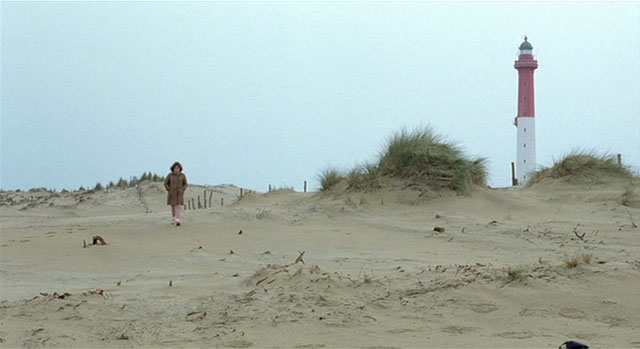
Anaïs (henceforth Anais) is the fat girl (French title was something like To My Sister!) on vacation with her parents and hot older sister. After some frank sex chat (younger Anais: “If I meet a man I love I’d want to be broken in. The first time should be with nobody.”) the girls meet roguish Italian Fernando, who’s making out with older sister Elena in a restaurant within minutes. Anais barely seems to pay attention, kills time the whole movie singing and talking to herself, imagining multiple boyfriends, chanting about being bored.

First-time sex scene follows between Elena and the boy. She tries to back out, but he counters, not about to give up. “All the girls take it the back way. That way it doesn’t count. It’s a proof of love.”


Excellent, unique in its shots and pacing and general outrageousness. I’d watch more Breillat for sure. I get the feminist label for the most part – it’s told completely from girls’ perspectives. The ending worries me, where the older sister and her mom get killed by a maniac who then rapes Anais. Doesn’t seem too feminist, that. Maybe the very end is feminist – Anais insisting to the cops and medics that she wasn’t raped. She can’t mean she wanted it, so maybe she’s making comparisons to her sister’s experience (Anais was in the room at the time). All sex is/isn’t rape, that sort of thing.

The most interesting part is really the relationship between Elena and the boy. He steals a ring from his mother and gives it to Elena, leading to parental intervention and the abrupt end of the vacation. The boy tricked Elena into having sex, but it didn’t ruin her life; she’s still crazy for him. The director doesn’t talk plot in the DVD features, just metaphor – pressing forth, climbing mountains, doing something that is beyond me. Film should be a tormenting experience! She presents herself as an actor-torturing sadist, but the actors all seem happy in behind-the-scenes footage. Breillat seems the stereotype of an arty Euro filmmaker, but her great movie proves otherwise.
Older sister Roxane Mesquida later starred in two more Breillat films. Mom Arsinée Khanjian is Atom Egoyan’s wife so she’s in all his movies as well as Code Unknown and Irma Vep. Dad Romain Goupil is a director, has worked with Chantal Akerman. Our D.P. Giorgos Arvanitis shot films for Theo Angelopoulos, and Breillat made the movie Romance (X), which I skipped in Barcelona to see either Wild Wild West, Happiness or Judas Kiss.
“You’ll be your own downfall.”
The Lady of the title is Grace Elliott, a Brit in France during the 1789-93 French Revolution. Actually the French title is L’anglaise et la duc but Grace is Scottish, claiming English nationality for simplicity when it’s suddenly very dangerous to be a French aristocrat in France. The movie’s intertitles and much dialogue are taken directly from her diaries.

The Duke is one of my favorite Jean-Pierre Jeunet actors, but I didn’t recognize anyone else. Star Lucy Russell has failed to break into the Hollywood mainstream (landing such roles as “female restaurant guest” and “classy shopper #3” in recent big films). Ach, I missed Alain Libolt (Renaud in Out 1) as the Duke of Biron.
Renaud plus 30 years:
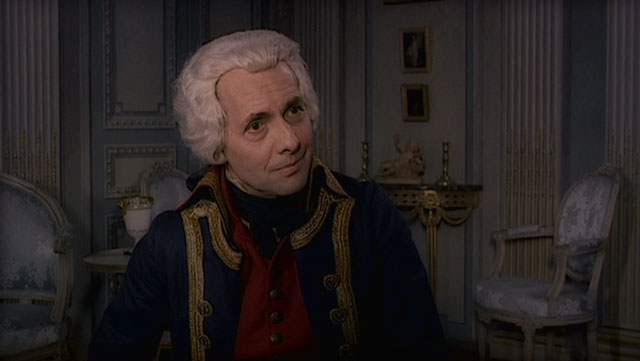
Grace is pure aristocracy, the very target of the revolution, and her sympathies lie with her friends whom she sees being rounded up and killed by the brutish masses. Steadfast in her devotions (though lying to stay alive), she’s contrasted with her friend the Duke, who changes with the times and ends up voting for the execution of the king. Plays like one of Rohmer’s Moral Tales only with more action, more heads on stakes, and more awesome digital backdrops of period Paris standing in for the usual stifling production design and avoidance of outdoor shots (except by filmmakers with Scorsese-budgets). Slant, in fact, called it an “economical antidote to the bloated costume drama.” Grace tries to negotiate the changing world without compromising her belief in the class system, while the Duke either adapts his morals or never had any to begin with. The main thing this movie has over the other Rohmers I’ve seen is historical interest… I delighted in the details of the revolution, about which I know very little. I thought the movie rather anti-revolution, which seems shockingly out of fashion, and one “Grunes” confirms that this was a problem:
Rohmer pitches the action from Elliott’s perspective, with which his own Roman Catholic penchant for order prompts him to identify—hence, the controversy the film engendered in France. Thus the street mobs are unwashed, grisly, barbaric, obscene; poor Louis XVI!
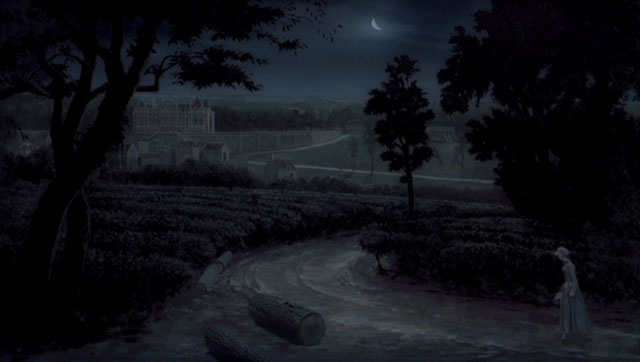
It’s hard to know what to make of the movie’s politics. There’s also a long scene where she successfully hides a Marquis from the police. We don’t get to know the guy very well, but he’s not made out as a man who deserves to die, so bravo, I guess. When Grace is finally arrested and held for two days for possession of a letter from an Englishman, the letter ironically turns out to praise the French revolution to the heavens. These examples and the duality in the title make it seem relatively even-handed, despite being adapted from Grace’s own horrified writings.
Duke Jean-Claude Dreyfus:

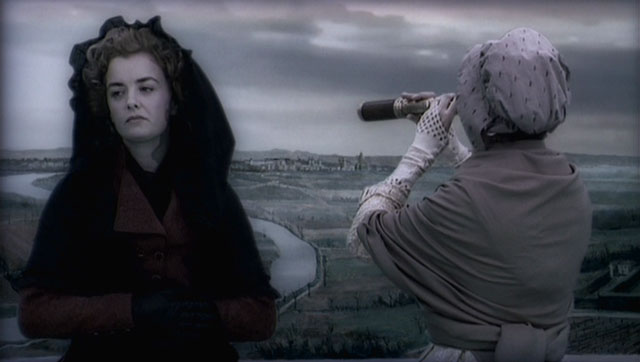
Watched this the night the director died. It got mentions on decade-end lists, with some screenshots that got stuck in my head (like the one below, peering into a painting with a telescope), so I’d planned to watch it soon anyway. I didn’t hear much when it came out, probably because of the timing (sept-oct, 2001). Beaten out for its only two César nominations by Amelie and Brotherhood of the Wolf.
NY Times:
The moral dilemmas that Grace and the Duke face are diagrammed, in Mr. Rohmer’s inimitable fashion, with equal measures of clarity and complexity. The director manages to evade both the stuffy antiquarianism and the pandering anachronism that subvert so many cinematic attempts at historical inquiry. His characters are neither costumed moderns, just like us only with better furniture, nor quaint curiosities whose odd customs we observe with smug condescension. They seem at once entirely real and utterly of their time. And the time itself feels not so much reconstructed as witnessed.
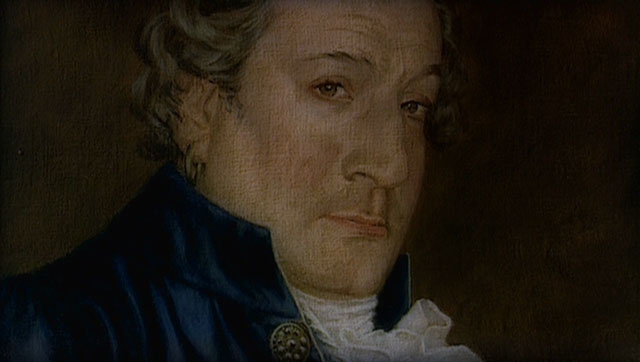
I’ll close by outright stealing an entire blog post by from Glenn Kenny, only because I want to always be able to find this Rohmer quote.
My films, you say, are literary: The things I say could be said in a novel. Yes, but what do I say? My characters’ discourse is not necessarily my film’s discourse.
There is certainly literary material in my tales, a preestablished novelistic plot that could be developed in writing and that is, in fact, sometimes developed in the form of a commentary. But neither the text of these commentaries, nor that of my dialogues, is my film: Rather, they are things that I film, just like the landscapes, faces, behavior, and gestures. And if you say that speech is an impure element, I no longer agree with you. Like images, it is a part of the life I film.
What I say, I do not say with words. I do not say it with images, either, with all due respect to partisans of pure cinema, who would speak with images as a deaf-mute does with his hands. After all, I do not say, I show. I show people who move and speak. That is all I know how to do, but that is my true subject. The rest, I agree, is literature.
—From “Letter to a critic [concerning my Contes moraux]”
Refreshing to see a period (early 70’s) flick that relies only on props, fashion and speech with no TV news montages, shouts-out to topical issues or drenching the soundtrack in pop hits of the time. Unfortunately that’s the only thing refreshing about this movie, in which Peter Jackson seems to be Taking Himself Seriously and not having any fun anymore. He’s got himself a serious, dark dramatic novel and damned if he’s going to do anything to dilute it with his own manic energy and kooky camera angles. Unfortunately it doesn’t seem to be pleasing anyone, not the reviewers, not the fans of the book sitting near me who complained that the film turns the rapist/murderer into just a murderer (though Stanley Tucci gets a rapist-mustache so I thought it was implied) and not me, who wished I was tired enough to fall asleep through the interminable digital “heaven” scenes in which Saoirse Ronan from Atonement pulls faces (surprise! sadness! delight! ennui!) while the sky turns colors, tree leaves turn into a flock of birds, mountains part, gazebos crumble, fields turn into swamp and other murdered girls throw a picnic. Sometimes she tells us “it’s so beautiful,” which failed to convince me that it actually was. I dug the Super Mario Galaxy-looking planet effects, but Jackson’s swirly heavenly skies seemed significantly less beautiful than every single shot in the A Single Man trailer, which I’m gonna punch myself if I end up missing. The real sadness, sadder than the death scenes and the grieving parent scenes (The Sweet Hereafter or In The Bedroom this ain’t), was that nothing happened in the heaven scenes. They weren’t beautiful or terrible. Saoirse didn’t do anything, the eskimo girl she befriends didn’t do anything, nothing happened at all. Okay, so she touched the hand of creepy loner girl Amanda Michalka causing Ronan’s almost-boyfriend Reece Ritchie to kiss her, and she made dad Marky Mark (not half as convincing on his obsessed search for the truth as Jake G. in Zodiac) see flickering candle reflections and dead roses bloom.
For all its dragged-out length, certain parts seem too skimpy, like mom Rachel Weisz skipping town to pick fruit in California while working through her grief. Susan Sarandon has fun as hard-drinkin’ gramma in the movie’s only comic relief. It’s little sister Rose McIver who gets the best scene, pure tension as she breaks into the killer’s house searching for (and finding) evidence before making her narrow escape. Second-best would be Tucci’s random demise, year(s)? later trying to pick up a girl in a parking lot he’s hit by a supernatural icicle and tumbles horribly down a cliff, Jackson’s cartoonish gruesomeness making a late appearance in the PG-13 movie. PG-13 is how it felt overall, not through lack of swearing or smoking (Sarandon does) or blood or sex but lack of anything challenging. I got the early speech about obsession and hobbies, the parallels between Marky/Saoirse and Marky/Tucci, the snow-globe penguin in his perfect isolated world, and the goofy director cameo in a camera shop but didn’t get any sense of wonder or sadness from what’s supposed to be a splendorous film about mourning, just some pretty pictures.
Reverse Shot calls the movie “profoundly disingenuous,” accusing Jackson of being primarily interested in Tucci’s killer, not the victim and her family. Also: “Even Jackson’s celebrated CGI wizardry feels off; his color-saturated vision of the afterlife has all the visual dexterity and emotional weight of an iTunes screensaver.”
Assayas’s idea of a good, fun b-movie, except he forgot the “good” and the “fun.”
Asia Argento used to do demeaning sex work for powerful businessman Michael Madsen in order to turn him on and steal business secrets, and now after years she is back. Long push-pull dialogue segments prep us for twisty psychological intrigue, but nothing is ever especially twisty. Oh wait, Madsen has a big-money disagreement with Alex Descas (scientist/vampire-boyfriend in Trouble Every Day) but that couldn’t possibly be important. Asia pulls a gun and kills Madsen, planned by her new boyfriend Carl Ng, whose wife Kelly Lin (Zu Warriors, ex-wife/cop in Mad Detective) is in on the plot.
Girls still faint in movies:
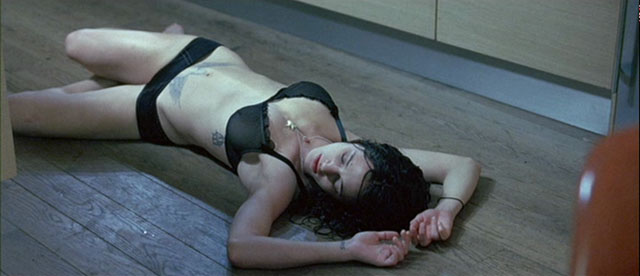
But will Kelly really let Asia get away with the crime and leave with her husband? No, well, yes, sort of. Shocker: Alex Descas shows up at the end. It was his idea to kill Madsen! None of the surprises are surprising and none of the tension is tense… Demonlover had more twists in its last five minutes than this one can manage in ninety. If I’d seen this when it first came out I might have skipped Summer Hours, which would have been a mistake. Guess Assayas can be inconsistent but still makes great films.

It might hurt Michael Madsen’s feelings to be cast in what the director calls a b-movie, but he’s not any good, nor is Sonic Youth’s Kim Gordon as a Hong Kong crime boss, and even Asia isn’t giving a knockout performance. I’d think Kelly Lin stole the show if there was much of a show to steal. Turns out most critics agreed with me – I didn’t re-check the reviews, probably got this confused with Go Go Tales in thinking it was well-loved.

Truth 24FPS agrees:
The project must have seemed promising, at least on paper – a globe trotting thriller with kinky sex, drug deals gone awry, murder, double and triple crosses, gun fights. But the film comes across as tepid, warmed over trash, and strangely, contains none of the kinetic forcefulness of the Hong Kong films Assayas champions. Assayas’ view of the world can at least partially be gleaned from his casting choices – an Italian who speaks French and English, with American and Chinese lovers, who travels from Paris to Hong Kong and eventually encountering a crime boss played by an indie rock icon. … The first half of the film consists of [Argento & Madsen] squaring off in increasingly repetitive encounters, with a kind of will they or won’t they do it sexual tension (answer: who cares?).
Asia Argento only liked the movie thiiiis much:

Dissent from G. Kenny:
His mastery of the camera and his always innovative approach to setting are constant, knotty pleasures; the Paris of the film’s first half is as alien to our recieved ideas of Paris as Godard’s Alphaville was, while his Hong Kong is a crumbling labyrinth where the only clues about which corner to turn are provided by cell phone rings.
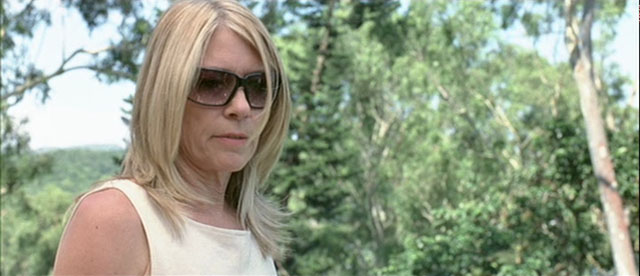
But my favorite comment is from a forum poster on Premiere: “It made me want to punch Asia Argento in the face, but that would probably turn her on.”
On one hand, this guy’s got a point that his is a life worth documenting… I mean, he and his boyfriend directed a musical version of Blue Velvet in their high school using Marianne Faithfull songs.
On the other hand, this is a guy who filmed himself in closeup while on the phone hearing that his mother overdosed on lithium. Reminds me of the Grizzly Man setting up his camera and doing retakes of himself jumping down a hill. Too much information sometimes, too personal, blogging-as-filmmaking.

But it’s an engaging movie, edited to death with music video segments and as many cheap visual effects as he could find. Frequent use of intertitles (which refer to himself in the third person) help make it less narcissistic, and in fact it looks like the film was supposed to be about his mother, documenting her history and personality as a warning against electro-shock therapy, but she’s not always around since he moved away from the family for a few years. Don’t think I’d agree with the “best doc of the decade” raves I was reading last week but it’s definitely a good one.
