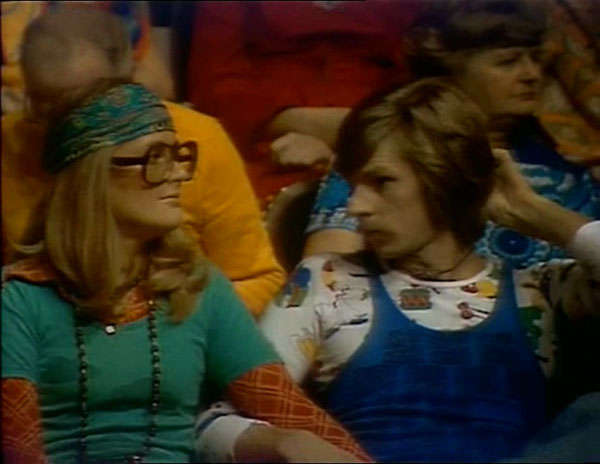
The stop-motion in Coraline seemed untoppable, and now a few months later this seems untoppable. Coraline felt slicker and this had more rustling animal hair which gave it a rough feel without ever looking less than terrific. Anderson’s controlled compositions and affinity for tiny visual details are a perfect match for the rigorous stop-motion process, and the writing and voices and action were all wonderful – this was better than I dreamed it would be.

So I don’t know the original story, but in the movie Meryl Streep agrees to marry Fox on the condition that he stop stealing livestock from farmers. Years later Fox, still a “wild animal,” has a midlife crisis, enlists his buddy and his nephew and sets out to defeat the security systems of the three farmer fatcats in town. Bandit hats are handed out (seems to steal too obviously from Bottle Rocket) and all kids have major parental issues (Anderson would’ve added those if they weren’t already in the book), and Fox ends up getting all the animals in trouble when the fatcats team up to retaliate. Ends happily with a grocery-store hoedown.

Katy liked it, too.

The Coens follow up their grim oscar-winner with the star-studded, absurd and murderous Burn After Reading and then a star-less (recognized one guy from Spin City) return to excellence. Like Miller’s Crossing, it’s a series of perfect scenes, building and building, and leading to… ambiguity. Would need to watch a few more times to work out the film’s philosophy. Part of the problem is all the biblical references (IMDB trivia: “His son Danny’s looking at the oncoming tornado recalls God speaking to Job from out of the whirlwind, saying He will not explain why these bad things have happened to him.”) and I’ve only skimmed Revelations looking for the parts about the seas running red with blood (I think that’s actually in the Necronomicon), so I miss certain allusions.

Michael Stuhlbarg as Larry leads a pitch-perfect cast (relative unknowns or not, the actors must be the best ensemble of the year, Inglorious Basterds their only rival). His wife is leaving him for a smarmy neighbor just as he’s up for tenure, a student is threatening/bribing him, his kids are pains in the ass, his brother is a closeted, medically-impaired couch physicist, and the rabbis offer no help at all. The story builds to a final tragedy (presumably bad news from the doctor, which we never hear, directly after Larry caves on the bribery issue) and a final mystery (a tornado outside the son’s school) but shortly before the denouement comes the son’s quiet, nervous post-bar-mitzvah visit with the elder rabbi which just explodes the movie’s long-held tension when the old man’s handed-down wisdom consists of quoted Jefferson Airplane lyrics.

G. Kenny calls it “something new in the Coen oeuvre: A completely seamless hybrid of their putatively mature mode with their outrageous cartoonish one.”

Bright Lights:

To watch A Serious Man – their most morally sophisticated work – is to feel what it’s like to be Joel or Ethan Coen, to see the world as a pointless series of endless sufferings and inconveniences, surrounded by insufferable buffoons and irrational cretins. This is not a world of their making. This is the world they live in.

Slate:

You could know the Kabbalah inside out and still struggle with these mysteries every bit as fruitlessly as Larry does. And that’s just how his creators want it. Though the movie concerns a specifically Jewish crisis of faith (and paints a satiric but lovingly precise portrait of Jewish-American culture), A Serious Man unfolds in a moral universe that’s recognizable from earlier Coen films. It’s a cruel and ultimately inexplicable place. What Anton Chigurh, Javier Bardem’s pitiless mass murderer, was to No Country for Old Men, the Hebrew God is to this movie.

I should also mention that this movie had one of the best trailers of the year, a montage of annoying sound effects and cries for help set to the rhythm of Larry’s head being banged into a chalkboard. If not for that propulsive Arcade Fire song on Where The Wild Things Are, I’d have to give it top honors.

Nicolas Cage’s first good part since Lord of War and Val Kilmer’s first good movie since Kiss Kiss Bang Bang. Cage hurts his back rescuing a prisoner, starts taking lots and lots of drugs and racks up gambling debts. He robs kids outside clubs, gets a violent dude mad at Cage’s hooker girlfriend and loses a key witness. Surely he is a bad lieutenant, but he has a few principles, and Cage’s charismatic intensity keeps us on his side even as he’s waving guns at grammas (lovable Irma P. Hall of the Coens’ Ladykillers). Ultimately he takes down a drug baddie (Exhibit, fifth-billed in the second X-Files movie), saves his girl (Cage’s Ghost Rider costar Eva Mendes) and pays off his bookie (Awwww Brad Dourif is getting old. Life is too short).

Nic, Brad and red beans:
image

The story (from a lead writer on Cop Rock) isn’t great, and the idea (remaking Abel Ferrara’s Bad Lieutenant) is awful, but Herzog pulls it off with flair. The occasional weirdness (extreme closeups of reptiles, including an iguana music video – what is it about drug movies and visions of reptiles? See also Fear & Loathing in Las Vegas), the sense that Cage is having too much fun to take anything seriously, and a lovely tacked-on ending where Cage meets the ex-con he saved and they get philosophical at an aquarium rescue this doomed movie and turn it into something I’d actually recommend. Can’t wait to see Werner’s other 2009 movie (star Michael Shannon, the contagiously crazy dude in Bug, shows up here as a police property guy).

image

Cage pulls up at a building I think I saw in Wild At Heart. Maybe lots of buildings in New Orleans look like that. Jennifer Coolidge (Pootie Tang), Fairuza Balk and other names I know or faces I’ve seen pop up regularly. Surprising that so many actors wanted to be associated with a cheapie indie remake of a cult film, but I guess you can’t discount the Herzog factor.

Salon:

Your ending really defies expectations. I’m not quite sure what to think about it, in fact. We expect one of two possible endings — the bad lieutenant triumphs, or he is punished for his misdeeds. And you really don’t give us either one.

Herzog:

In my opinion, it’s a very beautiful and very mysterious ending. You see, according to the screenplay, it ended with a false happy ending that became a real abyss of darkness. And I thought, no, we should not dismiss the audience like that, out into the street. There should be something vague, something poetic, something mysterious.

A tumbling act vaults in different styles according to their costumes (hockey players, military parade). Magicians one-up each other. The audience participates. We go backstage and into the lobby. Tati mimes at different sports (badminton, soccer, fishing)…

image

Not a documentary of a circus performance but a film (make that a video, one of the first video-shot features, after 200 Motels) with a circus performance in it. Doesn’t look like an existing, functioning circus but a soundstage with paid extras for audience members, complete with choreographed “backstage” scenes. Amused me as well as any real circus (and more than Fellini’s The Clowns). Video quality on my copy was below average, but the editing (and lack of talking heads/announcers/titles) differentiates it from, say, a period PBS special on a circus, and the pacing would confirm Tati as director, rather than simply performer, even if his name wasn’t there in the credits. Whole thing has an attractive draw to it… I liked it better than I thought I should, can’t say just why.

image

Rosenbaum has a good theory: “[a] gag is more likely to make us smile than laugh; but the cumulative effect of dozens of such underplayed gags is to make reality itself seem both slightly off-kilter and alive with comic possibilities–every moment brims with potential gags that often require an audience’s alert participation in order to be noticed at all.” He has written a long, perceptive article which makes me want to watch this again immediately.

Katy said it didn’t feel very JohnFordian, but it did to me, because two thirds of my previous John Ford experience consisted of Judge Priest and The Sun Shines Bright. Takes place in a small town in the south – there’s mob violence and a courtroom climax, and along the way we hear “Dixie” more than once. Sounds extremely Fordian to me. In fact I’m thinking Atlanta-born writer Lamar Trotti, who also cowrote Judge Priest, could stand to vary his game.

Two simple men and their simple mother (Alice Brady, the mom in My Man Godfrey, in her final film) were enjoying simple pleasures in town when they got in a fight with a blowhard and he ended up dead. Blowhard’s buddy Ward Bond (John Wayne’s old friend in Rio Bravo) says they stabbed the blowhard, so off to jail they go. Fortunately, hat-wearing slave-freeing superhero Abe Lincoln (Henry Fonda with a fake nose, looking spookily Lincolnesque in the occasional profile shot) stops the angry lynch mob by picking on them one at a time (a la Sun Shines Bright) and agrees to defend the kids, in between watching his girlfriend (Pauline Moore) die and meeting a new girlfriend (Marjorie Weaver, the lady in The Cisco Kid And The Lady). It’s all based on a completely true story! Except that it was a blunt weapon, not a knife, and the accused men weren’t brothers, and one of them (the one not defended by Lincoln) was convicted of manslaughter and imprisoned for six years, and Lincoln got the other guy acquitted but there was no sneaky buddy to take the fall instead.

Movie slides along peacefully and slowly builds. Very pretty in parts. I’d need to read more or study further to figure why this was one of Sergei Eisenstein’s favorite films… missing something, as usual.

Felt slightly long and slow and full of old men for a Hawks movie. Gary Cooper is a hunky young encyclopedia writer locked in a house with his coworkers (including “Cuddles” Sakall). Barbara Stanwyck is the ball of fire who hides out with them on the pretense of helping with an entry on slang, hiding out from her gangster boyfriend (young Dana Andrews, star of one of my least-favorite Fritz Lang movies).

Mostly fun to watch for the language. Written by Billy Wilder and Lubitsch vet/future Sunset Blvd. collaborator Charles Brackett. Same cinematographer as Citizen Kane, the same year. Remade in ’48 with Danny Kaye in the Gary Cooper part, Virginia Mayo as Barbara Stanwyck and Louis Armstrong as Cuddles Sakall.

The internet likes to say the encyclopedaeists were inspired by Snow White’s seven dwarfs, and so here’s me on the internet faithfully repeating it.

Based on the bestest-selling novel which everyone in the world has now read. I’d heard it would be relentlessly bleak, and so that’s what it was. Hillcoat and Nick Cave and Viggo Mortensen and Javier Aguirresarobe (also cinematographer of Talk To Her, The Dream of Light, the Twilight saga) and Charlize Theron and the boy all did terrific jobs, first-rate, award-deserving and everything else.

But it’s kinda like Polanski’s The Pianist… a perfectly-made film in service of the most depressing story ever. One person survives a (nuclear/nazi) holocaust, and while that’s somewhat encouraging, the movie spends its runtime rubbing your nose in the terrible enormity of said holocaust making for a mega-bummer experience. If a great movie makes you feel crappy for having seen it, is it still a great movie?

I suppose Theron is only alive in flashback. She doesn’t have the survival instinct of her husband, just wants to kill her son and herself peacefully before cannibals catch them or they starve to death. Viggo won’t agree, so she wanders out into the cold alone. Viggo goes from being the only honest man in the world, protective and generous to his son, ruthless in his survival, to seeming slightly savage, giving a thief a death sentence, unable to ever trust anyone. When he dies from cold & sickness, the son is immediately picked up by Guy Pearce and family, and you get the feeling that he’s better off. Robert Duvall is unrecognizable as a decrepit man who may not be as feeble as he lets on. Viggo gets shot by an arrow, discovers a hidden food bunker, avoids cannibal camps, shoots a guy in the head – it’s hardly Children of Men as far as slam-bang action but it’s creepier as far as apocalyptic atmosphere.

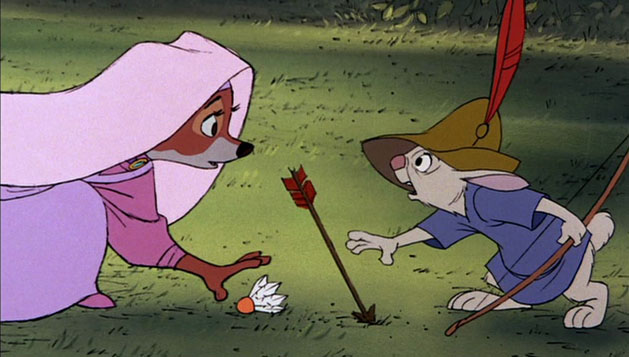
Cute movie, actually one of my favorite Disney cartoons. That’s probably because I first saw it when I still liked Disney movies (age 10-ish) and didn’t see it again when I was sick of them (age 12-20). Watched it this time because I’ve been listening to Roger Miller albums on repeat all autumn and I never realized he played the troubadour narrator rooster and contributed songs to this movie. Miller has three original songs, Johnny Mercer wrote one, then there was a crappy love ballad which of course is the one that got oscar-nominated (and easily beaten by “The Way We Were”).

image

I thought Robin and Little John had a fight on a log but that must’ve been the Errol Flynn version. And I was expecting King Richard’s appearance at the end to be dramatic, a la Sean Connery in Prince of Thieves or Patrick Stewart in Men in Tights, but his scene got deleted for being frightening to children, so he only appears in epilogue. Lots of talk of death and hangings for a kids movie.

Director Wolfgang was a Disney animation lifer, from early 30’s shorts through feaures in the late 70’s. Robin is Brian Bedford (Grand Prix) – he doesn’t get his name on the poster like Tom Hanks in Toy Story. Former bandleader Phil Harris as Little John sounds annoyingly close to his Baloo. Andy Devine (Friar Tuck) was in Stagecoach and The Man Who Shot Liberty Valance. Monica Evans was in The Odd Couple, abruptly disappeared from the movies after voicing Maid Marian. Pat Buttram (heh), a western actor in the early 50’s, has the most memorable voice in the movie as the Sheriff. The oft-awarded Peter Ustinov (Lola Montes, Spartacus, Logan’s Run) is the prince (and the king) and famously gap-toothed comic Terry-Thomas (Danger: Diabolik, Bachelor Flat) is his snake assistant.

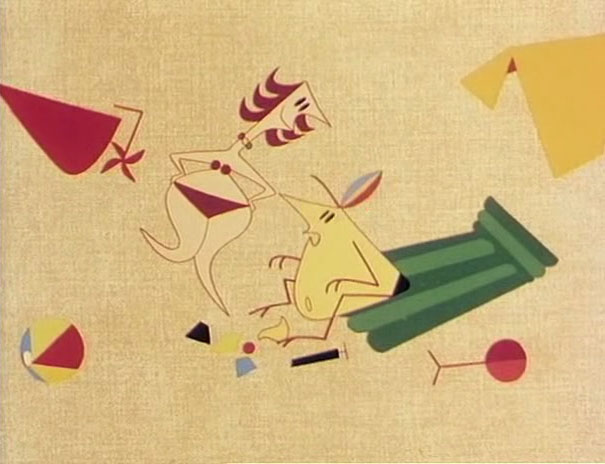
Surogat (1961, Dusan Vukotic)
Slightly naughty beach picture about a fat guy who brings inflatable ball, boat, car, food and girl. Real great anything-goes animation. Disney, Friz Freling and Chuck Jones must’ve cancelled each other out, giving the award to the underdog foreigner.
image

The Crunch Bird (1971, Ted Petok)
“Crunch bird, my ass!” Ugh, punchline shorts. Was there no competition this year? I would’ve awarded Thank You Mask Man over this. From a co-writer of What’s Up Tiger Lily, this beat a comic Canadian short about evolution and an adaptation of an Oscar Wilde fairy tale (OW wrote fairy tales?).
image

The Sand Castle (1977, Co Hoedeman)
A desert man with arms and legs but no body creates clay creatures to help him build a giant sand castle. All stop-motion, the short that (probably deservedly) beat Doonesbury at the oscars.

image

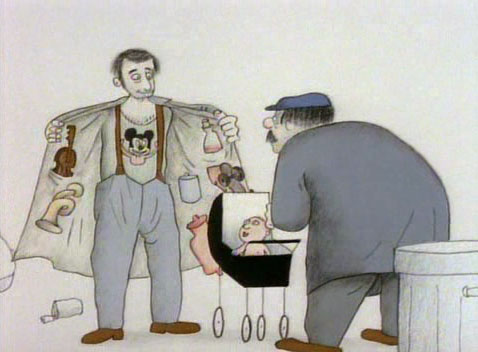
Every Child (1979, Eugene Fedorenko)
More of a foley demonstration than a proper cartoon. The animation is there I guess, though slightly Squiggle-visioney. Wow, someone sings the Umbrellas of Cherbourg theme. So the foley guys are telling the story of an unwanted baby… to a baby. One foley guy went on to voice the French version of Chief Quimby on Inspector Gadget. This beat a short called Dream Doll which I’d like to see, apparently an X-rated spoof of The Red Balloon.
image

Tango (1981, Zbigniew Rybczynski)
An empty room, simple tango music. A kid (looks like stop-motion cut-out photographs) throws a ball into the room, comes in, throws the ball outside, leaves, repeat. Then another person is added, then another and another, none of them interacting with each other until the very end. How’d they do it? Beat out some stop-motion from the great Will Vinton and a half-hour piece about a snowman.
image

The Man Who Planted Trees (1987, Frédéric Back)
Just about the happiest thing ever, so lovely it made my head hurt. Story of a lonely shepherd who singlehandedly reforests an entire region of France. I looked it up, hoping that it’s a true story, and unbelievably it is. Narrated by the familiar voice of Christopher Plummer and animated with lush, colorful sketches. The romantic short from the creators of Bob & Margaret and a big of head-morphing Bill Plympton hilarity never stood a chance against this beauty.
image

A Greek Tragedy (1985, Nicole Van Goethem)
The characters are man/pillars holding up a stone wall that has fallen into ruins. When it finally collapses, the pillars are free to frolic. The kind of simple cuteness you’d see at a festival with three of four similar pieces, not the kind I’d think would win a major award. Hard times in 1986. Actually this beat Luxo Jr. somehow. I guess computer animation wasn’t in style until ’88. At the same time, it’s nice
image

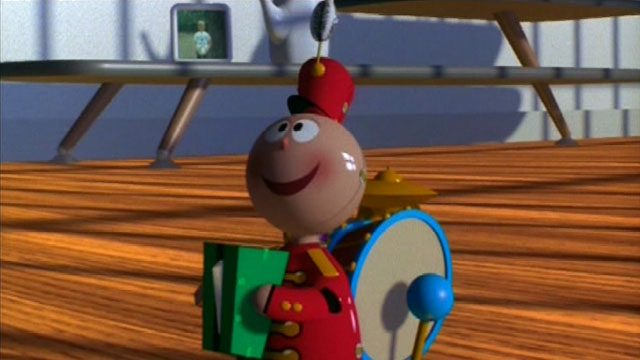
Tin Toy (1988, John Lasseter)
A one-man-band toy escapes the wrath of a slimy toddler, then grudgingly returns to cheer it up when it’s crying only to be ignored in favor of an empty box and a paper bag. Clear precedent to Toy Story. 1988 computer technology was not up to the task of accurate baby rendering, but it’s still pretty cool looking. It beat a Tex Avery-style short from the future director of FernGully and Cordell Baker’s great The Cat Came Back.
image

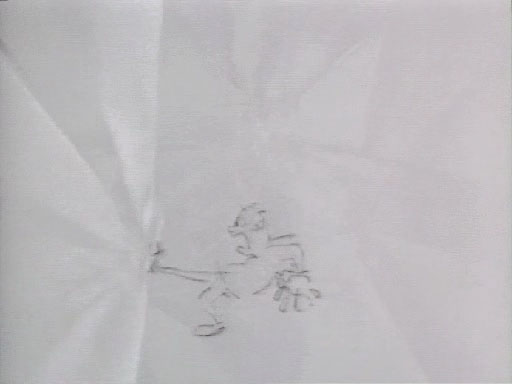
Manipulation (1991, Daniel Greaves)
A good ol’ artist’s-hands-interacting-with-drawing-table short, somewhere between Duck Amuck and Rejected. Funny how one of the most recent shorts is the one available in the lowest quality. The line-drawing guy turns 3D at the end, which I think was done in claymation. Very inventive and fun. Apparently Greaves’ Flatworld is also a must-see. No U.S. shorts in this year’s competition – this UK film beat out two Canadian pieces (including long-time fave Blackfly).
image

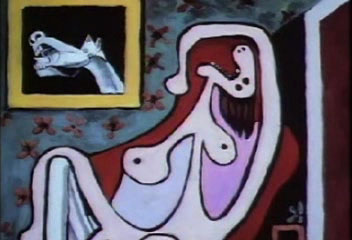
Mona Lisa Descending a Staircase (1992, Joan C. Gratz)
Really wonderful little animated film which would probably be the greatest thing ever if I was an art history major. Since I only knew about five of the paintings which were mighty-morphing into each other, I probably attribute more of the film’s beauty to its director than I probably should. Oh wait, it won the oscar so I guess I’m not the only one who was impressed.
image

Then again, some of it is just silliness.
image

Quest (1996, Tyron Montgomery)
A man made of sand navigates increasingly more difficult and dangerous worlds of paper, rock, metal and water. The end is the beginning – would work as a looping DVD or art installation. Nice stop-motion, like The Sand Castle but I liked this one better, Thought it was anti-technology for a while, but now I think its just trying to say the world is a dangerous place. Competition included an Aardman, a Canadian piece I’ve seen but don’t remember, and a stop-motion short from a future Pixar animator.
image