Tarsem’s previous movie The Cell had a crappy story and bad acting wrapped around a handful of intensely cool but disconnected imagery. This one has a simple but decent story and good acting, with about half the movie being intensely cool imagery, finely intertwined with the rest of the plot. A quantum leap forward!

The gimmick of not having a gimmick (no digital effects, etc) was distracting as hell. We were always “what country do you think that is” or “THAT isn’t a real place is it” or “aha, that’s GOT to be a digital effect” or “is the little girl acting or not, she seems so natural.” From online trivia we learn it’s a remake of a 1981 Bulgarian film and the little girl was often improvising.

Movie itself is a wonder. In Princess Bride’s framing story, grandpa Peter Falk is reading a great, classic storybook, so the bulk movie has to be great and classic, and it lives up – but in The Fall we have an unreliable narrator, suicidal, heartbroken, wasted on morphine, making it up as he goes along. In a sense this makes the story more unpredictable, but it’s also a huge cop-out because if the writing is poor you can say “oh it’s supposed to be poor, didn’t you get that?” And it is kinda poor. Our hero the masked bandit with his lost love and archnemesis kinda fizzles, and his side characters Luigi (“explosives expert” who only uses explosives once, suicidally at the very end), The Ex-Slave and The Indian just make poses and look beautiful against the exotic scenery, getting shown up by the problem-solving Charles Darwin and his pet monkey. So it doesn’t sound too good and it’s probably not, but if you’re gonna throw out images this nice, I’ll let your thin plot slide. Carried over from The Cell we’ve still got some nightmarish imagery too. When their guide The Mystic is captured, being chopped to death with an axe (barely offscreen), crying and repeating the safe word “googly googly”, small birds flying out of his mouth, that’s a thing that gets stuck terribly in my head while I’m trying to sleep.

Movie ends with a montage of Keaton and Chaplin stunt scenes, half of which I recognized, in a belated homage to stunt men (our hero is one, ended up in the hospital with the little girl by falling badly off a bridge). Weird. Nobody I’ve heard of in the cast, which makes sense. If you’re shooting a self-financed movie over four years in 20+ countries, you’re not gonna get many recognizable actors to sign up. However, Lee Pace (our storytelling hero) is now starring in Pushing Daisies.

Nic Cage goes to jail. Twice.

Harry Dean is a lovestruck sucker, gets killed by three characters who are far more prominent in the deleted scenes: Quiet Dropshadow (Jerry Horne in Twin Peaks), talky, over-friendly Reggie (black islander Calvin Lockhart, who played “Biggie Smalls” in Sidney Poitier film Let’s Do It Again, which I must see sometime), and creeeepy cane-walkin’ woman Juana Durango (Grace Zabriskie, even creepier in Inland Empire, also Laura Palmer’s mom). Alex de la Iglesia made some sort of a sequel featuring these three characters called Perdita Durango or Dance With The Devil. I guess it’s not really a sequel, but both films are based on novels by Barry Gifford, who also cowrote Lost Highway and Hotel Room.

Lynch has plenty of contenders for Creepiest Character In Film History – there’s Robert Blake in Lost Highway, Dennis Hopper in Blue Velvet… my personal pick is Willem Dafoe in Wild At Heart.

image

Crispin Glover also gets a bigger part in the outtakes, including the scene below where he’s almost discovered by our heroes working at a gas station. I can’t remember if the revelation that he impregnated cousin Laura Dern when they were younger was in the movie or not… I’m thinking it’s from the outtakes too.

image

“How many stars you think are up there, baby?”
“There’s a couple.”

“What’s happened to us is like war… easy to start… hard to stop.”

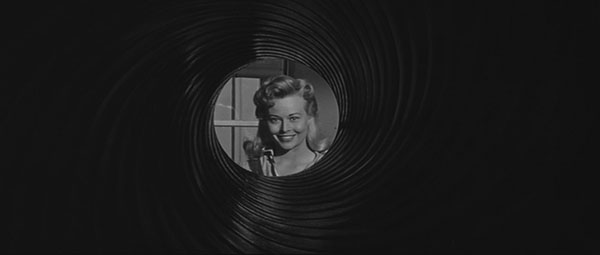
A wordless intro before the opening titles, so no dialogue until 4:30… and it’s only an 80 minute movie, so that’s significant. Once the action starts, of course, it barely lets up, led by a hero named Griff who talks like a hero should talk (sorta like the host of a news magazine show). The star is Barbara Stanwyck but she’s not in the movie half as much as Griff, which only serves to make her more of a presence when she is around.

Anyway, Griff is one of those western heroes who’s amazing with a gun, unbeatable, but hates to use it, haunted from having killed a guy some years ago. He’s an oxymoronically peaceful bounty hunter with his two brothers in tow – nice-guy Wes who falls in love with a local gunsmith girl and eager Chico who wants to be a gunfighter. Griff swaggers into town as Stanwyck’s unhinged little brother Brockie is shooting up the streets, and busts the violent asshole brother’s nose in one of the baddest-ass western showdowns ever filmed. This and Griff’s humiliating public arrest of one of her “forty guns”, a man wanted for robbery, causes a balance-of-power problem with Stanwyck, who formerly owned this town uncontested. But of course… the two of them fall in love.

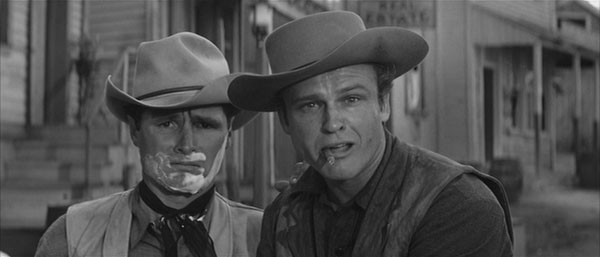
Charlie Savage (played by John Wayne’s stunt man) and Brockie (John Ericson of Bad Day at Black Rock):
image

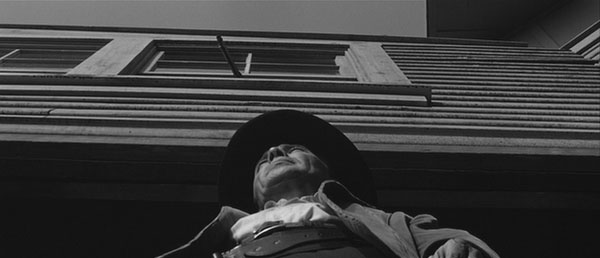
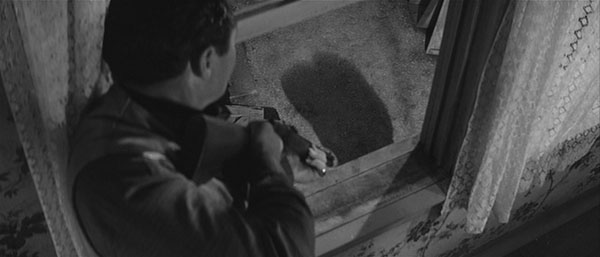
John the marshall is a slow-talkin’ goodly old man with bad eyesight whom Brockie shoots (not to death) just for the hell of it, but the cowardly nasal-voiced sheriff Logan and the local judge are friends of Stanwyck’s, so when Brockie is arrested he’s quickly let out. They have a harder time protecting Swain, the wanted man, since he’s got a federal warrant on him, so Charlie Savage kills him in his cell before Swain can say too much. Griff is on the case right away, knowing it’s Charlie because he’s the best shot in town (although why does it take the best shot in town to blast a guy through a prison window?). Charlie sets a trap for Griff, but young Chico interferes and kills Charlie.

image

“Now what did I do wrong?”
“Now you’ve killed a man.”

image

I’m out of sequence here but it doesn’t matter. Griff and Barbara have a symbolic love scene during a tornado and bond over their wild little brothers. Griff bathes in a barrel (but does not get shot up a la House of Bamboo). The movie breaks into a song about Barbara (“She’s a high-ridin’ woman with a whip”). And whenever a man and a woman are alone, the innuendo cranks way up, higher than I thought it could go in the 50’s (well, I suppose Will Success Spoil Rock Hunter was the same year). There’s talk of the death of the wild west, of a peaceful, civilized future.

image

But the kids still wanna play shoot-’em-up. Wes is predictably but still terribly, killed on his wedding day by Brockie, and that’s not the kind of thing Griff can let go. He shames the sheriff, who fails to kill Griff and so loses Barbara. The famed ending, in the writer/director’s own words:

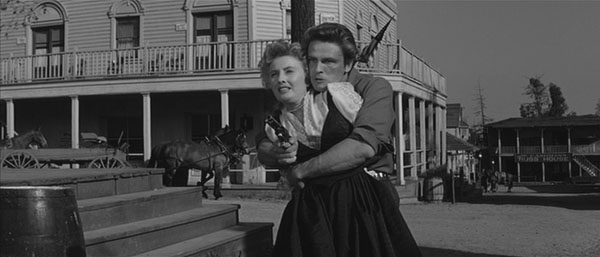
Brock knows Griff loves his sister and surely won’t shoot a woman. He’s wrong. Griff plugs Jessica in the leg and, as she slides to the ground, empties his pistol into the bastard brother.

Griff doesn’t kill Brock out of vengeance. He’s eliminating a cancer that’s terrorizing the community. But he’s disgusted with himself. By resorting to guns, Griff sees the last ten years vanish in a flash, as he becomes the killer he’s renounced.

My original script had Griff killing both Jessica and her brother, stepping over their corpses in a daze, throwing his gun down – this time for good – and walking up the dusty street without a pause. Nothing and no one exists for Griff anymore. The End. That version ran into trouble at the studio…

image

Instead Chico ends up marshall and Barbara runs after Griff as he’s leaving town and they ride away. A few months after China Gate (and somehow Run of the Arrow came in between them), the filmmaking is smooth as hell – scenes playing out in single long takes with powerful fast cutting during the action scenes.

Barbara, in her final year as a headlining movie star:
image

Fuller again:

My story hinged on America’s pervasive fascination with guns. Hell if I know why people think guns are sexy. I cooked up a helluva lot of sexual metaphors playing with the idea.

image

Our gruff hero Griff (far left) is professional tough guy actor Barry Sullivan (The Bad and the Beautiful). Gene Barry (on right, star of China Gate, played a fake Mexican in Red Garters) is brother Wes. Robert Dix (writer/star of Five Bloody Graves) is Chico, and in the light coat is Sheriff Dean Jagger (the beloved major in White Christmas, also in Lang’s Western Union):
image

Fuller:

With Forty Guns, I’d really hit my stride. I considered it one of my best efforts so far. Sure, there were some compromises – like the ending, but it came pretty close to my original vision. At the time, very few people were given the opportunity to write, produce, and direct their own movies.

image

Did anyone know it was illegal to be catholic in Mexico in the 1920’s and/or 30’s? That there was some kind of war going on? Thanks to my schooling history of dry, unengaging, U.S.-based history classes, I am barely aware that there is a country called Mexico, so my ignorance of its religious-political history can’t be surprising.

Elías lives with his mom and very pregnant wife, has seven kids and a leaky roof. Wife falls down fixing the roof, thinks her baby is dying, so asks Elías to fetch the preacher. Problem: the government has declared Catholicism illegal so getting a priest is risky. Now either the priest is leaving town, or he’s getting a group together to fight the gov’t, but Elías interferes and everyone (incl one of his sons) is killed. E. himself escapes but now everyone is mad at him so he grabs his newborn son, his newlydead wife and his remaining six kids and heads out to live all reclusive in the desert, building a church to atone for the killing of all those people.

Years pass! Youngest kid grows up sickly then gets better. A boy dies raising the church bell, two boys die of plague, and a girl goes mad and drowns herself looking for signs from god. Another boy visits his grandmother, who thinks he is Elías so he ends up living quietly with her and starting a family. The church is finished but Elías isn’t sure that he has been forgiven, frets about it and starts wrecking the church wall to rebuild it until he gets it right. Meanwhile, the two remaining kids, boy Aureliano and girl Micaela, start having sex with each other. She dies, father kills himself, Aureliano lives to narrate this movie in framing story.

Movie comes off as your standard prestige-pic, professionally made but without anything interesting to recommend it. It’s bummer city for the first half hour, then seems to go on forever and I’m thinking things will get better with the whole church-building, but tragedy and madness slowly follow until the movie dumps us off right back in bummer city where we started. I mean I guess Aureliano is free now, but the death of his sexy sister puts a damper on that, and the thing with the brother taking his father’s place at gramma’s could be fascinating if it was given more than a minute of screen time. Surprised to hear that this swept the Mexican academy awards, leaving the AFF’s big-deal closing-night pic Rudo y Cursi empty-handed.

I didn’t know anything about Samuel Beckett or existentialism, but I’m going to assume from this movie that they involve repetition, jokes, dry absurdism, ponderings on the meaning of life and existence of God, and repetition. The movie’s contributions would be black-and-white photography of wonderful, stark locations – seaside, desert and long, long roads – long shots with blackouts between scenes, and lots of random dance music.

Our heroes are Freak (a former punk rock singer) and Jaja (ex coma patient with drug and family problems). They get driven around by a heavily bearded dude named Agent Zero Six, talk with the Karaoke-loving Oracle, watch a performance by Adam and Eve (and her secret lesbian lover), and finally get killed on the beach trying to swim with a sexy naked lady – the only scene in color.

That color scene, with a stripe of blood through the ocean, looked even more spectacular than the rest of the movie… but spectacularness is relative, since the Atlanta Film Festival was playing us some kinda letterboxed blurry video. IMDB says it was shot in Super 16 and printed to 35mm, so why can’t we get a film print? Expense? Why throw a film festival if you’re not gonna play films? Format complaints aside, great movie and a nice start to the fest.

Katy and I each saw this movie when we were little. She has always hated it because it gave her nightmares, and I have always loved it because it seemed weird and awesome and had Corey Feldman in it. Watching it again, it seems neither love nor hate is appropriate… it’s a pretty good movie. Pretty well made, pretty funny, with pretty good acting and a pretty satisfying ending. As a Joe Dante fan I was cheering for another Matinee, but it seems I got another Explorers instead.

Tom Hanks (between Big and Joe vs. the Volcano, on his way to permanent movie-stardom) is a listless suburban dad with wife Carrie Fisher and nosy neighbors Bruce Dern (manic, scuzzy, Busey-esque – he should be in every movie), fat Canadian comic Rick Ducommun, and still-cool Corey Feldman (I don’t know if he lives on the block or has just been hired to paint somebody’s porch). They get into comic situations trying to spy on new neighbors the Klopeks, suspicious that they have kidnapped or murdered toupee-wearing little-dog-toting neighbor Walter (1960’s TV star Gale Gordon). Finally they break into the house when the Klopeks are away, accidentally blowing it sky high by activating the overpowered furnace in the basement. Hanks thinks they’ve proven nothing except how smallminded they’ve been, but in an incredibly unsurprising twist ending, it turns out the Klopeks were murderous evildoers after all and Hanks’ gang is off the hook.

Dante throws in some cartoonish visuals, has Feldman talk into camera at the end, but it’s not as stylish or fun as his other movies, feels more tied to the obvious script. The story seems like a mystery, then starts developing into a satire of suburbia, making the suspicious neighbors look crazy and the weird reclusive family seem like the victims, culminating in a speech by Hanks (who barely comes alive in the movie otherwise) – but this is undercut by the ending.

A good Jerry Goldsmith score – in fact that might have been the best thing about the film. Robert Picardo (theater manager in Matinee, lead in 976-EVIL) and the wonderful Dick Miller cameo as garbagemen. Besides the ever-hungry comic-relief Rick Ducommun and our blank lead Hanks and his wife, the other characters are all exciting and worth watching, especially gun nut Bruce Dern and the Klopeks. The diminutive doctor is Henry Gibson of Nashville, inbred-looking young Hans is Courtney Gains, five years after playing a lead corn kid in Children of the Corn, and horrible mean uncle Reuben is Brother Theodore, who I hear was “one of America’s most respected humorists and monologists.” Dante, or whoever was responsible for casting, put an excellent enough group together to compensate for any script problems.

I read that the ending of the script had Tom Hanks getting killed at the end, leading to the same studio-mandated rewrite that Gremlins got. Wasn’t until the Masters of Horror episodes that Joe could finally execute all his main characters at the end of the movie, just like he’s always wanted to.

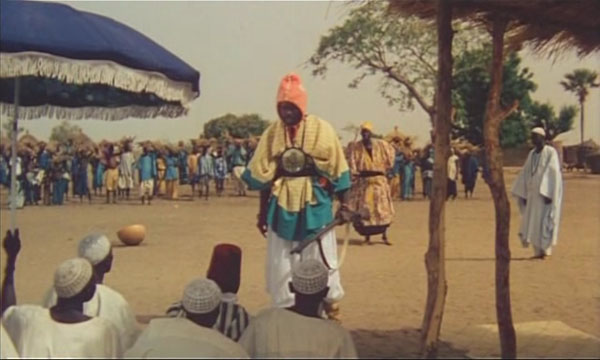
Firstly, the “Ceddo” are the outsider townspeople. Took me half the movie to figure that one out. The town is converting to muslim, and the local imam is becoming more powerful than the king. A small group of traditionalist men kidnap the princess to protest the forced religious conversion. Meanwhile, a white christian missionary is looking for followers but is not doing so well.

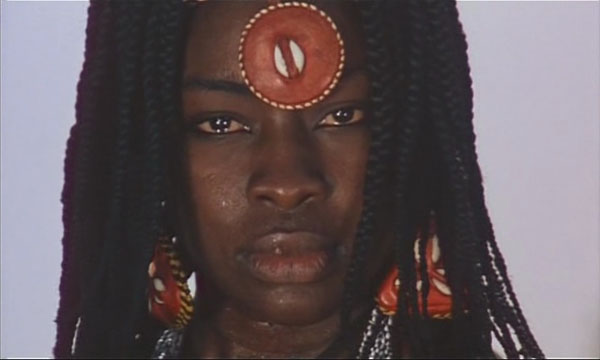
While the king and imam disagree over how to proceed and the imam’s men plot to overthrow the throne, three younger men – the king’s potential successors and the princess’s potential husbands, depending which rules you follow – aim to rescue the princess, bringing guns to a bow-and-arrow party. Biram is kind of a compromise choice between mirror-wearing king-loyalist Saxewar and committed muslim Fall, but Biram is easily killed by an arrow. Saxewar goes next, dies stabbed through the throat by the kidnapper. Fall becomes suspicious of the imam and renounces his position, and finally the imam carries through his threat of deposing the king (who dies offscreen) and has the lead kidnapper killed, freeing the princess. She marches right back into town, grabs a rifle and blows away the imam herself. Damn, Sembene was good with endings.

image

Much of the story revolves around slavery. A white trader is in town accepting slaves in exchange for wine and guns, so Ceddo are trading members of their own families for guns to fight the muslims. One reason people are converting to islam in the first place is because law prohibits children who are born muslim to become slaves, so if young adults convert, they might still become slaves but their children will be born free. The christian missionary has no such promise, and at most manages to collect one follower, or at least a curious onlooker to the white man’s sermon. This leads to a wonderful dream sequence, a large modern (as opposed to the no-specific-year historical period of the rest of the film) crowd is gathered as this new guy reads a memorial service for the white priest, seen in a coffin… dreams of a successor, unfulfilled, as the christian is killed unceremoniously later in the movie.

image

Watched this from a very good print with strong color rented from recently-folded New Yorker Films – we were warned that this may be the last screening of this particular film for a long time. This was made two years after Xala – seems that this is the turning-point film for me in Sembene’s career, since I’ve enjoyed this one and everything after it (Guelwaar, Faat Kiné, Moolaadé) more than everything before it (Xala, Emitai, Black Girl). Can’t put my finger on why I like the later ones more… better color, stronger characters, easier-to-follow narratives? I don’t know why I like movies, but this one was damn amazing. We’ll see how unseen early film Mandabi and late Camp de Thiaroye hold up.

The princess appeared 20+ years later in Faat Kiné, and Prince Biram played an interpreter in Coup de torchon

We were always looking for the camera’s reflection in Saxewar’s mirror:
image

From the valuable article by J. Leahy at Senses of Cinema:

Sembène goes so far as to articulate something completely ignored in the discourse of the male protagonists of the village’s internal war: the desire of this strong, silent, beautiful young woman. This is revealed in what I read as a subjective flashforward to a possible future, similar to that of the priest. It is characteristic of the complexity of Sembène’s analysis of the interaction between the individual, history and traditional practice that this shows her married to her kidnapper and finding happiness in the role of a traditional wife serving her husband. Others have read this as flashback to their first encounter. Even if this is so, the moment remains equally evocative in terms of the possibilities it suggests.

Three half-hour Tokyo-set films by three famous non-Japanese filmmakers. I didn’t read the reviews very closely but I gather that some viewers thought the Michel Gondry segment about a struggling couple moving into the city and the Bong Joon-ho segment about socially-dysfunctional residents of an earthquake-prone Tokyo were pretty good and the Leos Carax segment about a sewer-dwelling monster was awful, and some viewers agreed that the Gondry and Bong were pretty good but thought the Carax was brilliant. A fan of Carax’s Lovers on the Bridge, I assumed I’d fall into the latter group, but I wound up finding the whole experience somewhat unsatisfying. By the time I finished watching six previews and an overlong ad for the film festival through an allergy-induced headache I was ready to go home already. Then the movies themselves, a far cry from Paris, je t’aime, seemed awfully down on their host city, and the whole thing was kind of a bummer (and a digital-video-looking bummer at that).

Gondry’s bit featured a wannabe-filmmaker come to the city with his first film, which turns out to be terrible, and his girlfriend (Ayako Fujitani of the Gamera trilogy) who feels like nobody notices her. There’s fanciful talk of dreams and ghosts, and in the end she turns into a piece of furniture, a wooden chair. She’s picked up by a musician, and finally finds happiness – to be of use.

After this portrait of selfish men in an inhospitable city, Carax dives right in with a sewer-dwelling monster (Denis Lavant, of Lovers on the Bridge and Chaplin in Mister Lonely) named Merde walking the street shoving and groping people and being a general nuisance. It’s all jolly and hilarious until he finds a cache of grenades in an underground cave, and on his next rampage he blows up a bunch of people and is arrested for murder. Now we get an achingly prolonged trial where the monster is represented by a lookalike (but more posh) lawyer (Jean-François Balmer of films by Ruiz, Chabrol, Akerman), who speaks our guy’s mythic language of grunts, whines and head-slaps. It’s all over-silly and over-serious at the same time, and I don’t know what to think when the unrepentant Lavant is hung at the end.

Bong tries to restore some whimsy to the proceedings with Shaking Tokyo. His story of a shut-in (Teruyuki Kagawa, in Serpent’s Path a decade ago, starring in the new Tokyo Sonata) is at least the most Japanese of the three stories, the reclusive “hikikomori” being a recent phenomenon of that country – as far as I’m concerned, the other two movies could be set in any major city. Due to an earthquake, our guy accidentally makes eye contact with another person for the first time in a decade, and that person is substitute pizza-delivery girl Yû Aoi, who has button-like tattoos representing different emotions – when one is pushed it determines how she feels. The next day, she decides to shut herself away in her room, along with seemingly everyone else in the city, while our guy steels himself and goes outside to search for her, leading to a cutey happy ending when he presses her LOVE button. The “earthquake changes everything” conceit reminded me of Chan-Wook Park’s short Judgement, and the empty city reminded me of Pulse.

Bong: “I had an image of the people of Tokyo as oddly repressed, defensively lonely… I think I had a desire to wake them up, shake up and liberate such people. That’s where the title, Shaking Tokyo came from and how the motif of the earthquake also came about.”

I guess I’m liking the three movies better now that I’m thinking about them, but at the time they didn’t seem to be working together and I wasn’t sure what the movie’s point was. I’m sure it’ll be like Eros or Three Extremes, where the omnibus concept disappears in time and I start to think of ’em as decent individual shorts.

I insulted Katy’s rental choice at the video store so as retribution she rented us a slow-as-dirt, pretty-as-a-picture Sri-Lankan film. Being There would’ve been better, but I was in enough trouble already so we watched this instead, each one of us bored but assuming the other was enjoying it.

image

The guy in the pink shirt is a security guard. He has an elder co-worker, whom he is possibly forced to kill at the end. He’s stripped naked and tossed in the lake by some buddies. He has a bored wife and a restless sister, one of whom is below.

image

And here is an outhouse.

image

Long static takes, pretty shots, disaffected post-war characters who don’t relate to each other. I fell asleep but I think I got the general idea. Movie won the Camera d’or at Cannes, and the DVD helpfully includes the whole press book as a PDF file. Interviews with the director are very convincing… besides the fact that he’s illustrating modern interpersonal disconnection, and I am getting tired of movies about mopey people who don’t talk to each other which claim to be commenting on the present human condition, he sounds like he really knows what he’s talking about without being arrogant, admits a Tsai Ming-Liang influence (I’d been wondering), and from his description this sounds like a film I’d really want to see. Maybe under better conditions next time.