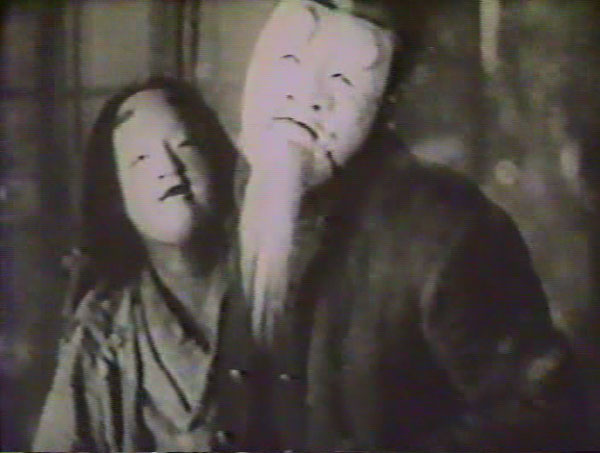
Seki (Kazuko Yoshiyuko of Lady Snowblood 2, Kikujiro) is married to a decent guy, the town’s rickshaw driver Gisaburo (Takahiro Tamura of 24 Eyes, Seisaku’s Wife), but young Toyoji (Tatsuya Fuji, the killer’s father in Bright Future) falls in love with her and ruins all that. One night, in an unexpectedly frank bit of sexuality (later note: not frank at ALL after watching In the Realm of the Senses), he’s going down on her and orders her to shave. A couple hours later he matter-of-factly tells her that since she’s shaved, her husband will suspect them, so they’d better kill him. So they do, strangling the guy and dropping him down a well. Three years later the townspeople haven’t seen their taxi driver around but his ghost has been spotted, Toyoji seems to spend an awful lot of time at Seki’s house and is seen lingering at the well, Seki’s daughter is asking questions and nobody doubts what’s going on… only a matter of time before the cops (led by Takuzo Kawatani of The Burmese Harp and Battles Without Honor & Humanity) catch up and hang ’em. But things get worse before that – Toyoji kills the young master of the property where he works and Seki goes blind.

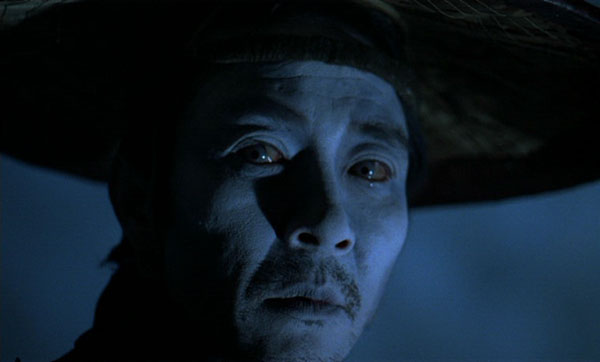
As with Senses, this is based on a true murder from 1896. This one has more town life in it, more theatrically heightened colors, maybe more traditionally studio-looking shots. A very Japanese (pre-Ring) ghost, Gisaburo dressed as he was when he died with an all-white face, wordless. Some wonderful shots from inside the well, as seen on the box art. I failed to get screen shots, so I’ve stolen a couple from DVD Beaver. I liked the movie a whole lot… not a groundbreaking story, but well told with a nice visual style.
image

If I may quote heavily from Tony Rayns’ great essay:

What intrigued Oshima so much in the story of Gisaburo and Seki? First and foremost, the fact that it bore witness to an eruption of amour fou in a social setting where such passions were previously unrecorded. Western literature from the Middle Ages to the nineteenth century—from Geoffrey Chaucer to Émile Zola—had acknowledged and explored the sex lives of the rural peasant class, but there was no real Japanese equivalent; the bawdy fiction of the Edo period had dealt exclusively with the love lives of the samurai and merchant classes. Oshima responded to the factual account of a torrid affair between a married mother of two and a recently discharged soldier twenty-six years her junior. … He recognized the story as an interesting counterpoint to the one he had told in In the Realm of the Senses. Sada and Kichi had retreated from the increasingly militarized Japan of 1936 into a private world powered by their own sexual fantasies; Seki and her lover, Toyoji, lived out their adulterous passion in a world circumscribed by the laws of nature and the rural traditions of village life. For Oshima, the key element in the story was their defiance: the realization that their affair and their murder of Seki’s husband would be exposed rekindled their passion and made them recklessly indifferent to their punishment.

Oshima has said that he reads the tradition of vengeful spooks as a phenomenon related to the militarist code of Bushido—which he has always vehemently rejected. He sees Gisaburo’s ghost as coming from somewhere very different; he once told me, “The ghost in Empire of Passion is a farmer’s idea of a ghost, not a samurai’s.” Gisaburo, in fact, accepts his sad fate as passively as Kichi succumbed to Sada’s murderous fantasies in In the Realm of the Senses. He doesn’t return to the village as a ghost because he wants revenge but because he’s an unquiet spirit; he appears beside his old rickshaw because he wants to go on serving his wife and the villagers, and beside the hearth in his old home because he still wants the comforts of a pot of warmed shochu liquor. He represents, of course, the guilty conscience of his murderers, not assuaged by emptying dead leaves into the well where his body was dumped, and the collective disquiet of the community that a crime has gone unpunished.

Where is Oshima himself in all of this? … The figure he is closest to is the village’s young master, who also represents the author in Nagatsuka’s novel; he’s the most educated person in the community, the most clear-sighted, and the most ineffectual. First seen at his wedding ceremony, he’s played by Kawarazaki Kenzo, the same actor who stood in for Oshima in the tortured family saga The Ceremony. The young master stands for modernization and “progressive” ideas, but he’s fated to be silenced by an ex-soldier who can think no further than self-preservation. The character’s death suggests that the pessimism that led Oshima to abandon filmmaking in the early 1970s was undimmed.

image

Oshima:

The space in Senses was delineated by the different rooms of love. It was artificially created, completely designed for voluptuousness. On the other hand, in Passion it is all about nature. Seki has a house where she lives with her husband, and Toyoji a small hovel that he shares with his young brother. Neither of these places is artificial. The two lovers live in fear because they constantly feel threatened by nature. I am trying to depict the human condition in its primal stage. In that sense, my new film goes back to the roots of all life, much more deeply than Senses ever did. The lovers seem cast into hell because of their sexual urges, but in my opinion, the rumbling of the earth, the murmur of the wind, the rustling of the trees, the songs of the birds and insects, in short, all of nature, is guiding the couple into hell. And the ghost itself is part of nature. Neither sex nor love has any meaning. Life itself has no meaning. And if it doesn’t have meaning, isn’t it hell? All I can do is express and project before you this human life devoid of any meaning, this hell that for me is always beautiful.

I found, several years after directing my first films, that I was very attracted to these two topics, sex and crime. Subsequently, my films have addressed them in a very analytic way. Today, I’m at a stage where I simply like to project the naked reality of sex and crime before the spectator’s eyes.
I guess I’ll count this as a movie, even though it’s just footage from Planet Earth, which we’re gonna catch soon on video. We watched the U.S. version narrated by a coddling James “Earth” Jones. The UK version is reportedly more environmentally to-the-point, sort of how our cigarette packs say “cigs are known to the state of california to contribute to cancerous growth of the blah” and UK packs say “these will kill you.” Anyway, animals are pretty cute and wonderful, so we liked this a whole lot.

These Duplass fellas made The Puffy Chair and are somehow involved with Ryan “Half Nelson” Fleck, Joe “LOL” Swanberg and Andrew “Mutual Appreciation” Bujalski.

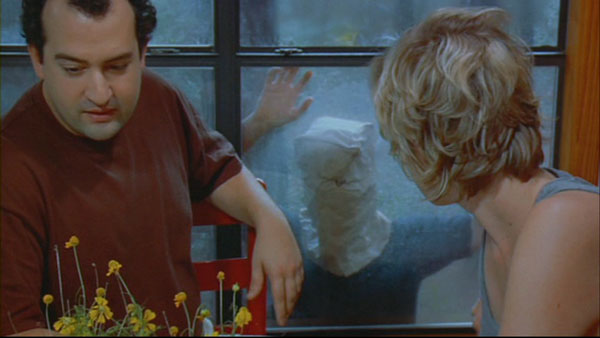
Four movie extras go to a cabin in the woods to script their own indie movie to kickstart their careers. The girls want to make a relationship drama and the guys want to make a horror about a killer with a bag on his head. Meanwhile, they themselves are having relationship drama and being stalked by a dangerous bagheaded dude. So sorta like Behind the Mask: The Rise of Leslie Vernon, except the movie tries to bring its own humor instead of deriving all fun from geeky references to horror movie tropes. Naw, it’s still pretty geeky, and instead of playing with two filmmaking styles (handheld doc / slick studio horror) like in Behind The Mask, this one goes all the way shaky-cam. I am glad I watched it in a window on my computer or it would’ve driven me batshit… when the cam isn’t shaking enough, the cameraman (a Duplass himself) plays with the zoom lens to keep us from getting comfortable. Jerk.

L-R: dude who is appearing in new Amy Poehler show, Baghead, Hannah from Hannah Takes the Stairs
image

L-R: appeared in the Prom Night remake, appeared in Vampire Lesbian Kickboxers
image

Okay I totally liked it but I’m not sorry I didn’t watch it fullscreen.

See, used to be I’d go to the video store and rent anything that looked interesting, and I’d come home with wild, awesome, insane movies. But one Tetsuo The Iron Man and a pile of Richard Kern films later, I start to get wary of the weird stuff. It seems the few weird, random films I rent these days are crappy movies trying too hard for cult success (Sukiyaki Western Django, Tokyo Gore Police). Eventually I get this crazy idea that I should seek out good movies instead of bad ones, and become obsessed with lists of great and important films and magazines like Cinema Scope. So imagine my surprise when C.S. did an article on Craig Baldwin, one of those purveyors of cult-reaching found-footage hyper-weirdness peppering the video shelves. Bug had been a C.S. recommendation and that wasn’t so bad, so I finally overcame my angry memories of Baldwin’s Negativland documentary Sonic Outlaws and I rented this.

And wow is it a mindblowing pile of awesomeness. Footage from ALL sources (godzilla/molemen/cartoons, star trek scenes played as news footage, actual news footage superimposed with sci-fi business) combine to form a tell-all exposé of aliens from planet Quetzalcoatl who landed on earth in the year 1000 and live underground for centuries, waking after nuclear bomb tests to affect global climate change and politics in South and Central America and the U.S., leading to annihilation of the planet in the future year of 1999.

Movie is a wild, hilarious masterpiece of montage, with the nutty stuff woven into actual history, then 45 minutes in, after I thought it had just ended, it refocuses on Africa and becomes kind of dull. Turns out this was the short RocketKitKongoKit (1986), with no opening title so I didn’t know what was happening. Story is more news reporting with less fanciful writing, with stuff on Mobutu (evil ruler of Zaire/Congo) and others I already can’t remember, and I think there was stuff about Germany in there. Loved the conspiratorial half-whisper of the narrator in the first film, so the dull, accented narrator of this one lost interest in comparison.

Next up on the DVD: Wild Gunman (1978), apparently featuring scenes from a dragon’s-lair live-action cowboy video game, but I guess they didn’t have laserdisc players in ’78. Clever montage of advertisements, cowboy shows, repeated bits back and forth (not quite Martin Arnold-obsessive, just for fun). All three movies are divided into numbered sections… the last one used reverse-images of a girl holding up numbers and this one’s got film countdown leader. Playful and fun, brings back the energy the middle film lost.

Internet says Baldwin is a Bruce Conner devotee – no surprise there.

Video distributor says:

Baldwin’s “pseudo-pseudo-documentary” presents a factual chronicle of US intervention in Latin America in the form of the ultimate far-right conspiracy theory, combining covert action, environmental catastrophe, space aliens, cattle mutilations, killer bees, religious prophecy, doomsday diatribes, and just about every other crackpot theory broadcast through the dentures of the modern paranoiac… a truly perverse vision of American imperialism.

T. Maloney in Senses of Cinema:

On the surface RocketKitKongoKit is the true story of a German rocket firm leasing land in the Congo (then called “Saire” under Mobutu’s reign), for testing rockets. The larger implications, that of Europe’s colonial attitude towards Africa in the 1960s and the exploitation of its people for a program the Europeans didn’t want in their own backyard, is not an entirely inaccurate one. History is, of course, highly malleable, and interpretations of any event can continue for decades – especially with relatively recent and well-documented events. The direct links between the ESA’s rocket program and deteriorating conditions in Africa are made more forcefully than would a more conservative historian, and the information is presented with the authority and integrity the documentary form affords.

and on Trib 99:

Organised into 99 chapters, each with a terrifying title screaming out in full screen capital letters, (9) the structure of the film invokes both conspiracy theories and biblical texts. And yet a great deal of the narration in Tribulation describes a readily verifiable history of American intervention in Central America from the 1960s through the 1980s. It is mixed in with vampires, voodoo and killer robots, but it is there.

Oh man, I don’t know what happened plot-wise, but clearly (dimly) we’d have an expressionist madhouse classic to beat Cabinet of Dr. Caligari on our hands here if we had a better print copy.

image

No intertitles, and I guess I was paying more attention to images and technique than trying to puzzle through the story, so even the one-line IMDB plot-blurb “a man takes a job at an asylum with hopes of freeing his imprisoned wife” is news to me. I thought he might have always worked there, maybe he imagines she’s his wife, but he’s either hallucinating – crazy enough to be at the asylum, but gentle enough to be given menial jobs – or maybe he becomes mad from hanging out there too long, or perhaps the ending is a dream… so either Caligari or Shock Corridor.

image

Watched it with Superchunk’s score playing on the stereo. Now Superchunk are heroes of mine, but they wouldn’t be my first choice to score a bonkers dream-logic silent film… worked pretty well, but maybe next time I’ll cook up a mix CD for the occasion.

Based on a short story by Yasunari Kawabata, who has other titles with interesting names to his credit and film adaptations by Naruse, Shimizu, and Kon Ichikawa.

Kinugasa made Gate of Hell, which I think I’ve heard of, and some 100 other films. I hope somebody has looked into this.

An IMDB user: “the film makes use of every single film technique available at the time: multiple exposures and out of focus subjective point of view, tilted camera angles, fast and slow motion, expressionist lighting and superimpositions among others.” V. Petric via Midnight Eye: “These devices… are used not for their own sake but to convey complex psychological content without the aid of titles.”

Silents Are Golden has a plot description: “An elderly man, a former sailor, works voluntarily at odd jobs in a lunatic asylum where his wife is confined after having attempted to drown her baby son in a fit of madness many years ago.”

Excerpts from M. Lewinsky’s well-informed interview on Midnight Eye:

The strongest direct influence was certainly Murnau’s Last Laugh. There was much debate in Japanese film magazines about this film – it was released in Kyoto in January and in Tokyo in mid-April 1926 (A Page of Madness was shot in May 1926) – and its having no intertitles. In a published enquiry “My Favourite Film”, Kinugasa chose Last Laugh saying he had seen it five times. If you compare the two films you will find many elements and images from the German film used in A Page of Madness, but transformed and integrated in a different structure.

The comparison with Dr. Caligari is quite pointless I think. This German film from 1919, despite being popular in Japan, is too different in its mood and making, and its treatment of madness has nothing in common with A Page of Madness.

There are many instances in A Page of Madness where the film relies on benshi narration to furnish crucial information. Without narration, without dialogue, the film at times is nearly incomprehensible.

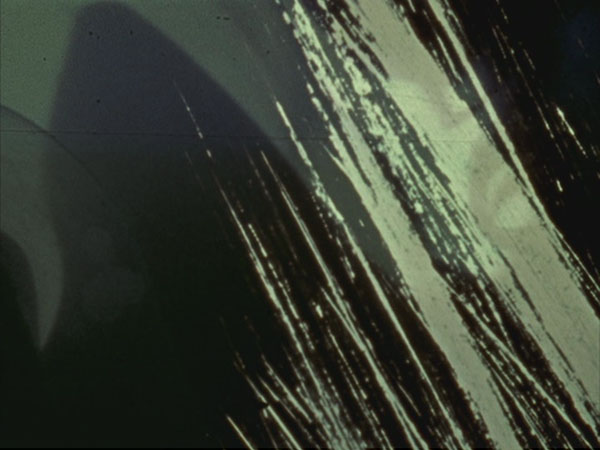
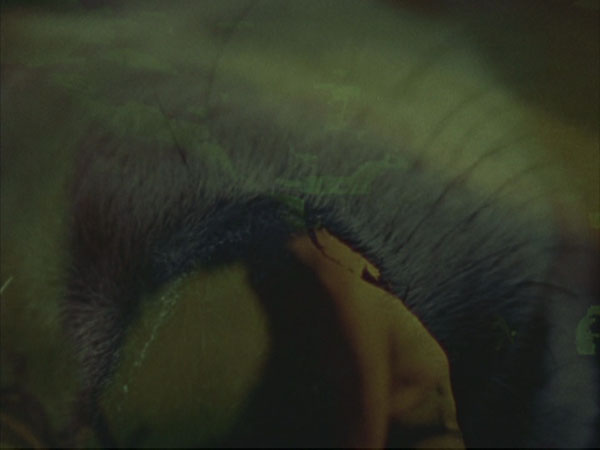
I’ve said the Brakhage set is my favorite DVD… and yet I’d never watched Dog Star Man all the way through, and never seen The Act of Seeing With One’s Own Eyes until lately. Soon after I got the discs, I had a traumatic experience with DSM. Thought I’d watch it at night lying on the couch with Coil’s Moon’s Milk (In Four Phases) album playing. I remember the image of a man (Brakhage himself, I believe) with his dog climbing a snowy hill, but I quickly fell asleep and had awful nightmares, my worst in years, and woke up not wanting to watch DSM anymore.

So some years later I tried again, this time with Sonic Youth’s Koncertas Stan Brakhage on the stereo, again at night on the couch. Dozed off again during sections of Part 1 and most of Part 2, but I got more of an impression of the overall film this time. It’s tremendously complicated, with ideas and techniques from his other films all run into a feature which actually plays as a feature… I didn’t realize you could extend a Brakhage film past the hour mark and it’d stay gripping. And I know it sounds bad for me to call “gripping” a movie which I can’t stay awake through, but I know what I mean, and I’m the only one who reads this stuff anyway.

Prelude:
image

Part 1:
image

Part 2:
image

Part 3:
image

Part 4:
image

“If I had to choose between Elmer and the itch, I’d start scratchin'”

image

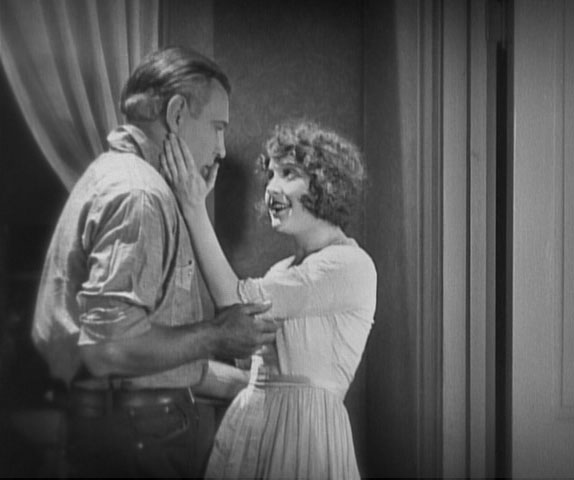
Kind of an unexpected story. Not that Street Angel was business as usual, plot-wise, but somehow I expected this one to be more normal and boring, which is maybe why I put off watching it for four months. Lazybones is a very lazy boy with an amazingly patient mother. He’s hot for neighbor Agnes Fanning but doesn’t do much about it, just expects her to marry him someday. Her sister Ruth is summoned home from college by their dour, domineering mother to marry snotty businessman Elmer, but Ruth has already been secretly married and widowed and has a baby. So she does the natural thing: puts the baby safely in a basket then jumps into the river to drown herself. This is the only act of free will performed by the Fanning sisters in the movie… they do everything their forbidding mother demands, to the ruination of both of their lives. Ruth spends the next 15 years unhappily married to Elmer, sneaking glimpses of her daughter through the window, having no more kids and finally dying of illness/madness, and Agnes breaks up with Lazybones and spends her days shut up in mother’s house, only learning the truth at the end.

Ruth (left) and Agnes:
image

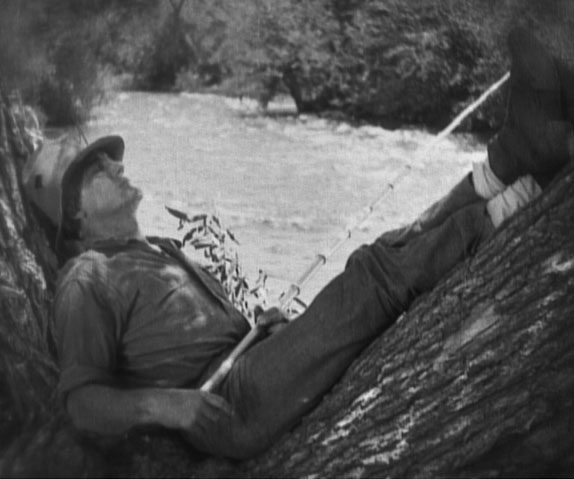
Lazybones, meanwhile, agrees to raise the baby (it’s a girl, his mother tells him). Raises her well with the help of mother, but doesn’t get any less lazy. He goes off to fight in the WWI trenches and stumbles into heroism when he sleeps through a battle and finds himself behind enemy lines, helping take 20 captives. Comes home and finds his adopted daughter has become a young woman, so he starts falling creepily in love with her, until she’s fortunately whisked away into marriage by a nice local boy. LB grabs his fishing pole and heads for the river, as if the last eighteen years was just one long afternoon.

image

Lazy Buck Jones was in 150+ westerns and this, and his grown stepdaughter (above) Madge Bellamy starred in John Ford’s The Iron Horse a year earlier, would later appear in White Zombie.

Emily Fitzroy (of The Bat and the original Gentlemen Prefer Blondes) played the evil mother of sisters Ruth (Zasu Pitts of Greed, Ruggles of Red Gap and Stroheim’s The Wedding March) and Agnes (Jane Novak of some Harold Lloyd shorts).

image

Senses of Cinema refers to Ruth’s “illegitimate daughter.” Has the author not seen the movie lately, or is it like Miracle at Morgan’s Creek, where we know that Hollywood must provide a girl with a lost or deceased husband in order to have a child, but it’s understood by the viewer that the girl wasn’t actually married – a complicit understanding between film and audience of the limits imposed by censorship? Ah, Michael Grost agrees: “While there is a censor-placating marriage ceremony for Ruth (Zazu Pitts in a great performance), this is a thinly disguised look at the problems faced by unwed mothers and illegitimate children. It recalls Way Down East (D. W. Griffith, 1920). The negative look at small town life, and the wasted lives full of pain of rejected people who live there, also recall True Heart Susie (D. W. Griffith, 1919).”

M. Grost again:

Borzage’s heroes love technology. The hero’s main passion is tinkering with his car. Unfortunately, he never does anything serious with this interest, unlike later Borzage heroes who become engineers or scientists. The hero’s car links him to high technology and progress in the opening scenes. By contrast, his well-dressed, well-to-do rival drives a lavish horse-and-buggy. This suggests that respectability and social prominence are linked to backward, anti-progress forces. Kit and her boyfriend eventually open a garage, while the hero is away at war. Such garages, run by the heroes of later Borzage films, are a principal locale of Borzage’s cinema: Big City, Three Comrades. They too are signs of technological modernity.

A. White for New York Press:

Comparing Lazybones to its contemporary literary landmarks The Great Gatsby, Manhattan Transfer and An American Tragedy helps define how movies transmit deep insight through visual power. Steve, a feckless young man at the dawn of the automobile age, anticipates the existential protagonists who wait for life to happen. Letting romance pass him by, Steve helps an unwed mother raise her child and then slowly awakens to passion. Borzage shows Jones and Madge Bellamy’s sensuality with startling erotic attention—throughout his career he was certainly a master of the romantic dual close-up—and this conveys a profound sense of lost opportunity, of everyday tragedy. And this insight compares well to 1925’s other cinematic landmarks: The Gold Rush, Greed, Seven Chances, The Last Laugh, Master of the House—less ostentatious but no less deep.

Lazybones doubtlessly influenced the Johnny Mercer-Hoagy Carmichael song that celebrated Southern ease; more proof that Borzage’s films once touched the core of pop mythology. (Just as Bad Girl and After Tomorrow are quintessential Depression-era films, containing emotional values the recovering nation still hurries to forget.) In its sublimely simple way, Lazybones epitomizes the potency of American pop art at its most morally sophisticated—the same greatness that is underrated in Spielberg.

A. Kendall for TCM:

Lazybones, made prior to Murnau’s arrival on the lot, helps illuminate the degree to which Borzage’s visual style was influenced by the emigre. Borzage is in full command of the emotionally complex characters and moments of bitter pathos that highlight his “prime” work, but it lacks the visual eloquence that Murnau brought to the studio. … The emotional texture of Lazybones is remarkable for a film of 1925, and it would surely stand alongside Borzage’s best-known works, were it not for a misguided turn in the final reel, when Lazybones falls in love with his adoptive daughter Kit, who has just come of age. The sudden shift from paternal affection to sexual desire derails our identification with the hero, and makes us aware of the filmmaker trying to pile more pathos onto the story than its narrative framework can support.

Wallace & Gromit’s Cracking Contraptions (2002)
Ten W&G shorts. I think these were made to promote the full-length film… of course I had the chance to watch them back then and somehow put it off for seven years. Anyway these are cute – faves were The Snoozatron (a machine that dresses G. up as a sheep and flips him on a trampoline so W. can “count” him and fall asleep) and The Turbo Diner (a table-setting device exactly a la Charley Bowers in He Done His Best).


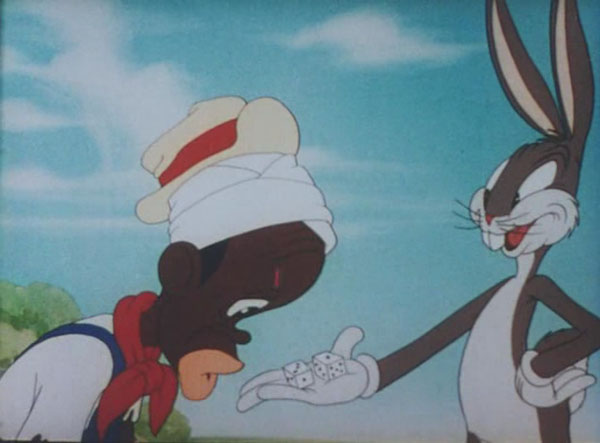
All This And Rabbit Stew (1941, Tex Avery)
Tex’s final Bugs short before moving to MGM. Hooray, now that I’ve watched those John Ford movies I can recognize that the offensive black stereotype hunter is based on Stepin Fetchit. I tried telling myself that if he didn’t look African the character would basically be Elmer Fudd – but then Bugs gets out of being held at gunpoint by shaking some dice and that idea goes out the window. Ouch.
image


Vivian (Bruce Conner, 1964)
If you liked a girl in the 1960’s, you made an avant-garde film of her. Harvard Film Archive: “An ecstatic portrait of actress Vivian Kurtz that features footage of a 1964 Conner exhibition and couches a humorous critique of the art market.” Set to a pop song called Mona Lisa, loads of fun and only three minutes long. This would go on my “best of a-g” gift reel if it wasn’t such a problem to make such a thing.
image


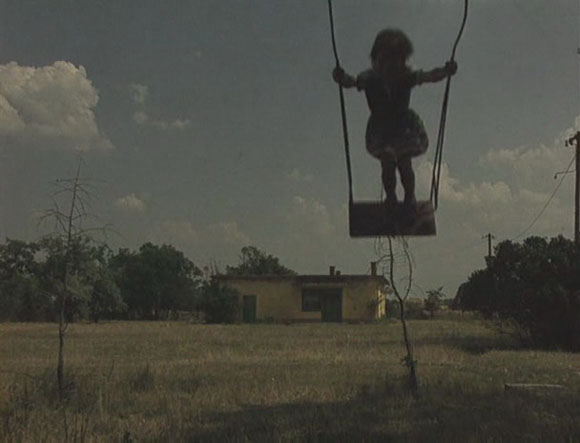
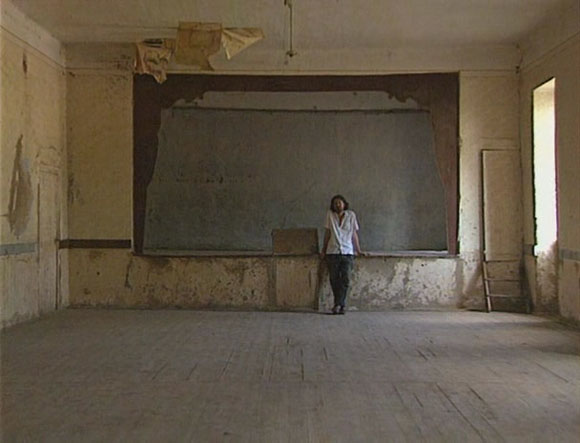
Journey on the Plain (1995, Bela Tarr)
Poems about friendship loss, life and death, each with a long tracking shot (imagine that), written by famed Hungarian poet Sándor Petöfi and performed by one of my favorite film music composers, Mihály Vig (Irimiás from Sátántangó, in color!). Suddenly in one scene 20 minutes in, he’s on a truck loudly playing a doomed keyboard. An odd movie, peaceful and beautiful. I would gladly watch again, paying more attention to the words of the poems.

image

image


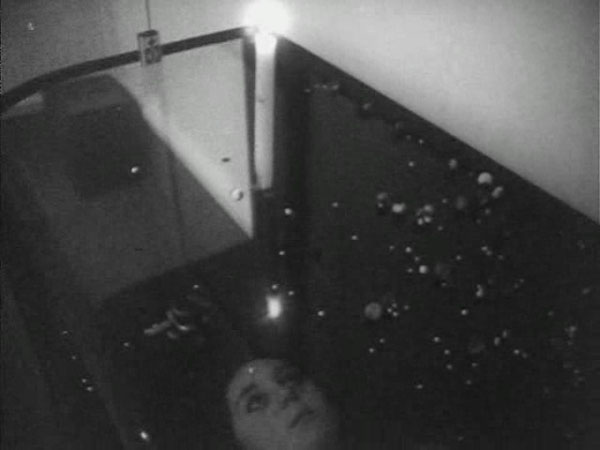
Thriller (1979, Sally Potter)

A narrator goes over the story and characters of an opera, then analyzes it while staring into a mirror, memory and identity swirling about. Very art-film, told in black-and-white stills and scenes, narrator all heavily french-accented. Kind of entrancing, really, with repeated poses and images and phrases, never quite turning into something I can make sense of (though I hear it’s some kind of marxist-feminist critique of Freud and contemplation of human existence, thanks to a useful, knowledgeable and well-considered review on the IMDB – a rare thing indeed).

Sony Pictures: “a critical re-working of Puccini’s opera La Boheme, was a cult hit on the international festival circuit.” Sudden bursts of the shower theme from Psycho. “Yes, it was murder. We never got to know each other. Perhaps we could have loved each other.” I need to see it again, obviously, but I’m not dying to do so anytime soon.

from K. McKim’s great Senses of Cinema article

Potter’s 16 mm black and white cult hit Thriller (1979) overtly equates revision with survival; the film invokes formal conventions to interrogate the narrative necessity of Mimi’s death. Inscribing this inquiry within allusion to female murder victims (Thriller cites Bernard Hermann’s screeching Psycho score), Mimi questions the conventions that locate meaning in the death of a young beautiful woman. Scripted, edited, produced and directed by Potter, Thriller transforms the opera into, as the title suggests, a thriller that uncovers operatic form’s generic and gendered hypocrisy.

image

image


Dottie Gets Spanked (1993, Todd Haynes)
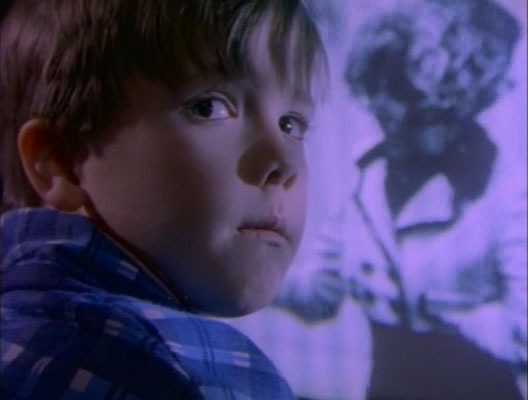
Wow, this was great. Boy with a mommy complex idolizes an I Love Lucy-esque TV show, wins a contest and gets to visit the set. Movie swirls with repression and fantasy and budding sexuality.

The distributor: “anticipates … Far from Heaven with its excavation of placid mid-century surfaces and deeply-buried emotions.” R. Lineberger: “This short film was commissioned by the Independent Television Service as part of a search for short films about American television. The pairing is perfect. Haynes is subversive, but approachable. His film deals with ominous and disturbing themes, but he never comes out and says anything objectionable. For example, Steven’s father is suggested to be violent, or at least sharply critical, but we never actually see any aggressiveness from him. The whispered consequences and punishments exist in glances, or in Steven’s thoughts.”

image

image


13 Screen Tests (1964-66, Andy Warhol)

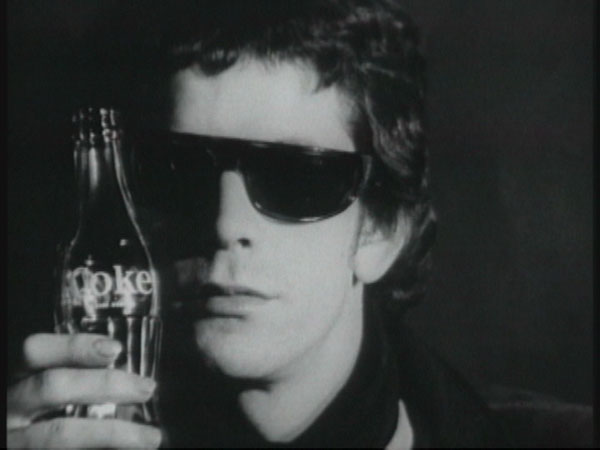
Rented Warhol’s screen tests sorta against my will (I just wanted to hear the new Dean & Britta songs) then proceeded to half-watch ’em while listening to the music. The films were better than I thought (that Edie Sedgwick has got something, and Lou Reed and Dennis Hopper are funny) and the music was worse (standard instrumentals, a few new songs and some covers). I did try watching a screen test straight through, the way I’m supposed to, to see if I experienced a sudden tingly appreciation for the Cult of Andy, but it didn’t work; maybe I picked the wrong one.

G. Comenas:

Factory visitors who had potential “star” quality would be seated in front of a tripod mounted camera, asked to be as still as possible, and told not to blink while the camera was running. … Some of the earliest Screen Tests were those included in Warhol’s film The Thirteen Most Beautiful Boys. … More than 500 Screen Tests were made. In addition to The 13 Most Beautiful Boys, some of the footage was incorporated into other compilation reels such as The 13 Most Beautiful Women (1964) and 50 Fantastics and 50 Personalities (1964).

LA Times:

Each test lasted as long as a single 100-foot roll of film. Each was shot at 24 frames per second and projected at two-thirds of that speed, a trick Warhol often used. Each took a little less than three minutes to film, and takes a little more than four to watch. The slow-motion effect adds a discernible flicker, heightens every movement and contributes to the dreamy, ghostly quality.

image

A lot like the trailer, but a ton better and with a sadder ending. Katy liked it too!

Much of the same crew as Chop Shop but all new actors – and as before, most of them have never acted in a film before (except for Red West, an old Hollywood vet). Set in Winston-Salem NC, near where Bahrani is from, Solo (Souleymane) is a cab driver who aspires to being a flight attendant but keeps failing the exam. He lives with pregnant girlfriend Quiera and her daughter Alex, is kicked out halfway through the movie, but probably not for good. Cheery, happy dude makes it his mission to solve cranky Red West’s problems, like a Wendy-and-Lucy-realism version of Happy-Go-Lucky. Red warms to him until he feels that Solo has interfered too much with his life and plans (threatening to reconnect Red with his estranged grandson, whom Red secretly visits working at a movie theater) then cuts Solo off. But Solo won’t allow himself to be cut off, sticks close to Red in the last couple days before his suicidal trip, and drives him up there with no further questions. Not the ending I was expecting