Fifth movie by writer-turned-director Cohen, and it’s surprisingly good – better and less campy than The Stuff. Tightly written (gets a lot done in 90 minutes) and fun to watch, kinda the opposite of Cohen-penned-but-not-directed Maniac Cop. Has that dull 70’s color, with get-the-job-done cinematography, but some odd creative shots keep things lively.

image

A sniper starts shooting citizens with fake-blood paintballs, causing them to boogie wildly in the streets. Pained-looking detective Peter Nicholas (Tony Lo Bianco of The Honeymoon Killers) goes up to talk to the killer. Asks his motivation, and we have our title. In a TV montage, the killer’s mom provides a sweet JFK-conspiracy reference and an announcer with a washcloth in his mouth gives us exposition.

Our freaked-out hero:
image

Our cop Tony goes home to his girl Casey (Deborah Raffin of Scanners II, who wears giant joke glasses throughout the film for some reason) and fakes like he’s going to finally divorce his separated wife Martha (doomed-looking Sandy Dennis of Who’s Afraid of Virginia Woolf, 976-EVIL)… but Tony is super-Catholic, which means lying to his live-in much-younger girlfriend is okay, but divorce is absolutely not.

image

More crazed killers take out more innocents, and obsessed Tony makes it his job to confront them all and ask “why did you do it” right before they commit suicide. He seems to be the only cop working on the biggest case in town. In middle of the St. Patrick’s Day Parade, cop Andy Kaufman (!!!!!!!) shoots some people. Mesmerizing scene, both because I’m wondering what Kaufman (a year after his mighty-mouse SNL debut) is doing in this movie, and because the crowd is so well-integrated into the scene that it looks like the parade was staged for the film, unlike the crappy parade shootout in Maniac Cop.

I’m not kidding – you can ask anyone. That’s Andy Kaufman.
image

This time Tony was warned beforehand of the killings by a beardy cultist (Sam Levene of Sweet Smell of Success and some 40’s noirs). Tony sleuths out that each of the killers had talked to a blurry-faced young man named Bernard (who later turns out to be Full Moon Pictures regular Richard Lynch). Movie now goes wacky… Tony finds the suspect’s mom, who reveals (via a sepia-toned nudity-filled flashback) that she was impregnated by God, a virgin when her hermaphroditic “son” was born – but due to some visual details in the flashback, the audience suspects not God but aliens. Tony talks a War of the Worlds-referencing polka-dot-hatted science editor at the newspaper into printing the story, which refers to Tony as a “suspended lieutenant” (we didn’t get a scene of his suspension, but if we were wondering why he never spends time at the station with other cops, now we know – that’s some script efficiency!). Meanwhile, seemingly undoing that script efficiency, a velvet-jacketed pimp stabs a cop on a stairwell with no connection to anything else.

image

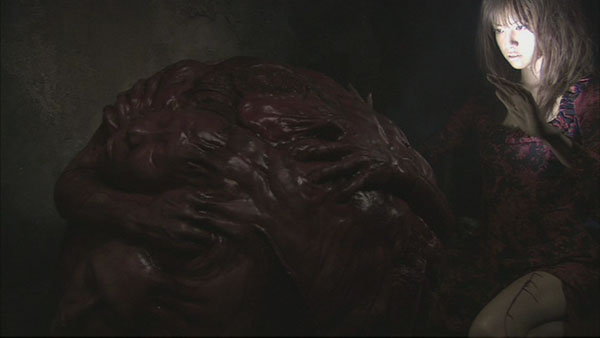
Tony tracks down God, who turns out to be a glowing, nightie-wearing hippie basement-dweller who makes our cop see fires everywhere but seems to be unable to control his mind like he can control others. Why is this? Well, in the next scene, Tony visits a woman in a derelict nursing-home with a similar story (alien abduction, virgin birth, this time shot with greens and oranges with a disturbing closeup on a rubber vagina) played by Sylvia Sidney (of Fury and You Only Live Once in the 30’s, and recognizably the Slim Whitman-loving grandma in Mars Attacks!) and finds out he is her son, therefore the half-alien kin of God.

God:
image

Back to Tony’s personal life, Martha (who now looks like she has a cold) meets Casey for the first time, and the third line Casey ever speaks to the wife of her boyfriend is “why weren’t there any children?” Tacky, but there’s that efficiency again! Tony catches up with the cop-killer pimp and practices his God-powers by making the guy kills his friends then himself, then confronts Bernard-God, who has a vaginal Jesus-wound in his side (a born counterpart to Marilyn Chambers in Rabid) and strangles him (willowy, psychic Bernard-God doesn’t have much practice with physical activity).

Jacob has many kids. His favorite son was killed by animals (bible scholar Katy tells me he’s not really dead) so Jacob is in mourning. King Hamor’s son wants to marry Jacob’s daughter Dina (after kidnapping/raping her), but Jacob’s not responding to requests nor is he acknowledging any of his children. Meanwhile, his brother Esau is lurking with his warriors. Jacob’s sons kill all of Hamor’s people (including Dina’s would-be husband) and there’s gonna be a three-way showdown, but Jacob comes to his senses in time and his clan goes off to Egypt where they’ll presumably find his not-dead son.

image

I also dug the flashback stories in the middle… and Jacob’s climactic nighttime battle with God. There’s lots more that I did not get. Found the movie hard to follow, but I think a passing familiarity with the bible (maybe the book of genesis) would’ve helped some. Was nice to watch anyway, with all the great desert locations, color-coordinated outfits and completely decent actors, a welcome change from the film-fest screeners that have become my constant sorrow.

Albino musician Salif Keita, whose music I’m not all that into:
image

Of the lead actors, Salif Keita (Esau) is better known as a musician (he composed for Yeelen), Sotigui Kouyaté (Jacob) and Fatoumata Diawara (Dina) costarred in Sia, the Dream of the Python a couple years later in Burkina Faso, and Balla Moussa Keita (Hamor) appeared in Sissoko’s Guimba the Tyrant and a bunch of Souleymane Cissé films including Yeelen. Hamor is also the guy I would least recognize if I saw him again, unless he was wearing that coiled-white-tube getup.

Jacob:
image

Helpful bit from the distributor: “Based on the book of Genesis, chapters 33-37, the film follows the bitter rivalry between brothers Jacob and Esau and the resulting cycle of violence, with Sissoko mixing relevant allusions to African history and culture into the Biblical tale.”

NY Times called it confused and rambling. “Complicating matters is the involvement of Hamor, the leader of the Canaanities, when his son Sichem abducts Jacob’s daughter Dina (Fatoumata Diawara) and rapes her, then falls in love with her. In the most disturbing scene, a temporary peace is negotiated when Hamor accedes to Jacob’s demand that the Canaanite men be circumcised, and the obedient Canaanites glumly line up to be circumcised by a knife-wielding blacksmith.”

image

Sissoko: “In the Bible, there is a fraternity which does not stop conflict: we love one another and we fight. This is more and more apparent in the world today, in Rwanda, Yugoslavia, and in northern Mali. The same enmities existed amongst the patriarchs of the three great monotheistic religions. … In our farming and herding societies, people reinforce the rivalry between the nomads and farmers: the situation is analogous with that at the beginning of time.”

Movie was written by a French theologist. Sissoko only made one film after this then became Mali’s minister of culture. According to wikipedia, he’s off the government payroll as of late 2007, so maybe there’ll be another film soon.

Katy, here’s the link I told you about.

I can’t remember according to who was this the greatest film of 2006 (or ’07 or ’08, depending when they saw it) but I was predictably underwhelmed. Having seen The World and Unknown Pleasures, I kept my whelm-expectations low, so I was only mildly underwhelmed, but still…

A nice, straightforward story… woman is searching for her husband who went missing two years ago to obtain a divorce. We’re on the Yangtze (flood levels are lower than in the documentary since this one was shot sooner) but this movie has less of a tourist feel, sticks with the characters instead of reveling in landscapes. Don’t know which approach I preferred.

Quiet movie, medium-paced with lots of breathing room. Unexceptionally serious-artfilmesque for long stretches. But then there’s the aliens. One scene with a darting UFO in the sky, one awesome bit where a statue becomes a rocket and blasts off, and the final shot: the woman leaving town, looking back at a man walking a tightrope between two buildings unexplained. I am all for more weirdness in movies, but the weirdness here seemed to be wedged in where it didn’t belong.

According to IMDB, all the actors in this were in all the director’s other films (two of which I’ve seen, but I barely remember the films let alone the actors).

I hope I figure out what everyone is on about, watch this again sometime with a new appreciation for its rich subtexts and symbolism and emotional impact, and come back to revise this post, embarrassed that I once called such a masterpiece underwhelming and unexceptional. I surely enjoyed it more than The World (and 4-5 times more than Unknown Pleasures) so I’m getting closer anyway.

Set near the Three Gorges dam in east-central China (as previously seen in Manufactured Landscapes). Girl from dirt-poor family and relatively privileged boy hire on to a tourist cruise line. With better knowledge of English, he gets to interact with the customers, while she’s tucked away washing dishes (but in the end, she gets to keep working to support her family, and he is fired for being an overconfident kiss-up). Meanwhile, her family watches their shack and farmland slowly sink as the river rises, finally having to relocate into an apartment on higher ground.

Liked it a bunch, glad I got to see at the High instead of on video. Opens and closes with dramatic dam shots, some real good landscape stuff throughout.

The full title (one of my all-time favorites) is Godzilla, Mothra, King Ghidorah: Giant Monsters All-Out Attack!

Sparkling print (because it’s never screened anywhere) of the English dubbed version. Dubbing is always humorous, but it was less hilarious here than in For A Few Dollars More. Maybe that’s because the dialogue here was too worthless to worry about lip-sync… 90 minutes of soapy garbage surrounding an awesome 15-minute monster movie.

imag3

Forgetting about the garbage (it involved a disreputable docudrama production company somehow having handy all the equipment necessary to do wireless live reporting, a possible love triangle dropped early due to disinterest, a spooky old man/ghost who tells everyone about the spirits of dead soldiers trapped in some guardian stones, and somebody’s dad driving a research sub into Godzilla’s mouth to explode his insides), Godzilla is back and is fucking pissed. Reborn as a purely evil human-extermination machine with milky-white eyes and atomic breath, he easily stomps a friendly-looking burrowing Barugon halfway through the movie.

Big G. unleashes the mighty tail-flip upon Barugon:
imag3

This awakens the other two guardian monsters, honestly-not-all-that-powerful Mothra and three-headed dragon Ghidorah, who head to Tokyo for the big showdown. Ghidorah’s knocked cold, then Mothra is incinerated while trying to sneak up behind G. (who sometimes seems to be toying with his opponents).

Mothra sneak-attack:
imag3

But gold-sparkly Mothra-dust descends upon Ghidorah, turning him dramatically into the golden, winged KING Ghidorah, to the cheers and applause of the sold-out Plaza Theater. King G. bullies Godzilla underwater for a bit, finally eats atomic ray, and just when all hope seems lost for humanity, that girl’s dad does his thing with the submarine.

Triumphant rebirth of Ghidorah:
imag3

Yuri, our reporter heroine, appeared in Ju-on:Grudge 2, and her boss – is that the long-haired guy? – was in Godzilla 2000, the terrible Final Wars, and Evil Dead Traps 2 & 3. The ghostly old fella is a 60’s Godzilla veteran, also appearing in King Kong Strikes Again and Farewell to the Ark. Our director made the fully-decent 1990’s Gamera trilogy, a supernatural teen live-anime thriller series called Death Note, and a pyrokinesis horror called Cross Fire which I’ve had for seven years on VHS but never watched. His D.P. shot the non-Kaneko-affiliated Mechagodzilla follow-up feature, and Tsukamoto’s Hiruko The Goblin. And the guys in the monster suits all did motion-capture acting for the Metal Gear Solid video games.

The beginning of Sirk’s glorious late period of overblown technicolor melodramas, two years before the even wilder Written on the Wind. This one has a loonier plot, though – adapted from a cheap Christian novel with a romance veneer written by a pastor, which Sirk hated: “I tried to read it, but I just couldn’t. It is the most confused book you could imagine.”

Starts out loony as hell and stays that way. Dreamboat millionaire Rock Hudson is running dangerous stunts on his motorboat, crashes, and the only respirator in town is brought out to save him… meanwhile, extremely giving and well-loved Doctor Phillips (who has a secret society of people he has helped with no charge) has an attack, needs the respirator, drops tragically dead. Rock sees Phillips’ hot widow Jane Wyman (Reagan’s ex-wife!) and tries to get with her… but he is too forward, and it is too soon, so she runs into traffic to escape him and goes blind. Blind! Rock, who almost graduated from medical school some years ago, goes back, graduates and fixes her eyes (and saves her life) for a happy ending. There’s more to it, but hey, I’ll watch it again sometime.

J-L Bourget in Bright Lights: “The earlier, implicit and scandalous equation of the two men is, by the end of the film, both explicit and exemplary – that is, according to the film’s apparent standards. Bob Merrick is now a famous surgeon, a philanthropist, Randolph’s best friend, Helen’s husband: everything that Wayne Phillips was.”

Written and/or adapted by ten people, including Robert Blees (High School Confidential), and shot by master Russell Metty (Touch of Evil, Spartacus, Bringing Up Baby and a bunch more by Sirk). Also stars Barbara Rush (It Came From Outer Space) as Jane’s suspicious-then-enabling daughter, early Welles collaborator Agnes Moorehead as a nurse with a thing for Rock, Otto Kruger (Dracula’s Daughter) as an artist/doctor/conspirator, and Paul Cavanagh (Secret Beyond the Door, Bride of the Gorilla) as Rock’s med professor.

Lovely, wide, technicolor movie, more womany and less transparently ironic than Written on the Wind. One of Katy’s all-time faves, but she considers it a nostalgic guilty-pleasure chick-flick and she is very suspicious that I liked it too. She suspects that I’m in secret collaboration with the Criterion Collection and film critics everywhere to make fun of her.

So I’m with you here… Cassavetes was a great man who made great films. This doc is so convincing, in fact, that I want to give two movies I disliked some years ago (Chinese Bookie and Shadows) another shot. And there’s good footage: film clips, interviews with cast and crew, and behind-the-scenes stuff. And I understand if you’ve got that much good stuff you want to use it. But three and a half hours of pure Cassavetes love is an awful lot to take!

Good to see the actors from Faces thirty years later. Good to see Peter Falk… every story he tells is golden. And of course, good to see my favorite actress Gena Rowlands.

image

JC:
“In this country, people die at 21. They die emotionally at 21, maybe even younger now. For those of us who are lucky not to die at 20, we keep on going, and my responsibility as an artist is to help people get over 21. The films are a roadmap through emotional and intellectual terrains that provide a solution to how one can save pain. As people, we know that we are petty, vicious, violent and horrible, but my films make an effort to contain the depression within us and to limit the depression to those areas that we can actually solve. The resolution of the films is the assertion of a human spirit.”

Zowie, a pip of a western, and not at all a sequel to A Fistful of Yojimbo like I’d feared. Thrilling action with all the close-ups and wide-shots, Morricone twang and badass tough guys we’d expect.

Clint, eight years before facing off against Briggs:
image

Clint is a steely young bounty killer out for heaps of money.

Lee, some six years after Ride Lonesome:
image

Lee is a steely older bounty killer out for revenge. Of course we do not know he’s out for revenge until the very end when it’s revealed that the music-box portrait chain he carries around belonged to his sister who was long ago killed by super-thug El Indio.

Gian Volontè of Hercules and the Captive Women, later in Le Cercle rouge and Sacco & Vanzetti:
image

The meaning of this musical/emotional prop is withheld until the final showdown, almost exactly like Charles Bronson’s harmonica in Once Upon a Time in the West. Lee and Indio are shown to be excellent long-range shooters. Lee, however, is the Fastest Man In The West (making the outcome of the climactic shootout a foregone conclusion). I think Clint’s special skill is a supernatural awareness of his surroundings, knowing exactly where/who to shoot. Awesome movie, anyway.

image

Flight of the Conchords: A Texan Odyssey
Short doc of the duo band at SXSW. Funny! Seen below massaging the feet of Peaches.
image

Wallace and Gromit in A Matter of Loaf and Death (2008, Nick Park)
This was as fast-paced as the action scenes in the Wallace & Gromit full-length, and packed full of jokes and puns. Our heroes are bakers now, and a former bread company model, now grown fat on breads and pastries, is out for revenge on the bakery world. She gets cozy with Wallace, plotting to murder him with a giant cartoon bomb (among other things) while Gromit and the woman’s terrified pet poodle try to ruin her plans. Lovely movie, probably inspired by the name of cowriter Bob Baker and/or voice actor Peter Sallis’s appearance in the movie Who Is Killing The Great Chefs of Europe. Must check out Nick Park’s series Shaun The Sheep.
image

Living in a Reversed World
Educational doc. Sadistic Austrian professor, trying to prove a point about perception, gets students to wear special mirror/prism glasses which reverse left/right or up/down and see if they can adjust. They can. He also puts goggles on a chicken, which I don’t think is a good idea.
image

The Contraption (1977, James Dearden)
Closeups of construction. What’s he building in there? What the hell… is he building in there? Turns out to be a giant mousetrap for our suicidal handyman. Dearden later made Matt Dillon thriller A Kiss Before Dying. Contraption-builder Richard O’Brien had lately been in Rocky Horror, would play Mr. Hand in Dark City. Tied for best short at the Berlin fest… this is pretty neat, but I wouldn’t have thought it an award-winner.
image

Cameras Take Five (2003, Stephen Woloshen)
Abstract hand-drawn animation set to Dave Brubeck’s Take Five. Liked it, not super busy, didn’t think people were doing stuff like this anymore.
image

Herb Alpert and the Tijuana Brass Double Feature (1966, Hubleys)
John & Faith animate two short musical numbers to Spanish Flea and Tijuana Taxi. Not slick like the Doonesbury short, homemade-looking. Cute pieces though (predictably about a flea and a taxi). Beat out a Pink Panther short and an anti-smoking PSA for the oscar. Rough year for animation, I guess. Lost at Cannes to a documentary on Holland (not by Bert Haanstra).
image

The Tortoise and the Hare (1935, Wilfred Jackson)
Hare is kinda an asshole – supposedly his character was stolen by Warners as a prototype for Bugs Bunny. This plays like the other Silly Symphonies, not as good as the Three Little Pigs though.
image

A Perfect Place (2008, Derrick Scocchera)
Sharp b-w cinematography and two very dryly comic actors (Mark Boone Jr. of Memento & Thin Red Line and Bill Moseley of all the Rob Zombie films) make for a good movie. In the first second, MBJ “kills” an acquaintance who was cheating at cards, then they spend the next 25 min trying to dispose of the body. Not the usual over-the-top situations either, movie keeps it cool. I guessed early on that the cheat wasn’t really dead but that didn’t make it less enjoyable. Dig the theme song by Mike Patton.
image

MANT! (1993, Joe Dante)
Tracigally not a full feature. All the scenes shot for the film-in-a-film of Dante’s awesome Matinee were assembled into this short included with the laserdisc.
image

Three excellent shorts by Norman McLaren. Fiddle-de-dee (1947, painted to an upbeat fiddle tune), Boogie-Doodle (1948, drawn with pen to a piano boogie) and Serenal (1959, etched and hand-colored to a Trinidadian string quartet number)

Fiddle-de-dee:
image

Boogie-Doodle:
image

Serenal:
image