Celebrating Cannes week by watching last year’s winner, part of a Cannes strip-club double-feature. Annie dances for a Russian guy who looks like Rodrick, then agrees to marry him in Vegas so he can stay in the US, but he runs when his parents send two hapless thugs after them, and Annie is stuck with the thugs while they search, finally catching him back at the strip club with her rival Diamond. There’s a lotta sex and dance music in this. It stretches on forever, then she fucks Igor, and that’s the ending?

Kingsley loves outer space, wants to be an astronaut but can’t read, gets in trouble in school and is busted down to a kindergarten-level special school. A bit upsetting that the night after watching Pink Floyd Live at Pompeii I’m subjected to a fake schoolteacher singing “House of the Rising Sun” in its entirety. Nice little story with crazy end credits music. Naomi Ackie plays an activist exposing the new school for being completely useless, and it ends (ironically I assume) with them putting their hope in an up-and-coming politician named Margaret Thatcher.

Sicinski called this and Wheatle the weakest episodes: “Still, even understood as fundamentally educational efforts, these films are much more adept than the work of Loach and [Paul] Laverty when it comes to articulating the complexities of systematic oppression.”

Live for no audience, the original pandemic livestream. The editing is out of control – there’s more picture-in-picture and rotoscoping than you would imagine, or desire. It’s lovely to see some pure uncut source material that inspired This Is Spinal Tap, the restoration is beautiful, and it all builds to the band’s improv blues song with a dog on guest vocals. Guess this was released as an hour-long concert film then they added 20 minutes of pre-Dark Side interview junk a year later, including a regrettable scene where Wright(?) gets defensive about the band running their technology and not vice-versa like some people say.

Cagney and his dimwitted men rob a train and kill a lotta guys then hide out, but boring cop John Archer (Destination Moon) and his men are closing in, so Cagney confesses to a different, non-fatal job as an alibi for the train heist and goes to jail for a little while. “A very good friend of mine… me!” sounds like an Odenkirk line.

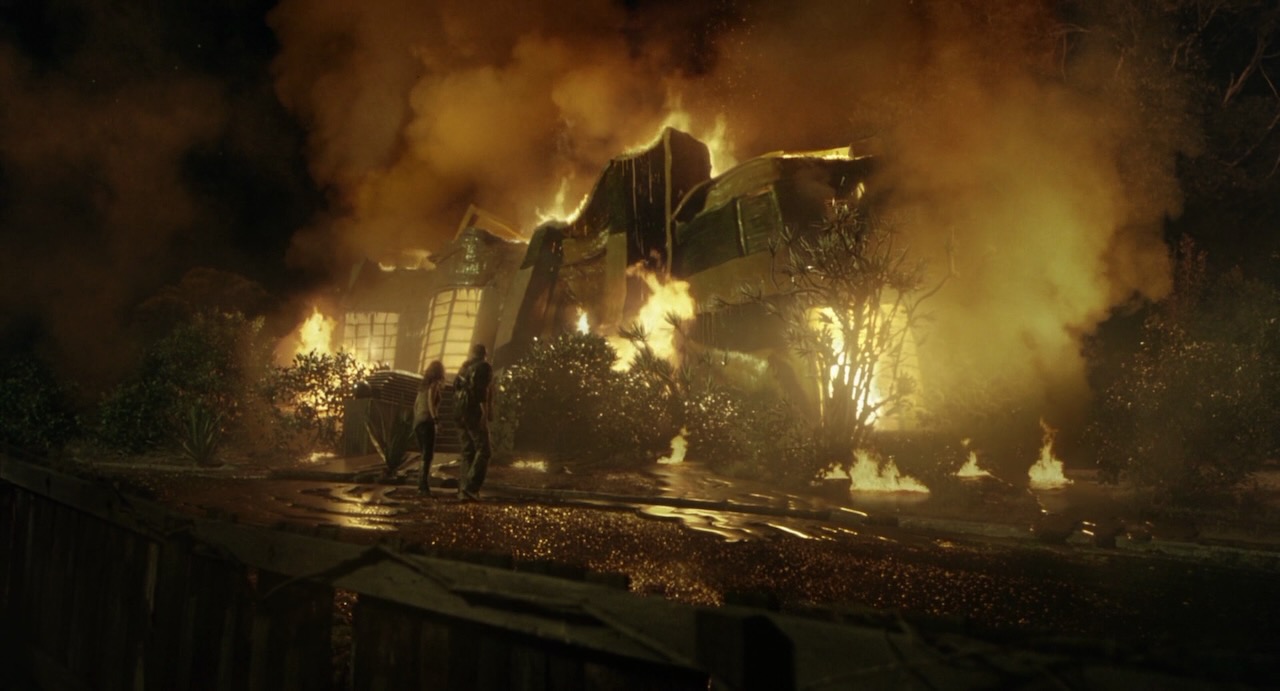
The cops want more on Cagney so they send Large-faced Eddie “Rock Around the Rockpile” O’Brien to jail as a mole to gain his trust. Rivalries in jail then prison break, while outside Big Ed steals his girl Virgino Mayo (Walsh’s Colorado Territory the same year) and they kill Cagney’s beloved Ma (Margaret Wycherly, fake mystic of The Thirteenth Chair). This is the movie where Cagney is a mother-obsessed seizure-prone psychopath, but I don’t find him any more psychotic than most movie gangsters. The cops track him to the next job with newfangled radio equipment – trapped in a burning building he’s made it, ma, top of the world.

Long-take first-person camera to the point of absurdity, with eye blinks. Our guy, swearing to himself he’s not a junkie, smokes some bad drugs. We are Oscar, but it turns out you shouldn’t yell “I have a gun, I’ll shoot” to the police, and then we become Ghost Oscar floating above his body then roaming the city, clipping through walls.

Your first destination as an invisible ghost: the strip club, to watch your sister have sex with some guy in a back room. Sister (Paz de la Huerta, who got naked in The Limits of Control) flashes back to her happy childhood with Bro Oscar until their parents die in a car crash, while Bro remembers meeting Cool Alex who lent him a book of the dead. I guess Oscar’s obsession with his sister, watching psychic steam emanate from sexual encounters, leads to his getting reborn through her?

me, watching this movie:

We’re all watching this because of his Region Centrale camera, right? It bounces back and forth in time but never gets more than a half hour into his post-death, repeats and belabors its points too much, should’ve taken more hits from Je t’aime, je t’aime. Follow-cam with head-piercing sounds, not such fun to watch – Massive Attack’s “Protection” video is both cooler and shorter. At least it’s funny that, in retrospect, by the time Noe made his 3D porno Love, it was the most tame thing he’d done.

A city filmmaker is driving post-earthquake with his kid – per the commentary this is a re-enactment of a trip the director made with his son in the days after the quake – talking to his son with more patience and respect than young Ahmed ever got in the previous movie. For the first half hour they don’t give away the reason for the trip, then he finds a guy from Koker and shows a picture of Ahmed.

So we’re in a new fiction film responding to real events that involve the previous fiction film – but it gets more complicated. “A film has its own truth.” They find the guy who played the slow hunchback in part one, now playing “himself” with his house still standing after the quake, but he breaks character and calls this his “movie house,” says his real house was destroyed and he lives in a tent.

The kid, not understanding the scope of the situation, wants to buy a coke then complains that it’s warm. Later, to a mourning mother: “your daughter’s lucky she died – she’ll never have to do homework.” But the kid getting distracted from his dad’s trip and wanting to hang with some locals and watch soccer gives the movie its title: “The World Cup comes once every four years, and life goes on.”

One of the blu extras opens with an admiring quote from the other AK. Kiarostami made some 200 advertisements before working on features, and he supervised road repairs, which makes a lot of sense.

My blu-ray of Treme is arriving tonight and I just realized I’ve never watched its prequel. I know I started it at least twice, but pretty sure I’ve never made it to part two before, because I don’t recall armed police “defending” the bridges from residents of other parishes.

Historian Doug Brinkley: “I’ve never seen such a time when the US government turned its back on people in need to this degree, to have a people in such dire need getting such little help from the federal government while they’re screaming for help, I think it’s unprecedented.” Maybe in 2005/06 that was new, but it’s doubly depressing to watch this the week FEMA is getting dismantled. Movie opens with Mayor Ray Nagin under great suspicion, then by episode two he becomes a great populist hero fighting for the people, so imagine my disappointment when I pulled him up on wikipedia to see where he went next (to jail for corruption). Fighting for the people might now have gone permanently out of fashion. Very good music, at least.

It’s been a minute (twenty years) since I’ve seen this. Officer Kitano lives a depressing life in forced retirement with his sick wife, one friend dead, another crippled and suicidal, and loansharks after him. So he robs a bank, funds the suicidal friend’s new painting hobby, and takes his wife to the beach, fighting off the gangsters and capitulating to the cops.

Won the top prize at Venice, same year as Ossos, Chinese Box, The Tango Lesson, and 4 Little Girls. As usual, Josh Lewis gets it.

Male filmmaker (gasp) Byungsoo (Kwon Hae-hyo, of everything) takes his daughter Jungsoo to visit interior designer Ms. Kim (Lee Hye-young, dying actress of In Front of Your Face), hoping she’ll take the girl on as an apprentice.

Next visit, the daughter is gone, having quit the interior design business after a month, and Ms. Kim introduces the guy to a big fan of his films. They drink quite a bit, of course. Later, he’s living with the fan Sunhee (Song Sun-mi, who usually plays Kim Min-hee’s friend) in Ms. Kim’s upstairs apartment.

Later still, he’s living there alone even though Ms. Kim is a crappy landlord, and seeing a realtor (the main kid’s mom in Introduction). He goes down to the street and runs into his daughter and… I can’t remember if anything else happens. I enjoyed myself though.