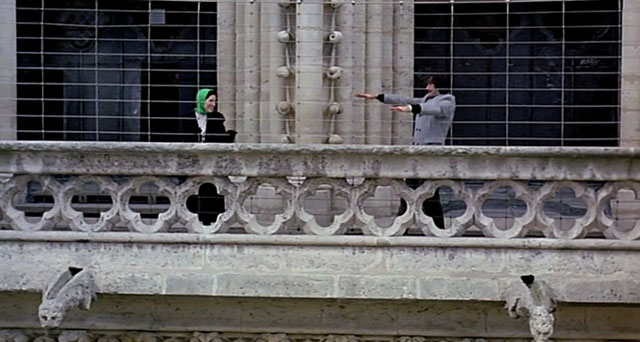
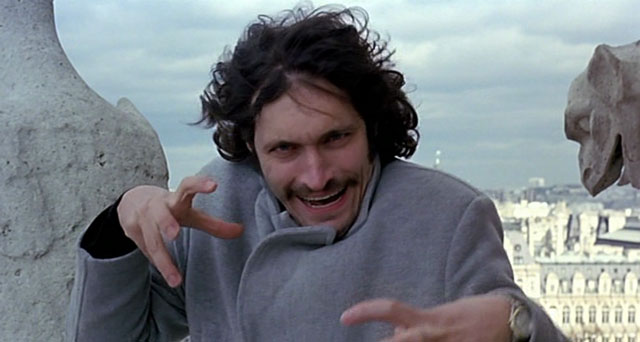
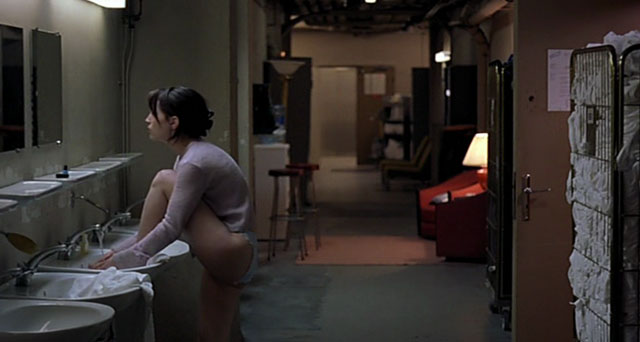
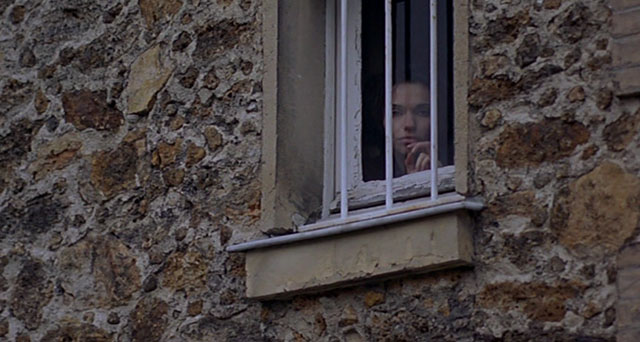
A solid movie, somewhat hopeless and dusty and dreary, but nicely told through its visuals and not overly weepy in tone. I give you the oft-quoted official synopsis: “Mocktar, a Nigerien peasant, comes looking for work in Essakane, a dusty gold mine in Northeast Burkina Faso, Africa, where he hopes to forget the past that haunts him. In Essakane, he quickly finds out, the gold rush ended twenty years before, and the inhabitants of this wasteland and strange timelessness manage to exist simply from force of habit. The beautiful Coumba, however, is still courageously struggling to raise her daughter after the death of her family. Mocktar will soon be fighting not only to survive, but also to provide a better future for this mother and her child.”

Opens with a shot of the dusty desert, the mine entrances invisible beneath the dunes, then one by one the miners start appearing from the ground. Closes with the revese of that shot as they go back into the mines. Throughout, when we’re at the entrances to the mines, the camera is always in the same couple of positions, giving a familiarity to the faceless desert. Rasmane Ouedraogo (from Tilai and Moolaadé), recognizable with his short, white beard, is the elder guru miner, who becomes the mine owner at the end when the old owner, a stern but somewhat fair (profit sharing!) fat man, decides to retire, only to be killed for his money on his way out of town. Our hero is kind of a blank, less memorable than the characters and situations around him.

Variety

Salgues’ screenplay is perfectly crafted in the Western tradition, while Crystel Fournier’s striking cinematography connects the film to a broad African vision. Viewers have a lot of time to admire her dazzling desert panoramas, as there is almost no narrative motor to underwrite the visuals. … Mathieu Vanasse and Jean Massicotte’s music track matches the rest of the film in being extremely refined. The French and Canadian post-prod work is top quality. Improbably, all dialogue is in very formal French.

The Freshman (1925, Newmeyer & Taylor)
The sad truth about Harold Lloyd is that I loved him when I first saw him, but every time I rewatch a movie I like it less. So far I’ve seen Safety Last! and The Freshman twice, and each dropped from “great” down to around “pretty good”. I’m afraid to rewatch the ones I thought were pretty good to begin with.

image

Young Harold (he was actually 32) watches imaginary film The College Hero over and over to prepare himself for college, filling his head with stupid ideas about college life. I would’ve loved it if they’d done more movie-vs.-reality comparisons, but it seems the only thing he took away from the film was the hero’s nickname (“Speedy”), catchphrase (“I’m just a regular guy”) and silly jig, which everyone at college mocks until Harold manages to win the big football game, then the jig becomes the coolest thing. It’s a wonder that nobody else at school had seen this movie and figured out Harold wasn’t even an original nut, just a nerdy guy ripping off a bad movie joke. But my biggest surprise was finding that the silly hat Harold wears wasn’t an invention of his silly movie – college kids (according to this silly movie anyway) actually wore those hats!

Below: Harold and “the college cad” in silly hats. The cad, Brooks Benedict, later appeared in Leo McCarey’s not-sequel The Sophomore.
image

In the scene below, Harold’s tailor hides behind a curtain, ready to patch Harold’s unfinished suit should the need arise, but the two get their signals crossed because of a dude at a table ringing a bell. Supposedly the bell ringer is Charles Farrell, star of Street Angel, but he sure doesn’t look like he does in my screengrabs from that movie.

image

The girl who likes Harold, cutie Jobyna Ralston, was in The Kid Brother and Wings, didn’t make it in the sound era.

image

The Mystery of the Leaping Fish (1916, Christy Cabanne & John Emerson)
Written by DW Griffith and Tod Browning, the same year they did Intolerance, and co-produced by Keystone. Douglas Fairbanks was apparently famous enough to play himself in a framing scene – I think he plays himself, and the rest of the film (starring himself) is his rejected pitch to a producer for a film to star himself. That’d already be plenty to wrap one’s head around for a 1916 short, but that’s before we even get to the main story, which involves incompetent and extremely drug-addicted hero Coke Ennyday trying to stop criminals from smuggling contraband via one-man inflatable toy rafts, and stop the criminal mastermind from forcing the lovely Fish Blower to marry him. Coke gets the drugs and the girl, and I didn’t know I could have my mind blown by Douglas Fairbanks. Bessie Love, the Fish Blower, appeared in three major films in the early 1980’s, sixty-five years after this one. I wonder if anyone on those sets asked her about her cult druggie silent short.

The Play House (1921, Buster Keaton & Eddie Cline)
I’d seen almost all of Keaton’s solo silent shorts, but I’d missed this major one, in which he plays all the characters in a trippy dream sequence that lasts the first half of the film. Reliable heavy Joe Roberts finally wakes Buster from his funhouse-mirrored delusion and he goes to work as a stagehand, where he’s spooked by a pair of identical twins with mirrors. A sheer delight of visual invention only grudgingly held together by a plot.

That’s two of Virginia Fox, daughter of William Fox:
image

Buster Keaton’s minstrels:
image

Cops (1922, Buster Keaton & Eddie Cline)
The Freshman was a movie about a boy whose ideas about life have been warped by the movies, Leaping Fish had Douglas Fairbanks the actor playing Douglas Fairbanks the aspiring screenwriter, and The Playhouse featured Buster Keaton playing a hundred of himself in a stage performance viewed by even more of himself. Cops has no self-conscious reflection that I can think of. It’s just a damn fine heist/love/chase flick with great invention in props and situations. However it does fit in with the outrageousness of last two films in its ending: snubbed by his intended love, Buster effectively commits suicide by running back into the police station where he has just locked up hundreds of angry cops.

Bunch of Chuck Jones movies on TCM accompanied their new documentary Chuck Jones: Memories of Childhood by Peggy Stern, partially animated by John Canemaker, the duo who made The Moon and the Son. I’m not a huge fan of the TM&TS approach, and they take a similar animated-documentary-reminiscence approach here, but it’s lovely to hear Mr. Jones talk about his youth and how different events and memories shaped his life and the characters in his cartoons.

Haredevil Hare (1948), already a decade into CJ’s directing career, sent Bugs to the moon and introduced Marvin the Martian. A silly episode, ends with them blowing up the moon and me unavoidably obsessing over that Mr. Show episode. Marvin has a different, less distinctive voice, but his character was supposed to be a one-off, so I guess Mel didn’t worry about coming up with a brand new one until Marvin became a recurring thing.

Duck Amuck (1953), supposedly one of the most groundbreaking, original WB shorts with Bugs as Daffy’s animator, tormenting him with pen and eraser, and lines like “It may come as a complete surprise to you to find that this… is an animated cartoon.” It is an outrageous conceit, and there’s nothing more fun than pushing Daffy until he flies into a rage, but maybe I’ve seen this too many times because I find it kinda unsatisfying these days. Would rather see all those wild effects going into something with a story. I’m sure I’m just being a negative nelly… it’d probably still rank in my top ten CJ shorts, but whatever… I was anxious to get through it tonight. Most outstanding Daffy line: “Thanks for the sour persimmons, cousin.”

One Froggy Evening (1955) – one of my all-time fave shorts, and from Robert Osbourne’s loving introduction, it seems like it’s a lotta people’s favorite. A construction worker finds a singing frog in the cornerstone of a 100-year-old building and thinks he’ll get rich exploiting it, but finds the frog will only sing for him. Ruined, he buries the frog again, where it’s discovered in 2056 A.D. by a space-construction-worker. No spoken dialogue except by the frog, who has about ten wonderful old-timey songs.

What’s Opera, Doc? (1956) – Maybe it’s the musical ones that grab me, because I could sit through this one and the last three times in a row. Tells the same story as Fritz Lang’s Nibelungen but this is way shorter. Also the only movie in which Elmer actually kills the wabbit. I suppose operas can’t have happy endings. Some credit should finally be given to Michael Maltese, who wrote the last four shorts.

The Dot and the Line (1965), ahh, finally something new. By now, Bugs’ heyday is over and Chuck is working at MGM doing more independent work but with much lower budgets. Writer of The Phantom Tollbooth contributed this story of a line (not just a line segment – he always extends past the screen in both directions) in love with a free-spirited dot, who in turn is enamored with a wild squiggle. Seems awfully 60’s, and not as much fun as its oscar-winning cannes-nominated reputation would imply, but it’s cute… and short. The line learns to impress by forming shapes and super-complex patterns and formulas, and all the squiggle can do in response is freak out and wriggle about, so the faithless dot hooks up with the line for our happy ending. My favorite bit was near the start, trying to convince the dot verbally rather than through shape-shifting physical prowess, the line tries telling her “I know where I’m going!

The Bear That Wasn’t (1967), based on the story by the great Frank Tashlin, and just in time – R.O. says it was the last-ever MGM theatrical animated short. The premise is super, and typical of Tashlin’s cynicism and distrust of “progress” and technology: while a bear hibernates, a giant factory is built over his cave, and when he wakes up nobody believes he’s a bear. If he’s in the factory, he must be an employee, or as they call him, “a silly man who needs a shave and wears a fur coat.” Finally the factory chain-of-command’s pigheaded insistence convinces the bear that he isn’t a bear, and he goes to work… but when winter comes, he returns to the cave (through a maintenance closet) to hibernate again, a cautiously optimistic ending. Unfortunately the movie itself is repetitive (probably the book too – children’s books sure can be), harping on the “silly man” line, and watching the bear’s spirit get crushed is surely less satisfying than watching Daffy get poked and prodded into a rage, and the happenin’ title song is played too often, but I still liked it more than The Dot and the Line. Maybe I’m a sucker for talking animal cartoons, or abstract math stories are too high-class for the likes of me.

Finally I tried to watch the feature-length The Phantom Tollbooth (1970). It seems cute enough, but perhaps too much of a kids movie for me to completely enjoy. After a live-action intro with some famous child actor it goes all animation. Our kid, who keeps learning slow and pointed Valuable Lessons about things, ends up in a swamp called The Doldrums at which point the sludgy narcoleptic music put our hero to sleep, and me with him.

Marsh, director of Wisconsin Death Trip, weaves stock footage (shot by the participants), current interviews and re-enactments to show how Philippe Petit and associates snuck to the top of both Twin Towers one night in ’74 and shot a line across their roofs for Petit to walk and dance upon. Pretty unbelievable stuff, kinda sad and inspiring. I flashed back to Maddin’s comments on lost buildings of his youth in My Winnipeg as much as I paid attention to the screen.

I wanted a lock-groove Michael Nyman score to propel the movie into a screaming intensity, but that never happened. Recognized a few other music pieces, which I suppose were “In The Hall Of The Mountain King”, “A Fifth of Beethoven” and Erik Satie.

David Edelstein: “It goes without saying — and happily, Man on Wire doesn’t say it — that all this took place in a more naive time, that the notion of foreigners with fake IDs slipping past guards into the Twin Towers has a different meaning now. So does the prospect of falling from the top.”

Wild Boys of the Road (1933)
TCM presented some pre-code treats from Wellman, who made a bunch of them. This was one of six films Wellman directed that year – those were the days.

A fully action-packed youth depression drama that wastes no time. Well-made and, incredibly (since I hate child performances in early movies), well-acted too. I kinda loved it.

Eddie (played Robbie the Robot in Forbidden Planet!) is a cool kid who proudly drives a junker car with impenetrable 30’s slang phrases scrawled all over it. He and his best friend Tommy (22-year-old Edwin Phillips) drive around, sneak into school dances and make out with their girlfriends a whole lot. Unfortunately, Tommy’s got The Great Depression, and he passes it on to Eddie, whose dad gets laid off, leading the kids to sell the car and flee the city to look for work elsewhere. While rail-riding, they meet a girl named Sally (Dorothy Coonan, 18, who married 37-yr-old Wellman the following year) who later gets raped by a train brakeman (Ward Bond, John Wayne’s murdered friend in Rio Bravo) – that and all the hot high-school kissing earlier in the picture justify the movie’s inclusion in whatever “forbidden” pre-code DVD set is coming out this week. One scene on the trains is memorably wonderful: rail cops ducking behind a barrier on the ground while being pelted with eggs by a hundred kids on the moving train – the one time the movie goes into giddy Zero For Conduct territory. But during all the fun, Sally is getting raped on a train car, and the kids take bloody offscreen revenge when the perpetrator is discovered, immediately and severely darkening the mood set by the egg-tossing scene.

Sally and the boys make it to Sally’s aunt’s house in Chicago. The aunt (Minna Gombell of a couple Borzage films) is extremely friendly and welcoming and feeds them all cake, but she’s also running a speakeasy, a brothel, or something else (it wasn’t very clear) and is immediately busted by the cops, leaving our kids on the run again.

Hard-luck kids from around the nation build a sort of youth shantytown in Ohio. Tommy loses a leg to a train. The kids flee to New York where Eddie finally finds a job, but in order to earn a quick buck to afford respectable clothes he accidentally gets mixed up with a holdup gang and is arrested. The judge, with a hard-luck kid of his own, buys their story and sends them home… maybe not the most believable ending in the world, but a deserved bit of relief.

Other Men’s Women (1931)

Back a couple years for this next one, the sound quality is noticeably worse. The movie is noticeably worse too… I’m not sorry I watched it, but I wouldn’t have missed much if I’d just gone to sleep dreaming of troubled youth.

Everything seems to revolve around trains in these movies. This time all our heroes work on the trains, starting with our cheesy lead, alcoholic Bill (Grant Withers, would play Judge Priest’s political rival 30 years later in The Sun Shines Bright), who is always handing out gum with his puzzling catchphrase “have a little chew on me.” He’s dating Marie, a big-eyed blond-wigged waitress played by Joan Blondell (popular in ’31 with Blonde Crazy and The Public Enemy, much later in Will Success Spoil Rock Hunter), but he’s fond of Lily (Mary Astor, the princess in The Palm Beach Story, far less outrageous here), the wife of his best friend Jack (Regis Toomey of The Big Sleep, played older salvation army man in Guys & Dolls). Bill, staying with the couple while he sobers up, presents it to Jack one day at work like this: “Lily and I found out all of a sudden we loved each other.” A fistfight ensues and somehow Jack is blinded… blinded! Things couldn’t get sillier – but wait – a rainstorm is flooding the river and threatening to knock down the dam. Bill figures if he drives a loaded train out onto the dam the extra weight will stabilize it. While more sensible supporting characters (have I mentioned James Cagney, a few months before The Public Enemy?) try talking him out of it, blind Jack sneaks onto the train and drives it onto the dam himself, resulting in a spectacular suicide. A few months later when things settle down, Lily and Bill are happily together, a weird sort of happy ending.

Written by Maude Fulton, who adapted a film of The Maltese Falcon the same year (not the one starring Mary Astor). I’m not sure if this is sordid enough to count as a naughty pre-code movie. I guess married Lily kisses another man. Bill acts gay for a laugh in an early scene, but that’d probably still be allowed. There’s another guy with one leg. Clever bit where Bill jumps off the head of a train slowly rolling past a coffee joint, gets himself a cup while counting the cars that pass, then jumping back on at the end. Nothing wrong with the film or the acting (though Bill and Marie suck at playing drunk – the illusion falls apart in close-up) but nothing especially exciting either.

From the director of Hitchhiker’s Guide To The Galaxy. It seems that after British directors make flop sci-fi epics, they then crank out a life-affirming children-starring film-fest pic to make up for it. Oooh, Jennings also made Blur’s “Coffee & TV” video. That makes up for a lot.

The movie, with cinematography by Jess Hall (Hot Fuzz), was very, very small, all 2.35 letterboxed on our little hotel TV way across the room. But what we managed to see was pretty good, a fun little movie totally worth the rental. Katy says I said it was better than the trailer, which I think is a weird thing to have said but I suppose is true.

When Clive Owen is drugged and scammed by Julia Roberts at the start of the movie, you know they’ll be together a few scenes later. It doesn’t look like the kind of romantic comedy that’s going to artificially keep them apart for eighty minutes followed by a super-romantic get-together at the end, especially after such a confrontational intro to their characters. But when they end up working together – sure enough, a few scenes later – are they going to stay together, or end up tricking each other in a series of unsatisfying twist endings?

Surprisingly, their relationship is real and they stay together through the whole picture, though pretending they hate each other in public. Plot revolves around their counter-intelligence jobs at Paul Giamatti’s huge faux-Proctor & Gamble company, trying to steal a big secret formula from Tom Wilkinson’s rival company, with Roberts as the inside man. Giamatti’s plan is to beat Tom to the patent office and take his product public before he has the chance, and Roberts/Owen’s plan is to let Giamatti think he’s won while they take the formula to Europe and sell it for millions. The Big Twist: Wilkinson and his company’s superior counter-intel program knew everything all along and the formula was a fake.

A very fun movie with classy, classic style and charming acting. Some floaty split-screen montages give the light Soderbergh feeling of an Ocean’s Eleven sequel. Opening title sequence featuring a slow-motion airport-runway throwdown between the two CEO’s sets the comic tone. Chronology-juggling gradually, effectively reveals the depth of Roberts and Owen’s relationship and their scam, seems more purposeful than the chronojuggling he did in Michael Clayton. Same producers, cinematographer (Robert Elswitt, There Will Be Blood), editor (the director’s brother) and composer (James Newton Howard) as the previous movie. I am already looking forward to whatever Gilroy does next. Critics would disagree, judging from the rotten tomatometer, and Katy thought it was just pretty good.

Yep, they put the most beloved children’s book franchise in generations into the hands of the director of Bicentennial Man and Stepmom. Why… because he’d made Home Alone a decade earlier? Anyway, everyone knows good filmmaking doesn’t matter when it comes to franchise entertainment. And since I’d been watching all things Potter, with works by Sally (Orlando), H.C. (Hellzapoppin’) and Dennis (Secret Friends), figured it was time we gave old Harry another chance.

Sadly, Katy agreed that it’s pretty crap overall. Good scene where Hagrid busts down a door is the last good scene in the movie. There’s something about a traitorous teacher (who was it?) resurrecting the main evil dude using the titular stone, but I was ignoring most of that and wondering why they couldn’t hire kids who could act. Nice to see John Cleese and Alan Rickman anyway. I’m sure Richard Harris was a very fine performer, but I prefer Michael Gambon’s less-boring Dumbledore.

I don’t especially want to talk about Secret Friends. On one hand, it was interesting to compare to Potter’s book Ticket To Ride, which I just read, and the flashbacks and ambiguous dream sequences a la Alain Resnais’s Providence should be worth discussing, but on the other hand I’ve overdosed on Potter’s poisonous misanthropy and just want to move past this one for now.

Our hero on the train, looking like he is wearing a wig and false eyebrows:
image

Alan Bates (Losey’s The Go-Between) is our guy, scheming against his wife Helen (Gina Bellman, title character in Blackeyes, later starred in the show Coupling) who doesn’t actually seem so bad. Riding the train to attempt to sell his obsessively detailed paintings of wildflowers, he has an identity crisis. Plenty of weirdness follows involving hotel prostitutes, affairs with neighbors, our contemptible protagonist’s painful upbringing, confused passers-by, and stuff that is happening which is not happening… which does not seem to be happening at all. Potter directed his own adaptation of his own novel.

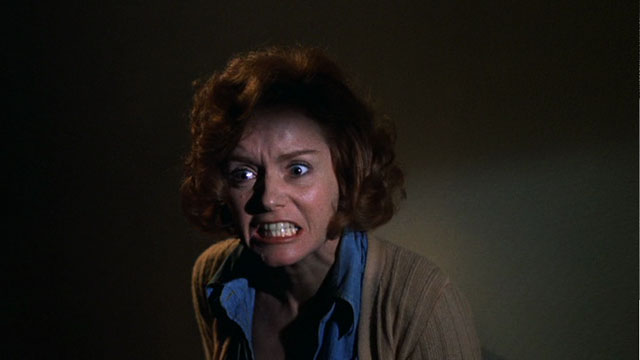
Helen, spooked:
image

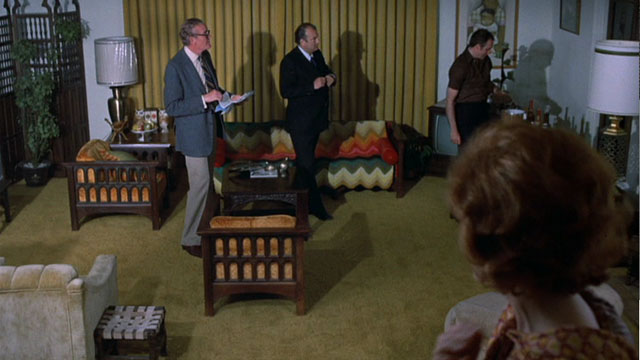
Strangers on a train:
image