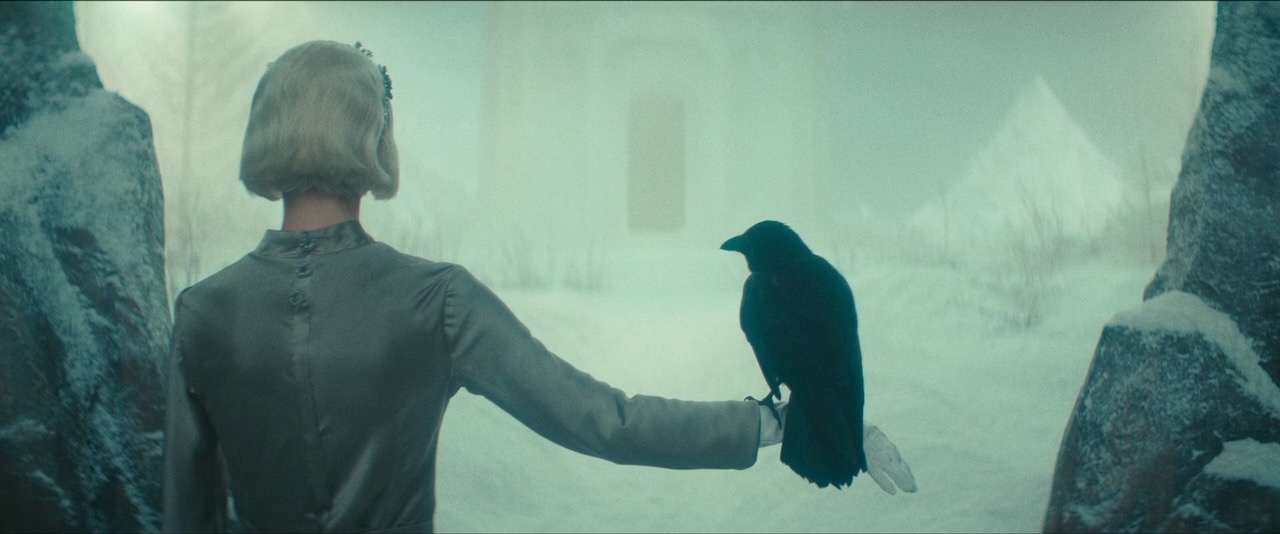
Lot of recent references to spa town in films: Road to Wellville, Cure for Wellness, Days, now this. In the late 1960s DDL meets Juliette Binoche on a business trip but he’s already with hat girl Lena Olin, wants to keep both girls and for everyone to be friends. He’s a professional surgeon and casual writer, Juliette’s getting into photography, and when the Soviets invade Prague, his story gets him in trouble, and her photos of street protests get a hundred protestors in trouble. They escape to Switzerland but Juliette returns and he follows her, arriving smugly principled to a fallen society, where he’s demoted from brain surgeon to general practitioner to window washer, until they decide to live the rest of their (few) days with a friendly pig farmer. Director and actors (esp. Lena) do their best to save the movie from its clunky script, which is somehow by Bunuel’s writer and also got an oscar nomination.

Part one was a straightforward drama, part two was a reenactment of events that took place after filming that drama, and part three is a reenactment of the filming of part two, whew.

It spins off into a side drama, as the actors cast as And Life Goes On‘s newlyweds know each other – Hossein wants to marry Tahereh, her family says no, and she won’t say anything at all. After filming he follows her and… something happens in extreme-wide-shot which I simply couldn’t make out on the VHS when I first watched this, but seemed clearer now, before Godfrey Cheshire further complicated it.

Or possibly all three Koker movies were made to explore AK’s deep interest in homework, and we’d more accurately call it the Homework Quadrilogy.

Watched all the box set extras. The included Cinema de Notre Temps episode is fantastic, a precursor to 10 on Ten. Crew follows him around as he drives familiar routes and looks for people he knows and interacts with random pedestrians. He finds the Friend’s Home kids yet again, catches up with the star of The Traveler, and teases them all about their acting… talks about truth and fiction, philosophically and in the specifics of his films.

Excessively, whimsically French-new-wavey – a silly-ass low-budg indie comedy, more admirable than enjoyable. Brigitte (Francoise Vatel, a Brigitte in Brigitte and Brigitte) and Francesca are stuck with the same guy, a “customs officer”/smuggler. When they get cornered they keep rewinding the film until they figure out the right strategy for escape. Their schemes are successful, but it gets tiring so they move into the city and get government jobs. “Stealing a few minutes from the boss raises the personnel’s morale and efficiency.” The director: “Bresson praised the grace of the film. But did he mean it or was he just fucking with me?”

Kayak battle:

Most relatable scene: Francesca does the dishes by hyperballading them off a cliff:

Christy needs a job, finds one in the box office of a porno theater alongside Luis Guzman. Inspired by her new job, she starts writing dirty stories and reciting them to people. This all scares away her uptight boyfriend Will Patton (boyfriend #1 of Janet Planet), so she lets stalker-customer Louie take her out to a Yankees/Red Sox game. When he leaves abruptly she goes detective mode and follows him to a shady under-bridge deal. After a few days of this she tells Louie she’s been following him and to meet her on a corner. This seems like a dangerous move, but the movie ends with a street shot (the corner?) over some nice John Lurie music, so maybe it worked out. Some lovely scenes of a fish market at night, though I wish they wouldn’t pick up the fishes by their eyeballs, and the meditation handshake montage is great. Written by sometime-Mekon Kathy Acker.

Spy/hunter Fassbender gets five potential spy/leakers together (including his wife Cate Blanchett) and pits them against each other, while he and Cate carry on like a low-budget True Lies. The rare movie where the polygraph test is the best scene. I accidentally just watched Naomie Harris’s earliest and latest movies about havoc caused when an internal science experiment is freed from its lab.

Back to basics, just Joel and Joshua Burge alternately amusing themselves with fire or glowsticks and driving each other nuts in the woods. As their growing tension and weird vibes and the movie’s awesome poster indicate, the end goal is a double suicide, but squirrely Joel can’t follow through, so his head is exploded by a supercharged firecracker while Josh gets a half-hour coda of legal issues and regret. Really messed-up movie, a perfect addition to the Joel/Josh canon.


Ludovico Testament (1999)

Best-case scenario of early homemade short films. This is exactly the sort of lifesize stop-motion that I would’ve made in my VHS-cam days if I’d seen The Secret Adventures of Tom Thumb the year it came out instead of eight years later.


Gordon (2007)

Gordon takes his kid to the playground and dies unexpectedly, then comes back a few months later as a zombie, his face deteriorated but his suit still in nice shape. Family has moved away, and nobody can stand to look at him, so he bums around town to Beck’s “He’s a Mighty Good Leader,” his teeth and fingernails falling out, then returns to his grave.


Joel Calls Indie Film Type Dudes (2020)

Conceptual comedy, Joel calls all the industry people in his phone to ask how the quarantine is going for them, then doesn’t listen to their responses and hangs up in a hurry. The joke is on Alex Ross Perry, who gets called four times, each time listing him as the director of a different film.


Unemployees (2023)

Dani and Kandy are slacker idiots with an ill-thought-out plan to get jobs and be fired then collect unemployment. After stints in an office, a factory, and a cafeteria (all filmed at Grand Valley U in Allendale MI) they take a field labor gig and discover that money does grow on trees – but trees that cause horrible skin infections.

I admit I only watched this because I’m rewatching the long Rivette film with a similar title, but it turned out to be great, currently my favorite Hausner movie. Set in the 1810s, pleasantly suicidal poet Christian Friedel can’t convince Sandra Hüller to die with him, so terminally ill poetry fan Katharina Schüttler steps up. Many quotable scenes within.

This is what I imagine the Fast & Furious movies are like: filling the gaps between action scenes with sappy talk and meaningful glances between friends and family. When everyone shuts up about how meaningful are their relationships and how many times we’ve saved/endangered the world, the highlight is two nearly wordless action scenes in vehicles. In the submarine I think Cruise says one thing (“torpedo tube”), and the plane fight gets better when Esai stops supervillain-monologuing.

Coming a decade after Suzuki’s exile from studio film directing, and not long before his awesome Taisho Trilogy, I wasn’t sure where this movie stood in Suzuki’s career and I’ve put off watching it due to the dour title. Turns out it’s a real hoot, a brightly colored golf/advertising/stalker melodrama.

Taisho star (and a drunk pimp in Ronin Gai) Yoshio Harada plays the shitty boyfriend of a not-top-rated golfer, who hires trainer Takagi (of a handful of Ozu films I haven’t seen) to turn her into a golf champion, but only so an agency can sign her to a modeling contract. She succeeds, and on her first ad shoot they put her in all brown with a fluffy wig – I’d think they don’t know what they’re doing, then again it’s the 1970s.

Golfer Y?ko Shiraki was only in one other film:

The hot new star moves into a custom house with her little brother, where the neighbors don’t accept her, except for Ky?ko Enami (she starred in a Lady Gambler film series) who is starstruck, until she feels wronged by the golfer and the shitty boyfriend and turns dangerous. In the end the golfer is fired from her modeling job and getting pimped out by her stalker, the boyfriend is arrested (by Jo Shishido!) and goes violently mad on a golf course, then the little brother kills both women and burns the house down, all in high wild style.

From the writers of Naked Rashomon, Karate Bear Fighter, and Inflatable Sex Doll of the Wastelands, and the cinematographer of Female Teacher in Rope Hell. Japan is a source of neverending delight. The commentary promises to talk about “idols” in their culture, something that’s been bugging me since Perfect Blue, but I only listened to the first half hour.