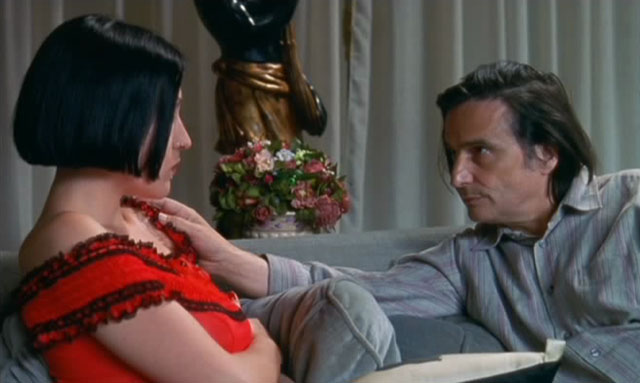
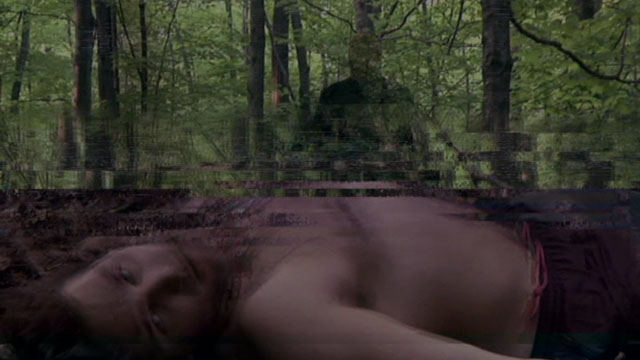
Luckily, a Canyon Cinema program was playing at the university when we rolled into Portland, and I somehow got Katy to come along to the severely under-attended screening.

Our Lady of the Sphere (1969, Larry Jordan)

Occasionally amusing clip-art animation with a colorful circus theme, featuring a woman with a balloon head. But if amusing is what Jordan was going for, he’s about 20,000 leagues below Terry Gilliam. I assume there’s something else that eludes me. The sound was irritating. I give it slightly more credit for difficulty once I realized it was made in the 60’s with physically-clipped-art and not on a Macintosh in the early 90’s. Apparently this is one of his best-known works – it’s in the National Film Registry, whatever that is. Internet says it draws from the Tibetan Book of the Dead.

Dream Work (2002, Peter Tscherkassky)

Quiet (relatively) centerpiece of the Cinemascope Trilogy – a world of difference seeing this on a cinema screen vs. my laptop and television. So, so awesome. Katy watched with her eyes closed. I’ve seen it before on DVD, noted here.

Self Portrait Post Mortem (2002, Louise Bourque)

A decaying pattern scrolls up on left and right of frame, low frame rate but with a weird sliding motion. During the second half, a woman appears in the center of screen.

Happy-End (1996, Peter Tscherkassky)

The one composed from stock footage of a couple in the 60’s at different holidays (or is it just one holiday?), opening and drinking a ton of celebratory booze, dancing and posing for the camera. I’ve seen it before on DVD, noted here.

Very (2001, Stan Brakhage)

We saw a trailer for some upcoming Helen Mirren thing before the shorts started, and I was annoyed to see that the projectionist was running another trailer beneath this totally gorgeous, brightly-colored hand-painted Brakhage piece, but no, it looks like Stan ran out of blank film and painted over a trailer reel for the movie Quills, taking his title from the on-screen superlatives complimenting that movie and cast. Hilarious and wonderous.

Night Mulch (2001, Stan Brakhage)

Companion piece to Very, coloring over the shortened TV version of the Quills trailer. Katy loved these.

Mirror (2003, Matthias Muller)

The rare piece with original footage using actors and locations and lots of careful lighting, not hand-tooling some stock footage. Lots of darkness, and chairs.

The Observer: “The tableaux in which the figures stand like statues are animated by light alone. A light that glimmers, or suffuses a room like smoke, or crackles and fizzes from overhead lamps in long corridors. It polishes a grand piano, soothes the cheek of the pensive woman, surrounds the man with glassy halations and then makes him vanish, as if his part was over, before the room in which he stands disappears.”

Phantom Limb (2005, Jay Rosenblatt)

Title cards tell the story of Jay’s little brother who died as a boy, then a series of short pieces (home movies, some stock footage, some staged) are presented in order of the stages of grief. Katy didn’t approve of the birthing scene, and I was mesmerized by the sheep-shearing one.

Part 1: The Castle

“The photo is the hunt. It’s the instinct of hunting without the desire to kill. It’s the hunt of angels… you track, you aim, you fire and–clic! Instead of a dead man, you make him eternal.”

A slideshow of photographs with a voiceover discussion about the nature of photographs, flipping rapidly all over the globe. Familiar sights: streets of Cuba, “commuter trains full of sleeping Japanese,” an owl in a flight museum, that shot I love of the Russian woman holding a turtle. Many references to things I don’t follow, but because of the great photos and the 50-minute length, this would make a great Intro to Marker – especially if there was better-quality video available.

They fawn over Russia for a while, moving to to lonely monasteries in Greece, then the first day of Algerian independence (below).

“One instant of happiness paid for with seven years of war and one million deaths. And the following day, the Castle was still there. And the poor are still there, day after day. And day after day, we continue to betray them.”

Part 2: The Garden

A montage of animal shots, then a tour of a Korea, and on to Scandinavia.

Different kinds of music, including bits of the electronic effects and percussion that would become more prominent in his later films.

“One needs to look closely at this Scandinavian man. He has everything, truly everything that nine tenths of humanity doesn’t dare to imagine in their wildest dreams. It’s for his standard of living that the Black, the Arab, the Greek, the Siberian and even the Cuban militiamen are striving. He has everything the revolutions promised. And when one shows him some Brecht – free moreover – in the Stockholm gardens, he doesn’t really get the message.”

How do you say elephant in Russian? Slon.

Then a tour of tombs and discussion of death. “I met a man who lived his own death” sounds like an alternate intro to La Jetee.

A yugoslavian hog considers the day to come:

After a wordless musical section, all fades out, but returns for a strange coda, a montage of torn posters with the sound of a screaming monkey, then final voiceover, which seems lovely when it accompanies the images, but didn’t make sense when I tried to transcribe here.

I’d heard that Criterion will be releasing this, hopefully as a precursor to the uncut The Devils, and since I so enjoyed Tommy, I thought I’d check it out. But I got my wires crossed – Criterion is putting out Quadrophenia, the other post-Tommy, Who-related feature, not Lisztomania. Their loss! My loss too, I guess, since I probably would’ve rented this again just to hear what the commentary track would say about things like this:

Oh but wait, my DVD does have a commentary track by a sleepy Ken Russell, who rouses himself to tell us spectacularly obvious things about once per minute – I didn’t play through very much of it.

Train vs. Piano:

Roger Daltrey brings his boyish energy from Tommy straight into this, as enthusiastic womanizer and rock-star pianist Franz Liszt. He throws parties, hold concerts, flees from sword-wielding husbands, and generally ignores his own wife (Fiona Lewis of The Fury and Innerspace) and children. When his daughter Cosima marries his rival Richard Wagner (I already know how Russell feels about Wagner), Liszt must travel to Wagner’s castle (in a loopy Dracula parody scene) and prevent them from creating a nazi superman.

Vampiric Wagner:

Bored Liszt at home with wife:

In the middle of the film, Liszt goes to Russia and stays with Princess Carolyn (Sara Kestelman of Zardoz) in her penis-decorated palace, leading to a fantastic, cock-filled chorus-girl number. I don’t know why exactly, but Liszt joins the church (under Pope Ringo Starr) sometime later. This is what leads him to fight Wagner (Paul Nicholas, Tommy‘s sadistic cousin Kevin), who is defeated but resurrected as a Frankenstein Siegfried Hitler, who guns down Jews while Liszt’s daughter kills her dad with voodoo. But murdered Liszt returns to Earth from heaven in an angel-winged rocketship, gunning down FrankenWagner, achieving peace at last. All of this really happens. This movie is amazing.

Hitler/Wagner with electric-guitar machine-gun alongside Cosima and Superman-caped children brigade wearing Weezer/Wagner t-shirts:

Liszt with Piano Flamethrower:

Russell: “My film isn’t biography. It comes from things I feel when I listen to the music of Wagner and Liszt, and when I think about their lives.”

The Princess:

Senses of Cinema: “By Russell’s account, producer David Puttnam interfered with the project, insisting on more pop art and less context, and also adding the painfully stupid hoedown music to the opening scene.” They also point out visual references to Eisenstein’s Ivan the Terrible in the Russian scenes.

A stupid, jittery, high-energy action remake by Anderson, one of Cinema Scope’s 50 Under 50, highlighting what is for me the biggest problem with auteurism these days. In the 1960’s, movies were made on a factory line, some better than others, mostly credited to studios and producers, until observant critics realized that certain directors put out work of consistently high quality – no huge surprise there – but that they also had thematic and structural consistencies throughout a body of films from varied writers and studios. Heroes were belatedly made of Hawks, Ford and Hitchcock, and their films from critically-unloved genres (comedy, western, thriller) were reassessed. Today the studio system is totally different and every director thinks of himself as an auteur. Since the hardcore auteurists have nothing to discover, instead of enjoying the new world of supposedly personal cinema, they stare at the studio genre movies that still get made, searching for new names they can take credit for discovering. My pick was Hong Kong-turned-Hollywood Ronny Yu (Bride of Chucky, Freddy vs. Jason), but I lost interest after Fearless. Mubi latched onto the late Tony Scott, and Cinema Scope loves Paul W.S. Anderson, responsible for three of the worst video-game adaptations I’ve seen in theaters (Mortal Kombat, Resident Evil, Alien vs. Predator) and the underrated Event Horizon.

In a dystopian future, racing legend Jason Statham is set up for killing his perfect wife, and sent to a post-reality-TV prison, where he can earn his freedom by winning a few weapon-equipped car races which are, of course, rigged by the authorities (Joan Allen). He takes the place of a masked driver called Frankenstein (role reprised from the original by David Carradine), gets a mechanic (Ian McShane), a saboteur-spy sidekick (Natalie Martinez) and a rival (Tyrese Gibson, in the Sylvester Stallone role). After some ‘splosiony car races, Statham avenges his wife by killing mohawked driver Max Ryan and Pryzbylewski-looking guard Jason Clarke, then secretly teams up with Tyrese, easily breaking out of prison by shooting the walls with their missile-equipped cars, driving away to a Shawshank-esque incognito freedom.

Also, Ian McShane blows up Joan Allen:

Set in the dystopian future world of 2012. Will someone tell me again why future-movies always take place in the extremely near future? Followed by two sequels starring Ving Rhames and Danny Trejo. Produced by the great Roger Corman, in between Supergator and Sharktopus.

C. Huber in Cinema Scope calls him “the elder, least pretentious, and most consistently amusing Anderson of the current director trifecta: its termite artisan.”

It’s a nice change that Ti West makes old-fashioned, slow-moving, simply-plotted horror films, but I think he goes too far in that direction. I didn’t like House of the Devil either, but at least the ending of that one was overall less lame. Here he gives the lead girl an inhaler (assuming nobody in the audience has ever seen a movie before), allows crappy, predictive string-drone music to detract from the decent cinematography, and sets up a boring haunted-hotel scenario with dense characters who do things like go down to the basement when they’ve been warned not to.

Claire and McGillis:

Claire (Sara Paxton of Last House on the Left Remake) costars with Pat Healy (a Ford brother in The Assassination of Jesse James), who was the one character I kinda liked, because he’s so flaky. He runs a terrible-looking website about hotel ghosts, but he’s lazy as shit and doesn’t seem too excited about ghost-hunting (turns out he invented all his ghost stories). And at the end, after declaring his love to Claire and saying he’ll do anything for her, he flees the hotel in terror, leaving her to die alone (from ghosts? or asthma? we’ll never know!)

1980’s starlet Kelly McGillis plays a surly washed-up actress and spirit-healer, Tiny Furniture‘s Lena Dunham has one scene as the annoying girl at a coffee shop, and George Riddle, looking like a death-bed Gene Hackman, is an old man who wants to die in the room where he stayed on his honeymoon.

Claire stalked by undead Gene Hackman:

Of all the loud genre movies I rented this week, this one was the champion. A lot like Super (or a comedy Falling Down), a hilarious piece of wish-fulfillment that turns ever-darker. Joel “Bill’s brother” Murray hates his life (in which everyone calls him “bro”) but mostly hates self-centered airheads on television, so after he’s fired then misdiagnosed with a Joe vs. the Volcano-esque brain-plot-device, he chooses to go on a rampage instead of killing himself, killing a spoiled sweet-16 reality star, then her parents. It gets uncomfortably more similar to Super when Frank unwillingly attracts a teen-girl sidekick (Roxy) whom he keeps calling “Juno”.

Watching this a week after some nut shot up a Batman screening, I was surprised at the scene where Frank and Roxy shoot up an underattended movie matinee because a row of teens wouldn’t shut up and put down their phones (scored to a cover of Bjork’s It’s Oh So Quiet). They kill a republican TV talking-head, a guy who takes up two parking spots and a funeral-protesting cult leader. The media keeps misinterpreting their motives, and the killers grow more comfortable with their motels-and-murders lifestyle, gearing up towards a lovingly-shot slow-motion suicidal massacre on a live American Idol-like show.

Excellent movie, more complicated than it seems.

The AV Club gets it:

It isn’t a funhouse mirror; it’s just a mirror. The debasement on its airwaves isn’t some Ow My Balls-style future Idiocracy, but rather a straightforward reflection of what’s already present… The key point about God Bless America is that it’s extreme but not exaggerated, a dark comedy that indulges — and questions — a violent, misanthropic fantasy about laying waste to the cultural landscape while staying grounded in a recognizable reality. In other words, Goldthwait isn’t doing the satirical equivalent of shooting ducks in a barrel here, though his recreations of televised stupidity do offer a funny twinge of recognition. What interests him more is how we live in that culture, particularly those who are alienated by it.

Writer/director Goldthwait:

I could have made a whiney movie or a documentary about how nasty our culture is, and a couple of other people that may see things the way I do would have liked it. Or I could have made a comedy that was very aggressively saying, “Cram it” to all these people, and that’s what I chose to do.

Not at all surprised when the end credits told me it’s based on a novel. The novel was Herman Melville’s follow-up to Moby Dick, which according to wikipedia was “a critical and financial disaster… universally condemned for both its morals and its style.” The movie plays like a piece of tragic literature without feeling uncomfortable in its present-day setting. I mean that as a compliment, but it also means the plot, as strange as it initially seems, has a feeling of inevitability. It opens on a rich couple, happy, alive and in love, so I know things won’t end well. Maybe it would be interesting to someday make a movie that opens on a loving couple who manage to stay that way.

Anonymously bestselling author Pierre (Guillaume Depardieu, star of Don’t Touch The Axe) is engaged to marry Lucie, but already a weird incestual vibe is creeping in when he calls his mom “sister” and gets all clingy around her. His best friend Thibault returns from travels, congratulates Pierre on his engagement to their mutual childhood friend Lucie, seems sincere about it. But Pierre is distracted by a stalker, and when he finally catches her, she claims to be his long-lost sister Isabelle, hidden away and raised in Bosnia. So Pierre visits some good places to die: the highway at night, a massive unstable rock, a waterfall, then tells his fiancee and mother that he’s moving to Paris by himself.

Pierre and mother:

Pierre tells Isabelle (Yekaterina Golubeva, sinister stalker in The Intruder): “for the world, you’ll be my wife,” even though nobody in Paris knows who he is so it shouldn’t matter. They immediately run into trouble on both sides of the law, Thibault throws him out, and newly-disillusioned Pierre is having trouble with his follow-up novel. His agent: “The need to spit the world’s sinister truth in its face is as old as the world itself.” Another woman and a little girl travel with them – I was never sure who they were, exactly, but the girl dies after being smacked in the head by a passer-by, and the couple moves again.

Now they’re in a warehouse run by a drums-and-feedback noise conductor and his all-black-clothed orchestra – just the kind of thing people assume goes on in Paris – and now their public/private roles seem reversed, as they sleep together when nobody is looking, but stay in separate beds. Back in the country, Pierre’s distraught mom (Catherine Deneuve, the same year she did Ruiz’s Time Regained) gets on his motorcycle and dies on the highway at night – so it beats the massive rock and the waterfall as the movie’s foreshadowed death monument. Lucie tracks Pierre down and stays with them (“we’ll say you’re my cousin”).

More troubles: Isabelle jumps off the winter ferry trying to die, Pierre publicly identifies himself as the author of the bestselling novel but is called an impostor, nobody wants his new book (“a raving morass that reeks of plagiarism”), Thibault is harassing them, and Pierre is getting shit from his conductor/landlord, whose musicans apparently also double as his private militia. So Pierre grabs some guns, goes into town and blows Thibault’s head off, is packed into the police van as his women both run after him, then Isabelle walks in front of a speeding ambulance.

It struck me as ironic that Pierre is trying to write a great, tortured novel, seeking the ultimate truths, while all his relationships are full of lies. Watched this because I enjoyed the unhinged awesomeness of Carax’s Lovers on the Bridge and his Merde short, and I’m hearing that his new one is bananas. But this was apparently the grimly serious piece between features of transcendent weirdness, despite a blood-soaked dream-sequence or two. I was looking forward to the Dirty Three score, but it’s actually by Scott Walker – what was I thinking of?

Lucie, in happier times:

Senses of Cinema:

If compared to Jean-Luc Godard and later Philippe Garrel in his first works, in Pola X we find a Carax closer to Jacques Rivette – who, not in vain, has declared that for him this is the most beautiful French film of the ’90s. The Rivettian airs can be found, for example, in the importance of the ideas of conspiracy, secrecy and masks; in the shots of large interior spaces like factory buildings and chateaus; and, above all, in the treatment of time: so many meters of film are used to follow the characters’ journeys, living the process with them – at the beginning of the film we follow Pierre all the way from the chateau where he lives to Lucie’s home, including the ferry ride; similarly, at the end of the film Carax spends a lot of time following Pierre’s journey to Thibault.

Stiller manages a perfectly realistic virtual-reality simulator set in the future so government (and increasingly, industry) can make predictive policies. And about ten minutes into the three and a half-hour movie I realized that Stiller is himself a fictional character inside a virtual reality. I knew this because I’ve seen science fiction before, and the story was seeming familiar – turns out it’s based on the same source novel as The Thirteenth Floor. Fortunately, Stiller figures this out at the halfway point, after obsessing over an erased security chief whom only he can remember, so we’ve got the whole second half (episode – this was a TV miniseries) to deal with this info. More fortunately, there’s no slow grinding of the plot gears as the characters slowly realize something that I already know, because the film is 100% fun to watch, even while being obvious. Fassbinder has found a way to make low-budget, no-effects TV sci-fi look terrific, covering every surface with mirrors and windows and screens (you catch sight of the camera crew pretty often – another fun game), creeping around corners with his Ruizian camera (with sparing use of the requisite 70’s zooms) and playing with perspective. With this and Sam Fuller’s Dead Pigeon on Beethoven Street being my only touchstones, I have to assume that mid-70’s German television was amazing.

Stiller (Klaus Lowitsch of Peckinpah’s Cross of Iron), the shortest person in the movie, is taking over the project because his predecessor/father-figure Vollmer has unexpectedly suicided. Vollmer’s daughter Eva, Stiller’s main squeeze, has grown distant, the corporate project head (Stiller’s boss) Siskins is becoming more demanding, and Stiller’s new secretary Fromm (Fassbinder regular Barbara Valentin) is obviously a spy, implanted to keep Stiller abreast of the situation.

Get it?

Stiller gets more impertinent, programs a singing, tap-dancing version of his boss into the simulacrum. He goes on the run after his mid-movie revelation, realizing that Vollmer was killed for finding out the same thing. Eva reappears, says she’s from the real world, that Vollmer never had a daughter until she programmed herself in a few days before, that they have many virtual worlds but this one captured attention for being the only one that created its own sub-virtual-world. And since the real Eva is in love with the virtual Stiller, she helps him escape by swapping psyches with someone outside.

Eva and Stiller trying to pull a Minority Report pose:

I liked the electronic music, daring for 1973, but sometimes the bonkers, intense squeals which occur when Stiller is troubled would make Ash upset. I also like that you can have fully naked women on German television. Don’t know much about Fassbinder, assumed he’s kinda Nick Ray meets Doug Sirk meets Sam Fuller meets Hedwig, based on my decade-ago half-rememberance of watching The Marriage of Maria Braun.

Stiller being told that he’s a fictional character:

Stiller sneaks into a theater while on the run from the law, watches what appears to be based on the last few minutes of Dishonored:

Nashville Scene rightly calls it “a film that feels somehow inevitable in your viewing, a missing link that should have been there all along.”

Another key reference for World on a Wire is Jean-Luc Godard’s own lone foray into sci-fi, 1965’s Alphaville. Much like Godard’s film, World generates a futurescape from the present mostly by judicious selection. Abandoned building sites, freeways and glass skyscrapers, it seems, are forever. (In the final moments of World, Fassbinder completes the homage as Alphaville’s star, Eddie Constantine, makes a cameo appearance.)

Eddie C.:

Film Quarterly:

Despite not actually being an adaptation of a Dick fiction, World on a Wire has more in common with the wry mordancy of Dick’s work than many official Dick adaptations, not least in the way that it shows each of its three nested worlds as being equally drab. We actually see very little of the world “below” (the world inside the Simulacron) and almost nothing of the world “above” (the world one level up from what we first took to be reality). The world below we see only in snatched glimpses of hotel lobbies and inside a lorry driver’s cab. But it is the revelation—or non-revelation—of the world above at the climax of the film that is most startling. Instead of some Gnostic transfiguration, we find ourselves in what looks like a meeting room in some ultra-banal office block. At first, the electronic blinds are down, momentarily holding open the possibility that there will be some marvelous—or at least strange—world to be seen once they are up. But when they do eventually rise, we see only the same grey skies and city- scape.

Vollmer, just before his death:

Herzog, whose voice is too rarely heard, listens to the stories of people affected by a stupid double murder in Texas, mostly the victims’ families but also a few unenlightening minutes with the killers themselves. There’s little attempt to question whether these two (one of whom is on death row; the other avoided execution because his dad cried in front of the jury) actually committed the crimes. And there’s little attempt to make polarizing statement regarding the death penalty, until the end when the movie tries to land hard on the anti- side. But I’ve been on the anti side for years, and the movie almost has me convinced that the death penalty is a great thing, because these kids are horrible and have learned nothing, so they might as well be dead. One of the highlights is a long interview with a former death row prison guard, who walks us through the whole procedure before saying he had to quit after too many executions messed with his head. No mercy from Texas. Music by Soul Coughing’s Mark De Gli Antoni.