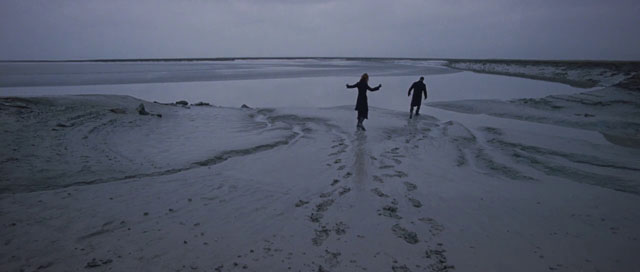
A slideshow of filmed images from Russia and Eastern Europe, decontextualized, no voice-over or dialogue (though people notice the camera and speak to it). Generally quite long shots cut together, though the sound is mixed and faded nicely, not always simply cut with the picture. Camera is often moving, slowly gliding through a scene, and the photography is top-notch.

It’s probably my favorite Akerman film so far, at least the most lively and eventful (from what I remember of From The Other Side). Much of the joy comes from watching people stare back at the camera and crew. Chris Marker would approve. Mostly shot in public places, she also films some women at home, posing for a motion portrait or going about their day. Mostly it gave me a happy sense of peace, with vague anthropological and historical interest – not an intensely moving film, but much more enjoyable than any description of it could sound.

The montage has no discernable purpose, and I saw some complaints about how she almost ends with a long cello performance followed by the musician collecting roses from audience members, but then cuts to one more street scene, perversely denying the movie its obvious finale.

E. Henderson in Slant:

[Russia] was at a précis between history and future, and many of the individual frames in Akerman’s motion picture slideshow rumble with the juxtaposition of the Old World and the New. What Akerman does not do is offer exposition, commentary, or argument. Essentially, she eschews the tenets of documentary in order to avoid clouding her presentation up with, as she suggests in her explicatory notes, agenda.

As observed by Jonathan Rosenbaum, From the East is one of Akerman’s—and maybe cinema’—most fully realized attempts at existing as place, not setting. Rosenbaum notes that almost each and every human being caught by Akerman’s camera (some candidly, others in deliberately staged tableaux) appears to be waiting interminably for God knows what, standing and looking and breathing as Akerman pans to the right, pans to the left.

Rosenbaum also says (and I, too, was reminded of the Straub-Huillet):

The only other film I know that imparts such a vivid sense of being somewhere is the Egyptian section of Straub-Huillet’s Too Early, Too Late. Everyone goes to movies in search of events, but the extraordinary events in Akerman’s sorrowful, intractable film are the shots themselves–the everyday recorded by a powerful artist with an acute eye and ear.

Grunes calls it “a film populated by ghosts whose substantial reality provides an index of the depth of humanity that, metaphorically, has been lost,” and finds tons of deeper meaning in the shots.

Jon Jost liked it somewhat less (though it’s impossible to like it more than Grunes did):

Again and again the camera passes grim townscapes, and their equally grim occupants… Akerman in a sense gives very little, though what she gives provides enough suggestive power for the viewer’s mind to swarm with thoughts. . . Critics naturally scurry in to fill in the blanks with innumerable speculations, most of which show more about themselves than what is on screen. For those for whom guidance is a requirement a film such as this is doubtless quickly boring and pointless.

Set at a girls’ boarding school in 1900, shot with dreamy sunlit photography, scored with Zamfir panpipes, and run through with an inexplicable tension. Great mood movie, providing no answers at the end, made fifteen years after unsolved disappearance drama L’Avventura.

The girls go on a field trip to the base of a mountain, are “forbidden any tomboy foolishness in the matter of exploration,” except for mute Sarah who is forced to stay behind at the school, which seems to be a place where rich girls wear all white and learn poetry. During naptime, four girls get up and walk up the mountain, led by Miranda (Anne-Louise Lambert of The Draughtsman’s Contract) and separately I think, a teacher also wanders off. One girl, complainy Edith, runs back screaming. The rest awaken, search until dark then return to the school.

After a days-long search party, rich Michael (Dominic Guard, the lead boy in The Go-Between five years earlier) and servant Albert (John Jarratt, baddie of Wolf Creek), young men who witnessed the girls at one point, begin their own search and come across one of the missing girls, who requires medical treatment and finally leaves the school, never speaking to anyone about what happened or where the others might be.

Albert wearing Michael’s hat:

Principal Mrs. Appleyard (Rachel Roberts of O Lucky Man) tells mute Sarah, whose best friend is still missing, that her bills haven’t been paid and she’ll be sent to an orphanage. Sarah commits suicide, which is the last straw in the school’s quickly failing reputation. Weird detail: Albert is revealed as Sarah’s long-lost brother, though I don’t think they ever meet. In postscript, the school closes and Mrs. Appleyard dies attempting to climb the mountain.

Sarah with Principal Appleyard:

Also in the movie: Jacki Weaver (who I just saw as a murdered aunt in Stoker) as a sexy maid.

V. Canby:

Horror need not always be a long-fanged gentleman in evening clothes or a dismembered corpse or a doctor who keeps a brain in his gold fish bowl. It may be a warm sunny day, the innocence of girlhood and hints of unexplored sexuality that combine to produce a euphoria so intense it becomes transporting, a state beyond life or death. Such horror is unspeakable not because it is gruesome but because it remains outside the realm of things that can be easily defined or explained in conventional ways.

E. Roginski for Film Quarterly:

The use of Gheorghe Zamphier’s Pan Pipes is insidious and mesmerizing. The notes from the pipes, echoing an ageless music of the hills begins early in the film to indicate the powerful presence of something primeval. It is played in counter-point to the sophisticated music of Beethoven’s Fifth Piano Concerto, the music of the civilized world. These two strains of music, then, struggle for attention and dominance throughout the film.

Feels like it’s trying too hard to be a cult hit, and the pacing is often weird, with our somnambulist hero Dave always moving and speaking slower than you’d expect, and its universe and logic seem simultaneously under- and over-developed (maybe since it’s an incomplete adaptation of the source comic), but overall a damned fun flick, unlike anything else out there, and a welcome return to weird-movie-making for Coscarelli ten years after Bubba Ho-Tep.

Attempts at plot summary would be ridiculous, but here are some people and things.

Tall Man as dark-eyed priest:

Basement meat monster summoned by Obscure Object snake girl, destroyed by Dr. Marconi phone call:

Paul Giamatti as viewer-surrogate reporter:

Good weapon:

Glynn Turman as evidence-destroying, hero-threatening rogue cop:

Church of Dave & John: clothing and masks optional

Dave nearly falls into pit of Korrok before monster is destroyed by humanity-saving suicide-bomber dog:

Set in one day, almost a real-time portrait of the failings of local pastor Gunnar Bjornstrand (bad father from Through a Glass Darkly). He gives his sermon to a sparse, unattentive congregation then has a series of disspiriting meetings in his office. Gunnel Lindblom (servant girl in The Virgin Spring) wants him to speak with her husband, a depressed Max Von Sydow, never looking more sad and powerless. Local atheist teacher, friend and off-again love interest Ingrid Thulin (Sydow’s secret wife in The Magician) writes the pastor a an attack/analysis letter, delivered as a speech to-camera.

Gunnar and Ingrid:

Then Von Sydow is back (mentioned: “a spider God, a monster”, direct callback to Through a Glass Darkly). He is feeling suicidal and the pastor so completely fails to help (“I’m no good as a clergyman,” he even admits) that Sydow promptly wanders outside and shoots himself in the head. Ingrid goes with Gunnar to inform the widow, and along the way he discusses their lack of a relationship. “I don’t want you. Once and for all I have to escape this junkyard of idiotic trivialities. And I don’t love you, because I love my wife. When she died, so did I.”

Widow Gunnel:

Off to the next church service in another town, joined by the hunchbacked sexton, a thoughtful man and the best character in the movie. Each tormented by their lives’ lack of meaning, Gunnar begins the service, which is attended only by Ingrid.

Sexton Allan Edwall, later in Fanny & Alexander and The Sacrifice:

A strong contender for Most Depressing Film of All Time. Made the same year as Frantisek Vlácil’s The Devil’s Trap (“an allegory regarding science, religion and secular power”) and The World’s Greatest Sinner, in which Timothy Carey renames himself God and defies the other God to show himself. Max von Sydow would follow this up by playing Jesus in The Greatest Story Ever Told.

The ending, in Bergman’s words: “Irrespective of everything, you will hold your Communion. It is important to the churchgoer, but even more important to you.”

P. Cowie from the DVD extras:

When it came out, I remember certainly being very shocked that this did not look like a Bergman film. It didn’t have that spectacular technical expertise which we associated during the 50’s with Bergman. But looking back I think it was very deliberate on his part. It wasn’t a budget problem or anything like that. He just wanted something very, very wintry and very, very severe.

P. Cowie:

Film buffs who know Bergman’s earlier film Through a Glass Darkly will note the organist’s scornful dismissal of that work’s conclusion: “God is love; love is God.” Indeed, Winter Light stands as a bridge between Through a Glass Darkly and The Silence, as well as Bergman’s farewell to his own religious upbringing. Some might call it an exorcism.

Ebert:

The sexton, the little twisted man, alone has a face that is alive with wonder at the mystery of faith. He has been reading the Gospels, he says, and thinks the emphasis on Christ’s suffering on the cross is all wrong. Christ only suffered a few hours, he says, while he, Algot, has suffered more and longer, and it is not so bad. No, the real suffering of Christ came when his disciples betrayed him at Gethsemane, and when he cried out to a father who seemed to have forsaken him. He suffered because he feared no one had heard or understood his message. Christ suffered because he, too, was dismayed by the silence of God.

I guess it’s about two people with traumatic pasts who try to track down where their lives went wrong – but as I could tell from the trailer, it’s hard to say exactly what it’s about. One thing I wasn’t expecting: it opens with Swanberg/Wingard regular Amy Seimetz being kidnapped and force-fed a mind-control worm by a patient abductor who takes her home and gets her to sign over all her home equity, which he cashes and disappears.

In her shabby new life working at a signage shop, Amy is relentlessly courted by divorced ex-junkie Shane (our writer/director/etc) who tries to help her come to terms with her life. He has his own identity problems – she tells him stories and he fashions them into his own memories and tries to re-tell them to her. During the mutual-paranoid-freakout scene in a bathtub the movie started to remind me of Bug.

Elsewhere in the world, a pig farmer is somehow involved with the worm-brainwashed abductees and possibly the harvesting of new mind-control worms. Also he seems to be a sound recordist. Amy pieces together enough details to discover his farm and kill him, upon which they find documents on all the other kidnappees, and invite them all to the pig farm.

And I haven’t even mentioned these guys:

The above is a silly description of an entrancing movie.
This was a long time coming after Carruth’s great Primer.
Co-edited by David Lowery, whose Ain’t Them Bodies Saints made waves the same year.

Cinema Scope has an excellent interview with Carruth:

From a writing perspective, I don’t want these people to wake up and have a normal resolution. That’s impossible for me because that means that I understand all of this and have a morality lesson to explain to the audience. And I don’t. All I have is an exploration. So the characters can resolve their story in their own way, but that doesn’t stop the exploration for me.

Leo starts out a naive stockbroker under the wing of weirdo drunk Matthew McConaughey (having a big year), eventually starts his own business (with a terrific Jonah Hill) using hard-sell techniques to trade junk stocks to rich people, until finally his nonstop cheating, drug-taking, money-laundering (Jean Dujardin is wonderful as a Swiss banker) and FBI agent Kyle Chandler (of Zero Dark and Super 8) take him down. Internet says Leo, Jonah and Matthew spent a few years in prison each (The movie sadly doesn’t portray Leo’s prison friendship with Tommy Chong), but Leo’s out selling his sales techniques at seminars, still a controversial mofo.

Written by Terence Winter, creator of Boardwalk Empire, who says: “You are being sold the Jordan Belfort story by Jordan Belfort, and he is a very unreliable narrator.”

G. Kenny: “There is a certain irony that Scorsese’s particular critique of capital is such an expensive one, and don’t believe for a minute that he is not unaware of it. We all, or most of us, do what we can with the resources made available to us. ”

MZ Seitz:

“Wolf” starts with a Fellini-like party on the floor of Belfort’s firm, then freeze-frames on Belfort tossing a dwarf at a huge velcro target, literally and figuratively abusing the Little Guy. The traders get away with their abuse because most people don’t see themselves as little guys, but as little guys who might some day become the big guy doing the tossing. “Socialism never took root in America,” John Steinbeck wrote, “because the poor see themselves not as an exploited proletariat but as temporarily embarrassed millionaires.”

R. Brody on the final shot:

Scorsese’s camera rises over their heads to scan the yearning, vacant faces of the aspirants in the rows behind them. It’s a moment with a terrifying, Olympian blend of compassion, disdain, and anguish; it shows a fatal lack of imagination combined with a desperate range of unfulfilled desires. The shot shows not just an audience, but the audience: Scorsese puts the film’s viewers face to face with themselves, charges us with compensating for our lack of imagination and fatal ambition through contact with the wiles of a master manipulator. Just as the fictionalized Belfort (Leonardo DiCaprio) is presented at the seminar by a host (who, in a diabolical cameo, is played by the real-life Belfort), so we, the movie audience, have been introduced to Belfort by another enthusiastic impresario, namely Martin Scorsese, who knows perfectly well that he is giving us something that we want, something that we need, and something that taps into dreams and ambitions that are both central to life and completely suspect.

I wasn’t completely crazy about it, but gotta agree with Ben Wheatley, who says:

I saw Wolf Of Wall Street, and that was a fantastic experience, just going, “God, this is a proper film.”

Total acting showcase, starring two oscar winners and three multiple-nominees. So who do you get for the sixth-billed slot? Louis C.K., hell yes!

Scammer Christian Bale attracts scammer Amy Adams, who both attract the attention of overeager federal agent Bradley Cooper, who wants to go big with the scams and nab charismatic mayor Jeremy Renner. Also Bale is married to Jennifer Lawrence, who seems to have been pried into the movie. Also Robert DeNiro plays a scary gangster, and the scammers screw over the agent (and, reluctantly, the mayor) at the end.

I can’t believe people took this movie as serious criticism of The Shining and complained about its arguments instead of reveling in Ascher’s technique. He wastes no time showing us the Shining obsessives and conspirators on-camera, or obtaining rebuttals from people involved in the original film’s production – just uses these stories and fantasies to spiral further inside the movie, revisiting and altering footage to suit him, bringing the rest of Kubrick’s films into the mix (one speaker is visualized using Tom Cruise from Eyes Wide Shut). It’s a clear progression from his short The S From Hell to this – can’t imagine where he’ll go next.

Noel Murray says it best:

The Shining can’t be a coded confession by Kubrick that he helped fake the moon landing and a metaphor for the Holocaust and a symbolic representation of the American government’s slaughter of the Indians and a subliminal-message-filled exploration of deviant human sexuality and a complicated structuralist film that’s essentially 2001 in reverse. Or can it? Room 237 joins the ranks of classic documentaries like Rock Hudson’s Home Movies and Los Angeles Plays Itself that encourage cineastes to take a closer look at the secret messages that movies send, and to ask whether they’re intended or not—or whether it matters. What makes Room 237 work so well is that Ascher shows the same Shining clips over and over, with different interpretations, letting only the voices of the theorists and the images from the film (plus a few other relevant movies) tell the story. The effect is intense: a deep dive into the rabbit hole of semiotics, which leaves viewers more alert to what’s really on the screen.

Quintín:

The manipulation of the film material, the juggling of meanings, the associations connecting truth, memory, and film in Room 237 add up to something very enjoyable, as a kind of a fresh pleasure in film viewing, which is not exactly the same as the essay-film format, nor the usual patchwork in the found-footage genre. Made with no clear tradition behind it, Room 237 invites us to a dance with a cinema that is daring and free.

A very Malickian movie, with fields of grain and far more voiceover than dialogue. Absolutely full of camera movement, all of it motivated by place or action, and brilliant associative editing. Maybe a few too many shots with the sun right behind the foreground person’s head (this happens in most of the shots), but a beautiful, breathtaking movie to watch – and to hear, with appropriately big music by Hanan Townshend (returning from Tree of Life).

As for what actually happens in the movie, I’ll need to watch (happily) some more times, or refer to film writers and/or philosophers. Ben Affleck is our central/absent hero, with hardly any lines, as the film takes the POV of the women with him. First Olga Kurylenko (of a recent James Bond movie) comes from France to Oklahoma with her daughter, leaves again when Ben won’t marry her. Rachel McAdams (of a recent Woody Allen movie) takes up with Ben, but this doesn’t last long, and Olga returns without her daughter, marries and later divorces the stoic Ben. Meanwhile Javier Bardem (of a recent James Bond movie and a recent Woody Allen movie) is a local doubting minister who knows all three primary characters but doesn’t play a central role in their story, spending more time among the poorer citizens. The great DP Emmanuel Lubezki (nominated this year for Gravity instead of this) rightly described it all as abstract – and as usual, rumors abound of major actors and storylines that didn’t survive into the final edit (they’re not in the DVD extras either).

Not as straightforwardly religious (or as straightforwardly anything) as I’d heard, and possibly even less narrative than Tree of Life. Malick increasingly makes all other films seem unaccomplished and inadequate. Looking for articles I’m surprised at how many critics hated the movie, are tired of Malick’s techniques, say the characters and story are over-familiar. These critics have no love in their hearts.

M. Koresky:

He was once a myth, and many seem to have preferred him that way—with hallowed artists, absence is easier to confront than presence. He’s now a constant in our film culture, a searching, grasping, wrestling artist. … he seems to be discovering the world anew right along with Marina; this is a searching, selfless filmmaker, imagining the point of view of a good-hearted, soulful, and terribly solitary woman. In this way, To the Wonder is like the more elegiac second half of The New World — everything following Q’orianka Kilcher’s marriage to the laconic yet loving husband played by Christian Bale — stretched to feature length, a fish-out-of-water tale that finds beauty and harmony in disruption and estrangement.