I don’t know why I didn’t get L’Atalante upon first viewing. Maybe ’twas the low-grade VHS tape I rented, or maybe I was drowsy or impatient, but now I see it’s almost as beautiful and twisted a love story as Sunrise.

Provincial girl marries a barge captain passing through town then finds that spending life on the boat with his two assistants is less excitingly romantic than she’d imagined. Tension mounts between the captain and the gruff-looking but tender Jules leading the girl to flee the ship to see Paris on her own. But she doesn’t fare well and the captain goes into a depression, so Jules goes and finds her for a tearful reunion finale.

Not the fault of the video, I guess, because many shots were out of focus on the 35mm print. Must’ve been rough to do so much location shooting in 1934. So many other gorgeous shots and ideas scattered throughout that it’s easy to overlook technical shortcomings. Movie holds a poetic, dreamy state throughout, and the ending seems deserved despite the captain being kinda unlikeable most of the time.

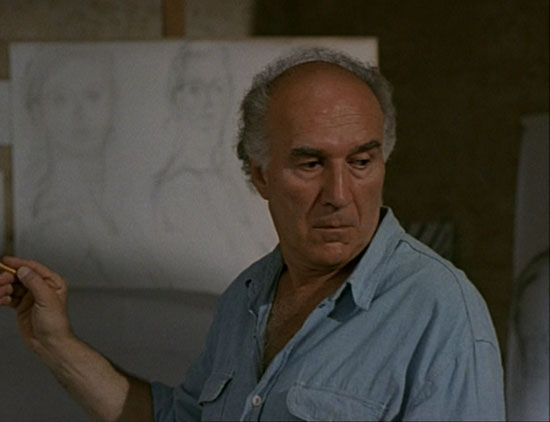
Jean Dasté got small roles in Jean Renoir films, and many years later, larger roles in Francois Truffaut films. He was also the sympathetic teacher in Zero For Conduct.
image

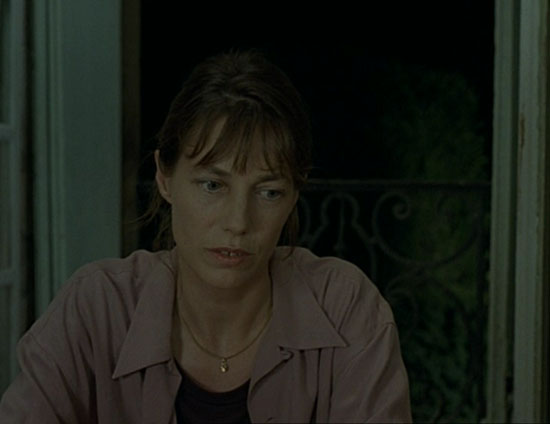
Dita Parlo appeared in Grand Illusion and didn’t do much acting after the 30’s.
image

Michel Simon was more well-known, starring in The Two of Us, Rene Clair’s Faust, Port of Shadows and at least three by Renoir. Jacques Rivette did a 100-minute Cinéastes de notre temps with him in ’66.
image

Cats are thrown at people from offscreen, an obvious influence on Dario Argento.
image

Happy ending:
image

Zero For Conduct, by contrast, was less anarchic hilarity and slightly more tedious than I remembered it. Still a fun boarding school romp with good characters (the dwarf headmaster, the head-standing supervisor played by Dasté who is on the kids’ side from the start) and great portrayal of repressive school life, friendships and rivalries and minor (and in the end, major) rebellions.

image

image

I watched the above two at Emory on 35mm last November but delayed posting this until now because I wanted to go through the rest of the Artificial Eye DVD.

I dug the Cinéastes de notre temps episode by Jacques Rozier (new-wave filmmaker with Adieu Philippine, also shot some of the stuff on the Contempt DVD and the Cinéastes episode on Bunuel excerpted on the Viridiana DVD). 90 minutes of Vigo stories and interviews with the three L’Atalante leads thirty years later. Michel Simon looks the same, and Dita Parlo is very recognizable when she smiles. Now that I know what Jean Daste looked like in the mid-60’s, I’ll look out for him in The War Is Over. Didn’t realize that Jean Vigo knew Jean Painleve… and Painleve has an indirect connection to Oskar Fischinger.

Not much to say about the two shorts. The Jean Taris doc has some cool photography, but I wouldn’t say it’s worth watching over and over. The Nice doc is more creative, has lots of cool photography, and is definitely worth watching over and over.

Jean Taris, swimming champion:
image

À propos de Nice
image

I’d heard this was one of those forgotten comic masterpieces, have to say I was underwhelmed. Humor and references seem state-of-the-art to 1957 – I got Groucho’s “you bet your life” cameo but probably missed a lot more.

an alarmed Tony Randall:
image

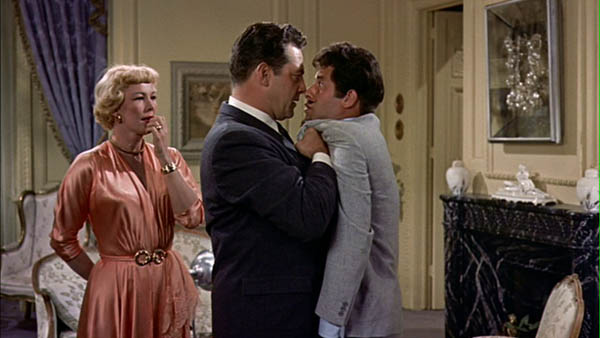
In high cinemascope color, a cross between Tashlin’s cartoony style, an advertisement (since our protagonist is an ad-man) and a regular 60’s comedy (Tash was ahead of his time). Tony Randall (from Let’s Make Love) is our ad-man, who makes a deal with superstar Rita Marlowe (Jayne “The Girl Can’t Help It” Mansfield). She’ll do a bunch of ads for his makeup company client, saving him his job (and eventually earning him an unwanted promotion to president) if he’ll publically pretend to be her new boyfriend to make her ex, Bobo Branigansky, want her back. The ex, also a TV star, sort of a Hercules/Tarzan type, is played by Mickey Hargitay, a bodybuilder who would play Tarzan for real three years later. Betsy Drake (not a big star, best known for being Cary Grant’s wife throughout the 50’s) plays Tony’s pissed-off fiancee who threatens to leave him over the whole Rita thing, and 16-yr-old Lili Gentle (one of her only movie roles) is Tony’s excitable niece, a bit Rita fan.

a very red Lili Gentle:
image

It’s all about knowing where we belong, being happy with our lot in life, finding true love, and making fun of television. Tony and the president of the ad company (John Williams of Dial M For Murder) end up a farmer and a gardener, and Tony’s boss (Henry Jones of 3:10 To Yuma and Vertigo), a born ad-man, ends up an ad-man. Joan Blondell (star of 1930’s musicals, Nightmare Alley) has an interesting part as Rita’s washed-up assistant who yearns for the life she could’ve had with the love of her youth, a milkman, and gets Rita thinking about her own young love, George Schmidlap (Groucho, below).

image

Katy somewhat liked it, but I have a feeling she’s about done with Frank Tashlin comedies, so I’ll save Artists and Models for another time and go back to the always reliable Billy Wilder (although she didn’t like Ace in the Hole either, hmmm).

check out Rita and her matching poodle:
image

Maaaan, what part of “from the writer/director of Dog Soldiers and The Descent” made me want to watch this, even for free? At least it was a midnight screening so I didn’t waste too much precious time on it, but the thought that I could’ve spent even half of that time playing Wii instead shall always haunt me.

People whose work I will avoid from now on:
– Marshall, of course
– actor David O’Hara (The Departed, upcoming Wanted)
– producer Steven Paul (Ghost Rider, The Uninvited, Castlevania)
– producer Benedict Carver (Bratz, Tekken, Castlevania)
– cinematographer Sam McCurdy (Hills Have Eyes II, Bob Hoskins pic Outlaw)
– editor Andrew MacRitchie (recent James Bond films, Sahara, Victims, Solomon Kane)
– production company Rogue Pictures (Seed of Chucky, Balls of Fury, Hack/Slash, The Strangers, Castlevania)

In other words, don’t see Castlevania!

Bob Hoskins and Malcolm McDowell paychecked it on this one – guess I don’t blame them. Anyway, this is a rip-off of 28 Weeks Later in which the girl from Resident Evil wanders into a post-apocalyptic Irish Yojimbo war between some non-magical Lord of the Rings castoffs (led by McDowell) and some Mad Max wannabes (led by two stuntmen-turned-actors). This leads to a buncha ineptly-shot action scenes, but don’t think this is an action movie – most of the runtime is dedicated to boring wordy exposition which wasn’t even appreciated by the couple sitting next to me who loved the movie. There’s an A.I. flesh fair, and some token cannibalism, and lots of unexplained futurey stuff and plot holes galore. Marshall also loves to show us pointless gruesome gory details including a cow, a rabbit, and more than a few people exploding or getting eaten or shot or run over. An ugly, stupid, trashy movie.

MAR 20, 2008
————–
Saw on 35mm for the first time. I do not know this movie as well as I think I do… lots of forgotten parts (the town in Iceland buried in ash) and mis-remembered bits. I was grateful to see it projected, but don’t feel that it loses too much on television – gonna keep happily watching the DVD for years to come. If I have a favorite movie right now, this is it.

A new favorite line: “At nightfall the megalopolis breaks down into villages, with its country cemeteries in the shadow of banks, with its stations and temples. Each district of Tokyo once again becomes a tidy ingenuous little town, nestling amongst the skyscrapers.” This is the impression I got from some Japanese movies.

Checked out the DVD again and watched some of the extras. The Chris Darke short didn’t teach me much, just strengthened my belief that nearly all video-art installations consist of too-small TV screens in too-large white rooms full of uncomfortable folding chairs.

DEC 30, 2006
————–
A reminder of the attempted Chris Marker Marathon begun in late August. Showed it off to Jimmy & Dawn.

A movie about memory, images, directing and editing, making pictures, turning life into art and vice versa.

“I will have spent my life trying to understand the function of remembering, which is not the opposite of forgetting, but rather its lining. We do not remember, we rewrite memory much as history is rewritten.”

Explanation for the electronically processed images: “He showed me the clashes of the sixties treated by his synthesizer: pictures that are less deceptive he says—with the conviction of a fanatic—than those you see on television. At least they proclaim themselves to be what they are: images, not the portable and compact form of an already inaccessible reality.”

Owls and cats! Digitally processed images. Tarkovsky’s Stalker. Three children on a road in Iceland. Apocalypse Now. Sacred symbols at Macy’s. Teens dancing in the streets. The same scene in Vertigo that Marker references in La Jetee. Kamikaze. An image. A memory. A glance.

Even better than I remembered, and I remembered it as a masterpiece. Such a good documentary that it may not be a documentary at all. The best travelogue ever.

If this site didn’t already exist, I may have felt compelled to create it myself.

Dawn loved it. Jimmy too, I hope?

The Chris Marker Marathon will continue someday. Got some Rivette to watch first, I think.

I think Gregg Araki has nothing to do with Arakimentari, the photographer doc I kept almost-renting a couple years ago. Rather he’s the director of hottt indie films Mysterious Skin and The Doom Generation.

A talked-about hit of Sundance 2007, this predictably turned out to be a breezily likeable little comedy which relies on the idea that watching someone act extremely stoned will stay funny for 90 minutes. It pretty much does. Mostly I liked the bummer ending and the rest was pretty okay, a time waster. Rented it as a palate-cleanser after Redacted, which was rumored to be crappy and which I feared would put me in a bad, bad mood like Road to Guantanamo and The War Tapes did… but I kinda loved it so there was no need.

Anna Faris with her mouth hanging open:
image

Watching someone who is very stoned is, of course, hilarious. Anna Faris (who I do not remember from Brokeback Mountain) is very good, but could leave her mouth hanging wide open less often. There are also hilarious cameos by actors I mostly don’t know. In reverse order of how well I know them, they were:
– Danny Trejo, who doesn’t have much to do here
– Brian Posehn, who plays a big pothead on the Sarah Silverman Program
– John Cho, Harold himself
– Danny Masterson (Hyde in That 70’s Show), awesome as Jane’s roommate
– Adam Brody (skydiver in The Ten) as the dealer
– John Krasinski (The Office U.S.), who I’ve never seen before but I’ve heard his name a lot, in a good role as Jane’s duped love-interest
– Jane Lynch (Christopher Guest movies) as an unimpressed casting director
– late 70’s star and Hitchcock actor Roscoe Lee Browne as the narrator

Anna Faris with her mouth hanging open:
image

Actually I had a better time wandering the IMDB looking up names than watching this movie. Get this, Anna Faris is gonna star in Kids In America this year. Her co-stars are a different guy from That 70’s Show, a different guy from The Ten, a guy who is playing Hitchcock in a fakey bio-pic, and someone from the previous Gregg Araki film.

Anna Faris with her mouth hanging open:
image

Wow, this was a lot better than I thought it’d be. Why did nobody like it… because it was fakey or obvious? Aren’t all B. De P. films fakey and obvious? But they way he puts those fakey pieces together, and their very in-your-face obviousness (or audacity) make for compelling pictures. This seems like an angry, hastily-assembled statement against the war, but at least it is an angry statement against the war, and against injustice, and one which is interestingly different from anything else out there – attention-grabbing, appealingly watchable, and truthful even as it makes stuff up.

Firstly, it does not seem documentary-like, even when the camera work is handheld. Very purposeful movements, good framing, not pretending like this is Really Happening To Real People, and this style is a great success. It’s a nice blend of the Blair Witch / Diary of the Dead aesthetic with some actual professional photography. I guess after YouTube, studios think people want to see crappy handheld home-movies a la Cloverfield, but De Palma, in not making his camera work “realistic,” has made a fakey movie, but an improved one. Also by using this documentary approach, he has a built-in excuse to employ his signature long takes, a stylistic bit that nobody seems to be commenting on.

Angel Salazar unwittingly filming his own kidnapping:
image

At most half of the movie is this soldier’s handheld “doc” of his war experiences… the rest is made of leisurely intercut segments from similarly visually-enhanced sources: a French-made documentary on a checkpoint, a security camera, a legal video deposition, news footage, and websites with streaming video (!). It’s an interesting new way of incorporating the scary internet into a feature film… really just a website cut-and-pasted into the middle of the movie. The point being that each of these sources either progresses the story by giving us more information than a single source could provide, or gives us a new view or perspective on events we’ve seen.

Movie ends with “real” photos from the war, which have been censored by order of the cowardly film studio (HDNet/Magnolia)’s legal department, closes with a staged photo by B de P, I don’t know why exactly.

from the French doc:
image

BdP: “The US government has co-opted the Fourth Estate. It made the networks buy its spun, whitewashed version of the facts. The government has made sure there are no images that are too upsetting. We don’t see the soldiers being hurt or killed. And we don’t see Iraqi civilians being hurt or killed. I’ve been watching this incursion into the Middle East and, being a director, I naturally wonder: Why are they leaving certain things out, and where are they? Even in the case of my movie, where I tried to get these images in, I got redacted.”

A redacted photo:
image

I see nothing to complain about here. This movie shouldn’t have died like it did at the box office (I definitely would’ve gone if it hadn’t disappeared so quickly) and it shouldn’t be getting so many anti-American accusations by people who haven’t watched it. It’s specifically a film by an American about American troops killing the people they are supposed to protect, and that’s dangerous idealogical territory to be treading, so who we needed to tell the story was a filmmaker who walks hard like De Palma, who can’t (judging from an interview I just read) seem to tell when he’s being provocative or embellishing the truth, and who is well used to backlash. Not being an actual documentary, I didn’t find it as heartbreaking as The War Tapes (though they have similar endings), watched it with a more artistic remove, but from what little I’ve read in the media and Redacted-related articles and interviews, the story is real and is worth telling. Better to tell it now while it’s still happening (the soldiers were actually just acquitted, no surprise there) than to wait 60 years when it’s safe enough to make a Flags of Our Fathers prestige-pic out of it. It’s too bad the people who haven’t heard the story aren’t gonna see it here. Better luck next time, Mr. De Palma.

image

Angel’s helmet-mounted night-cam shoots conflicted compadre McCoy:
image

image

Jean-Louis is a Catholic engineer with an interest in mathematics and a dislike for Blaise Pascal (the mid-1600’s scientist and philosopher). JL meets up with old long-time-no-see friend Vidal, who takes him out dancing and then to visit Vidal’s friend Maud, a single mother, at her house on Christmas night. The section at Maud’s house must be at least a third of the film’s running time. Vidal is attracted to her, but she’ll have none of that. He gets drunk and finally walks home, Leaving JL to fend for himself. They talk about life, love, religion and Pascal, JL sleeps next to Maud but they only kiss once. The next day JL meets Franciose, a girl he has noticed at church, and makes a date with her, then joins Maud and Vidal out hiking in the snow, talking like comfortable old friends. Another friendly kiss. JL gives Francoise a ride home, stays over at her place (but in a separate room), flash-forward they are married with a kid, he meets Maud, and we find out that Francoise had an affair with Maud’s ex husband, but all is forgiven and the family goes to romp in the surf.

Like a more fleshed-out story of The Bakery Girl of Monceau, but this time the women have histories and personalities, and the bakery girl (or Maud) is much harder to write off. JL has a deeper character than anyone in the first two Moral Tales – Criterion calls him “one of the great conflicted figures of sixties cinema.”

JL and Maud:
image

On the film’s style, Kent Jones says “No one’s films are more ‘written,’ more narrative based, or more logistically tied to particular places and times of year.” True that, an extremely talky picture, and reliant on its snowy seasonal setting. Finely but simply shot in black and white. No real visual or plot excitement, no stylistic heightening of mood or emotion, but a deeply thought-out script and characters evolving before our eyes. This particular week from Christmas to New Year’s is one of the most important in JL’s life, and we see (or hear) his changing and challenged beliefs, principles and decisions, creating the kind of real human complexity very rarely seen in movies.

Came out a decade after its closest (so far) kin in New Wave cinema, The 400 Blows, probably the quietest and most reserved film of 1969, the year of The Gladiators, Mr. Freedom, Topaz, Satyricon and Easy Rider (but to be fair, also the year of Andrei Rublev, Passion of Anna and Army of Shadows). Third of the Six Moral Tales, the last four of which were shot by Néstor Almendros, who also worked with Truffaut and Barbet Schroeder and later shot Days of Heaven.

More Kent Jones:

What are the chances that Jean-Louis and Maud will have a life together? Based on her luck with men and his avowed preference for Catholic blondes, not so great. Based on their immediate affinity for each other, not so small. “You are a happy soul, despite appearances,” observes Maud of Jean-Louis—and the essential rightness of this observation is what makes Rohmer a greater artist than Bertolucci and also points to what gives My Night at Maud’s its special spark and effervescence. … Current fashion would favor Maud as the voice of reason when she tartly dismisses Jean-Louis’ prevarications: “I prefer people who know what they want.” Yet there’s something equally admirable about Jean-Louis’ insistence on adhering to his story and fulfilling his own platonic conception with Françoise, a decidedly unhappy soul. The necessity of choice, the pain of choice: no film is better at illuminating these two ­equally real aspects of living. There are no moments of grace in My Night at Maud’s. … Yet there are intimations of grace in the slow, serpentine movement toward intimacy between Maud and Jean-Louis.

Maud and Vidal:
image

Movie picked up a few screenplay awards, but mostly beaten out by the big political films of the era – Lindsay Anderson’s If… for feature at Cannes, Costa-Gavras Z for foreign film oscar and, ahem, Patton for screenplay oscar.

Vidal – Antoine Vitez (a smallish part in Truffaut’s The Green Room).

Franciose – Marie-Christine Barrault (Queen Gueneviere in Perceval le Gallois, also in Woody Allen’s Stardust Memories)

Maud – Francoise Fabian (the lawyer Lucie in Out 1 and the mother in Secret Defense)

Jean-Louis – Jean-Louis Trintignant, who worked with (in order) Roger Vadim, Jacques Demy, Alain Robbe-Grillet, René Clément, Claude Chabrol, Costa-Gavras, Bertolucci (star of The Conformist), André Téchiné, Kieslowski (Red), and Patrice Chéreau (Those Who Love Me Can Take The Train).

JL and Francoise:
image

Jimmy came over for an unexpected evening of avant-garde shorts which I kicked off by fast-forwarding through Michael Snow’s Presents to show off its wackyness. Then we skimmed the Index DVD catalogue and I watched some others after he’d left.


Structuralist Films By Kurt Kren
I kinda know what structuralism is, though I’d have trouble defining it… so I defer to P. Adams Sitney, who says a “tight nexus of content, a shape designed to explore the facets of the material,” and the films render content “minimal and subsidiary to the outline.” Sounds a lot like Presents.
37/78 Tree Again – stop-motion of a tree, sometimes with cows, sometimes without.
2/60 48 Heads From The Szondi-Test – I liked this one best – heads cut out of newspapers or magazines rapidly edited into a time-montage.
17/68 Green-Red – a meditation on green and red bottles. Not too exciting… hardly up to the meditation standards of Lemon, for instance. Not just green/red, I saw some yellow in there.

Christoph Huber, when asked “What is the greatest movie ever made?”:

“Why, Kurt Kren’s 37/78 Tree Again, of course.” – which usually just raises eyebrows. So then, it’s my pleasure to expand on how a film they’ve never heard of, by a filmmaker they’ve never heard of, embodies the beauty and contradictions of cinema in its essence – and does so in less than four minutes. Kren’s film has an additional advantage, not always the case in that grey zone we shall term for purposes of straightforwardness “avant garde:” It can be described quite vividly in words, and its genesis makes for a good story. For about two months Kren returned daily to the same spot in Vermont to shoot single frames of a tree (using a roll of infrared film well past its expiration date). The succession of frames was not chronological, but Kren rewound the film according to a prearranged plan. The result is intoxicating, miraculously and mysteriously capturing time out of joint. In split seconds, seasons change and leaves are flashing in different colours, animals and clouds rush by, light and weather mutate constantly. In capturing decay and renewal of (and around) this tree Kren communicates the perpetual flux of the entire world, and a central paradox of cinema.


Actionist Films By Kurt Kren
A contemporary of Peter Kubelka, who made the irritating short Pause, Kren is also known for his “actionist” films. Actionism was an Austrian movement of artists who rejected “object-based or otherwise commodifiable art practices. The practice of staging precisely scored actions in controlled environments or before audiences.” (wikipedia). A precursor to performance-art, this mostly meant that people like Gunther Brus and Arnulf Rainer stripped naked and threw paint on each other, and people like Kren and Kubelka filmed it. Not as exciting as the structuralist works.
7/64 Leda and the Swan – Leda is covered in goo and acts as the main course in a feast, but the actionists stopped short of actually eating her. Eli Roth might’ve seen this before filming Thanksgiving.
10b/65 Silver Action Brus – Brus is in a tent, painting the walls, I dunno, looked like something high school kids would do as an art piece (because of the cheapness and easy shock-value) then edited to bits by Kren.

Leda and the Swan:
image


Peter Tscherkassky
One of my new favorite people! His “Cinemascope Trilogy” (first three titles below) is mindblowingly awesome. I hope to watch it over and over again… it joins the ranks of Heart of the World and Life Wastes Andy Hardy and Dog’s Dialogue in my short-film hall of fame.
L’Arrivée
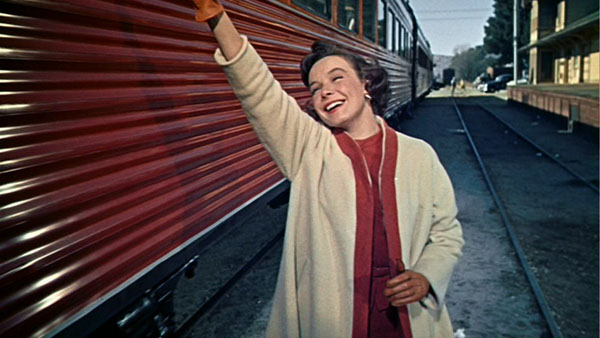
2 minutes, train arrives and happy woman disembarks, film itself “arrives” on the screen too after fluttering about for the first half.
Outer Space
10 minutes of terror, as a girl in a haunted house movie gets brutally attacked by film editing and multiple exposures.
Dream Work
11 more minutes of sheer awesomeness taken from the same film as Outer Space, but not as terrifying.
Manufraktur
Super-multi-exposure remix of some TV ads.
Motion Picture
All light/dark white/black flicker with no distinguishable image, short
Get Ready
A trailer for the 1999 Vienna film festival using PT’s exposure techniques

L’Arrivee:
image

Outer Space:
image

Dream Work:
image


Today (1997, Eija-Liisa Ahtila)
“Today my dad’s crying. Last night a car drove over his dad who died instantly.” First part, Tanaan, a pretty girl tells us about her sad dad. Second part, Vera, an older woman, says some stuff but it doesn’t last long and before I’ve gotten my bearings we’re on to Third part, Faija (dad). First we see grandad lay down in the shadows of a dark road, then the pretty girl’s dad talks about being a dad. Movie wasn’t what I was expecting after sitting through all that Kurt Kren, but it’s actually pretty good, really nicely shot, some kinda associative pondering of three generations (going from the girl to her dad to vera/grandad, back to the dad and girl) maybe? Music by 22-Pistepirkko! Ahtila is Finnish. I found art gallery websites spouting off about her methods, but it’s all fancy-talk for “she tells stories about people.”
image


Alone. Life Wastes Andy Hardy (1998, Martin Arnold)
Mickey Rooney, Judy Garland and Fay Holden are trapped in the moment, rewound, slowed down and turned into robots, their every subliminally sexual movement revealed. I can not watch this enough times… so happy to have it on DVD now.
image


Le Film a Venir (1997, Raoul Ruiz)
Yay, more wacky short fun from my man Ruiz. Black and white and mysterious, once more about hidden meaning and light sources and repetitions, abruptly shifting mood and plot, either surrealistic or beyond my comprehension. I’ve watched it twice and I’m pleased to say that I can’t manage a plot description. More play with narrator voices and narrative shortcuts, like in Hypothesis and Dog’s Dialogue. And Ruiz has a hundred movies – a hundred movies! – to explore. I could not be more excited.
image


Letter to America (1999, Kira Muratova)
Disappointingly not half as wacky as the Ruiz. A dude is being filmed by his friend, sending a video message to new york, but the dude has nothing to say. So dude goes to the place he rents and tries to get some rent money out of the woman staying there. She’s being a jerk about it, but gives him a little money. He wanders back to his video friend and recites a triumphant poem before the camera. Apparently had some Crime & Punishment references I didn’t catch. J. Taubman: “Muratova’s film is itself a letter to America. One of its not so hidden messages is an ironic self-commentary on Muratova’s own situation, an example of what talent can do even in poverty.” She won a $50,000 award in Berlin, which helped fund her next feature. I liked it alright, but rather than seeming like a new cinematic voice, it kinda seemed like an american indie short that speaks Russian.
image

This came right in between the two other Ozu films I’ve seen, around the same time as The Hidden Fortress, Underworld Beauty and Giants & Toys.

Ozu’s first color film (in a very nice looking print at Emory) and the handout told us to watch for the red teapot but didn’t say why. The teapot was often anchored in the corner of the shot, a helpful indicator of which way the camera is oriented in the room. Not too familiar with Japanese traditional housing so it confused me that there was a giant opening on both sides of the living room until I noticed the teapot. That probably wasn’t the intention.

Music is nice for the most part, but turns into an icky music-box score sometimes in the home scenes. Reading what I wrote about Tokyo Story, it says Ozu’s signature line is “it’s a beautiful day”… I remember it in this movie, though I don’t know if it was during the family outing at the lake or another time, because I wasn’t listening for it.

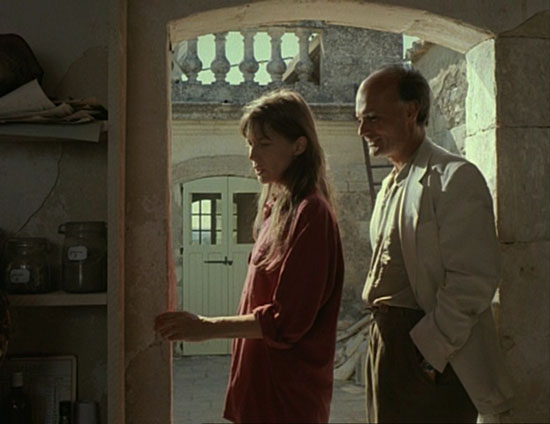
Stars Shin Saburi (from a few other Ozu films) as Hirayama, a man to whom everyone turns for family advice. He claims that happiness for the children is the most important thing, but when it comes to his own oldest daughter (Ineko Arima from Tokyo Twilight, The Human Condition and Late Chrysanthemums) he backs down and refuses to let her marry who she wants. Hirayama’s wife (Kinuyo Tanaka, star of Life of Oharu, Flowing, The Crucified Woman, Sansho the Bailiff) patiently waits it out as he wrestles with his daughter’s decision to marry without his consent, agrees to attend her wedding at the last minute, and finally goes to visit her new home in Hiroshima to make up for having never smiled at the wedding (final shot is his train leaving).

Hirayama’s younger daughter was Miyuki Kuwano, only 16 when this came out, starred in Oshima’s Naked Youth two years later. The family’s giant-mouthed friend from Osaka with health problems, Cheiko Naniwa, appeared in Mizoguchi’s The Crucified Woman. Hirayama’s good friend (whose daughter leaves home and marries against his will, working at a bar which Hirayama visits) is the great Yoshiko Kuga, main guy from Tokyo Story and everything else, appearing in 180 films, 32 of them by Ozu.

Everything works out in the end. Hirayama is on the train, his friend is seeing his own daughter again, and the big-mouthed woman’s daughter is thinking of marrying. All the men have lots of daughters in this film – there’s a theory presented for that, but I think it was just meant for laughs. The scenes at the bar with Hirayama and his employee are pretty funny, too – I’d forgotten that Ozu was sometimes a humorist. Ozu had a co-writer, and it’s based on a novel – not trying to credit the director with every line of dialogue, but he embraced it at least.

Senses of Cinema explains the style: “There are no long takes or are there any very brief shots in his films. Each character’s contribution to a dialogue is delivered in a single shot. This technique is not however, to be confused with television dialogue where one actor looks left to the other actor looking right. Ozu’s performers are centrally placed, looking at the listener, and, at the audience. Between each dialogue scene, there is an establishing shot. These are held longer than establishing shots are in other filmmaker’s works, and they contain very little movement, or if movement is present, it occurs in the distance, often at the junction in a long corridor framed either side by the walls.”

And: “Ultimately Ozu’s films are observational. The Osaka woman may be the most annoying and irritating individual in Equinox Flower, yet she is not judged by the film. Hirayama, in his stubbornness towards his daughter and in excusing himself to escape another conversation with the Osaka woman demonstrates his human fallibility. Ozu easily identifies his characters faults, but he readily understands and forgives their foibles. Along with Renoir, he is one of the great humanists of the cinema.”