At first I read the title like “Alfred Hitchcock Presents…” but now I think it’s more like Christmas presents. PREH-sents. We’ll never know for sure.

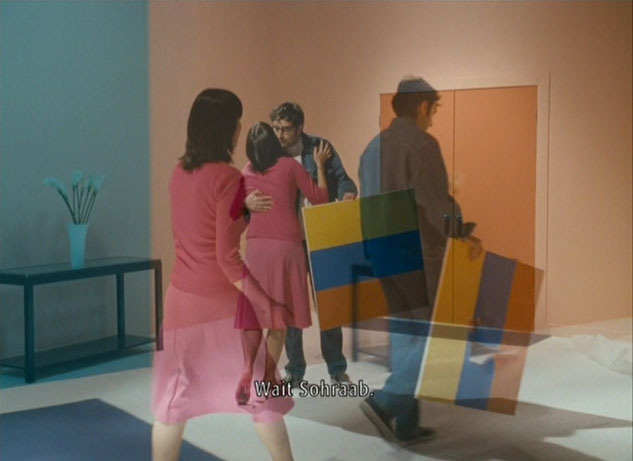
A line sloooowly twists itself into an image of a room with a naked woman on a bed, slooowly twists itself back into a line. The soundtrack is a terrible drone noise and I’m getting worried, watching the time pass on the DVD player face and asking myself whether Mr. Snow would approve if I watched his movie on fast-forward, or at least played some nice music and silenced his drone noise.

Then I was thinking that Snow probably wouldn’t approve of my watching “Presents” at home on a TV with afternoon light from the windows glaring off the screen in the first place. So I’m better off not worrying about it.

image

Suddenly the lines stop mutating into boxes and I cry out loud, “The camera moved! I am in heaven!” but it turns out the camera did not move. The whole set moved on a truck and hydraulic lifts while the camera stayed still. The naked woman gets up and puts on a robe, answers the door and lets in some guy. They look everywhere for something, while a record plays (and scratches and skips because the set keeps moving). Finally she finds whatever they were looking for, and the camera rolls up onto the set housed in some unseen destruction vehicle with a plexiglass front (you can see reflections which I’m pretty sure were not part of my TV glare) and clumsily mangles the set. Finally drives through the back wall, which falls down to reveal sky…

Drum hit!
camera pans down a waterfall
Drum hit!
we are creeping through the underbrush
Drum hit!
camera follows a line of buildings sideways
Drum hit!
I fall asleep.

A few days later I watched a bunch more avant-garde films (shorter than this one) and started P. Adams Sitney’s avant-garde book, then returned to this, beginning when the wall falls and the montage part begins. I fell asleep again! Seen most of it by now, and I get the point, so I am quitting.

The short shots in the montage section continue, camera always panning (note: camera mostly pans, not moves, but there’s clearly some movement in there), one shot cuts into the next with a drum hit, sometimes matching the same motion as the previous shot, sometimes changing direction, but always in motion, imitating the gaze of the human eye, oooh. After an hour and thousands of pans, the last cut is to a pink screen that fades to red then black.

A film camera attacks and destroys a TV set:
image

Don’t have it with me, but in the Sitney book the author says he uses the term “avant-garde” instead of “experimental”, because experimental implies that the artist is still messing around with his technique and doesn’t intend his film as a finished, planned piece. Can’t say that’s true of Presents, which was clearly planned, but it does feel experimental to me in that it’s an “investigation” of camera/eye movement which is actually interesting but I’ve found hard to watch. Snow bemoans that people’s attention spans for this kind of film aren’t what they used to be (hence his time-compressed reissue of Wavelength) and I guess I’m not helping matters by saying I thought this was too long.

Snow says he used a “Quantel analog effect” to stretch and squeeze the image in the first ten minutes.

Distributor calls it “an investigation into representation, process and material and the nature of camera movement.”

P. Monk:

The apparent vertical scratch in celluloid that opens Presents literally opens into a film within the film. When its figure awakens into a woman in a ‘real’ unreal set, the slapstick satire of structural film begins. It is not the camera that moves, but the whole set, in this first of three material ‘investigations’ of camera movement. In the second, the camera literally invades the set; a plexiglass sheet in front of the dolly crushes everything in its sight as it zooms through space. Finally, this monster of formalism pushes through the wall of the set and the film cuts to a series of rapidly edited shots as the camera zigzags over lines of force and moving fields of vision in an approximation of the eye in nature. Snow pushes us into acceptance of present moments of vision, but the single drum beat that coincides with each edit in this elegaic section announces each moment of life’s irreversible disappearance.

S. Liebman:

A major work, even when measured by the standards of Snow’s most impressive achievements. The title is a complex, provocatively ambiguous pun. The first section is a play based on the slipping and colliding senses of the word ‘presents,’ its homonyms, synonyms, and related concepts …. In the last section, assisted by the drum beat accenting each cut, the editing insists on the separateness of each shot and by doing so it constructs a vast inventory of different things and events. This extraordinary concluding montage sequence poses the most concerted and comprehensive challenge to the discourse of presen(ts)(ce) mounted by the film.

M. Snow in a 2002 interview:

Presents has something like three different modes in it. There is pushing and stretching, the tracking of the set, which because of convention you think of as camera movement, but you can see that the set is moving, then there is the smashing up of the set, followed by almost an hour of hand held pans which are from all over the world. Each one the pans is a different reaction to the scene with the camera. So that if the camera was moving in one way you might follow it or if the shape was round you would shoot it in a round way. One of the things I wanted to do was to cut each pan so that there would be no continuity from shot to shot, so they were isolated in time and space as these little instants taken from life. Pans are obviously much different from dollies or tracks. They are a glance. And they also reinforce a certain ephemerality, so there is a sadder aspect to the glance. It is recorded but then it is gone and then there’s another glance and it is gone. So that part of Presents is a particular thing that I have not done that much, a montage of things that have a tremendous variety, not in terms of the world itself but in terms of what you can gather from the world.

“And the third? Where do you want me to put the third rose?”

Starts out like Diving Bell and the Butterfly (man awakens after traumatic accident, can barely communicate in hospital) but ends up like The Shining (our hero frozen to death outside). Has some striking shots and scenes but does not have what those two movies do – a unified look, a consistent tone, a sense of sanity. Coppola veers briefly into Lynch-land then comes thudding back to earth with long dialogue scenes only to pop off again a few minutes later. On one hand, it is always refreshing to watch a movie that isn’t quite like any other because it is nuts. On the other, it is attempting to be a narrative film, to present some characters and tell a story, so I wish it would go ahead and do so. Either it makes a load more sense if you’ve read the book, OR the book is mysterious and ambiguous so the film tries to preserve that.

image

What the movie does right: casting the always awesome Tim Roth (above), being likeably insane, playing with time and memory and sci-fi elements without putting the scenes out of order like everyone else does nowadays (there are flashbacks, but there have always been flashbacks). Opening with classic-hollywood-style credits and closing with a simple “The End” title card. I have to admit that made me happier than anything else.

image

I don’t think the movie was as beautiful as it intended to be. The shot above (captured from the trailer) is very nice, but most of this underlit blueish photography was just sort of dull. Themes of love and religion are touched upon but not tied into the time and language focus of the plot. Whenever the movie wants to get philosophical it gets interrupted and bogged down in more story. Movie is crazy, but it’s Bram Stoker’s Dracula crazy, or Apocalypse Now crazy, an affecting crazy that makes you feel a little crazy yourself, not a stupidly faux-cult sort of Buckaroo Banzai crazy. I wouldn’t want to sit down and watch it again tomorrow, but I enjoy that feeling from time to time. Lots of dubbing. Uneven sound mix. Makes much better use of its Romanian locations than, say, Man With The Screaming Brain did. Uncredited Matt Damon cameo (but he’s in the trailer and the promo stills so it’s no secret).

I’d like to thank the Tara for mis-framing the film AND projecting it out-of-focus. Few people knew this was playing, even fewer cared, and still fewer got out to see it in the one week it lasted… and we had to watch it out-of-focus. This is why it’s okay to watch movies at home on DVD.

Oh, story, let’s see. Tim Roth is 70 years old in 1938 when he’s hit by lightning and nursed back to health by Dr. Bruno Ganz (Hitler in Downfall, one of the angels in Faraway, So Close). Tim starts aging in reverse, can remember everything and learn instantly, has to hide out from nazis during WWII then moves to Switzerland. Remembers his 1890’s lost love, now dead, finds a girl who looks just like her, she gets hit by lightning, starts flashing-back to previous lives in ancient civilizations and speaking ancient languages. This helps Tim greatly since he’s a master linguist writing an ultimate linguistics book which will be a rosetta stone for future generations and teach them something important about humanity which isn’t quite explained. Tim had given up on the book previously, was gonna kill himself when the lightning hit. Anyway the woman (Alexandra Maria Lara, also in Downfall) starts aging rapidly because of her proximity to Tim, so Tim leaves her despite their mutual love, sees her years later married with kids. Tim has been talking to his other self/selves, apparently schizophrenia but one time the girl saw it too. One day (mid-50’s?) young Tim returns to his hometown in Romania and smashes the mirror in which another self appears, then goes to his old favorite bar and is back in 1938 with all his old friends, aged 70 again, a few minutes before he goes out and freezes to death.

image

Must’ve been more spoken languages (real and created) in this movie than any other I’ve seen. IMDB says the first cut was an hour longer… this makes sense. Look for Youth Redux on disc, I guess. Only award nomination was an Indy Spirit for best cinematography, appropriately beaten for the prize by Diving Bell and the Butterfly.

I must’ve missed the line when Tim Roth said he was gonna eat poison that day in ’38. So that’s what he does in the end… that is why he spits blood when leaving the bar. Makes the ending much more Donnie Darko than The Shining.

Note, a few weeks later I’m starting to like this movie more and more. Its age/time/youth themes are obviously deeply-felt by Coppola, and the movie takes the time to explore them during those slow parts, no slave to regular movie pacing. Maybe should be seen more as a Romanian film than an American one. Plus, I mean, it is way crazier than There Will Be Blood or anything else out right now. Gotta see again someday, in focus this time.

Slate: “Coppola, describing his first reading of the Eliade novella that inspired him, has said, ‘I loved the way one darn thing after another kept happening.’ If nothing else, his film has certainly captured that feeling onscreen.”

AV Club: “It’s somehow both incomprehensible and not experimental enough; the more Coppola hangs onto his stilted narrative, the less vibrant his free-wheeling ideas become.”

FF Coppola: “I’m offered projects where there are five directors I can think of who can do it as good, or better, than me. I want to make movies that only I can make. Youth Without Youth, maybe I’m crazy, but I am the only one who would make that movie. It would not be a movie if I had not existed. I was offered Thirteen Days, and I had some wacky ideas about how to do it. But they didn’t want wacky ideas. And in the end, the guy [director Roger Donaldson] did it fine. I want to make movies with the same attitude as if I were going to fall in love with something. And if I don’t, there isn’t enough money on earth to pay me to do it.”

“I think most people today are imprisoned by what they have been told movies have to be.”

Some shots from the ending:

Hedwig-Hansel as Gnosis-Corgan. It’s complicated.
image

That’s songwriter Stephen Trask on the left.
image

Yitzhak unleashed! I will look out for her next time I watch Shortbus.
image

An Emily Hubley moment:
image

edit August 2011:
I finally got Katy to watch this, after five years of trying.
I don’t think she hated it, either.

edit March 2017:
Well, she didn’t like it enough to watch again with Maria.

Norma Shearer won best actress for this part, beating out Garbo and Swanson.

Conrad “Paul” Nagel is an overly-made-up stagy-acting dude, later starred in Tod Browning’s The Thirteenth Chair. Paul broods lamely for Norma the night she gets engaged then drunkenly crashes his car disfiguring Dot, whom he’s coerced into marrying.

Chester Morris, later to star in The She Creature, with black hair slicked down to his skull, is Norma’s new husband Ted, cheating on her with his ex. Norma finds out, Ted tells her it doesn’t mean a thing. So she cheats also. Doesn’t mean a thing, right Ted? They divorce, but Norma learns her lesson and restrains herself from breaking up Paul’s marriage, getting back together with Ted in a new-years-eve finale.

Robert Montgomery, later to star in Lady in the Lake and Mr. & Mrs. Smith, is their comic-relief friend.

Pre-code raciness: divorces and married couples kissing, ooooh. Promiscuity! “From now on, you’re the only man in the world who my door is closed to.” Only reason this movie wouldn’t be rated G today is the car crash scene when Dot’s sister sees Dot’s disfigured face and screams “oh, I hope she dies, I hope she dies!” Terrible!

The sound quality wasn’t too great. Movie is pretty okay, but I expect to have forgotten it by the middle of next week. Ten minutes later the TCM documentary on the Hays code showed all the good scenes from this movie in a quick montage… could’ve saved me some time.

No wonder Oklahoma oilman Ralph Bellamy looked familiar – he was Hildy’s falsely-arrested fiancee in His Girl Friday. Hmmm, also third billed in Pretty Woman fifty years later. And no wonder Irene Dunne did not look familiar – I’ve never seen her before. This is now the earliest Cary Grant movie I’ve seen, and he was already unmistakably Cary-Grant-ish in it.

image

Based on a play (which was previously filmed twice) and partly improvised on-set, a screwball comedy, which is just to say that the storyline is less important than getting the most comic potential out of each moment. I thought it held together pretty well, except for a bit towards the end where it suddenly swerves to have Dunne destroy Grant’s affair with a rich young woman, as if realizing that too much time had been spent destroying Dunne’s own affairs while he was getting off the hook.

Grant and Dunne get divorced but still see each other at nightclubs and on court-ordered dog visitation days. Very suspicious of each other, but still mutually attracted, each tries to break up the other’s real or imagined romances. I can’t tell if the movie is smartly concealing the truth from the audience (is Dunne really having an affair with her music teacher? where was Grant when he claimed to be in Florida?) to keep things tensely ambiguous, or if we’re just supposed to assume that they’re cheating on each other and the movie can’t address it directly because of the hollywood production code. Katy says her grandmother would not have approved of the ending, where the two wait until the clock strikes midnight (signaling that their divorce is final) to get back together (adultery!).

image

Senses of Cinema:

Who else would make the final scene of such a loud screwball comedy as The Awful Truth end as quietly as it does? Compare the film with Bringing Up Baby (1938) or Twentieth Century (1934) – Hawks’ strategy is to go faster, louder, zanier. McCarey, by contrast, slows down The Awful Truth at its climax, startlingly so. The ending, suddenly, is not screwball. This is something deeper, more realistically romantic, than “sophisticated comedy.”

A. Vanneman:

Remarkably, Dunne holds her own, thanks to an excellent script and her own acting. … Classy, yes, very, but not condescending, and very light on her feet. She’s always one step ahead of Jerry, a tantalizing gadfly that never lets him relax into his godlike perfection.

Ralph Bellamy gives us a very nice ride as Dan Leeson, the interloping cowpoke boyfriend from Tulsa. Yes, he’s corn-fed and lives with his ma, but he sure knows how to fill out a top coat, doesn’t he? It’s a very nice touch to make Dan so open and good-natured, laughing with naïve delight at the slightest witticism. “Hey, that’s funny! You know, you’re funny!” How can you get mad at someone who laughs at your jokes? If you didn’t want him to laugh, why did you tell a joke in the first place?

In addition to fine performances from the leads, The Awful Truth shines for its beautiful mingling of verbal, character-driven humor and superbly paced slapstick. The tale of the hats, the fatal mix-up involving Jerry’s and Armand’s derbies, is probably the most elegant hat-play on film, Stan and Ollie gone uptown. McCarey almost seems to be working on a dare — taking the lowest piece of vaudeville shtick, putting it on Park Avenue, and making it work. 10 Nothing is forced; each step in the farce is quite reasonable and sensible on its own — little bits of paper floating randomly together to form a picture of disaster.

image

Leo McCarey won best director at the oscars, but The Life of Emile Zola and The Good Earth beat it for picture, actress, supporting actor and screenplay. Very good movie. Katy liked it too.

Things noticed during this, my third viewing of Peeping Tom and first in a theater:

  • Moira Shearer doesn’t do much dancing – but she does a little.
  • Similarities to Hitchcock’s Psycho with the psychoanalysis of a killer, probably better done here than in Psycho.
  • Written by Leo Mark, my old databases teacher!
  • The girls Mark kills don’t try very hard to get away.
  • Mrs. Stephens (Maxine Audley, Chaplin’s queen in A King In New York) is drunk during her close-call confrontation in Mark’s back room. She is always drunk!
  • Helen (Anna Massey, later in Frenzy and still a prolific actress) has the best “thank you”s that I have ever heard on film. This was her second film, and her first (John Ford’s Gideon’s Day) also featured a serial killer. She is kind of annoying at times, though, like when she sees the lizard on one of Mark’s films.
  • Powell appears as Mark’s father, who abuses Mark in the name of science.
  • The color and cinematography are awesome.
  • The movie is awesome!

Co-written by Maude. Maude!

Husband and wife lawyers defend opposite sides in a legal case of husband vs. wife. Both relationships get pretty rocky during the case. Good movie, and funny, but not a wacky romantic comedy like the DVD box would have you believe.

Judy Holliday is Doris, who shot her husband. She was great in this, later starred in Born Yesterday and It Should Happen To You before her career died thanks to meddling by the junior senator from wisconsin.
image

Hepburn & Tracy. IMDB calls this Hepburn’s last performance before she moved into “middle-aged spinster roles.”
image

Tracy, 13 years after Fury and still a bad-ass.
image

Tom Ewell (The Seven Year Itch, American Guerrilla in the Philippines) is Warren the wounded husband
image

Hepburn with David Wayne as Kip, their obnoxious musician neighbor. He’s sort of an annoying Donald O’Connor. What a sorry choice to play Peter Lorre’s character in the remake of M two years later. Also appeared in Hell and High Water, which I’ve seen twice but I still don’t remember him in it.
image

Jean Hagen as the other woman. She played the comically terrible silent film actress in Singin’ in the Rain.
image

Thought I’d watch some shorts tonight, starting with the Guy Maddin shorts listed in the previous post. Unintentional theme: none of them had any spoken dialogue!

Film (Emend) by Deco Dawson
Crazily-edited scratched, grainy black-and-white silent footage of hands? If I hadn’t already known that Dawson was involved with Guy Maddin (as editor and camera op on Dracula and Heart of the World), I easily would’ve been able to tell.

Film (Luster) by Deco Dawson
image
Same thing, except now it’s a boy shining shoes instead of a woman sewing. Some peephole photography and scary closeups of the bootblack-mascaraed boy. As far as falsely-aged avant-garde films go, this is thankfully closer to Maddin than Merhige, although it’s less captivating than it means to be. Good music.

Din of Celestial Birds by E. Elias Merhige
image
Some Begotten image manipulation meets the time tunnel from 2001: A Space Odyssey accompanied by minimalist music and too much MPEG artifacting. Merhige fans may ask “HOW does he do it?” but I’d like to know “WHY does he do it?” Did jobs dry up after Suspect Zero? Some cool time-lapse of plant life for a second there. Made in collaboration with Haskell Wexler’s grandson. There was a “visual philosopher” involved, ha! The actor who played “son of earth” in Begotten (the dude who gets dragged around by druids through the second half) played “son of light” in this (seen above).

Begone Dull Care by Norman McLaren
image
Handpainted film cut to jazz music, excellent in every way. I could watch this all day. First half is full explosive color, multiple layers, second half starts out all slow white scratch lines and finally gets crazy after a couple minutes.

Bread and Alley by Abbas Kiarostami (his first short)
image
Opens with a prolonged shot of a boy kicking a can down an alley to the Beatles “ob-la-di, ob-la-da”. Boy can’t figure out how to get down the alley without being chased by a dog. Puzzles it out for a long while, follows an old man but he only goes halfway. Finally braves it by himself and accidentally makes friends with the dog by feeding it. No dialogue. A very happy little movie.

The Running Jumping & Standing Still Film by Richard Lester & Peter Sellers
image
A jolly bit of madness out in a field. Not the funniest ten minutes of cinema I’ve ever seen, but worth watching. Some of these guys had a radio program called The Goon Show, which I’ve heard somehow led to this film which somehow led to Petulia and Strangelove and Steve Martin’s Pink Panther remake.

EDIT 2021: Watched The Running Jumping Etc. again in slightly improved picture quality, which didn’t elevate the comedy any – nothing new to report.

Guy Maddin: “My editor John Gurdebeke and I, hoping to release the powerful nectars of remembrance, have attempted to cut the film using a facsimile of the way we visit memories: We skip past the drab routines and the overly familiar events of yesteryear in our haste to arrive at our favorite and still potent recollections; once there, we rock back and forth over the cherished imagery, penetrating its pleasures, like a DJ scratching back and forth over the same sample of music, until we’ve used up what we need from that episode; then we race on to the next greedily consumed tableau of the distant past.” Glad to hear Maddin mention Martin Arnold in the commentary… the above sounds like something Arnold could have written.

The same editor worked on Brand, Dad, Caboose, Winnipeg, but not The Heart of the World, done by Deco Dawson, whose short-films dvd I will have to check out soon.

More bits from Maddin’s commentary below – all quotes are his.

“It’s the only one of my movies that I can actually re-watch with any degree of comfort.”

Louis Negin as Dr. Fusi [below] – cast because he reminded Guy of certain silent actors, particularly a guy who was cut from Greed. Also because of his hands, of course. Appeared in Rabid, played Truman Capote in 54, and returned as the blind seer at the intro/outro of Saddest Music.
image

Amy Stewart as Veronica/The Ghost [bottom screenshot] – “the ultimate child brunette.” She returns in My Winnipeg as a Maddin.

Tara Birtwhistle, replacing Alice Krige who got sick at the last-minute. Wearing “the same cheap wig I had Isabella Rossellini wear a few weeks later”. Tara played Lucy in Dracula, here portraying Guy’s aunt Lil and renamed Liliom, “a name I obviously borrowed from Fritz Lang’s Liliom, not even knowing that Liliom was a male name until I watched the movie after filming this.” On aunt Lil: “I thought I would give her a character in this movie that she never got a chance to be… In real life she’s just a sweet, bridge playing, tea-sipping spinster.”

Melissa Dionisio as Meta [below], “the result of some kinda local star search here”
image

“Sorry for all the blurry intertitles. I forgot to focus the camera. … I usually use intertitles to clarify the plot, but here they seem to be just giving everyone an eye-ache.”

Darcy Fehr, playing “Guy Maddin” [below], appeared in Hospital Fragment.
image

Chas, the impotent patriarch. “I’d been reading a lot of Euripydes, which I devoured like Mexican comic books”.

“That’s my mom, by the way.” [below] She was made to wear blacked-out glasses so she couldn’t see the autobiographical shame on display. “We filmed this scene without my mom really knowing. I have yet to explain it to her”.
image

David Stuart Evans, as semi-evil police/hockey captain Shaky, also appeared in Clive Barker’s The Plague.

Mike Bell as Mo Mott, of course played the engineer in Nude Caboose. Mo Mott is the name of an actual Winnipeg hockey player.

Victor Cowie as Maddin Sr. [below], appeared in Careful and Archangel. “The first actor I ever hired.”
image

Premature Maddin biographer Caelum Vatnsdal (the awesome fake Jesus in Heart) has a bit part somewhere.

“I like it when stories artificially tie up loose ends.”

The DVD also has a behind-the-scenes bit on Brand Upon The Brain! and a bunch of new shorts. FuseBoy, a 2005 short set at a fuse box starring Guy, Shaky, Mo and Dr. Fusi from Cowards. Dr. Fusi’s performance is actually edited in from his audition tape, also included here. Rooster Workbook (aka The Cock Crew), a mental blend of female nudity and roosters, the closest thing spastic Maddin has done to porno (closer than both Sissy Boy Slap Party and Nude Caboose). I don’t know who played the nude girl because he lists 13 actors in the credits. Zookeeper Workbook (aka Maldoror: Tygers) involves a man getting eaten by a tiger and a woman juxtaposed with a dog. Chimney Workbook has a girl welding, bunch of birth metaphors and I couldn’t tell you what else. Somehow related to Rooster Workbook.