More Out 1: intro, story day 1, story day 2

Prometheus Group:

Thomas – Michael Lonsdale, in a couple movies by Francois Truffaut and Marguerite Duras, Resnais’s Stavisky, Bunuel’s Phantom of Liberty, Welles’ The Trial, and some American thrillers like Ronin, Munich, and Moonraker.
img
Leader of the group, friend of Sarah, overall conspirator. Seems in charge for the first half and gets progressively more unhinged towards the end, possibly because of his romantic interest in Lili, Sarah, and/or Beatrice.

Achille – Sylvain Corthay, had small parts in Demy’s Donkey Skin and Rivette’s Joan of Arc. Has a public website and email address.
img

Beatrice – Edwine Moatti
img
Leaves the group towards the end of the movie.

Bergamotte – Bernadette Onfroy
img

Rose – Christiane Corthay
img

Faune – Monique Clément, played Myrtille in Celine & Julie (who was that?)
img

Seven Against Thebes Group:

Lili – Michèle Moretti, from Rivette’s L’Amour fou. Still active in TV and movies, has been in a lot of stuff, incl. an André Téchiné film.
img
Lili leads the Thebes group. She’s one of the 13, and used to be in Thomas’s group before she left and started her own using different techniques.

Quentin – Pierre Baillot, started out in William Klein’s famous 60’s movies, later in Rivette’s Joan of Arc.
img
Wins a million francs on a horse race, which is immediately stolen by Renaud. At the end, when things start unravelling, he’s the only member of Lili’s group to join Thomas’s.

Marie – Hermine Karagheuz, played a nurse in Secret Defense, also in Merry Go Round and Duelle.
img
Sent the letters to Colin? So, a friend of Pierre?

Nicolas – Marcel Bozonnet, also in Rivette’s Joan of Arc and Up Down Fragile.
img
AKA Arsenal, Papa, Théo, Yogurt and others. I think each character calls him by a different name. A real ladies’ man. These two things may be related.

Elaine – Karen Puig
img
The one who tells Lucie when Lili runs off to Obade

Solo Artists:

Colin – Jean-Pierre Leaud, french new wave poster boy, one of my favorite actors, star of Truffaut’s Antoine Doinel series, also appeared in films by Jean-Luc Godard, Agnes Varda, Jean Cocteau, Luc Moullet, Catherine Breillat, Raoul Ruiz, Jean Eustache, Philippe Garrel, Aki Kaurismäki, Olivier Assayas, Bernardo Bertolucci and Tsai Ming-Liang.
img
img
Colin is first credited as “the deaf-mute”. Gets coded messages that lead him around the city trying to uncover the secret group of thirteen. Falls for Pauline (Emilie) and hangs out at her shop.

Frederique – Juliet Berto also played Celine! Also in Duelle and a few Godard movies, died in 1990.
img
img
Along with Colin, one of the two who seem to drive the plot. Steals some letters between members of the 13 and tries to uncover the group and sell the letters.

Conspirators:

Emilie – Bulle Ogier, played Camille (the blonde ghost) in Celine & Julie. Starred in Duelle, Gang of Four, Don’t Touch The Axe and L’Amour Fou, also in Discreet Charm and Irma Vep.
img
Known as Pauline in Paris, has two kids by her lover Igor who has disappeared. Runs a shop in Paris, where Colin meets her. May own the house in Obade, too, so either she or Igor is wealthy.

Sarah – Bernadette Lafont, an original nouvelle vague actress, starring in Truffaut’s Les Mistons and Chabrol’s Les Bonnes Femmes and Le Beau Serge. Has been in a ton of things, incl. Noroit, Ruiz’s Genealogies of a Crime, Malle’s Le Voleur, and The Mother and the Whore.
img
An old friend of Thomas’s, her return to Paris leads eventually to the breakup of the Prometheus group, or at least the abandonment of the play.

Renaud – Alain Libolt, appeared in Army of Shadows and a few Eric Rohmer films.
img
The object of Honeymoon’s affection, ends up dating Frederique after stealing Quentin’s cash and fleeing the Thebes group.

Lucie – Francoise Fabian, title role in My Night at Maud’s and the mother in Secret Defense, among many others.
img
Lawyer, friend of Lili, seems to know everyone.

Warok – Jean Bouise, in a ton of movies I haven’t heard of, plus The War Is Over, Z, and Joseph Losey’s Mr. Klein, which had a bunch of interesting actors in it. Died before the release of his final film, La Femme Nikita.
img
Member (maybe leader) of the 13.

Etienne – Jacques Donoil-Valcroze, co-founder of Cahiers du Cinema, died in 1989. A screenwriter and director from as far back as 1956, played the husband in Le Coup du Berger.
img
Chess player whose letters get stolen by Frederique.

Iris – Ode Bitton
img
Emilie’s nanny

Georges, Pierre and Igor
Members of the 13, mentioned in conversations, letter and phone calls but never seen.

Minor Cast:

Honeymoon – Michel Berto, got small parts in Merry Go Round and Joan of Arc, died in 1995.
img
Frederique’s only real friend, it seems.

Max
Quentin’s son.

Nicolas’s friend
I think her character’s only purpose is for numerology’s sake… she and Max help search for Renaud after the theft, dividing the city into seven sections.

Gian-Reto – Barbet Schroeder, played the guy in the house in Celine & Julie and has a part in Don’t Touch The Axe. Directed Maitresse and some famed documentaries in the 70’s and since the late 80’s he’s been making commercial Hollywood thrillers.

Martin, Chausette, Leonard
Hangers-on at Elaine/Pauline’s shop, trying to start a newspaper or magazine.

Colin’s landlady – Gilette Barbier, had small roles in The Nun and movies by Rossellini, Resnais, Varda and Juan Luis Buñuel.
img

L’ethnologue – Michel Delahaye of L’Amour Fou and The Nun, has small parts in Truffaut and Godard films.
img

Chaussette
img

Lorenzo’s envoy – Stéphane Tchalgadjieff, producer of Out 1. He was somehow still willing to work with Rivette afterwards, producing Noroit, Duelle and Merry Go Round. Also The Devil Probably, India Song, Beyond the Clouds and Eros.
envoy

Le Balzacien – played by director Eric Rohmer
img

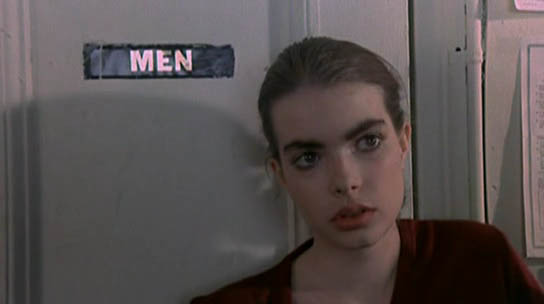
The charactors (actors) and their relationships seem more important than plot/storyline, so I’ve made a page for the characters first, then a story summary page, separated into day one and day two, totalling my most complex journal entry to date!

I spent all this time on plot and character description, not necessarily because the story elements are so important, but because I may not get to see this again and I want to be able to remember it.

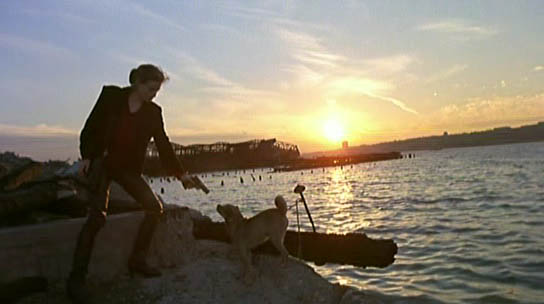
Thankfully, I have a downloaded copy of the movie from Raitre Italian TV, so I can get lots of screen shots.

But what of the movie, overall? Worth the trip to New York to see it, for sure. A total experience of a film, from the dedicated audience to the live subtitles to the 16mm presentation to the museum theater that hosted it to the sheer length and intermissions to the Jean-Michel Frodon (Cahiers du Cinema editor) introduction to the content, with its very long wide shots and very gradually developing story… many scenes that only form a complete big-picure scenario if you’re paying close attention for most of its runtime.

Dennis Lim of the NY Times called it “the cinephile’s holy grail” and says:

In the annals of monumental cinema there are few objects more sacred than Mr. Rivette’s 12 1/2-hour OUT 1. Shot in the spring of 1970, this fabled colossus owes its stature not just to its immodest duration but also to its rarity. Commissioned and then rejected by French television, the film had its premiere on Sept. 9 and 10, 1971, at the Maison de la Culture in Le Havre before receding into obscurity . . . has become a true phantom film whose reputation rests on its unattainability . . . Mr. Rivette worked without a script, relying instead on a diagram that mapped the junctures at which members of his large ensemble cast would intersect. The actors came up with their dialogue; the only thing Mr. Rivette actually wrote were the enigmatic notes Mr. Léaud’s character receives . . . With OUT 1 he found the perfect match of form and content, an outsize canvas for a narrative too vast to apprehend. In a 1973 interview Mr. Rivette described the film’s creep from quasi-documentary to drama in ominous terms: the fiction ‘swallows everything up and finally auto-destructs’.

I love it – not just a legendary museum curiosity that people pretend to like to impress other cinephiles, but actually an amazing film worthy of its reputation. Of course, mostly its reputation is that of an unattainable film (we were told this was the eighth-ever public screening), not of a great masterwork… but I guess it’s worthy of both of those.

The experimental theater exercises get very long, even too long, but not tedious. If a scene lasts “too long” in a regular movie, maybe you could’ve trimmed two minutes to make it feel right. But the theater scenes aren’t necessary at all, from a story point of view, so there’s no telling how long they need to be. When it hits me that I’ve been watching the same theater scene for twenty minutes, it’s not annoyance but awe that hits me. It’s hard to say what exactly is necessary in this movie… once you start cutting or shortening scenes, tying up loose ends and clarifying character connections and histories, you’re talking about a different movie (and not SPECTRE, but a different movie entirely). Best leave it the unwieldy beast it is, and appreciate it as that.

Dennis Lim’s article is a good one… here’s more:

“Out 1” now seems a relic of a bohemian heyday, a time when you could spend your days rehearsing ancient Greek plays or making 12-hour films. But even in 1970 that hazy idyll was already fading. The film takes its shape, as Mr. Rosenbaum has noted, from “the successive building and shattering of utopian dreams.” An epic meditation on the relationship between the individual and the collective, “Out 1” devotes its second half to fracture and dissolution. But it’s not a depressing film, perhaps because its implicit pessimism is refuted by its very existence. Experiential in the extreme, “Out 1” cannot help transforming the solitary act of moviegoing into a communal one.

And Lim says that Rivette’s 2007 movie Don’t Touch The Axe will be revisiting Balzac’s “History of the Thirteen”. “Does this represent a closing of the circle? An expansion of the master plan? If there’s one thing we know from Mr. Rivette’s films, it’s that the big picture will remain just outside our grasp.”

Ah ha: Rivette’s interview from Film Comment… he says shots of Paris’s landmarks “were inserted…frankly as empty spaces. As a kind of visual silence. . .” I had been wondering.

Reverse Shot says: “In Rivette there’s a sense, not just of watching or duration, both of which are passive ideas, but of actively being put through a process”.

Crawford in Reverse Shot:

Out 1 was made in the aftermath of the social uprising of May ’68, when a series of strikes by Parisian student unions devolved into a full-bore confrontation with the military. What once began as a hope to radically reinvent the mores of a stagnant and conservative society ended meekly, with the unions urging a peaceable return to work and De Gaulle’s party consolidating its power to a greater degree than ever. Out 1 taps into this post-May ’68 malaise, betraying an abiding mistrust in grand social movements, services organizations. Paris is turned into a disconnected amalgam of individual groups hermetically sealed off from one another. . .

Is it too simplistic to describe Colin as a spectator’s surrogate and leave it at that? What do we make of choice to pose as a deaf-mute and his return to that state at the end of the film? How, for that matter, do we take of the weird behavior of the male (Colin) and female (Frédérique) interlopers? Their logic and mode of behavior is vastly different from anyone else in the film; it’s like they’ve parachuted in from Céline and Julie Go Boating.

Set in Vienna, 1900, same as La Ronde. My third Ophuls movie, and the third with horse-drawn carriages.

Seems a straightforward old-hollywood love story at first, then seems a lot more grown-up and complex than its contemporaries after it’s over (and especially after checking out the DVD extras which conveniently explain everything so I don’t have to put in much thought myself).

Joan Fontaine lives in the same building as a famous concert pianist and falls madly in love with him. She lives her whole life thinking of him, but only meets him twice… once for a dream date at the end of which she gets pregnant, and again years later in a sad imitation of that date, where she desperately hopes he’ll recognize her, but he just recycles the same lines he used years earlier. She flees again, and as she and their son are dying of cholera, she writes him a letter telling her life story. He stays up all night reading it, forgetting to flee the duel he’d agreed to the night before with her husband. Nice.

Lots of graceful camera movements, one sick super excellent part I didn’t notice until watching the documentary (bottom screenshot) where she stands atop a staircase and watches him enter his apartment with a girl, repeated again later in the movie with the same camera position but with her as the girl. The kind of movie I like somewhat while watching, and like a lot more when it’s over… worth seeing again.

The novel by Stefan Zweig was filmed at least four other times. Ophuls made this between The Exile and Caught during his Hollywood period. The same year Welles made Macbeth, Hawks made Red River, Hitchcock made Rope, and the Italian Neorealist movement was taking off.

Joan Fontaine, star of Rebecca, Suspicion and Beyond a Reasonable Doubt:
image

Candy apple scene:
image

Louis Jordan, also of The Paradine Case, The VIPs, Octopussy and Swamp Thing:
image

Suspicion:
image

Postcolonial Wednesday, part two. Katy loved it because of the important story it tells, but I didn’t like it because it tells the story in the most predictably hollywood manner possible.

When the Hutus (largest group in Rwanda) decide to kill all the Tutsis (rich group that the colonialists put in charge), hotel manager Don Cheadle saves the day! Calls in all his favors from the Belgians and the UN and other Rwandans to protect his family and hotel guests. Goes pretty well for him (with some thrilling close-calls of course)… manages to save 1,000 people from horrible genocide.

Nick Nolte plays the disempowered UN captain who wants to help but can barely protect his own men since he’s not allowed to shoot. Joe Quinn Phoenix is a journalist who’s sent home with all the other non-UN foreigners halfway through the movie.

A really really good story told in straightforward, cliche hollywood movie format. Maybe I’m being too hard on the thing… it’s clearly a must-see movie because of the subject matter, and it’s well acted and well told… but it’s the kind of movie that doesn’t have to be great because it’s a true story about a great man who saved people from death, and how dare you criticize it? I’m just not the target audience for this… with my twin Joe Dante and Jacques Rivette obsessions, this one wasn’t very exciting. It’s probably better than Last King of Scotland, and definitely better than Amazing Grace and Sometimes In April (other rwandan genocide movie katy watched), which are the other new historical hollywood movies watched recently, so I’m feeling pretty good about this one overall. Maybe a 7/10.

Oscar® nominated Don Cheadle:
image

Oscar® nominated Sophie Okonedo:
image

Oscar® nominated Joe Quinn Phoenix (left):
image

Oscar® nominated Nick Nolte:
image

Sad Rwandan orphans:
image

Postcolonial Wednesday, part one. I loved everything about the movie, but Katy didn’t like it because of its colonialist politics.

Based on a Rumer Godden novel, and she was on set during filming. Harriet is a young aspiring poet, who thinks she knows all about India… neighbor Valerie is the daughter of a rich American… and neighbor Melanie is half-Indian with an American father (Mr. John) trying to maintain both her American and Indian heritage. One day Captain John shows up and they all fall for him, though Melania tries to hide it. Oh and Harriet’s little brother Bogey has an unhealthy (and eventually fatal) interest in animals, especially poisonous snakes.

A gorgeous movie, looked great on the big screen. Life/death/love/loss themes throughout, all loosely tied (by Harriet more than by the Indians) to the river. The dream sequence told by Melanie (featuring two Indian gods and some dancing) is so great it even impressed Katy. Renoir movies make me feel more alive.

Harriet’s father, Esmond Knight, was in some Powell/Pressburger movies. Most of the other actors were in plenty of other films, except the nanny “Nan” who was in one more IMDB-credited movie… and Harriet, who never was in another movie, and died from cancer in 1967. Her real dad, a comic movie star in the early 30’s, died three weeks later.

CONTEXT: Jean Renoir made The River semi-independently in India after his Hollywood period (Woman on the Beach, Diary of a Chambermaid, etc) and right before his return to France with the celebrated Coach / Cancan / Elena trio. Came out around the same time as Statues Also DieSamuel Fuller was getting started… Bunuel’s Olvidados, Bresson’s Diary of a Country Priest… some good sci-fi was out in the States… Fritz Lang was making House by the River and Clash by Night and Ophuls had “Madame de…” and “Le Plaisir“.

One of the very best movies of the eighties (forget that it missed the 80’s by six months). A slightly-too-slow buildup places the action in a state-of-the-art technological office building, brings back Billy and Kate, brings back the Futtermans, closes down the shop where the Gremlins came from and puts Gizmo in the hands of corporate scientist Christopher Lee. Then all fucking hell breaks loose and it’s a hilarious, gonzo 45 minutes of action and comedy and movie references. I love it.

Don & Dan Stanton from Terminator 2 with Christopher Lee:
image

Zack and Phoebe Cates, who has gotten cuter since part 1:
image

My favorite gag, again:
image

Hulk out:
image

The electric-gremlin death of Christopher Lee:
image

“I guess they pushed him too far”:
image

A great movie that does not get enough credit. Completely successful as a comedy, a horror, an action/effects popcorn flick, even a kids movie. I’ve loved it since I was 7.

The dog (“mushroom”) is amazing. In the commentary, Joe Dante says he loved the dog and little Corey Feldman, ’cause they were the only two actors that believed the gremlins were real. Apparently the whole production was a puppeteering nightmare, compounded when Spielberg decided (correctly, you’d think) to NOT kill off Gizmo halfway through the movie… hence little cheats in the second half, like carrying him in Billy’s backpack, and having him ride the toy car.

The black man’s the first one to die, of course. Dante fave Dick Miller plays xenophobic Mr. Futterman, who coins the term gremlins for our beasties. Dante wanted to play the old warner WWII cartoon short about gremlins before the feature, but they wouldn’t let him… too bad. Judge Reinhold has a small part, Chuck Jones has a cameo, Spielberg & Goldsmith & Robbie the Robot get cameos, and Howie Mandel is the voice of Gizmo.

Zach, Corey Feldman, and a lotta mogwai:
image

When mogwai go bad:
image

My favorite gag:
image

So you’ve created Godzilla AND Rodan, directed The Mysterians and made almost thirty other movies. Now what?? Well, Mothra, obviously.

When a ship is in trouble (it’s always a ship in trouble with these japanese monster movies) some guys wash up on an island long thought to be empty and used by Japan for nuclear testing. They meet some natives and tiny girls who give them something to drink that makes ’em impervious to the radiation. Neat. Back home in Tokyo, scientists want to know more and set up a team to check out the island.

Amer… I mean Rolisican jerky businessman Nelson leads the expedition and intrepid reporter Fukuda sneaks along without permission. They find the “tiny beauties” (just like in the 90’s Rebirth of Mothra) and Nelson kidnaps them to make money showing off their tinyness and their beauty and their singing to sold-out theater in his home of New Yor… I mean, New Kirk City.

But their song awakens Mothra, who is drawn towards the song like a moth to… well you know. Fukuda and photographer friend Michi and some damned kid team up to return the tiny beauties to Mothra… but not before many, many models are destroyed, usually by being blown down model streets by Mothra’s giant flapping wings.

This director would later make about fifteen more monster movies and end on a high note, co-directing two of Akira Kurosawa’s final three movies.

The director is not to be confused with Kevin McDonald of Kids in the Hall, unfortunately. Maybe McDonald could’ve added some humor to the whole thing.

Not a laughing matter, the movie is an untrue story about a loser doctor (young scot James McAvoy) who moves to Uganda so that he won’t have to work at his dad’s practice. After unsuccessfully trying to seduce older doctor Gillian Anderson out in the country, James meets General Idi Amin Dada, new ruler of Uganda, aka a completely badass Forest Whitaker. James is offered a position as Idi Amin’s private physician, and accepts… gets to see how quirky and odd Amin can be, sometimes very likeable, sometimes killing lots of people in horrible ways. James falls for Amin’s third wife Kay (Kerry Washington of Fantastic Four) and has some sex with her before Amin has her killed. Our man barely barely escapes with his life, escaping on a plane when he’s supposed/about to be killed as well.

Story is pretty straightforward, told from James’s eyes with some drifting short-attention-span camera work. A pretty okay movie with a single towering performance, then, just as the Oscars would have you believe.