Cop Glenn Ford is causing trouble by trying to prove that police-corruption-protected mobster Lagana killed a witness (actually ordered her killed, via lackey Lee Marvin’s lackey). He causes enough trouble that Lagana orders him silenced, but ends up killing Ford’s perfect wife Jocelyn Brando (Marlon’s sister) with a carbomb instead. Whoopsie! Angry Glenn Ford takes it personal and tears down the whole criminal establishment, with the help of Marvin’s girlfriend (who turns on him when he tosses boiling water in her face).

Movie opens with a cop committing suicide beside a letter he wrote to the newspaper exposing the crime-cop corruption coverup. His wife, instead of delivering to the papers, puts the note in a safe deposit box and extorts the gangsters. Lee Marvin’s girl Gloria Grahame (human desire, crossfire, in a lonely place) ends up killing the widow to expose the plot, a cool twist.

Nice, noirish crime thriller. Not the breakout amazing Fritz Lang’s Greatest Achievement that I’d not dared to expect. In fact, after all the movies I’ve seen by Fritz Lang (thirty, more than any other director), I can’t necessarily tell a Fritz Lang film from anyone else’s. That’s where film school would have helped, I guess.

Katy did not watch it.

A movie I definitely need (and want) to see again. Completely beautiful, more striking than any of the three colors movies. It was late and I enjoyed getting swept up in the whole thing, didn’t worry too much about which Veronique was which (I think it was one for a while, then the other), making comparisons to Jean-Pierre Jeunet films, and watching for reflections and refractions in glass(es) a la the Criterion cover art.

Star Irene Jacob was also in Red and Beyond The Clouds, won best actress at Cannes for this one. Cinematographer did Blue, The Scar, Gattaca, Black Hawk Down (hello oscar nom) and the next Harry Potter.

Veronika (Poland) drops dead during her first big singing performance, and her unknowing double Véronique (Paris) feels the loss and quits her singing lessons to be a teacher. Véronique sees a puppeteer who later summons her via a series of mailed clues. Some kind of fate theme, which would tie it to the Decalogue I guess. Storyline seems so unimportant compared to the visuals, the sensation while watching.

image missing

Katy said she liked it but then never mentioned it again.

Interesting from the Criterion essay by Jonathan Romney:
“Kieslowski denied that there were any metaphors in his films… Yet he also confessed that he aspired to those moments when a film manages to escape from literalism. If Véronique spurs us to search for meaning in a maze of fragmentary significations, it is perhaps because Kieslowski made the film in just such a spirit of pursuit, quite simply in the sense of teasing out narrative shape. By Kieslowski’s estimation, he and editor Jacques Witta prepared some twenty rough cuts of Véronique, some more narratively transparent, others considerably more opaque. … Finally, the Véronique we have is one among a multitude of possible versions. It is this incompleteness, this sense of the provisional and arbitrary, that finally ensures the film’s sense of mystery and saves it from the sometimes oppressive weight of narrative authority that finally overburdens Three Colors.”

image missing

image missing

Joaquin “Lucius Hunt” Phoenix is a Johnny Cash impersonator and Reese “Tracy Flick” Witherspoon is this girl who likes him.

Plays like a bullet-point list of Cash’s early career turned into a movie. Right when I said “I thought “cry cry cry” was his first single, not the folsom song”, someone introduces Joaquin by saying “here’s johnny cash, whose new single ‘cry cry cry’ is burning up the charts” or some such thing. So a series of facts mixed with re-enactments of famous events and made-up scenes and dialogue = an uncomplicated biopic of a man whose complicated life deserved better.

Amusing cameos by a decent Jerry Lee Lewis, a totally unconvincing Elvis and a very convincing Waylon Jennings (played by Shooter Jennings). T-1000 plays the judgemental father, and Madge from Prophecy III: The Ascent plays music legend Mother Maybelle Carter, the whole thing lovingly assembled by the esteemed director of Kate & Leopold. Five oscar nominations and three golden globes don’t lie! This is a class act.

Katy loves it.

With no backstory, Kirsten Dunst (Austrian Marie) is married off to the prince of France, Jason “the director’s cousin” Schwartzmann. The two of them soon come to bigtime power when king Rip Torn dies, and run around doing whatever they like. Jason sure doesn’t want any sex with Kirsten, but finally agrees to consummate in order to get everyone off his back about an heir. Kirsten lazes around, has at least one affair and two baby heirs, and ends up with her own custom-made house in a custom-made garden with all her friends and fancy fancy food and clothes. Meanwhile, people in France are poor and angry and something is happening with Austria but nobody cares about that until it’s way too late and the people are storming the castle and beheading people.

Kirsten’s always seeming totally out of her element as an actress finally works for the part, as Marie is an awkward princess who becomes an awkward queen, then once she realizes she can do anything, runs around doing anything. The movie sort of lets her off the hook, because really, she knew hardly anything about her position and had no reason at all to try and find out more. The king apparently had policy meetings but they were kept simple and short (and both of the ones they showed us involved sending money to America, maybe Sofia’s little rebuke for the freedom-fries thing).

Who else? Molly Shannon from SNL is a snippy friend with a possibly fake nose, Asia Argento is King Rip Torn’s slutty & improper (natch) girlfriend, and Alan “Steve Coogan” Partridge is Queen Marie’s ambassador to her family and/in Austria.

Beautiful scenery, clothing, sets, everything… nice low-light photography. Kirsten Dunst is pretty. Fine idea, this whole showing off Marie’s life from inside, as if she’s just a carefree teen who won a neverending shopping spree at the mall. Nicely paced, as Katy says, slow but purposefully so, following Marie’s languorous lifestyle. But the movie never gets around to proving itself necessary or rewarding me for watching it, besides the odd beautiful shot or good use of a Bjork song as mood music. Feels somewhat flat, though I can’t point at just why. Double Life of Veronique a few days later confirmed the feeling… Marie is missing something big. If I knew what it was missing, I suppose I’d be writing this someplace other than here. Katy liked the movie pretty well but feared the hype.

Still my #1 or #2 favorite documentary of the decade (grizzly man? same river twice? farmer john?). Saw Ross McElwee speak twice today. What I learned:

– His movies are all interconnected, which I’d know if I bothered to watch some of them.
– He considers Time Indefinite to be the sequel to Sherman’s March
– was impressed by DA Pennebaker docs but particularly by Fred Wiseman’s Titticut Follies, which he said made him want to make docs, but not the same way as DA and Fred… example of the crazy naked man staring back at the camera, put a human face behind the camera so it’s not as much a weapon (my words)
– tries to capture these little moments of feeling, of humanity in each picture. Showed us a scene of a mechanic discussing his daughter’s death, Ross says he once tried to find the exact frame where the man’s face flashes, changes, but he couldn’t find it. “The moment must have been between the frames”.
– question whether he’s considering the film, the big picture, while filming each small scene, he says “even while you’re having these conversations about life, death and god, you have to be thinking ‘how am I gonna edit this?'”
– Ross was once fired by Miramax (apparently, The Six O’Clock News deals with this)
– says his future films will have more old footage juxtaposed with the new stuff, will deal more with memory and pictures and how time and preservation change things.

image missing

Favorite bits are still the film scholar wheeling Ross around (says he showed the movie to a group of self-important film scholars and they *howled* at that scene), the little revelations and plot twists, the cousin’s house of memorabilia, the beach / fish rescue ending.

image missing

Ross films himself walking across a yard, pumpkins in the foreground, garden sculptures behind, with a little dog yapping at his feet. The dog has ruined his shot, the shot of himself contemplating all that he’s learned, so he gets rid of the dog and does the shot again, self-consciously narrating these facts and including both versions in the final film. That’s one of my favorite documentary scenes… the part where the narrative stops, and he reminds us that he’s making this movie, that we’re watching a movie that he made… it’s not Life Exactly As It Happened, it’s not The Pure Unedited Truth, it is Ross’s movie and he shows and tells us everything through his own filter. It’s a creation, a film, like The Godfather or Rushmore, a work of mostly non-fiction, but still a valid creative work. And usually, USUALLY (see: American Movie?) the minds behind this work are more important than the subject matter. Gotta remember that the next time I’m tempted to see dreck like Enron or Gunner Palace. Ross is my hero.

image missing

Jean Gabin is Pepel, lifelong thief, lives in a shifty boarding house, likes his girlfriend’s sister. Girlfriend’s dad owns the place but doesn’t enjoy it one bit. Along comes Louis Jouvet as The Baron, or ex-Baron, as he’s fired from his post for unpaid gambling debts as soon as he’s introduced. Pepel met the Baron after breaking into his house, and they become good friends at the boarding house. But life is hard: the resident poet kills himself and Pepel gets into trouble when the old man dies in a fight. But in the end, Pepel gets off easily, wanders into the sunset with his new girlfriend, and the Baron stays behind.

image missing

image missing

Leave it to Renoir to turn a bitter, harsh reality-check on the “lower depths” of humanity into actually a pretty upbeat and hopeful movie, if you look at it a certain way. Enjoyed it pretty well… more than La Bete Humanine for the most part. Will wait for further comment till I see the Kurosawa version. Katy did not watch it, but I’m sure she wanted to.

image missing

image missing

Katy would not have liked it. Not sure that I liked it. But at least I watched it, and now I don’t have to watch it again.

Details so that I won’t have to watch it again:
– Ringo Starr doing a fake interview show dressed as Frank Zappa
– Zappa on drums once, guitar a few times, but mostly absent
– the main guys bouncing delightedly through the movie were Flo & Eddie (?)
– some kind of devil/tempter keeps offering people dumb stuff if they’ll sign in blood
– groupie girls show up from time to time
– ten-minute animated dentist duck segment right in the middle
– Jimmy Carl Black sang “Lonesome Cowboy Burt”
– most of the music/concert scenes were really good
– lots of video (not film: video) effects. Lots. LOTS.
– some kind of druggachusetts episode where the effects were just off the hook

Not a “good” movie by any means, but interesting to see what those guys were up to. Will have to check out the footage from Uncle Meat sometimes, cuz that’s another double album that never made much sense.

Addendum March ’07: after seeing parts of this movie again while working on the DVD project, I like it a lot more. The music, the centerville segment, the endless self-referentiality of it all work together well. Gotta cut it some slack too, after watching the doc and reading about the mess of a production it turned out to be. I even like the soundtrack better now.

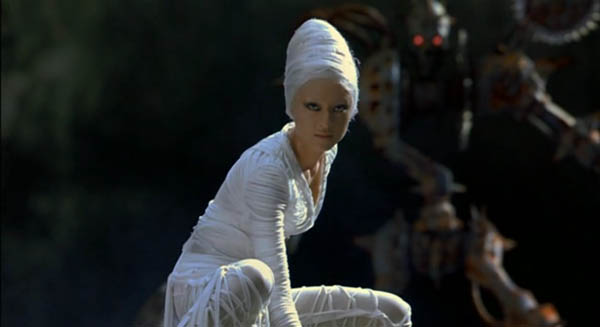
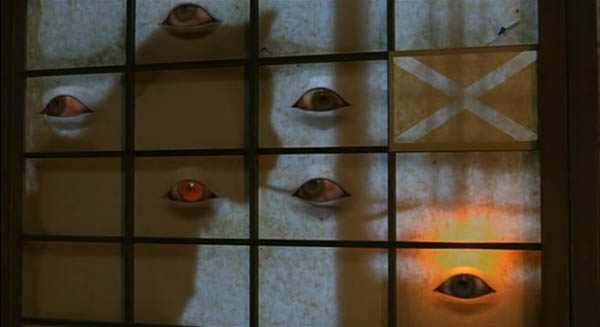
Takeshi Kitano plays sort-of-himself, a superstar gangster actor. But mostly he plays a beat-down loser wannabe actor who keeps failing auditions for small parts on TV shows. His neighbors laugh at him, and he works at a convenience store. But one day a real gangster hides in the store then dies in the back room, and the loser Kitano finds himself with a Falling Down-style bag full of guns… goes on a mighty rampage. Or does he? Dream sequences and fantasies are flowing in and out of the picture.

image missing

There aren’t as many Kitanos as I thought there’d be, and the whole thing made more sense than I thought it would. Lesson learned again and again: when everyone says a movie is difficult and confusing, that don’t necessarily make it so.

image missing

As usual, The Internets come in handy here. A couple weeks later, I saw the dvdbeaver review with a ton of great screen shots… really a great looking movie, full of signature Kitano setups, but I was too busy following the story and reading subtitles to notice at the time.

image missing

Rotterdam Film Festival calls it “a mocking, almost surrealist film about the star Kitano, his oeuvre and his failed alter ego”.

Trivia: Tetsu Watanabe the noodle cook was in Fireworks and Sonatine, Kitano’s friend Susumu Terajima was in Brother and Fireworks and everything else, and the manager & taxi driver was Ren Osugi, the chief from MPD Psycho.

image missing

So two approaches. I’m tempted to consider this viewing a test run, this writing a rough draft, and sit down with all of Kitano’s films, watch or rewatch them, then see this one again to catch more of the references. On the other hand, even though it’s an extremely self-referential film, I know the Kitano persona well enough to get the overall joke, and I enjoyed watching this… why not take it on its own merits instead of turning it into a study project? Kitano’s films are all worth re/watching anyway… maybe I’ll get to ’em after my upcoming Seijun Suzuki fest.

image missing

In the meantime I’ll have to say I liked this one more than I thought I would… it pretty much made sense, and looked great.

A thorough viewing of the second disc of my favorite DVD set in the world this weekend. Some thoughts:

I do not know how to talk about Brakhage. Mostly on this site I talk about story, quality of performance… how do I talk about a non-narrative motion painting? Don’t have the background or vocabulary for that.

Cat’s Cradle and Window Water Baby Moving are early ones with actual camera shots of actual things. The editing of Window Water is entrancing.

Mothlight will be great forever. I’ve watched it twenty times now.

Then, chronologically, came Dog Star Man and Act Of Seeing, which I haven’t watched yet because I am afraid of them. The scariest nightmare I’ve had in a decade resulted from falling asleep during my only attempted viewing of Dog Star Man, and if Window Water is so attractive and disturbing, I can just not imagine how my stomach will feel after viewing The Act Of Seeing.

Eye Myth (a nine-second film) took a year to complete because Brakhage had to convince himself that it could be done, had never done a hand-painted film before. Mothlight was almost a decade earlier, but I guess Eye Myth was a big step. I’ve watched it a ton of times just because I can.

I’m not so wild about the visuals of The Wold Shadow (painting on glass over a view of the forest) or The Stars Are Beautiful (creation myths with shots of home and chickens with sync sound) or Kindering (kids at play), but then The Dante Quartet and Rage Net hit hard… some of my favorites of the painted films.

Black Ice and Delicacies and Study In Color are creepy. The screen shots below reveal nothing about those two. The Dark Tower is always a favorite. And I don’t remember ever seeing Commingled Containers before so I watched it three times. Can’t understand what it is, what those things are, what is happening. Something in a stream? What are “containers”? Beautiful, of course. That applies to all of the above… beautiful, beautiful, blah.

Need to read Brakhage’s book(s), to read Fred Camper’s writings, to read the DVD liner notes again and listen to the interviews with Brakhage on the discs. But I don’t expect to learn much that will gain me a deeper appreciation of the films… they need no explanation.

Matt Stone and Trey Parker were Brakhage’s students. He acted in Cannibal the Musical and loved the South Park movie. Incredible.

Katy did not watch it. I’m afraid to show her any Brakhage. What if she doesn’t love it? How will I explain or convince?

A barrage of screen shots.

Cat’s Cradle
image missing

Window Water Baby Moving
image missing

Mothlight
image missing

Eye Myth
image missing

The Wold Shadow
image missing

The Garden of Earthly Delights
image missing

The Stars Are Beautiful
image missing

Kindering
image missing

I… Dreaming
image missing

The Dante Quartet
image missing

Nightmusic
image missing

Rage Net
image missing

Glaze of Cathexis
image missing

Delicacies of Molten Horror Synapse
image missing

For Marilyn
image missing

Black Ice
image missing

Study in Color and Black and White
image missing

Stellar
image missing

Crack Glass Eulogy
image missing

The Dark Tower
image missing

Commingled Containers
image missing

Love Song
image missing