The large family house still stands, where once lived two parents, two sons and a daughter (now grown with children of their own), and one best friend who often visited. They’re all somewhat miserable now, especially the daughter, a playwright who never smiles. The family reconvenes for the first time in years (after one had been banished for a time) in the big house because of a life-threatening illness. Old problems re-emerge, along with some new ones, and there’s a secret love affair involving the best friend. BUT ENOUGH ABOUT THE ROYAL TENENBAUMS, here’s the acclaimed new holiday picture from the director of the even-more-acclaimed Kings and Queen.

An IMDB review of K&Q calls Arnaud’s earlier 1996 drama “a rambling, shambling, thoroughly engaging 3 hour trip through the lives of a group of rambling, shambling, lost characters, made by a director looking to pour as much raw life into a film as possible and let the rest sort itself out. He has no interest in a well-knit story.” The same goes for this one, much to Katy’s frustration. This is roughly the same kind of movie as Happy Go Lucky, but instead of following the quirky life of one main character for two hours, we’ve got ten main characters for two and a half, so obviously we come away with less depth from anyone here than we did with Poppy in H-G-L – another Katy complaint. I liked the movie a fair bit. It’s an engrossing family sketch with great performances and no big scripted moments, fake-sounding climactic speeches or tidy resolutions, and the filmmaking was spot-on, tracking skillfully between a hundred different people and events (and featuring a hundred different music styles), cutting quickly without every becoming wearying or losing the threads of things. But then again, the Traumatic Family Drama isn’t really my bag, and while I’d happily watch this again over Rachel Getting Married (our last big family trauma film similarly featuring lots of shaky-cam cinematography), I’d even more happily forget both of ’em and sit through another show of Happy-Go-Lucky (or, ahem, The Royal Tenenbaums).

Junon (Catherine Deneuve, last seen in A Talking Picture) is sick (not visibly), needs marrow transplant. Her jolly, supportive husband Abel (Jean-Paul Roussillon of Same Old Song) rigorously calculates her chances of survival. Hot-tempered middle child Henri (star Jean-Do in Diving Bell and the Butterfly), eventual marrow donor, bounces around with his new girlfriend Faunia (Emmanuelle Devos, star of La Moustache and Read My Lips) joking around and getting people upset at him. Tormented oldest child Elizabeth (Anne Consigny, Jean-Do’s dictation assistant in Diving Bell) tries to protect her schizophrenic, suicidal teen son Paul, usually without the help of her husband Claude (Hippolyte Girardot, intrusive downstairs neighbor in Flight of the Red Balloon). Meek youngest child Ivan (filmmaker and regular Raoul Ruiz actor Melvil Poupaud) hangs out with wife Sylvia (Chiara Mastroianni of Love Songs and Ready To Wear, daughter of C. Deneuve and Marcello M.) and their two kids, and best friend/cousin/painter Simon.

Whew. So having introduced the characters, here’s where I lay out their story arcs and intersections, but I can’t think of a whole lot of those. There’s some to-do about Paul, a potential marrow donor, and whether his mental state is up for it. Junon and Faunia go shopping. Sylvia sleeps with Simon, in one of the only forward plot developments.

Easier to list are things the movie brings up which are not fully explored (or only barely). The childhood death of a sibling (who also needed a marrow transplant). Why Liz went from tolerating her brother Henri to hating him. Ivan’s reaction to catching his wife in bed with his cousin. And so on… but maybe it’s all comprehensible in hindsight, removed from the kinetic hustle of the movie. Take Henri’s Jewish girlfriend Faunia: a veiled attack on his possibly antisemitic mother, with whom he’s had a bitter history, plus, as an outsider who has never met the family, a window for the audience into the family home, someone for whom old family frictions can be described without the movie having to resort to narration (although it does – main characters talk to the camera), her outsider nature reinforced by her Jewishness on Christmas eve (she goes home before the day). Hmmm, that actually wasn’t so hard.

Shot by Eric Gautier, an impressive Assayas and Resnais D.P. who also did Into The Wild and Gabrielle. References include Shakespeare, Emerson, Funny Face, The Ten Commandments, The New World, and Angela Bassett’s ass.
Bing Crosby quits his NYC singing/dancing team with Fred Astaire (eight years after The Gay Divorcee, his head and hands still cartoonishly large) and moves to Connecticut (another CT christmas movie) to open the Holiday Inn, where he can goof off 350 days a year, and put on spectacular shows for each holiday with a custom-written song (incl. White Christmas, Easter Parade). When the girl (Charlotte NC native Virginia Dale) whom Fred stole from Bing leaves town to marry a millionaire instead, Fred invites himself to the Inn and tries to steal Bing’s new girl Marjorie Reynolds (later in Lang’s Ministry of Fear). Lots of singing and dancing ensues, Fred gets the girl and takes her off to Hollywood to make a film about the Holiday Inn (featuring the inn sets we’ve already seen, but with all the lighting now visible – it’s the most meta movie of 1942!). A few holidays later, Bing builds up the guts to ride down there and steal her back – plus V. Dale shows up again, so now everybody’s got a pretty girl, and happy holidays and remember to buy war bonds.

The movie obviously won best song for the bestselling single of all time White Christmas, but lost a writing award to 49th Parallel. Irving Berlin would return with Easter Parade in ’48, and White Christmas (which I didn’t like as much as Holiday Inn) in ’54. Sandrich would die four years later in the middle of filming another Berlin/Astaire/Crosby musical, Blue Skies.

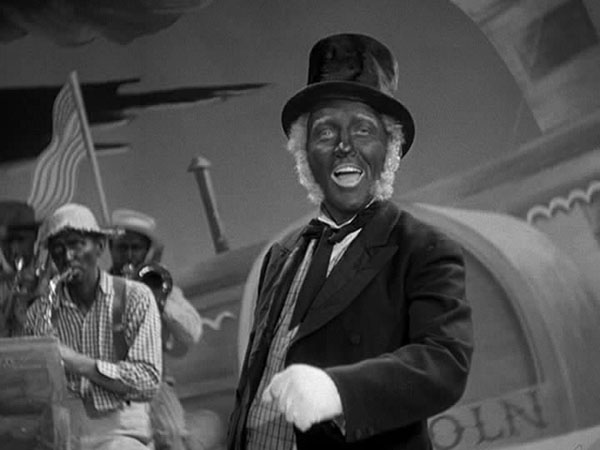
Bing Crosby, in between Road movies, celebrating Lincoln’s birthday:
image

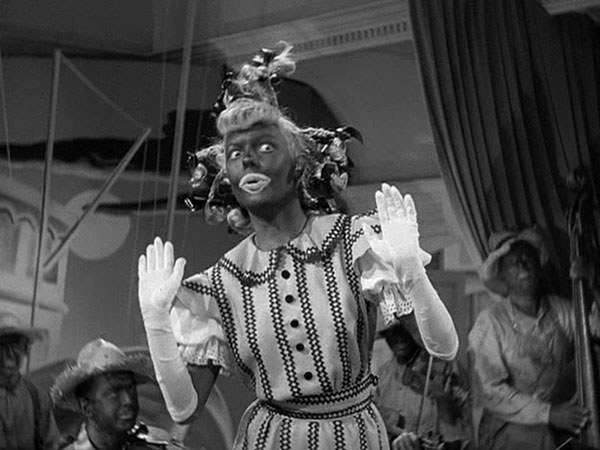
Object of affection Marjorie Reynolds:
image

Actual black person Louise Beavers appeared in Freaks a decade earlier, and would become one of the first black sitcom stars a decade later.
image

Three movies that I’ve never heard of, all Christmastime classics if Robert Osborne is to be believed. Nice to see Primal’s new open (featuring myself) introducing them.

The Bishop’s Wife (1947, Henry Koster)

Robert Osbourne tells us before every single movie on TCM that the studio wanted to get Cary Grant. With every 1947 picture to choose from, you’d think he could’ve livened up Unfaithfully Yours, starred in Moonrise or cameoed in Key Largo, but instead he did this inert religious drama with David Niven (a year after Niven appeared in P&P’s probably much better angel drama A Matter of Life and Death). Niven is a bishop with pretty wife Loretta Young (of Man’s Castle, also costarred with Niven in Eternally Yours). She misses doing nice romantic things with her husband, going out to eat, seeing old friends, so when actual angel Grant shows up, in addition to helping the bishop with his church work, he starts treating the wife right and falling in love with her. In the end it turns out he’s sabotaging Niven’s attempt to build a grand cathedral, and getting the lead sponsor (Gladys Cooper, Henry’s society mom in My Fair Lady) to invest in smaller, less gaudy charities instead. A real rogue prankster of an angel, he also inspires their lonely professor friend to start writing his long-delayed history book and gives him an infinite bottle of port.

Nominated for best picture and director, but twice beaten by Elia Kazan’s important issues drama. From the director of Harvey, another movie with a Hitchcock star and an imaginary friend. Movie seems to rely entirely on Grant and a few “miracle” fx tricks for charm, otherwise full of draggy scenes and dull dialogue.

Christmas In Connectitut (1945, Peter Godfrey)

Updated: here

Another romantic comedy based on a Big Lie, Barbara Stanwyck (post Lady Eve and Double Indemnity, lacking the fire and energy of either of those) writes a newspaper column where she’s a perfect CT housewife and mother full of amazing recipes. Her editor (Casablanca’s Sydney Greenstreet, big guy) invites himself over for Christmas, so she fakes it by borrowing a house and a baby from a dapper dullard (Reginald Gardiner of The Great Dictator) and inviting her master chef buddy Felix (Hungarian Cuddles Sakall, also in Casablanca). Also over for dinner is hot young WWII hero Dennis Morgan (of Affectionately Yours & The Return of Doctor X), who makes his desire for Stanwyck and her fake life known by meddling in simply everything and being overall a nuisance houseguest. It’s all seen as good and romantic though – after all, a guy who enjoys changing diapers is a real catch – and after the Lie falls apart, Barbara barely avoids marrying the dullard and snags Dennis instead.

Director Godfrey made a nazi shock drama starring Peter Lorre the same year. Despite having the least interesting plot of the three movies, this was the best written, and Cuddles Sakall steals every scene he’s in, very friendly to everyone except the big boss, whom he calls “fat man”, conspiring to ruin Barbara’s secret wedding to the dullard so she can end up with our hero.

Holiday Affair (1950, Don Hartman)

This one raises the stakes a little. Janet Leigh, just two years into her film career, has a real kid (not fake babies like Barbara Stanwyck), and a real threat to her happy, stable relationship (not a horny angel like Cary Grant) in the form of noir hero Robert Mitchum. Working as a secret comparison-shopper for a rival department store, she accidentally gets Mitchum fired. Forced into near homelessness without a job, he doesn’t whine about it, instead takes the opportunity to stalk Janet before departing to pursue his dream job of building sailboats. Janet tries to convince herself she’s happy with her extremely boring long-term guy (Wendell Corey, Stewart’s buddy in Rear Window, costar of The Furies), whom her little boy dislikes, but eventually she falls for our Mitchum. There’s some junk about an overpriced toy train which she buys for her store, then returns, then he buys for the boy, then the boy returns to give the money back to Mitchum when he finds out Mitchum is broke. It’d be a decent subplot if the kid himself (also in The Narrow Margin a few years later) hadn’t been unbearably crappy.

Don Hartman was writing Hope/Crosby Road movies before he followed Preston Sturges into directing. This was the middle of his five-year directing career. No word what he did after (besides die in 1958). Movie is full of arbitrarily placed mirrors and stupid framing (there’s a joke about a girl roller-skating on the ice rink, but her skates are blocked from view by a park bench), but is pretty watchable just for our two stars.

All three movies got 1990’s remakes: Holiday Affair made for TV from the director of Police Academy 5Bishop’s (Preacher’s) Wife from Penny Marshall starring Denzel and Whitney… and Xmas in CT from director Arnold Schwarzenegger (his only film) with a cast too baffling to list (plus a rumored 2009 remake with Jenn. Garner).

Watched the DVD version – the reissue with Chaplin’s score and a little song he sings over the opening titles. This came between The Gold Rush and City Lights, same year as Steamboat Bill Jr. and The Cameraman, Lloyd’s Speedy, and the first Laurel & Hardy shorts.

Cute movie. Katy liked it because she knew exactly how long it would be. Charlie/Tramp has a run-in with a thief, ends up with a rich dude’s wallet. Chased by cops through a funhouse (featuring the hall of mirrors), runs right into a lame, tired circus and makes the audience laugh for the first time in the show. Hired by the ringmaster (the steel company president in Modern Times) as a clown, but does the routines just as sadly as everyone else, only funny when he doesn’t mean to be – so he stays on as a prop guy while secretly the hit of the show. Meanwhile, ringmaster’s daughter (Merna Kennedy, who retired 6 years later when she married Busby Berkeley), object of affection (and parental abuse), falls for the tightrope walker (played by Chaplin’s assistant director). Charlie does a tightrope act of his own (involving monkeys!) to impress the girl, but when they’re both fired he hooks her up with the tightrope guy in order to get her accepted back into the circus, then Charlie lets it ride off to the next town without him. My favorite bits involved CC trapped in a lion cage, and pretending to be an automaton conking the thief in the head to avoid police.

Movie won an honorary “versatility and genius” award at the first Oscar ceremony.

Three from A. Vanneman:

1. “The darkness and despair that are the flip side of the artificial glamour and gaiety of the circus have been a potent symbol in art at least as far back as the haunted pierrots of Watteau. The classic film version is the classic of classics, The Children of Paradise. The fifties brought more treatises on three-ring existential despair, Bergman’s Sawdust and Tinsel and Fellini’s La Strada.”

2. “The shots of a 38-year-old Chaplin 40 feet off the ground with no net and no wire are not faked.”

3. “The Circus is the only Chaplin feature that has an unhappy ending.”

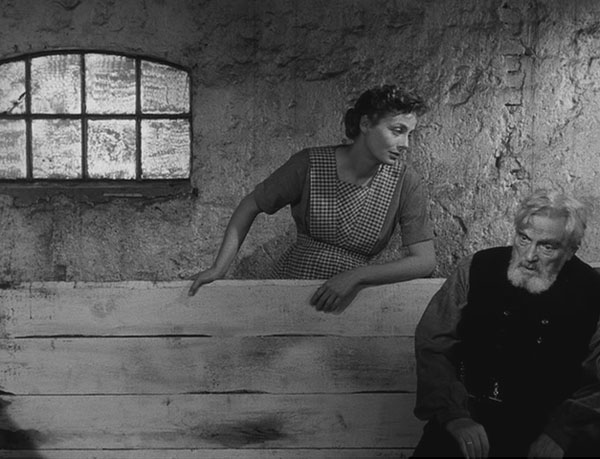
Proud father of three Morten Borgen has carved out a name for himself in the community. A devout Christian farmer, his beliefs differ somehow (I wasn’t exactly sure how) from those of the local prayer group and he’s trying to win more converts to his side. His son Mikkel’s wife Inger, the only woman of the house, is a mother of two with a third on the way.
image

Son Johannes was supposed to be a religion scholar, but he had a terrible time with Kierkegaard and lost his damned mind, now walks the house claiming to be Jesus Christ when he isn’t wandering the countryside lost.
image

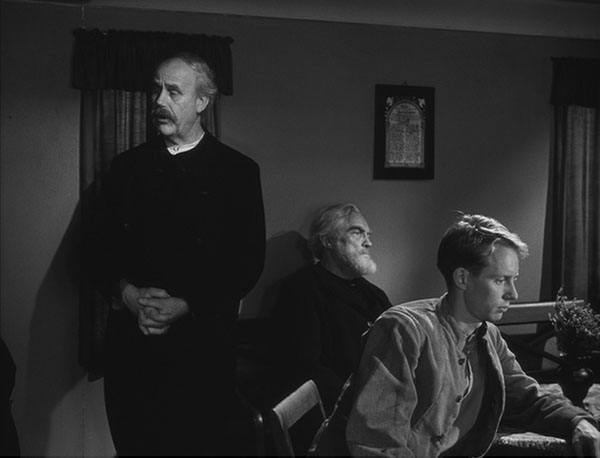
Youngest son (right) Anders wants to marry the daughter of Peter Petersen (left), leader of the town prayer group, but he’s disallowed because of the two older men’s religious feud.
image

When Inger’s pregnancy is suddenly in trouble, Peter wishes her death.
His wish is granted.
image

Johannes reappears mid-funeral during a reconciliation of the two stubborn men, who put aside their differences of belief so their children can be together. In front of the men, the kids, the doctor and Inger’s atheist husband Mikkel, Jesus-Johannes raises Inger from the dead.
image

Movie is set in 1925, so only the doctor has a car. Moves rather slow, glad I had some coffee in me. Didn’t seem like my thing for a while – flashbacks to Gertrud, a movie I didn’t get – but an hour later I’ve gotta admit it’s one of the most beautiful works of cinema ever made. Just look at these fucking stills. I’m sure there’s more reading I could do, tons and tons of articles written about it, but I’m gonna skip ’em and let it stand for itself right now.

Same director, writers, cast & composer (Craig Wedren!) as Wet Hot American Summer – but also the same as The Ten – so this could’ve turned out a beloved favorite comedy, or something worse than My Name Is Bruce. Instead it took the middle road, sort of a Richard Linklater’s Bad News Bears sort of thing – a nice, but somewhat generic and forgettable comedy about troubled adults trying to mentor troubled kids.

Two kinda-famous comedy actors play a total slacker and a dude with anger issues who work as energy drink reps. After they fuck that up, their community service is to be big-brother types to two boys, boobies-obsessed foul-mouthed young black kid and live-action-role-playing bully-magnet older white kid. Lessons are learned, lots of State alums show up, angry dude gets his girlfriend back, roll credits.

A decent way to pass the time. Made me laugh. Oh man I just found out David Wain has his own TV series. Why’s no one tell me anything?

I suppose this was probably just as bad as Man With The Screaming Brain, but for that one I was in the theater, forced to contemplate its obvious, unfunny crappiness on the big, big screen surrounded by unquestioning fans who just came to get an autograph. This one I could half-pay attention to while searching the internet for Silkworm bootlegs, a much better idea.

image

Not even half as good as Maniac Cop, which kinda sucked, this stars Bruce as the cult version of himself (washed-up loser asshole with huge ego). He’s kidnapped from the set of his latest awful horror sequel by an obsessed fan who wants Bruce to save his small town from a resurrected Chinese warrior demon, which he sorta does, even though the kid awoke the thing himself by stealing some stone that he doesn’t think to just put back. Bruce is an anti-hero throughout, killing townsfolk with his cowardice and incompetence.

Ted Raimi plays a bunch of characters, including a couple offensive stereotypes:
image

Directed, of course, by Mr. Campbell, along with the writer of Time Cop, producer of Barb Wire, and cinematographer of Command & Conquer (the videogame series!), and a bunch of actors whose secret hopes that this would be their big break into the movies were surely dashed when they saw the premiere.

December 2008:
Watched again on video, and it only gets better. Five (five!) commentary tracks to go, and two discs full of extras, wooo!

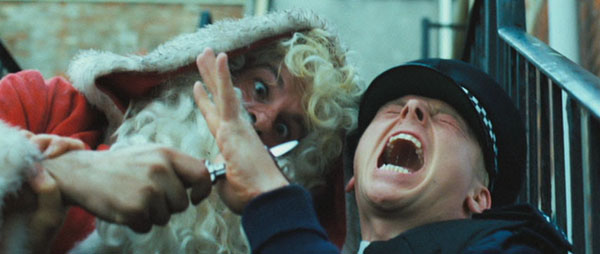
Peter Jackson as Father Christmas:
image

image

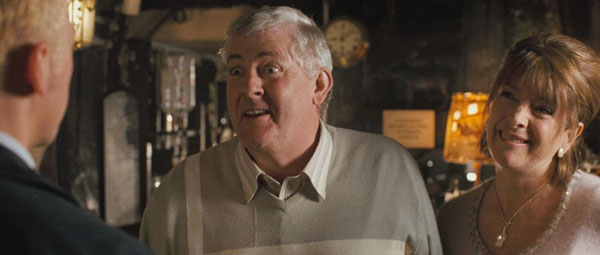
Marsha from Spaced:
image

image

image

March 2007:
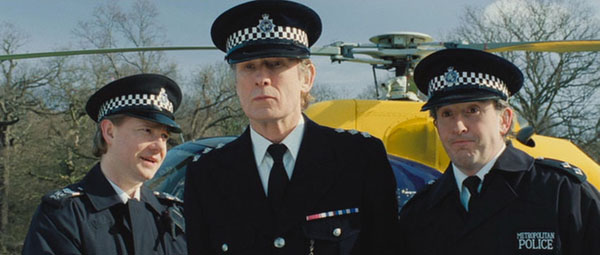
The trailer set it up right – supercop Simon Pegg is making the department look bad in comparison, so he’s shipped to the safest small town in England and paired up with lazy son-of-the-chief Nick Frost. All is well until the town elders turn out to be involved in a Wicker-Man-like conspiracy to beautify their town by any means possible (usually murder). Very suddenly it turns into an all-out war, with the police dept. (minus the evil chief) and Simon and Nick (or Shaun and Ed, as I still think of them) against the neighborhood watch.

Extremely funny and a great action flick. Nothing much or bad to say about it. The crowd gave big response to particularly gruesome killings, the jump kick to an old woman’s head, and Bill Nighy. Edgar says they were happy to be working with an ex James Bond (Timothy Dalton) and three oscar winners in this one (Cate Blanchett, Peter Jackson and Jim Broadbent, the former two uncredited). Such a very fun movie, this and Grindhouse have put me in the mood to watch less serious-minded movies, hence the appearance of Saw 3 on this page.

Immediately after watching Milk, I unaccountably wanted to watch something else featuring Diego Luna, who was the worst part of Milk. Not necessarily his fault though, and he’s been great before (in Y Tu Mama Tambien and Criminal) so I thought I’d give him (and hated Nashvillian Harmony Korine) a second chance.

image

Here he’s a Michael Jackson impersonator who meets a Marilyn Monroe impersonator. She takes him to her commune retreat, staffed only by other celeb impersonators, including her abusive cheating husband Charlie Chaplin and their cute daughter Shirley Temple. Meanwhile in an entirely different movie, Werner Herzog is a priest who airdrops supplies to people in need. One of his nuns accidentally falls out of the plane and lands unharmed. A miracle is proclaimed, and all the nuns start skydiving without parachutes and landing unharmed.

image

And that is good enough for me. That storyline (provided it’s done well, which it is) combined with moments of euphoria (MJ’s dances with sfx but no music, the camerawork on the falling nuns) is good enough. Korine is redeemed, Luna rises above being the crazy, clingy boyfriend in Milk, lovely Samantha Morton is freed from the dour prison that was Synecdoce New York, and all is well.

image

Of course all is not well, exactly. Why does Werner annoyingly repeat everything he has just said? What is the connection between the nun bit and the impersonator bit? How come Michael is so easy around others and never seems all that lonely?

image

I enjoyed it and didn’t worry too much about the questions above. Katy only watched the first half, which was all setup, and missed most of the story. The commune’s sheep are sick and have to be killed (with shotguns by the Three Stooges) and after that everyone’s depressed. They pick themselves up and decide to hold a spectacular show, open to the public. After much prep, the show is just okay and only ten people show up. That night Marilyn is discovered having hung herself from a tree. Charlie is painfully distraught (it’s a great turn in an interesting performance by French actor Denis Lavant, looking rough, star of Lovers on the Bridge). Michael takes the bus home and tells his agent (Leos Carax, director of Lovers on the Bridge, hmmm) that he’s quitting the impersonator business and is going to be himself from now on (after he is sung an uplifting song by the ghostly heads of his commune buddies upon some painted eggs). Meanwhile, in the other movie, the nuns set off in Werner’s plane for the Vatican to get their miracle blessed by the church, and the plane crashes on a beach killing everyone, heh.

Leos Carax:
image

Movie is divided into four sections titled by MJ songs: “man in the mirror” (luna/michael)… “beat it” (leaving town for the commune)… “thriller” (drama and death)… and “you are not alone” (the finale). Very nice music by J. Spaceman and the Sun City Girls and camerawork by Michael Winterbottom’s reguar guy. Actors were good (and surprisingly not overdoing it), especially young Buckwheat, who may be a bit nuts. As The Pope and The Queen were James Fox and Anita Pallenberg, two stars of the movie Performance… interesting. And playing Samantha Morton’s daughter was actually Samantha Morton’s daughter.

image