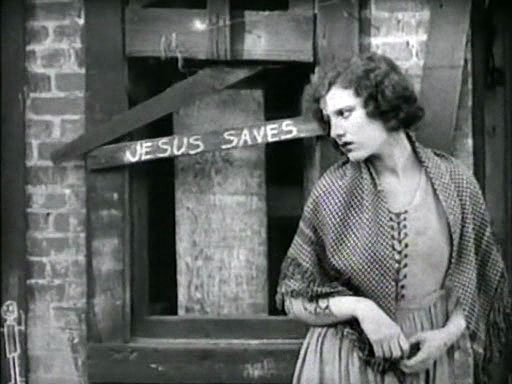
Sternberg puts poetry in his images, but he puts plenty in the intertitles too. Eight minutes in, I’d read about thirty flowery title cards – it’s like if Antonioni movies had subtitles telling you what everything meant, instead of relying on the images.

It’s not as plotless as the Criterion box’s commentaries and docs led me to believe – tells a story, just does it in an unhurried, lingering way. A cowardly young man, a bitter young woman and a helpless child live on the docks, spend their days full of ennui watching a dredge dig the same hole day in and day out, chased around by the dredge workers. One day they up and decide to leave for the city together, after seeing a cat. Take it away, intertitles: “The black cat, like an evil spirit, warned the three nobodies to leave the dredge before the thundering mud could bury their souls.”

My favorite title upon their arrival: “Man’s worst enemy is man. A city is full of enemies.” Some guy who wears lipstick lets them stay at his place for free, knowing that the boy is too stupid to find a job and planning to whore out the girl when the three get too hungry and hopeless. At least I think that’s his plan – things like that used to go unspoken in movies.

But all the makeshift family seems to do is sit on the couch and stare at the walls. Since they expend no energy, they don’t get hungry very fast, so the impatient lipstick man decides to “take her out for a ride in the country and let romance do a little work.” His idea of the country is a depressing little field next to the highway, where he tries to win her trust by beating up the little kid. The young man (“the boy” in the titles) finally asserts himself. “The man was only the victim. The boy was not beating him. He was conquering the harbor, the city, the mud – all the forces that had held him down, and most of all his own cowardly self.”

Horned Lipstick Man:

The titles beam about this moral victory! “Behold! They have fought and won a mighty battle – over themselves! It isn’t conditions, nor is it environment – our faith controls our lives!” The trio walks literally into the sunset, probably falling down and starving to death once out of camera range.

M. Gebert wrote an excellent article about early Sternberg:

Contrary to the usual Hollywood picture of the plucky poor, all must have felt like a slap from something utterly new in 1925. It certainly spawned a fair number of followers— when Lillian Gish gets a face full of wind, when James Murray’s dreams are buried in the crowd, when a Man thinks of drowning his wife for A Woman From the City, you can see how The Salvation Hunters helped shape Hollywood’s idea of what an artistic drama was

In between [Salvation Hunters and Underworld] is the famous unseen and lost film, The Sea Gull. We will presumably never know whether Chaplin suppressed it because he was jealous of how good it was, or because it was unreleasable crap. But I have my suspicions; many independent filmmakers have used their second, better-financed film to essentially remake their first film, much more self-indulgently and with a belief in their own genius inflated well beyond reality.

I thought this was quite good for ’25, it just didn’t make me leap out of my seat like Underworld did. I guess now I’ve seen all the silent Sternberg movies that are known to survive. Some of his other lost films include Exquisite Sinner (pre-Underworld, taken out of Sternberg’s hands by the studio after shooting) The Drag Net (after The Last Command) and The Case of Lena Smith (after Docks of New York). On to the talking pictures.

The year after The Gold Rush and Battleship Potemkin, Eisenstein’s teacher Kuleshov turned in his own gold rush masterpiece. It’s far less funny than the Chaplin feature, and far more economical than the Eisenstein – for the bulk it’s just three actors, a cabin and a storm. You don’t see a lot of Russian films set in Canada. I don’t, anyway, but then I don’t see a lot of Russian films – been meaning to correct that. The titles pronounce this as the “third work of the Kuleshov Collective,” the first two of which still mostly survive.

I don’t get the organizational structure here, but “chairman” Hans (Sergei Komarov of The End of St. Petersburg) with two “shareholders” (blonde-bearded Dutchy and black-bearded Harky) are out in the Yukon mining for gold – unsuccessfully, for the most part, along with Hans’s English wife Edith (Aleksandra Khokhlova of earlier Kuleshov Collective film Mr. West) and mustachioed Irishman (proven by fact that he spends his free time playing flutes and dancing jigs) Michael Dennin (Vladimir Fogel, the hero of Chess Fever).

Based on “The Unexpected” by Jack London. London’s stories made for extremely popular film adaptations from 1908 to 1930 – and he lived to 1916, so may have seen some of them. I suppose people back then enjoyed watching lone, underprepared hikers crash through the ice then slowly freeze to death. This group, however, is well stocked for the weather, and just as they were giving up on their present location, Dennin finds a cache of gold. Unfortunately, he makes up for this by developing a dark jealous rage and deciding to kill everybody. He blows away both the shareholders before Hans takes him down.

Edith is upset:

Now the surviving couple have to bury their partners (in a raging storm) then keep guard over Dennin for a whole season until the Law arrives, because Edith insists they not take revenge into their own hands. But Dennin is insane and destructive (he sets the bed on fire during a flood), and Edith seems to fall further into a religious fervor as they all suffer from cabin fever. This is the bulk of the movie’s runtime, the three of them stewing wordlessly in the cabin. It plays very much like a horror film. Kuleshov shows off his pioneering editing techniques, but also some great camerawork, like this post-Nosferatu hand shadow reaching for the gold.

Eventually the couple appoint themselves officials of the Law, give Dennin a British-style trial, sentence him to be hanged, then carry out the execution on a nice spring day. Dennin appears dramatically in their doorway that night amidst a raging storm – a ghost, a shared delusion or something else?

The trial, watched over by a painting of the Queen:

Nice day for a hanging:

I liked the rumbly electronic score by Franz Reisecker, though it provides some weird moments – while Dennin is playing his Irish flute music, the music we hear is despairingly atonal.

Came out the same year as Street Angel and The Passion of Joan of Arc, just as Hollywood was gearing up to make sound films exclusively. A period piece, but this movie was made so long ago that I can’t tell how much earlier it was set. Sternberg’s modern-day Underworld seems just as much of a period piece now. I watched with the Donald Sosin score featuring sung vocals in a few spots – interesting idea, and not so bad, but give me the Alloy Orchestra any day.

Ol’ George Bancroft gets to throw his bulk around some more, but he doesn’t roar laughter as much as he did in Underworld. He plays a furnace stoker on a ship, given one night of shore leave by boss Mitchell Lewis (of the original Ben-Hur). This is clearly not a good job, since it’s the same task Emil Jannings was forced to do by the revolutionaries in The Last Command, but George isn’t letting it get him down. Right after he gets cleaned up, he sees a girl (Betty Compson of The Great Gabbo and Tod Browning’s lost The Big City) attempt suicide by jumping in the water, and George jumps in to save her. He spends the rest of the evening with her, trying to cheer her up, and finally on a lark, offering to marry her.

It’s not strictly a legal wedding, since George doesn’t file the necessary papers in the morning – instead he sneaks off and prepares to return to the ship. But Mitchell has been creeping around George’s girl, having been rebuffed by his own wife (Olga Baklanova, baddie in Freaks) who resents being abandoned while he’s shipbound all year – at the saloon wedding between George and Betty, Olga offers her own wedding ring to the couple, saying “I hope it does you more good than it did me.” Mitch is now determined to get a girl before he’s due back on the ship. A struggle ensues – Betty shoots and kills him, but Olga rushes over to take the blame. Poor Betty is in trouble again, this time over her clothes, which George stole to keep her warm after the dock-jumping incident. But he’s decided to jump ship, own up to his crime and make good on his mock marriage vows.

Mitchell and Olga:

It’s an overwhelmingly beautiful movie, and almost as romantic as City Lights. I loved the last two Sternbergs I watched also, hard to say which I liked best. L. Sante: “The picture, if merely described, sounds merely sentimental. Everything that is really valuable about it hinges on von Sternberg’s treatment: its deliberate pacing, its unostentatious but exquisite framing, its delicacy cloaked in apparent gruffness, its devil-may-care romanticism.”

Watched half of the DVD extra (made for TV in ’68) in which a Swedish guy shows us clips from Sternberg’s silents and gathers brief thoughts from the director. After the silents, he runs out of clips and starts showing posters instead.

L. Sante again:

It exemplifies virtually every quality of von Sternberg’s films. It is theatrical, with complex but enclosed sets; it makes maximum use of lighting and atmospherics; it is nominally a melodrama but adds unexpected depth to a flimsy outline. It is justly famous for its use of slow dissolves, which serve, as Andrew Sarris noticed, “to indicate the meaninglessness of time intervals between moral decisions.” It is exquisite in its use of montage – but for all that, as Sarris also noted, this is primarily a moving-camera showcase – and its cinematography. The first is demonstrated by the delicate sequence of images showing that Lou has shot Andy, without any sign being more overt than two puffs of smoke, while the blurred subjective-camera shot of the needle Mae is trying to thread through her tears is the highlight of the second. It conveys extraordinary panache in the midst of squalor, and gives all that brio to its characters rather than depicting them from a worldly remove. It is possible to watch the whole picture without being exceptionally aware that it is silent. It is dated in nearly every particular, and yet it is somehow eternal.

JvS: “All my films were made inside of a studio. I don’t like the outside.”

Funny how I’ve never watched this until now, and everyone else has. Even Katy has seen it more than once. So, moments that seem fresh to me are probably way over-discussed to everyone else. I mentioned the movie to Steve and he says “that sailor sure smashed the hell out of that plate, eh,” referring to one of my favorite bits, a decisive moment of minor rebellion which Eisenstein shows repeatedly, from multiple angles, like an explosion in a Die Hard movie.

Due to unrest over spoiled food, the ship’s captain decides to hang a bunch of crew members – a bad move, since the others have been simmering rage againt their superiors, and choose this moment to mutiny, their leader Vakulinchuk shouting “brothers!” as a rally cry – a shout that will be repeated at the end, when the other battleships descending on Potemkin, presumably to quash the rebellion, choose to join it instead. Before that, the State is shown as brutally repressive, mowing down innocent civilians (children! mothers!) pitilessly on the steps of Odessa, where the ship lands and becomes a heroic symbol to the locals.

An imagined, phantom hanging:

Such an impressive piece of filmmaking and propaganda for the working man, it was banned in Britain and France for fear of sparking revolution. I watched the restored high-def version and was glad to discover that it’s a vibrant, brilliant movie, not the dusty old piece of film history I feared it might be. The movement and editing are rightly acclaimed, but the photography of individual shots is spectacular as well – compares very favorably to those gorgeously-lit Sternberg films I’ve been watching, only this was shot on location.

I dig the the hand-painted red flag hoisted over the ship. The ship’s crazy-haired priest was portrayed as a villain with a cross he wielded as a weapon, on the side of the power elite against the people. A guy in Odessa tries to use the crowd’s fervor for his own purposes, yells out “smash the Jews” and ends up getting smashed himself, the first casualty on the shores.

Another splendid Sternberg movie with an Alloy Orchestra score – how Criterion spoils us. It’s hard to fully embrace a movie with the dialogue “From now on you are my prisoner of war… and my prisoner of love.” But once I accepted the melodramatic story elements, this was almost the equal of Sternberg’s great Underworld.

Supposedly based on a real person, Emil Jannings is a powerful Russian general who escapes the country during the 1917 revolution (between this, Potemkin and Mother, Russian revolutions have been coming up often) and scrapes by in the U.S. as a Hollywood extra. This is not portrayed as a glamorous career path – note that The Life and Death of 9413: A Hollywood Extra was made in the same year. We’re also shown a bunch of resentful bastards at the studio costuming department, as if Sternberg and his writer were out to de-glamorize the movie-making process.

Directed by Michael William Powell:

Back in Russia, General Jannings (after his three great movies with Murnau, so already a star) clashes with young idealist revolutionary William Powell (with perhaps a thicker, less refined mustache than he sports in the Thin Man films). I was glad to see Evelyn Brent (Feathers in Underworld) again, and Sternberg and his photographer light her as ecstatically as before. She’s attached to Powell until taken prisoner by Jannings, eventually warming to him and helping him escape once the tables are turned. Later in Hollywood, Powell plans to shame the former general by casting him in a film that re-enacts his defeat, but the general gets too caught up in his nostalgic fervor and dies of a heart attack. Powell seems to forgive him after that, seeing that they both loved their country, just in different ways – which helps explain Evelyn’s split loyalties as well.

Evelyn Brent, revolutionary:

A. Kaes for Criterion:

Von Sternberg seems to have been fascinated by Jannings’s acting style and persona and did not restrain them in The Last Command. Instead, he used the actor’s histrionic theatricality to explore the power of performance and filmic illusion themselves—a subject he would continue to mine for the rest of his career.

Mulligan (Fred Kohler of a couple other Sternberg features) is a mean-ass gangster who tries to make a poor drunk pick a tenner out of a spitoon. Funny, since earlier this week Katy and I watched Rio Bravo, in which the same thing happens. Like in Rio Bravo, the poor drunk turns out to be one of our heroes – the smart and loyal Rolls Royce (Clive Brook, an early Sherlock Holmes, also in The Four Feathers). Unlike Rio Bravo, the guy who saves him isn’t the sheriff but another gangster making a show of power: the giddy, reckless Bull Weed (George Bancroft, the marshall in Stagecoach) in front of his lady, pouty Feathers McCoy (Evelyn Brent, a cult member in The Seventh Victim, also in a couple of “anti-Mormon propaganda films”).

Bull and his Feathers:

pre-reform Rolls Royce:

Rolls joins Bull’s gang (which seems to consist of himself and some comedian (played by Larry Semon, formerly a hugely successful comic but on his way to an early grave when he appeared in this). Rolls is a big help, giving his boss valuable tactical advice, but he’s transparently falling in love with Feathers. The boss goes to prison, sentenced to death for shooting down Mulligan in his own flower shop. He escapes with vengeance on his mind, but ultimately decides to surrender himself and let Feathers and Rolls have each other.

It’d be a good, entertaining gangster movie from the story and acting alone. Ben Hecht, who wrote more great movies than I can list, won an oscar for this, although he hated the final product for deviating from his script. But the visual style is so splendid it puts the story to shame, and accompanied by the Alloy Orchestra on the Criterion DVD, it’s a piece of cinema heaven.

Sternberg wrote, with apparently typical contempt for his audience, ““I had provided the work with many an incident to placate the public, not ignoring the moss-covered themes of love and sacrifice.” But as G. O’Brien points out, “His high opinion of his own capabilities and his majestic sense of his poetic vocation might indeed seem like intolerable arrogance were they not so undeniably justified.”

Mulligan inside his flower shop:

…while outside…

Guy Maddin’s article on Sternberg and the films is, of course, wonderful to read, and it sounds from the quote like Sternberg’s own writings might be essential:

Once, wandering the shower rooms among the actors washing the day’s grime off themselves, von Sternberg heard a background player release “a formidable laugh, an inhuman laugh, enormous and savage, monstrous, a child’s laugh and a murderer’s laugh.” This gigglepuss was George Bancroft, and … von Sternberg rushed right into the shower stall and cast the naked, roaring gigantopithicus he found there as Bull Weed, the gangster-king of his new picture, Underworld.

Dramatizes the 1905 Russian Revolution. Although I didn’t know that until I looked it up after the movie, because I know nothing of history or Russia. Apparently Battleship Potemkin is about a military uprising during the same time, and the 1905 events led to the 1917 revolution which took out the Tsars and formed the Soviet Union. So that’s why the ending, which seems tragic, is filmed as if it’s a great victory.

Full of great editing, a few cool overlapping images. Pudovkin worked under Lev Kuleshov, using his teacher’s montage theories to make grand works of propaganda, “far less ambiguously so than his rival Eisenstein.” I was in the mood for some Russian cinema, thought I’d watch a bunch of early features leading up to Emory’s presentation of I Am Cuba on 35mm, but I got busy, only watched this one and missed Cuba.

Brilliantly tense movie, vaguely similar to the other film called Mother I’ve watched recently in that both mothers try to free their sons from jail, becoming more like their sons along the way. In this one, she is partly responsible for his arrest, revealing a cache of weapons he was hiding after his group’s unionist revolt takes a bad turn. Later, she has turned against the state and teamed with the unionists, marching on the prison to free their comrades. Everyone we liked is dead in the end, but the individual is unimportant anyhow; the movement lives on.

J. Jones:
“The montage effects are different from those of Eisenstein, who believed editing was a way of achieving dissonance, making a jagged cinema of conflict. Pudovkin is more lyrical. His cross-cuts, while dramatic, do not break up but enhance the narrative.”

Also checked out:
Twilight of a Woman’s Soul (1913, Yevgeni Bauer)

Unfortunately, I found it a dullsville tableau drama, despite minor excitement over a mild camera move or two, a flashback and the presence of such a taboo subject as rape in a silent film. Seems like a good study film for an early-cinema class, but it’s not thrilling my current urge to watch quality Russian cinema. The film’s writer played the rapist, ha.

When I realized there is a movie called Finis Terrae from 1929 and another called Finisterrae from eighty years later, I set out to watch them both. Sometimes it’s as simple as that. The latin phrase means “ends of the earth.” There’s a place in Spain (where the 2010 film is set) called Finisterra, and a university in Chile called Finis Terrae (how wonderful), but this Epstein film was set on Ouessant, a small island off the coast of France (today home to an airline called Finistair), and on the even smaller island of Bannec. As the opening titles tell us, “on an island where winter storms wipe out all forms of life, four men come in two teams to spend the summer collecting seaweed in total isolation…”

A gorgeous film, made on location with nearly as many credited cinematographers (one of whom would later work on Vampyr and Hotel du Nord) as actors. Very simple story, a bit too poetically-paced at times, but it worked – I found it very affecting by the end. Apparently not much is known about the film on the web. I’ve seen it listed as a documentary – it’s clearly not, though Epstein seems to have cast local workers instead of film actors.

Strange that the team leaders look to be about sixteen, and their barely-named assistants are large middle-aged men with mustaches – why not the other way around? Ambroise, one of the two young men cuts himself on a broken bottle of liquor belonging to the other, Jean-Marie, causing both a grudge between the men and an infected sore on Ambroise’s finger that gets worse over the next few days, preventing him from working and finally threatening his life … “during a becalmed period making it impossible to cross the waters without the requisite wind in the sails. Cue a rescue mission launched from the mother island, Ouessant, to get them back to at least a semblance of civilisation.” (A. Fish)

D. Cairns:

When the sick boy starts to hallucinate, the movie almost oversteps its stylistic bounds by trying to evoke a state the audience is already in: Epstein snap-cuts a jangling montage of looming ECUs and what look like off-cuts and deleted scenes into an abstract nightmare that threatens to turn the whole experience into abstraction and dissonance, with no way out save the declaration of a cinematic Year Zero from which we can start afresh. Seriously, the movie feels like it was made tomorrow, or at any rate made in 1929 by time-travelers.

A. Fish again:

It would be Epstein’s parting glory; oh, other films would follow in its wake, but they weren’t worthy of him and he’d disappear, a fossil, a megalith one might say, of a silent era, not yet put out to pasture but with the fires not so much raging as flickering in the hearth. He wasn’t alone, one could add Gance, l’Herbier and de Gastyne to that list of exiles, yet his is a name that should stand tall in French film history, but instead often merits at best a paragraph in conventional histories.

A light, clever Keaton feature – not one of my faves, but well paced and only an hour long. Buster and his not-fiancee Betsy (Kathryn McGuire of Sherlock Jr. end up stranded on an adrift ocean liner with no crew after a complicated series of events stemming from a “funny little foreign war” (ouch, not a term we’d use today). The humor doesn’t come from the spy/war/hostage plot but from the fact that Buster and Betsy are millionaire kids with no idea how to do simple daily tasks, and now they have to survive until rescue – they’ve a well-stocked kitchen but no idea how to open a can or boil an egg.

They also run into cannibals (all island natives back then were assumed to be cannibals), deal with a submarine, and Keaton shoots a hokey underwater scene (swordfighting with swordfish, etc). Appropriately on the same DVD as nautical shorts The Boat and The Love Nest. I loved the end, when after a few weeks of trial and error, the couple has rigged the boat with ropes and pulleys to automate daily tasks a la Keaton short The Scarecrow.

Reminiscent of The Private Navy of Sgt. O’Farrell:

IMDB trivia reveals that four years prior, the boat used in filming had been used by the U.S. government to deport Emma Goldman to Russia.