A too-young Joel McCrea is out with his rich white yachting buddies when he decides to stay behind on a tropical island with the hot girl he met, who he soon learns is scheduled to be sacrificed to a volcano. Seems like this movie inspired both Joe vs. the Volcano and The Thin Red Line.

Ridiculous movie, but at least Dolores del Rio is good – and does some nude swimming.

Ballet Mecanique (1924, Léger & Murphy)

Every camera and editing trick known to man (at the time), in a rhythmic collage of pleasingly odd images. Plucky string music by Paul Mercer on this version.

The women (woman?) of Ballet Mecanique:


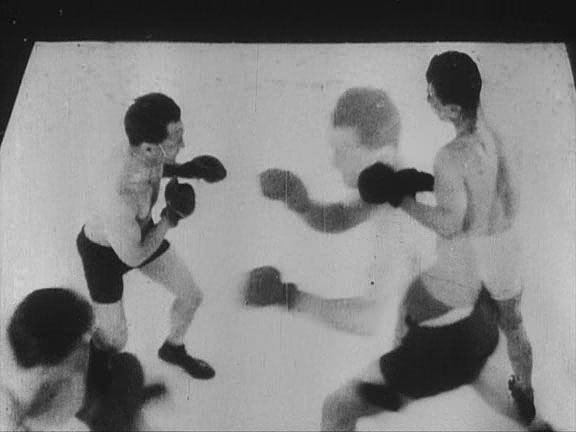
Combat de boxe (1927, Charles Dekeukeleire)

Someone allowed a filmmaker to shoot a sold-out boxing match, not knowing Dekeukeleire was a lunatic obsessed with film reversal and superimposition who would shoot anything but a standard angle on the action. Who did the great soundtrack, all pulsing sound effects and breathing? Dekeukeleire was a Belgian film pioneer, made two other influential avant-garde films in the late 1920’s according to wikipedia.

The boxer uses ghost mode:


Rose Hobart (1936, Joseph Cornell)

Cornell’s re-edit of East of Borneo, which appears to be a somnambulist jungle picture, highlighting the scenes of star Rose Hobart. Oh wait, he has slowed the film to silent speed, that’s why it looks so dreamy. The not-exactly-fitting-the-mood soundtrack is from a record called Holiday In Brazil.

Cornell’s first film, and his most famous. Reportedly during the premiere screening Salvador Dali attacked the film projector in a rage, claiming the film had been stolen from his dreams. I watched a whole program of Cornell shorts at Eyedrum in the pre-blog era, but hadn’t seen this one before.

Rose chats with a monkey:

B. Frye in Senses of Cinema:

Rose Hobart was only one of several mythologized actresses who populated Cornell’s hermetic world. Many of his boxes were homages to the actresses that formed his pantheon: Lauren Bacall, Hedy Lamarr, Greta Garbo and Deanna Durbin, among others. In Rose Hobart, Cornell holds Hobart in a state of semi-suspension, turning the film itself into a sort of box. She moves her hands, shifts her gaze, gestures briefly, smiles enigmatically, perhaps steps slightly to the side, and little more. The world appears as a sort of strange theatre, staged for her alone.


Betty Boop for President (1932, Dave Fleischer)

Okay, what? That is a cynical view of government for the 1930’s. Betty does caricatures of I’m not sure who, and appears to be a communist. Her opponent is Mr. Nobody, who gets booed by his crowd. After she’s elected, her victory parade fades into a giant beer mug, implying the entire film has been a drunken fantasy.


Betty Boop’s Penthouse (1933, Dave Fleischer)

Bimbo and Koko are incompetent, cat-tormenting mad scientists obsessed with their next door neighbor Betty. They accidentally create a Chemical Frankenstein who pursues her before being turned into a flower by her perfume. Insane and wonderful. Nice variation on the ol’ blackface Al Jolson gag.

Koko on fire:


Carmen (1933, Lotte Reiniger)

I don’t watch much opera, so don’t know the plot of Carmen. It seems she lures some fancy man to her sexy lair, then steals his clothes and sells them, buying herself a new outfit. But she fails to impress an even fancier man, the famous bullfighter, so she heads into the ring, dodging the first man who is now trying to murder her, and dances with the bull. Is that the general idea? Oh yeah, Wikipedia says that’s pretty much it, except the first man ends up killing her. The first of Reiniger’s silhouette films I’ve seen and it’s just wonderful.


Papageno (1935, Lotte Reiniger)

More opera… guess I never wrote up the Julie Taymor theater version of The Magic Flute we saw last year. It wasn’t a proper Taymor film like Midsummer but a live-televised version of her play. Anyway we both enjoyed. I wouldn’t have figured the carefree singing bird catcher Papageno for a spinoff film, but that’s what we’ve got here, set to the Mozart music. Papageno’s a real hero in this one, fighting off a giant snake that attacks his girlfriend Papagena by harnessing his bird-friends’ powers, like an avian Aquaman. She escapes on an ostrich, is gone for a half minute, which is too long for ‘geno, who attempts suicide, saved by a flock of parrots. Definitely best part is the ending, while the reunited lovers are singing to each other and the birds start rolling in eggs hatching baby Papageni.

Parrots!

There’s a lot of kissing and disrobing in these movies – guess you could get away with sexier stuff in silhouette animation than using actors in the 1930’s.

Making out in the trees:

About to catch an escape-ostrich outta here:

A pretty good Cukor movie made in between really great Cukor movies. For some reason I can’t ever get into movies about rich courtesans in ill health who can’t decide between their callous rich suitor or their young and energetic, devout but poor suitor.

Stars Greta Garbo, who I’ve rarely seen in movies and doesn’t make much of a distinctive impression, in one of her final films. We’ll have to watch Queen Christina or Grand Hotel sometime to see what the hubbub is about. Henry Daniell (The Suspect, Witness for the Prosecution) is the boring old baron and Nebraskan Robert Taylor (Ivanhoe, Three Comrades, the 1935 Magnificent Obsession) is young and in love.

Based on the Alexandre Dumas novel, which has been adapted a million times, because apparently audiences love courtesans. The Theda Bara version is presumed lost. Others starred Norma Talmadge, Pola Negri or Rudolph Valentino. Isabelle Huppert and Bruno Ganz appeared together. Ben Kingsley played Colin Firth’s dad. Raymond Bernard made a version. Fortunately, the Antonioni film The Lady Without Camelias is an entirely different story.

Weirdly, for one of the best romantic comedies of all time, I had much trouble remembering this a couple weeks later and had to look up the TCM synopsis – unlike The Good Fairy and Roman Holiday and High Society and What a Way to Go!, which I recalled as well as I ever do. So I’d better watch this again sometime.

Anyway, heiress Claudette Colbert (between Lubitsch films The Smiling Lieutenant and Bluebeard’s Eighth Wife) is on the run from her overdetermined life and meets chivalrous Clark Gable on the bus. He’s a reporter who agrees to help her if he gets an exclusive story – shades of Roman Holiday – but unlike that movie, this is one of the madcap screwball comedies where writing out the plot would take longer than rewatching the movie – the gist being that the two of them fall gradually in love after spending much travel time together, and she finally flees her society wedding to stay with Gable.

Unhappy bride:

Criterion ad copy: “The first film to accomplish the very rare feat of sweeping all five major Oscar categories (best picture, best actor, best actress, best director, and best screenplay), It Happened One Night is among the most gracefully constructed and edited films of the early sound era, packed with clever situations and gags that have entered the Hollywood comedy pantheon and featuring two actors at the top of their game.”

S. Winer:

That first autobus ride is clearly an alien experience for the heiress, who has until this point remained unaware of the greater world around her. At first, she is uncomfortable with her fellow passengers, but eventually she joins them in song and then feels sympathetic pain for the plight of a mother and son who don’t have enough to eat. (Explicitly here, and implicitly throughout the film, Capra is making a brave choice for a romantic comedy by telling us that this is no movie fairyland but very real Depression America — where buses might serve those who could no longer afford cars and hitchhiking those who could afford neither.)

F. Nehme:

In what must be the movie’s most famous scene (although it has a lot of competition), Pete demonstrates, at length and with a fantastic amount of condescension, the proper way to hitchhike: “It’s all in the thumb.” Ellie, splendidly deadpan, watches an entire traffic jam’s worth of cars zip by Pete and his magic thumb, then slinks over and lifts her hem to reveal one of the loveliest legs in movie history. Cut to slamming brakes, then the couple in the rumble seat of a car. But here’s the thing: The man who has stopped (played by Alan Hale) turns out to be a road thief, bent on stealing their remaining suitcase. For all Ellie’s triumph, the creep was looking for a mark, and probably would have stopped in any event.

Pretty-good movie with convoluted plot based on a Hungarian play with English dialogue rewritten by Preston Sturges. Wyler didn’t have a knack for this sort of thing. Comic timing is off from the start, and the Frank Morgan character crosses the line from annoying the protagonist to annoying the audience, but the second half seems to settle into a nice groove, thanks to the soothing influence of actor Herbert Marshall.

Margaret Sullavan (of The Shop Around The Corner, also set in Budapest) is quite good anyway. She’s an orphan recruited by Alan Hale (does he buy her? adopt her?) to work at his movie theater. Trying to avoid sexual harrassment in the street she latches onto sensitive, protective Detlaff (Reginald Owen, Scrooge a few years later), who works as a waiter at a restaurant where she meets wealthy, sexually aggressive annoyance Konrad (Frank Morgan, Sullavan’s costar again in Shop Around The Corner) who works for hilarious drunken gov’t minister Eric Blore.

Through a series of preposterous events, Margaret, who wants only to be a “good fairy” and help others, gets Konrad to enrichen randomly-selected destitute & honest (the movie isn’t necessarily saying he’s destitute because he’s honest) lawyer Max (Herbert Marshall, star of Trouble In Paradise). She then tries to carry on a relationship with Max while pretending to Konrad that they’re married, all under the watchful eyes of Detlaff.

Wikipedia: “In particular, Sturges added a movie-within-the-movie in which the actors communicate in one-syllable sentences.” Beulah Bondi of the Sturges-written Remember the Night plays the orphanarian, and the musical remake I’ll Be Yours a decade later featured Sturges regular Franklin Pangborn.

We also rewatched the Sturges-written Remember The Night for Christmas.

Oscar for best actress, obviously, and also seven more (director, cinematography, supporting for Joel Grey) but picture went to The Godfather. I don’t know Liza Minnelli from much – just this and Arrested Development – but she’s perfect in both. The movie though, eh, not my favorite nazi musical. Could’ve stood to be more musical, blurrier and more insane a la All That Jazz (I guess Fosse hadn’t had his drug-addled breakdown yet).

Brash dancer Minnelli gets a new roommate, closeted scholar Michael York. Both roomies have affairs with wealthy Max (Helmut Griem of The Damned and Les rendez-vous d’Anna) and help to hook up two of York’s English students (Fritz Wepper of The Bridge and Marisa Berenson, wife of Barry Lyndon). The nazi stuff is less foregrounded than I would’ve thought – they’re slowly going from a violent street cult to the dominant political party in the background of a story full of sympathetic gays and Jews. Fun times while they lasted, though. Interesting to watch this right before Phoenix, eliding the whole war in between.

Fred (of early Bunuels – also good roles in major Renoir movies, but I suppose I’ll always think of him as the enraged looney from L’Age d’Or) is would-be rapist who steals pretty Pola’s key to surprise her at home – a foolish plan, since without the key she spends the night with Al instead. He’s Albert Prejean of The Crazy Ray, the French version of Threepenny Opera, S.S. Tenacity and something called The Buttock. Also in the mix: pickpocket Emile and criminal Louis (Edmond Greville, who’d later helm a Hands of Orlac remake).

Will the pretty girl with the cheek curls choose the thief, the lout, the rapist or the cheater? She is Pola Illery, who’d appear in an unknown 1930’s version of The Indian Tomb / The Tiger of Eschnapur as well as a poetic realist Pierre Chenal film from the same year as L’Atalante. Anyway, she ends up with Louis but only because Albert is arrested for a crime Emile committed. We would’ve preferred she end up with nobody, or at least leave town and find some better guys. Anyway it’s quite a pretty movie and more importantly for 1930, uses the title song expressively.

Luc Sante for Criterion:

In that era, the start of the worldwide financial crash, important movies tended to be set in fantasy realms of impossible wealth. Clair’s Paris was, in a way, no less fantastic—every street and square, every tenement, garret, dancehall, and café was designed by the great Lazare Meerson and built in the studio. But its characters, who live on the border between ill-paid labor and petty crime, were both instantly recognizable the world around and imbued with romance by the magic of Paris. In the decade that followed, that setting and those kinds of characters were to constitute the fundament of the French cinematic style called “poetic realism,” a principal architect of which was Marcel Carné, an assistant director on Under the Roofs of Paris.


His Royal Slyness (1920, Hal Roach)

Katy went flipping through the endless scroll of Criterion movies on Hulu, settling on this. Of course we didn’t know it was a short, so 20 minutes later we started Under the Roofs of Paris. This one’s a Harold Lloyd short, where Lloyd and the King of Whatever trade places then he ends up joining the revolution against the monarchy. There’s a princess, and I dunno it was lightly amusing and now I don’t remember it all that well.

Down-on-his-luck writer Derrick De Marney (Things to Come, Uncle Silas) gets even worse-on-his-luck when he discovers a dead associate on the beach and witnesses assume he murdered her. The cops have got a suspect with motive (she left him inheritance), so no reason to do any further investigating. So Derrick escapes, hides out with police chief’s daughter Nova Pilbeam (who I also liked in The Man Who Knew Too Much), convinces her of his innocence.

Second Hitchcock movie I’ve seen with an old mill – the scene in Foreign Correspondent was better. Close calls as they journey to locate Derrick’s stolen raincoat to prove that it’s not the same raincoat that murdered the woman, or something I dunno, doesn’t matter because in 1937 all men’s raincoats looked the same so it’d hardly be evidence of anything. They flee from Nova’s constable dad (Percy Marmont of Hitch’s Secret Agent) and her horrible aunt (Mary Clare of The Lady Vanishes and the silent non-Hitch The Skin Game), get help from the bum with the raincoat (Edward Rigby of A Canterbury Tale), and finally track down the twitchy, blackfaced (argh) murderer (George Curzon of Q Planes, Jamaica Inn). It’s all a good bit of fun, if not as outstanding as The Lady Vanishes and The 39 Steps.

A clunky-ass early sound feature full of outrageous pre-code affairs. Feels earlier than it is, both sound-wise and code-wise, though it’s already a remake of another early-sound pre-code, Illicit starring Barbara Stanwyck.

Bette Davis (only the second of her movies that I’ve seen, after All About Eve) is the only one here with personality, surrounded by a buncha galoots. Let’s see if I can get the galoots straight: she marries Gene Raymond (Flying Down to Rio, Mr. and Mrs. Smith) but he cheats with business partner Kay Strozzi (Captain Applejack) so Bette cheats with Monroe Righter Owsley (his real name! of the similar-sounding Indiscreet with Gloria Swanson). Oh and their drunk friend Frank McHugh (The Dawn Patrol, I Love You Again) shows up at everyone’s house to drink for free, pines for Claire Dodd.

“Dull, dull, dull,” Bette proclaims, and we said the same. She’s cute at least, with a great voice. Florey, who’d helped make the remarkable Life and Death of 9413, a Hollywood Extra, was now churning out Hollywood crapola, 3-5 features per year. Shot by six-time oscar nominee Tony Gaudio. The editor worked on Bob Wills and His Texas Playboys, a movie which I must find.