“What’s happened to us is like war… easy to start… hard to stop.”

A wordless intro before the opening titles, so no dialogue until 4:30… and it’s only an 80 minute movie, so that’s significant. Once the action starts, of course, it barely lets up, led by a hero named Griff who talks like a hero should talk (sorta like the host of a news magazine show). The star is Barbara Stanwyck but she’s not in the movie half as much as Griff, which only serves to make her more of a presence when she is around.

Anyway, Griff is one of those western heroes who’s amazing with a gun, unbeatable, but hates to use it, haunted from having killed a guy some years ago. He’s an oxymoronically peaceful bounty hunter with his two brothers in tow – nice-guy Wes who falls in love with a local gunsmith girl and eager Chico who wants to be a gunfighter. Griff swaggers into town as Stanwyck’s unhinged little brother Brockie is shooting up the streets, and busts the violent asshole brother’s nose in one of the baddest-ass western showdowns ever filmed. This and Griff’s humiliating public arrest of one of her “forty guns”, a man wanted for robbery, causes a balance-of-power problem with Stanwyck, who formerly owned this town uncontested. But of course… the two of them fall in love.
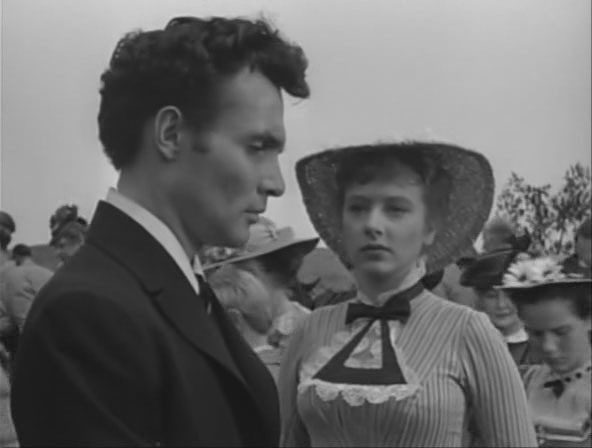
Charlie Savage (played by John Wayne’s stunt man) and Brockie (John Ericson of Bad Day at Black Rock):
image

John the marshall is a slow-talkin’ goodly old man with bad eyesight whom Brockie shoots (not to death) just for the hell of it, but the cowardly nasal-voiced sheriff Logan and the local judge are friends of Stanwyck’s, so when Brockie is arrested he’s quickly let out. They have a harder time protecting Swain, the wanted man, since he’s got a federal warrant on him, so Charlie Savage kills him in his cell before Swain can say too much. Griff is on the case right away, knowing it’s Charlie because he’s the best shot in town (although why does it take the best shot in town to blast a guy through a prison window?). Charlie sets a trap for Griff, but young Chico interferes and kills Charlie.

image

“Now what did I do wrong?”
“Now you’ve killed a man.”

image

I’m out of sequence here but it doesn’t matter. Griff and Barbara have a symbolic love scene during a tornado and bond over their wild little brothers. Griff bathes in a barrel (but does not get shot up a la House of Bamboo). The movie breaks into a song about Barbara (“She’s a high-ridin’ woman with a whip”). And whenever a man and a woman are alone, the innuendo cranks way up, higher than I thought it could go in the 50’s (well, I suppose Will Success Spoil Rock Hunter was the same year). There’s talk of the death of the wild west, of a peaceful, civilized future.

image

But the kids still wanna play shoot-’em-up. Wes is predictably but still terribly, killed on his wedding day by Brockie, and that’s not the kind of thing Griff can let go. He shames the sheriff, who fails to kill Griff and so loses Barbara. The famed ending, in the writer/director’s own words:

Brock knows Griff loves his sister and surely won’t shoot a woman. He’s wrong. Griff plugs Jessica in the leg and, as she slides to the ground, empties his pistol into the bastard brother.

Griff doesn’t kill Brock out of vengeance. He’s eliminating a cancer that’s terrorizing the community. But he’s disgusted with himself. By resorting to guns, Griff sees the last ten years vanish in a flash, as he becomes the killer he’s renounced.

My original script had Griff killing both Jessica and her brother, stepping over their corpses in a daze, throwing his gun down – this time for good – and walking up the dusty street without a pause. Nothing and no one exists for Griff anymore. The End. That version ran into trouble at the studio…

image

Instead Chico ends up marshall and Barbara runs after Griff as he’s leaving town and they ride away. A few months after China Gate (and somehow Run of the Arrow came in between them), the filmmaking is smooth as hell – scenes playing out in single long takes with powerful fast cutting during the action scenes.

Barbara, in her final year as a headlining movie star:
image

Fuller again:

My story hinged on America’s pervasive fascination with guns. Hell if I know why people think guns are sexy. I cooked up a helluva lot of sexual metaphors playing with the idea.

image

Our gruff hero Griff (far left) is professional tough guy actor Barry Sullivan (The Bad and the Beautiful). Gene Barry (on right, star of China Gate, played a fake Mexican in Red Garters) is brother Wes. Robert Dix (writer/star of Five Bloody Graves) is Chico, and in the light coat is Sheriff Dean Jagger (the beloved major in White Christmas, also in Lang’s Western Union):
image

Fuller:

With Forty Guns, I’d really hit my stride. I considered it one of my best efforts so far. Sure, there were some compromises – like the ending, but it came pretty close to my original vision. At the time, very few people were given the opportunity to write, produce, and direct their own movies.

image

JUDGE PRIEST (1934)

Something like John Ford’s 80th film, if IMDB can be trusted. Contemporary with L’Atalante and the silent Story of Floating Weeds. Set in 1890’s Kentucky – a couple decades past Civil War, which was still on everyone’s mind. And after all, the war wasn’t all that long ago… older audience members watching this film would’ve had parents who participated in it. Strange to think about now, a few more generations removed – my dad wasn’t born yet when this came out.

image

Humorist cowboy and populist philosopher Will Rogers plays the titular good-ol’-boy judge, and controversial sleepy-eyed black actor Stepin Fetchit is his sidekick. Priest is a former confederate soldier (“I kinda calmed down”) who is endlessly proud of Dixie, but respects the law and modern reality, or seems resigned to them anyway.

image

The judge’s nephew Jerome (Tom Brown) comes back to town and you can tell he’s supposed to end up with the neighbor girl Ellie May (Anita Louise) but he keeps ending up on dates with a dark-haired temptress instead (Rochelle Hudson, who voiced MGM cartoons and later appeared in Strait-Jacket and Dr. Terror’s Gallery of Horrors). Of course they do end up together after wasting plenty of screen time we’d rather be spending with Will Rogers, but first there’s some problem about Ellie May not having a father.

Our generic romantic leads… everything else in the film is more interesting than these two:
image

Trouble starts in town when the mysterious new guy in town, a blacksmith (the Walter Matthau-looking David Landau of Horse Feathers) punches out Flem the barber for making a crack about Ellie May. He is to be tried in court before Judge Priest, but meddling, villainous-looking senator Horace Maydew points out that Priest was present at the incident and took the blacksmith’s side, so Priest agrees to step down and let someone else (Henry Walthall, in the movies since 1908, costarred in Birth of a Nation and London After Midnight) preside. Priest stays involved by offering to defend the blacksmith, finally, triumphantly revealing him to be an ex-con, a confederate war hero, AND Ellie May’s father.

image

I found less stirring emotion in the overlong “dixie”-soundtracked heartfelt courtroom ending than in a scene early on with the judge talking to a photo of his dead wife. He’s supposed to be a lonely man, but with the young lovers and the big trial, and with Priest’s jovial nature, Ford doesn’t dwell on that aspect too much… just gives us that one lovely scene providing Priest with a deep enough soul to last the rest of the film.

image

Otherwise things stay pretty light, and there’s plenty of worthwhile diversions like the outrageous performance of Stepin Fetchit, and Hattie McDaniel (as Priest’s maid) singing “the sun shines bright in my old kentucky home.”

Look far-left for Hattie:
image

Screenplay written by Atlantan Lamar Trotti (American Guerrilla in the Philippines) and Dudley Nichols (Man Hunt, Scarlet Street). Based on a series of books by Irvin Cobb, author of McTeague (Greed), who hosted the Oscars the following year (1935 – this wasn’t nominated). Will Rogers had hosted in ’33. Time was unkind to the lead actors… Rogers, Walthall, and Landau all died within two years of the film’s release.

Sneering villain Horace Maydew:
image


THE SUN SHINES BRIGHT (1953)

I’d thought this would be a remake of Judge Priest, but not exactly. Sure, at the beginning a young man comes home and starts romancing a young girl with a conspicuously missing parent, and sure Judge Priest (now played by Charles Winninger, the captain in Show Boat) is our central character and Stepin Fetchit (the same actor!) is his slow, slurred-voiced sidekick/servant, but things take a turn from there.

image

Priest is still a likable soul, but now he’s an alcoholic on the verge of losing his seat to slick Horace Maydew. Priest doesn’t seem like he runs this hick town anymore – he’s an increasingly irrelevant member of a rapidly growing city. He’s a wise and engaging character, but he’s no Will Rogers. And while the first movie showed us the judge’s loneliness at the start then cheered us up for the next hour, this one gives the judge a rocky start (waking up and yelling for his negro servant to bring him whiskey!), builds him up more and more, then fires off a devastating visual ending, the judge silently retreating into his house alone.

Horace Maydew isn’t as cartoonish a bad guy in this movie:
image

The twist this time: young Lucy Lee’s mom, a prostitute who left town so her daughter wouldn’t grow up in shame, returns home to die. Lucy Lee finds out about this, and about her grandfather, the solitary wealthy General Fairfield (James Kirkwood, a director in the silent era, and the farmer in A Corner In Wheat), a former confederate who has distanced himself from his past and won’t talk before the veterans group which Priest leads each week.

The judge and the general share a tender moment:
image

Before LL’s mom died she asked brothel madam Mallie Cramp (Eve March: the little girl’s teacher in Curse of the Cat People, Hepburn’s secretary in Adam’s Rib) to give her a proper funeral and burial and strong-willed Mallie would like to, but she’s met with resistance by the townsfolk, who of course support the brothel but bristle at the idea of those women having public lives or even deaths.

image

The rest of the plot is more complex than in Judge Priest. No big climactic court case, but a few overlapping issues. First, Priest is up for re-election and it’s a close race with Maydew (Milburn Stone, a detective in Pickup On South Street the same year), who paints Priest as old-fashioned and out-of-touch. Young lover Ashby (stiff, cliff-faced John Russell, the main bad dude in Rio Bravo) wins a whip-fight (!) with slimy rabble-rouser Buck Ramsey (Grant Withers, who killed himself a few years later) over Lucy Lee (Arleen Whelan of Young Mr. Lincoln), and Ramsey returns leading an angry mob hoping to lynch young black harmonica player U.S. Grant Woodford suspected of raping a girl out of town. Priest is already politicking around town, leading his confederate group, and dealing with the Lucy Lee situation when he decides to risk his life by blocking the lynch mob and risk his reputation by being the first to follow the prostitute funeral procession through the streets. Priest closes those matters out (U.S. Grant is proven innocent and released, actual rapist Buck is shot trying to escape, Lucy Lee reconnects with her grandfather) just in time to cast the decisive vote re-electing himself. In the end he’s a hero of the town, and everyone stops by his house to wave and sing praises… but he still goes home alone.

image

There were 30+ John Ford films between Judge Priest and this (including Rio Grande and The Quiet Man) and he had nearly 20 more left in him. This one, unlike the original, can definitely not be called a comedy. It has some comic relief though, in the form of drunken hick sharpshooter duo Francis Ford (his 32nd and final appearance in one of his brother’s films) and Slim Pickens (a decade before Dr. Strangelove and Major Dundee). I wanted to like the 30’s movie more, with its lighter tone and a Judge Priest character who is affable without having to humbly heal the whole town’s social wounds while saving a boy’s life, but I think the latter movie impressed me more deeply. No doubt they’re both excellent and make for a lovely double feature though.

image

Jonathan Rosenbaum:

Today The Sun Shines Bright is my favourite Ford film, and I suspect that part of what makes me love it as much as I do is that it’s the opposite of Gone with the Wind in almost every way, especially in relation to the power associated with stars and money. Although I’m also extremely fond of Judge Priest, a 1934 Ford film derived from some of the same Irvin S. Cobb stories, the fact that it has a big-time Hollywood star of the period, Will Rogers, is probably the greatest single difference, and even though I love both Rogers and his performance in Judge Priest, I love The Sun Shines Bright even more because of the greater intimacy and modesty of its own scale.

I should add that in between Judge Priest’s stopping of a lynching and his triumphant re-election brought about in part by the potential lynchers is the act that the Ford regards as his key act of moral and civil virtue – arguably far more important in certain ways, at least in this film’s terms, than his prevention of the lynching. I’m speaking, of course, of his joining a funeral procession for a fallen woman on election day, thereby fulfilling her dying request that she be given a proper burial in her own home town. Once Billy Priest joins this procession, he is followed by almost every other sympathetic member of the community, starting with the local bordello madam and her fellow prostitutes, and continuing with the commander of the Union veterans of the Civil War, the local blacksmith, the German-American who owns the department store, Amora Ratchitt (Jane Darwell), Lucy Lee, Ashby, Dr. Lake, and finally – after the procession arrives at its destination, a black church – General Fairfield, Lucy’s grandfather, who has up until now refused to recognised his daughter under any circumstances.

There are actually two protracted and highly ceremonial processions in the film, occurring quite close to one another – the funeral procession for Lucy Lee’s mother and the parade of tribute to Judge Priest – and the fact that these two remarkable sequences are allowed by Ford to take over the film as a whole is part of what’s so extraordinary about them. Retroactively one might even say that they almost blend together in our memory as a single procession – despite the fact that the first is an act of mourning and the second is an act of celebration – and this undoubtedly contributes to the feeling of pathos in the film in spite of its overdetermined happy ending.

Ultimately, what the film may be expressing is neither celebration nor lament, perhaps just simply affection for cantankerous individuals who exude a certain sweet pathos because history has somehow passed them by – as someone says in the film, I believe in reference to the Confederate veterans, ‘the doddering relics of a lost cause’, which also suggests The Southerner as Everyman. This implicitly suggests a certain darkness as well as lightness – which is why the local blacks serenade the judge with ‘My Old Kentucky Home,’ the first line of which is, ‘The Sun Shines Bright’ – and yet this is a film bathed mainly in the melancholy of twilight. For to emphasise and focus on lost causes as opposed to causes that still might be won assumes a certain abstention from politics associated with defeatism – one reason among others, perhaps, why the Civil War plays such a central role in American history as well as in Ford’s work.

Someone can tell me if I’m out of line in quoting too heavily from this, but it’s so nice to see long, well-thought article devoted to an obscure classic film. If only EVERY film had as thorough a write-up on these internets. Maybe some day.

Our generic romantic leads. Once again, everything in the film is more interesting than these two, but this time Ford seems to realize it.
image

Merian C. Cooper’s name is on the title card – first time I’ve seen him mentioned in a non-King Kong context. I guess he exec-produced a bunch of John Ford movies. Shot by Archie Stout, who won an oscar the previous year for Ford’s The Quiet Man.

The beginning of Sirk’s glorious late period of overblown technicolor melodramas, two years before the even wilder Written on the Wind. This one has a loonier plot, though – adapted from a cheap Christian novel with a romance veneer written by a pastor, which Sirk hated: “I tried to read it, but I just couldn’t. It is the most confused book you could imagine.”

Starts out loony as hell and stays that way. Dreamboat millionaire Rock Hudson is running dangerous stunts on his motorboat, crashes, and the only respirator in town is brought out to save him… meanwhile, extremely giving and well-loved Doctor Phillips (who has a secret society of people he has helped with no charge) has an attack, needs the respirator, drops tragically dead. Rock sees Phillips’ hot widow Jane Wyman (Reagan’s ex-wife!) and tries to get with her… but he is too forward, and it is too soon, so she runs into traffic to escape him and goes blind. Blind! Rock, who almost graduated from medical school some years ago, goes back, graduates and fixes her eyes (and saves her life) for a happy ending. There’s more to it, but hey, I’ll watch it again sometime.

J-L Bourget in Bright Lights: “The earlier, implicit and scandalous equation of the two men is, by the end of the film, both explicit and exemplary – that is, according to the film’s apparent standards. Bob Merrick is now a famous surgeon, a philanthropist, Randolph’s best friend, Helen’s husband: everything that Wayne Phillips was.”

Written and/or adapted by ten people, including Robert Blees (High School Confidential), and shot by master Russell Metty (Touch of Evil, Spartacus, Bringing Up Baby and a bunch more by Sirk). Also stars Barbara Rush (It Came From Outer Space) as Jane’s suspicious-then-enabling daughter, early Welles collaborator Agnes Moorehead as a nurse with a thing for Rock, Otto Kruger (Dracula’s Daughter) as an artist/doctor/conspirator, and Paul Cavanagh (Secret Beyond the Door, Bride of the Gorilla) as Rock’s med professor.

Lovely, wide, technicolor movie, more womany and less transparently ironic than Written on the Wind. One of Katy’s all-time faves, but she considers it a nostalgic guilty-pleasure chick-flick and she is very suspicious that I liked it too. She suspects that I’m in secret collaboration with the Criterion Collection and film critics everywhere to make fun of her.

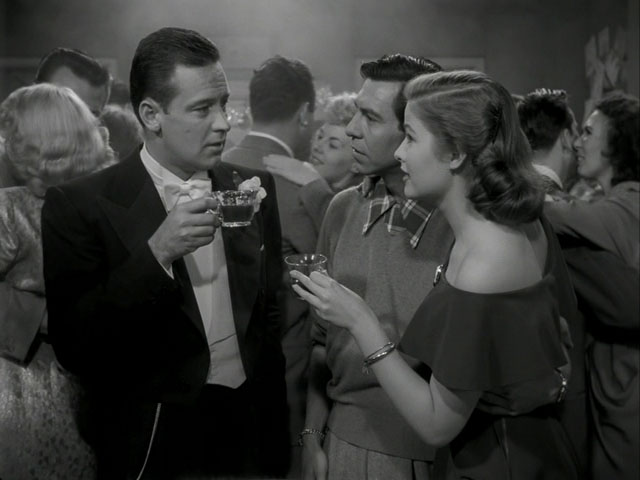
I liked this a whole lot, unexpectedly. Starts out in crisp black and white with moonlight shining on Audrey Hepburn’s mooning face, and only gets better. Not as much clever dialogue as Indiscreet, but a higher-quality film overall with just as much starpower, in its way – young beautiful Audrey versus super-suave Humphrey Bogart. Nominated for a pile of oscars, but trounced by On The Waterfront. Remade in the 90’s for some silly reason.

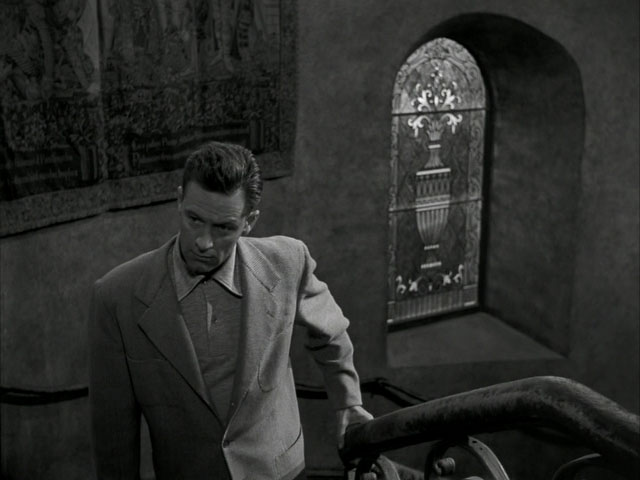
Audrey is the chauffeur’s daughter at the mega-rich Larrabee estate, has always been in love with wild, womanizing William Holden (normal-looking white guy from Sunset Blvd. and Executive Suite). She goes to Paris for two-year culinary training, comes back all fashion and sophistication. Holden falls for her before she even gets home – her dream come true. They go out, and dance at a family party, but he is supposed to marry a hot girl from another rich family as part of a family business merger (Larrabee develops super plastic made of sugarcane and her family owns a cane plantation) so big brother and super business-whiz Bogart incapacitates Holden by tricking him into sitting on wine glasses, then takes Audrey out for a few days to keep her away until the wedding. One place they go: a play of The Seven Year Itch, which is the next film Wilder would make.

But Audrey is awesome, has glowing moonlight cat eyes, and is now a master chef, so Bogie falls for her himself, and at end he cancels all appointments to catch up with the boat aboard which he’s shipped her off to Paris. Romantical!

This is now the latest Bogart movie I’ve seen – he’d be dead in under three years. Normal-looking William Holden is apparently a huge star, but I can’t say he stood out in this… certainly likeable enough. Head chauffeur John Williams had juicy roles in two Hitchcock movies around the same time, later in Will Success Spoil Rock Hunter as Tony Randall’s boss who dreams of being a gardener.

A lighter picture from the year of Vertigo and Touch of Evil. It’s Ingrid Bergman’s second Hollywood film after returning from her European Exile From Hollywood (where she’d met Jean Renoir, just back from his Hollywood Exile From Europe – she starred in his Elena And Her Men). Cary Grant, right between An Affair to Remember and North by Northwest, was still a household name. Movie about a potentially scandalous love affair starring two lead actors who had publicly scandalous love lives at the time must’ve added up to big box office bucks.

Based on a play, and you can tell since most of the big scenes take place in the same location. Rich actress (Bergman) meets rich NATO diplomat (Grant), they date and fall in love. Only catch is he claims to be married – not true, but an escape clause for someone who never plans to settle down. There’s lots of talk of “making love” (which we all know only meant “kissing passionately” in 1958, since sex-before-marriage wasn’t invented until the mid 60’s) and late-night sneakings-around. Katy points out that Cary seems awfully comfortable lounging in her bed during one visit. There is one time when they’re in bed “together”, actually a clever split-screen effect during a phone conversation.

Cary’s secret finally comes out in a convoluted final scene. He’s leaving town for months, plans to surprise Bergman on her birthday the night after he supposedly left. She finds out about the surprise and about his single status, plans to humiliate him by having Another Man (actually the servant in a robe) lurking in her bedroom at the appointed hour. All cleared up at the end, she forgives his huge lie because he decides he wants to marry her after all. So there’s never any actual scandal except among the six characters in the movie. Good, light movie with some snappy dialogue, mostly worth watching for the star acting.

Director Donen (still alive, sued The Gap this year for their classic-film-thieving marketing) had made three comedies the year before, would put out Charade five years later. Writer Norman Krasna was also behind Let’s Make Love and the stories for Lang’s Fury and Borzage’s Big City.

No big, memorable moments by the supporting cast, which means I probably won’t recognize ’em next time I see ’em. Skittish servant David Kossoff, who pretends to be Bergman’s suitor in the final scene, had been in a bunch of British films with interesting names in the 50’s (The Bespoke Overcoat, A Kid For Two Farthings). His pushy wife Megs Jenkins was in Green For Danger, a late 40’s film of The Monkey’s Paw, and something called The Gay Dog. Then there’s Bergman’s ever-present sister (Phyllis Calvert, later in Twisted Nerve) and brother-in-law (Cecil Parker, the colonel in Quartet, also appeared with Bergman in Under Capricorn).

Proud father of three Morten Borgen has carved out a name for himself in the community. A devout Christian farmer, his beliefs differ somehow (I wasn’t exactly sure how) from those of the local prayer group and he’s trying to win more converts to his side. His son Mikkel’s wife Inger, the only woman of the house, is a mother of two with a third on the way.
image

Son Johannes was supposed to be a religion scholar, but he had a terrible time with Kierkegaard and lost his damned mind, now walks the house claiming to be Jesus Christ when he isn’t wandering the countryside lost.
image

Youngest son (right) Anders wants to marry the daughter of Peter Petersen (left), leader of the town prayer group, but he’s disallowed because of the two older men’s religious feud.
image

When Inger’s pregnancy is suddenly in trouble, Peter wishes her death.
His wish is granted.
image

Johannes reappears mid-funeral during a reconciliation of the two stubborn men, who put aside their differences of belief so their children can be together. In front of the men, the kids, the doctor and Inger’s atheist husband Mikkel, Jesus-Johannes raises Inger from the dead.
image

Movie is set in 1925, so only the doctor has a car. Moves rather slow, glad I had some coffee in me. Didn’t seem like my thing for a while – flashbacks to Gertrud, a movie I didn’t get – but an hour later I’ve gotta admit it’s one of the most beautiful works of cinema ever made. Just look at these fucking stills. I’m sure there’s more reading I could do, tons and tons of articles written about it, but I’m gonna skip ’em and let it stand for itself right now.

A happy result of my French Film Hiatus is that I’m getting around to seeing some English-language movies I’ve put off for a long time. This one is particularly long-awaited, part of my decade-spanning quest to see Every Fritz Lang Film. I announced the end of the quest a year and a half ago with The Return of Frank James, but actually I still had this one and Harakiri to go, I just didn’t know where to find them.

This is Lang’s version of the same story Renoir filmed as La Bete humaine, with the writer of Clash By Night and cinematographer of In a Lonely Place, and his two lead actors from the previous year’s The Big Heat. It was a prime year for noir, and this movie acts like noir, but I’m not sure that it counts… after all, the hero gets a happy ending and only the bad people get punished. So it’s more like Shockproof than Clash By Night.

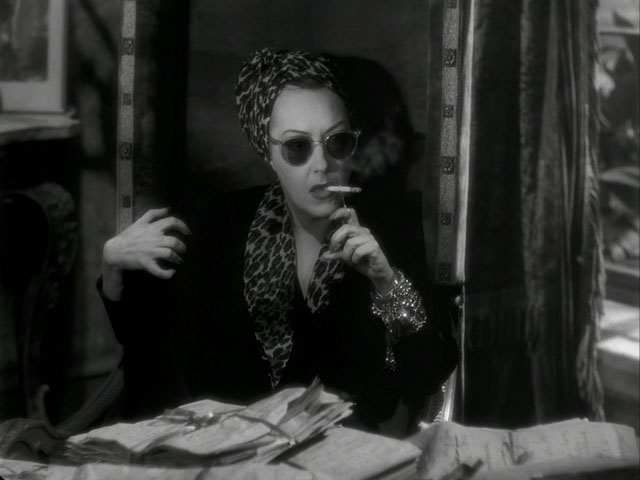
Gloria shouldn’t smoke inside – it’s bad for the birds.
image

Glenn Ford, who I couldn’t pick out of a lineup right now, plays a railman returned from the Korean War. Nervous, pinched-voiced fatale Gloria Grahame (Bogart’s neighbor in In a Lonely Place) is the dame he falls for. Then there’s a dichotomy of gruff middle-aged guys: Broderick Crawford (of The Black Cat and Born Yesterday) is Gloria’s mean, jealous, drunk, murderous husband, and Edgar Buchanan (later of Ride The High Country) is a kind friend and landlord to our man (with a daughter who’s hot for Glenn).

Glenn and Broderick:
image

Gloria’s husband murders her (ex?) lover in a train car and makes her watch, keeping the note she wrote the lover to lure him into the train as protection so she won’t turn him in. Although if he wanted this protection to be more effective, he would’ve had her write the guy’s name on the letter… this note could’ve been addressed to any of her lovers.

The incriminating (?) note:
image

Now tied to a husband she no longer loves (he also beats her – have I mentioned?) Gloria seduces Glenn and gets him to agree to murder the husband so they can run off together. Edward G. Robinson would’ve gone through with it, but Glenn Ford does not, telling off Gloria, who promptly blows up at her husband on another train and gets killed by him. Glenn ends up with his friend Edgar Buchanan’s underage daughter, to everybody’s delight.

Glenn and the good girl:
image

At the emotional height of a movie where sleazy characters are having secret meetings and lots of off-camera sex, and Gloria Grahame’s sharp, pointy breasts are poking right out of her sweater, in the background we can see that she and her husband have separate beds, and so America’s morals are safely upheld. Reminds me of the scene of The 40 Year Old Virgin I caught on cable today where every kind of sex is loudly discussed but the word ‘shit’ is safely bleeped.
image

A British comedy starring stiff, beefy American Gregory Peck (Robert Osbourne explained that American actors could reap tax benefits from working abroad a few months a year), based on a Mark Twain story, an early film work by the man who would become the Criterion-celebrated director of Hopscotch and other films I know nothing about.

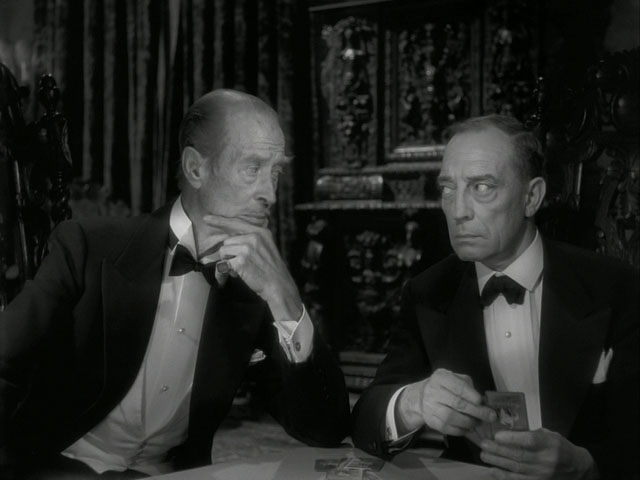
Penniless Peck is given the titular note by two hyper-rich pranksters (IMDB says that in 2002 dollars, we’re talking about a hundred million bucks) who have a bet that he can/can’t live for a month solely on the appearance of wealth without ever cashing the check (or, presumably, getting a job). Peck hires a mute weightlifter to help him out, gets some suits and a swanky hotel, and falls for a young noblewoman (Jane Griffiths, of not much else). A few close calls and but Peck makes it through the month and presumably gets the job (worth somewhat less than a hundred million bucks) and the girl.

More jokes about not paying your tailor, twenty years after the Lubitsch movies. Not paying your tailor is hilarious to the British! A pretty good light movie. Katy and Jimmy enjoyed it more than Hamlet Goes Business.

“Don’t waste your time in the so-called real life.”

image

One of my new favorite movies! Rivette must’ve dug this one, being about theatrical performances bleeding into real life, with characters and camera always behind and in front of screens and fences, sheets and curtains.

An Italian theater company arrives “in a Spanish colony of Latin America” in the early 1700’s and attempt to build a theater and make a living amongst locals who care more about bullfighting. Camilla, the lead actress of the group (Anna Magnani in an amazing, vibrant performance) entertains the affections of three fans: the local star bullfighter, the viceroy (who offers her the titular coach) and troupe member Felipe, who wants to settle down in the wilds of America. With the threat of duels, revolution, prison and worse, Camilla contrives a way out, donating her coach to the church and retreating back behind the curtain, letting all three men off the hook. Movie (this version of it, anyway) is in English, with a wild mix of accents.

In interview, Renoir says he was highly concerned with color (it is brilliant – see shot above), with Anna’s wonderful acting, with being able to change the script and with playing around with the nature of acting, on the stage and in real life.

Renoir: “My principal collaborator on this film was the late Antonio Vivaldi. I wrote the script while listening to records of his music, and his wit and sense of drama led me on to developments in the best tradition of the Italian theater.”

image

Andrew Sarris: “To claim, as reviewers at the time did, that Renoir had failed to produce a convincing narrative, is to scorn Matisse and Picasso for not painting plausible pictures.”

Andre Bazin: “Renoir directs his actors as if he liked them more than the scenes they are acting and preferred the scenes which they interpret to the scenario from which they come. This approach accounts for the disparity between his dramatic goals and the style of acting, which tends to turn our attention from his aims. The style is added to the script like rich paint liberally added to a line drawing…”

J. Rosenbaum: “As Bazin suggests, the actors are employed as if they were different kinds of paint, freely spilling over the initial designs, but it’s worth adding that the colors are employed on occasion as if they were actors – a splash of yellow or blue in an incidental decor carrying all the allure of a memorable extra.”

Rosenbaum again:

All three films are comic period fantasies in dazzling color, offering a kind of continuous, bustling choreography in which shifting power relations between upper and lower classes and between spectators and performers literally turn the world into a kind of theater. In this respect, they might be said to offer more abstract and less politically anchored versions of the films Renoir made during the thirties. Unlike their predecessors, they’re deliberately removed from real life. And given the sense of political as well as the personal defeat that came with the war and his departure from France, followed by a lengthy period of living in exile, they’re unable to hide a subtle aftertaste of regret lurking behind all that gaiety – a sense that utopia can only be found, if at all, on a soundstage, not in the Popular Front that once meant so much to Renoir. This sadness only occasionally rises to the surface, as in the memorable exchanges between actors Camilla and Don Antonio at the very end: “Felipe, Ramon, the viceroy… disappeared.” “Now they are part of the audience. Do you miss them?” “A little.”

Scorsese says there were versions in Italian and French, and that the ending (which looks like it came from a degraded print) was newly restored in the 90’s.

Don Antonio, leader of the actors group, played by Odoardo Spadaro of Divorce, Italian Style:
image

Rome’s Cinecitta studio was equipped for sync sound recording in the 50’s? You wouldn’t know it from the Italian movies I’ve seen.

A few comic reminders that we’re in the 18th century: “Tomorrow papa is being bled with leeches, the day after I have my purge.”

Cameo by French actor Jean Debucourt as the bishop, of Epstein’s silent Fall of the House of Usher, Cocteau’s Eagle With Two Heads and Max Ophüls’ Madame de…

The three men, below from left to right:
– Ramon the bullfighter – Riccardo Rioli, whose film acting career began the year before, and ended the year after with a small part in a Mankiewicz picture.
– The Viceroy – Scottish Duncan Lamont, charming in this, later in Mutiny on the Bounty and Quatermass and the Pit.
– Felipe: American Paul Campbell, who was a beef-and-cheesy enough actor to get himself cast in The Deadly Mantis. He lived long enough to have seen the MST3K version – here’s hoping he did.

image

The great Anna Magnani plays Camilla. Star of Mamma Roma, Bellissima and Rome, Open City, she also beat out Kate Hepburn and three other Americans for the 1955 Oscar for The Rose Tattoo.
image

“Where is truth? Where does the theater end and life begin?”

SEPT 2020: Katy watched this with me… and she liked it!