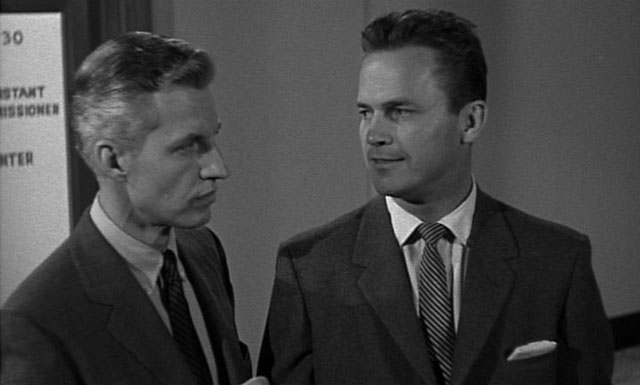
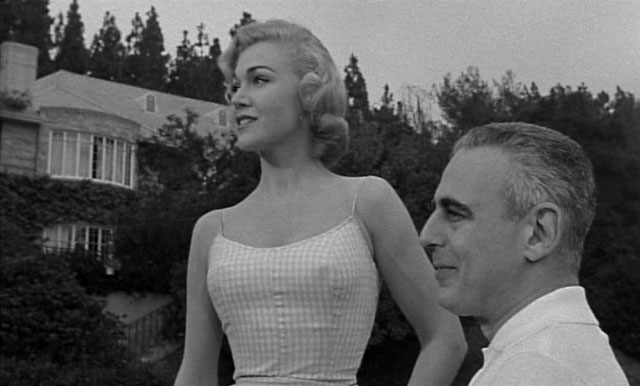
One of those long-discussed greatest-films-ever which upon first glance (and second glance) actually does seem to be one of the greatest films ever. It’s a super story with an incredible character for Gloria Swanson and boy, she nails it, but it also helps that I am a film nerd. Swanson helped destroy Erich von Stroheim’s directoral career 20 years earlier and now Wilder casts Swanson as a washed-up super-eccentric former silent actress and Stroheim as her tragic manservant. Enter William Holden and his young friends, all wannabe writer/directors, and a cameo by Cecil DeMille and Wilder’s got room to skewer damn near everything in Hollywood. And he manages to keep the mood comical while preserving a film noir (the commentary calls it monster-movie) atmosphere, without letting anybody’s flaws go unpunished.

image

Opens with William Holden dead in a swimming pool, as he introduces his own dead body then narrates his story. Sound familiar, American Beauty?

image

A dead-end screenwriter, he’s trying to avoid getting his car repoed when he pulls into a faded mansion just in time to see Swanson and Stroheim preparing to bury her pet monkey. She is pleased to meet a hot young screenwriter, hires him immediately to work on her monstrous script of Salome, which is to be her long-awaited return to the silver screen.

image

Holden had no clear prospects as a screenwriter, he’s got no cash and no girl and he dreads the shameful return home to the local newspaper he left to pursue his Hollywood dreams, so he hangs out working on her futile script for a clueless Cecil B. DeMille, realizing too late that he’s becoming her kept boy.

image

Was up for bunches of oscars but got its clock cleaned by All About Eve at the awards. Still came away with writing, art direction and music (beating Samson & Delilah, the actual film DeMille is seen shooting on the Paramount set). I don’t know if Golden Globes were important then (or if they are now) but it got picture/director/actress over there.

DeMille and Swanson:
image

Immediately preceded Ace in the Hole, a dark time for Wilder. Stroheim would only be in seven more films before his death. Holden would play Audrey Hepburn’s object of affection in Sabrina. Swanson had profitably retired from acting and did not use this as a springboard back in, though she did make quite a few TV appearances.

image

Apparently was turned into an Andrew Lloyd Webber musical in the 90’s.

image

IMDB trivia page is packed. Among the actors who turned this movie down: Double Indemnity star Fred MacMurray, Red River star Monty “Raw Deal” Clift, Mae West (who was not in silent films), early Lubitsch star Pola Negri and Greta Garbo.

image

Erich von Stroheim hadn’t directed in 20 years… Queen Kelly with Gloria Swanson having been his downfall. Norma Desmond says DeMille directed her twelve times – he actually directed Swanson six times. Love interest Nancy Olson went on to Disney flicks in the 60’s and Jack Webb (her fiancee Artie) would spend the rest of his career writing and acting for Dragnet.

Holden with Webb and Olson:
image

Norma’s “Waxworks” (her bridge partners): H.B. Warner (DeMille’s Jesus in King of Kings, later a Capra regular), Buster Keaton (who was actually doing alright in ’50 with his TV show, in between film roles In The Good Old Summertime and Limelight) and Anna Q. Nilsson (not pictured, who costarred with Warner and worked with DeMille).
image

Film/dialogue moment #1: “There was a tennis court… or rather the ghost of a tennis court, with faded markings and a sagging net.” We see the court already, but our screenwriter/narrator feels the need to fill spaces with dialogue and also tell us about it.
image

Film/dialogue moment #2: Norma Desmond wordlessly brushes away a microphone.
image

Ready for her close-up:
image

Pol Pot’s Birthday (2004, Talmage Cooley)
In 1985, the scrappy dictator’s men throw him a super-weak budget surprise birthday party, with grey cake and music on an old tape player. Awkward conversation ensues… P-P gets peed on by a dog and “Walking On Sunshine” plays over the credits. Kim Rew got paid?
image

Meet King Joe (1949, John Sutherland)
More generic propaganda with no direct sense of purpose. Joe is “the king of the workers of the world” because here in America, competition and investment in infrastructure make our jobs easier with more disposable income than anywhere else. Take that, dirt-poor chinaman! Statistics to be proud of: “Americans own practically all the refrigerators in existence. Bathtubs? We’ve got 92% of them.”
image

Hymn to Merde (2009, Leos Carax)
I agree that Merde/Lavant is wonderful to watch, but Carax doesn’t seem to know what to do with him. Protracted death-sentence courtroom drama wasn’t it, nor is a lo-res music video of him singing a Kills song translated into his own head-slapping language.
image

.tibbaR (2004, Leo Wentink)
Eerie music and nervous sound effects accompany time-remapped footage of lab rabbit breeding. I never know why anything is happening in short films anymore.
image

Go! Go! Go! (1964, Marie Menken)
So damn jittery it gave me an eye-ache, exactly what I was getting away from the computer in order to avoid. All nervous time-lapse footage shot around the city. Some real nice high-angle shots of construction sites and traffic patterns, superimpositions on a wedding, lots of boats and bridges. Color/picture looked perfect on my tube TV.
image

The Spook Speaks (1940, Jules White)
Not-at-all-good short full of corny sound effects and sub-stooges gags, but it’s better than the others I’ve watched on these DVDs since it has a roller-skating penguin. Buster’s costar Elsie Ames (she was in most of these shorts, then showed up 30 years later in Minnie & Moskowitz for some reason) is terrible, but then, Buster is terrible too. Thanks Sony for slapping warnings and disclaimers and legal shit before every short on the disc. They must’ve known it wouldn’t get tiresome because we’d only watch one before quitting.
image

Who Am I? (1989, Faith Hubley)
Things morph into other things, illustrating the five (or six or seven) senses. Short!
image

Blake Ball (1988, Emily Hubley)
Didn’t love the narration in this one. The woman who says “some are born to sweet delight/some are born to endless night” (without the preceding lines) has got nothing on Nobody. I guess all the lines are the words of William Blake, but they’re not making much of an impact, and I never figured out Blake’s connection to all the baseball stuff. There’s more five senses stuff anyway. A bit too laboriously new-agey, but some great moments (like below).
image

O Dreamland (1953, Lindsay Anderson)
Boy did I ever botch the Free Cinema box set, buying it then deciding I didn’t want to watch it after all and letting it sit on the shelf for years. Finally checked this out and I kinda really like it. Could do without the evil laughing clown all over the soundtrack. Kind of like Jean Vigo’s À propos de Nice which, given If….‘s resonance with Zero For Conduct, proves Anderson saw a Vigo retrospective at some point.

More miserable, miserable misery from the ol’ misery-monger Mizoguchi. I never like his movies, then I keep hearing they’re masterpieces so I watch another. This one and Ugetsu are universally acclaimed, and while I liked ’em better than Street of Shame and Life of Oharu, I can’t say I really liked ’em. So, laying off the Mizoguchi for a while after this.

Isn’t life torture? Sister Kyôko Kagawa was big-time, starring in movies for Akira Kurosawa and Mikio Naruse. Her mom played the wife in Equinox Flower.
image

Near Fukuoka in south of Japan in the 1100’s, this government guy who we never see is unpopular with the higher-ups because he actually wants to help people, so he’s banished to the other side of the country. His wife Tamaki packs up the kids (Zushio and his little sister Anju) to follow, and together they set off on a wonderful adventure! No just kidding, after the kids are kidnapped and sold into slavery, the wife becomes a prostitute, eventually goes blind and never sees her husband or daughter again.

Tha Bailiff:
image

Mostly focuses on the son Zushio. As a boy he learns his dad’s humanistic ways, but in the slave camp he gives in to authority, becoming a tormentor of his fellow slaves under the rule of Spiky-bearded badman Sansho. Finally he repents, takes a chance to escape (stays with ex-slave Taro, now a priest, who used to be in Zushio’s position), promising he’d be back for his sister. Z goes to Kyoto to appeal to the law, finds sympathy among men who knew his father, and they make Z a governor. He goes down and challenges Sanso’s authority, ordering all slaves freed. When Z says, “My mother and sister will be delighted. Now I can make a happy life for them,” those of us who’ve seen other Mizoguchi movies know what’s coming… he discovers his sister has drowned herself rather than face torture by the guards asking where her brother had gone (as if he’d even told her). Meanwhile mom has been living blind by the sea for years, her song “Isn’t Life Torture” about her kidnapped children spreading throughout the land, so now, having been fired from his post for trying to be nice to people, he manages to track her down and they hug each other and cry.

Zushio and the mad monk:
image

Sistercide:
image

Movie jumps back and forth in time, pretty unusual. The music, hailed on the DVD commentary for being authentic, is either tuneless twanging on a single guitar string or tuneless piercing flute.

Ringleader Lauren Bacall (pre-Written on the Wind) rents a super-expensive apartment (belonging to a millionaire on the run because of tax troubles, played by David Wayne of Losey’s M remake, but that’s only barely important) along with friend Marilyn Monroe (four months after Gentlemen Prefer Blondes) and hanger-on Betty Grable (post-The Beautiful Blonde from Bashful Bend, in one of her final film roles). They’re all attractive models, so the idea is they’ll start frequenting hangouts of the rich and famous in order to, duh, marry a millionaire. I thought the point of the apartment was men coming over to pick them up for dates will think they’re already wealthy (not gold-diggers) but when it takes longer than expected to get hitched they sell all the furniture to pay their rent, so the place looks kinda desolate.

image

I thought the movie would be a musical, especially when it opened with an overture – but Katy thinks that was just to show off the mighty Cinemascope process (D.P. Joseph MacDonald would later shoot ‘scope favorites House of Bamboo and Will Success Spoil Rock Hunter), and I thought it might’ve been a prestige thing for extremely oscar-winning composer Alfred Newman (father of Thomas, uncle of Randy). Looks like Katy was right – this was the first Cinemascope movie to be filmed (though somehow it was released second, after The Robe). Anyway, not a musical, just a girl comedy.

Cinemascope!!
image

Bacall is being stalked by Cameron Mitchell (Hell and High Water, Ride in the Whirlwind), who she suspects to be a gas pump jockey but is really one of the richest men in the world (she finds out after they’re married… oh, the 50’s).

A lotta Marilyn:
image

The movie would’ve been 50% better without Betty Grable, whose every scene is annoying. She goes off to a cabin with a married man then gets all whiny about it then catches the measles then falls for a forest ranger. Her character was the stupid one, a welcome change for Marilyn I’m sure – though M. wasn’t too bright either. Marilyn’s gimmick is she’s blind without her glasses but vainly refuses to wear them. She gets involved with a fake-eyepatch-wearing scam artist while Bacall flirts with an elder William Powell (he’s still got the mustache), who invites them to the party where Betty meets the married guy – I’m way out of order now. Anyway, Bacall almost marries Powell but they call it off with a few minutes to spare because she’s not convinced by her initial millionaire-lust anymore and she’s in love with her gas jockey. Also, Marilyn marries David Wayne at some point.

The girls with their false-alarm boyfriends:
image
image
image

Cute movie, better than it looked like it’d be, but nothing brilliant. TCM agrees, “entertaining but insubstantial.” Director Negulesco also made the 1950’s Titanic and writer/producer Nunnally Johnson wrote some John Ford films in the 30’s and 40’s.

The girls with their new husbands:
image

Another post-Civil-War American small-town drama – I kept flashing back to John Ford’s Judge Priest movies. Our hero this time is more priest than judge. Pastor Joel McRae (I’d forgotten he was a cowboy actor when not appearing in Preston Sturges films) comes to town in the wild old days, marries Ellen Drew (same year as Baron of Arizona, still the queen of not making a strong impression) and whips the town into shape.

image

A bunch of years later they’ve inherited a nephew (13-yr-old Dean Stockwell), our protagonist who shows us around the rest of the colorful town. They’ve got a friend called Uncle Famous, there’s a guy named Chloroform (his mom liked the word), Alan Hale (father of the Skipper) is hardworking but godless farmer Jed, and Pastor Joel’s best friend is the town doctor (Lewis Stone, better known as Andy Hardy’s dad). Well, when the doctor dies his son takes over as doctor, and the son doesn’t like mixing his scientific work with the pastor’s religious work.

Serious young doctor (dancer James Mitchell) with love interest Amanda Blake (later a Gunsmoke star):
image

There’s lots of work for doctor and pastor since young Dean catches typhoid fever from the school well and soon all the kids in town have got it. The pastor cancels church service to avoid spreading disease, and the new doctor becomes the prime influence in town; people stop calling for the pastor’s services. Joel gets a little credit for eventually finding the source of the illness and alerting everyone, but maybe he could’ve talked to his son sooner. Kids were thought not to have any information worth knowing in the 40’s-50’s, let alone the turn of the century.

image

More trouble: Uncle Famous (Puerto Rican Juano Hernandez, later of Kiss Me Deadly) is being menaced by a mine owner who first offers to buy Famous’s land for more than it’s worth, then trashes the place and ruins his crops and offers to buy it for less (farmer Jed helps him rebuild), then sends the KKK cross-burning lynch mob after him. Big climax comes when pastor Joel protects Famous by reading a fake will deeding all his possessions to the masked mob members, shaming them into going home.

image

image

image

Happy ending: Famous is safe, the illness is passing, doctor and pastor are reconciled and Farmer Jed and his family all come to church the next sunday.

Early in the movie Jack Lambert is a town bully – but instead of a Forty Guns situation, after Joel McRae whups his ass into the mud he sits and laughs. We’re all still friends here. Nicely sets the tone of the town – even the bad guys here are good at heart – which makes the klan-turnaround ending ring more true.
image

I can’t tell much about Tourneur judging from this and Out of the Past and Cat People – all very different but quite good movies. It’s weird watching this so soon after The Sun Shines Bright – another post-civil-war movie named after a song lyric and featuring people playing Dixie and a racial-barrier-crossing white authority figure. Safe to say I liked this a whole lot, even if I’m not anxious to watch it again.

M. Grost:

Stars in My Crown contains a ferocious attack on racism. It is one of the boldest of the post-war films, that supported the growing Civil Rights movement of the time.

This film is like Out of the Past, in that it shows evil forces laying siege to people in small towns. Both towns are idyllic places, filled with small businesses and homes. In both towns people love to fish, something that is treated as a source of friendship between grown-ups and kids. But the gangsters of the one film, and the typhoid and race hatred in the other, threaten to destroy the possibilities of harmony.

[Tourneur] is as exhaustive as Fritz Lang, in trying to find every interesting image possible in a scene, then staging the scene around it.

What’s up with Donen always having a co-director? Abbott was 70 at the time, and unless this is a misprint he lived to be 107.

A pre-Pillow Talk Doris Day is a workers’ union representative named Babe in a pajama factory, and Broadway actor John Raitt is the new middle manager Sid (but everyone calls him Sorokin – they’re into weird nicknames in this movie) who fires her. Seems like a fine setup for a romantic comedy if you ask me. I liked this, though I got complained at for falling asleep and had to finish it the next day. Katy didn’t like the songs, and a musical lives or dies by its songs, so it died. We both noticed the color was dull and drab, but IMDB people all rave about the bright colors, so maybe there’s a better DVD out there.

So yeah, Sid has to fire Babe, but she’s still on the union committee demanding a seven-and-a-half cent hourly raise, causing slowdowns and sabotage to shake up the owner, Mr. Hasler. This causes the committee (which consists of Babe, a heavy girl named Mae, a glasses guy who likes Mae, and a twitty nasal-voiced Marilyn-wannabe) to break into song and dance.

Sid also likes Babe, but doesn’t get much ground there. So he takes to stalking her friend Gladys (Carol Haney), the boss’s assistant, until he gets the key to the safe where the books are kept. I think he catches the boss embezzling money which had been earmarked for an employee raise six months earlier, and negotiates that they get their raise (non-retroactively) and nobody gets in trouble… which is sort of a copout, but maybe the movie didn’t want to appear too pro-union. Of course this means Sid gets the girl.

I told Katy that Carol Haney reminded me of Shirley MacLaine in Artists & Models. MacLaine was Haney’s understudy for this role on Broadway! I am good. Haney was great in this, and attention-grabbing with her dance to “Steam Heat” and singing on “Hernando’s Hideaway,” but this was her final film and she died of illness not long afterwards. Mae, unsurprisingly, didn’t have much of a Hollywood career, playing roles such as “angry lady”, “housing lady” and “fat lady.” Nasal-lady Barbara Nichols’ short life in film included Sweet Smell of Success and Beyond a Reasonable Doubt.

Sid Sorokin was nothing special, but Doris Day really came to life in this one. I liked Haney’s songs and the weird union plot and the neon signs that label everything in the pajama factory. Wasn’t keen on the playful comic romp of Gladys’s jealous husband Heinz chasing her around with a knife at the end, but overall found it a better-than-average musical.

From the director of… I’m not sure. The writers won an oscar for this, beating their own screenplay for Operation Petticoat as well as beloved classics North By Northwest (admittedly the writing isn’t the best thing about NxNW) and The 400 Blows and Wild Strawberries (disadvantage: foreign).

image

Kinda surprising, because it’s just your standard gimmicky romantic comedy. I mean, we liked it and all, I’m just saying I wouldn’t have thought “best writing of the year.” Doris Day (in between her Hitchcock film and her Tashlin films) and Rock Hudson (a few years after Written on the Wind and Magnificent Obsession) share a phone line (because the phone company doesn’t have enough!) and hate each other. The problem is that she occasionally needs the phone for business, but he’s always chatting up some woman – always a different woman. Day, a serious businessperson with no need for a man in her life, resents him and makes rules and starts fights.

Katy said Doris Day isn’t pretty. Insanity!
image

So Rock disguises his voice when he meets her in person and romances her as hard as he can as a practical joke, leading to lots of fun visual innuendo…

image

And more, even saucier innuendo!

image

She learns what he’s up to and takes revenge as only a professional interior decorator can – by redecorating his apartment. Ho! But of course they fall truly in love at the end.

I’d assumed Thelma Ritter would be my favorite actor in this movie, but that turned out to be Tony Randall. Maybe after Pickup On South Street I hold her to unrealistically high expectations… all she does here is drink and then act hungover, albeit hilariously. That was still enough to get her a fifth oscar nomination.
image

Tony “Rock Hunter” Randall is a rich guy who’s always after Doris. He thinks he might end up with her there at the end, but he’s just her fallback guy while she works out her feelings for Rock. Poor Tony.
image

Based on the true story of James Reavis – however his wikipedia article sounds like the true story would make for a far less interesting movie than Fuller’s script. It’s got the pen-and-ink technicality (his forgery is discovered because he uses the wrong kind of ink), the marrying a trumped-up land heir, and the prison time, but it lacks the monastery, the gypsy camp and Reavis-Price’s completely solitary audacity of it all (the real Reavis had financial backers, co-conspirators and hired thugs). Also the guy who exposed the fraud was named Royal Johnson, not John Griff.

image

Vincent Price hadn’t found horror fame yet, but he acts up a storm in this – convincing as a showman, a lover, a silent conspirator and an enraged victim of mob violence (see below). His plan involves the U.S. government honoring Spanish land grants – he trumps up his young ward (later his wife, ew) as the sole living heiress of a previously unclaimed grant for the whole territory of Arizona, planting her fictional parents’ gravestones, engraving a proclamation into a giant stone, posing as a monk for three years to inscribe the false grant into the ancient records and getting some gypsies to help him break in where the copy of the records is kept.

image

For all that work he is very nearly killed by the angry villagers, but the government saves him in order to imprison him. His wife (Ellen Drew of Christmas In July, who again fails to make much of an impression) apparently forgives him for giving her a false identity and roping her into his land-grab scheme, picks him up from prison at the end.

image

Fictional-historical adventure-romance-dramas aren’t exactly what Sam Fuller is known for, but he pulls it off. I guess he was one of the few writer/directors out there at this time, and The Steel Helmet wasn’t far behind. The only bit that doesn’t work for me is the silly framing device of old men smoking cigars and reminiscing about the Baron’s crazy scheme. At least Sam worked cigars into the story somehow.

image

That’s Reed Hadley as Griff, the government’s expert fraud analyst who manages to debunk Price and help him escape the angry crowd. Within a couple years of this, Hadley played both Jesse James (for Fuller) and Jesse’s brother Frank, and appeared in two MST3K-bait films.

image

Some selections from the Treasures IV avant-garde set – just the ones from the 1950’s, so they’re all post-Desistfilm but pre-Mothlight.

Eyewash (1959, Robert Breer)
Flickers and movements, accurately titled. Saw this at the Anthology way back when. Think I prefer A Man And His Dog Out For Air over this. Includes a whole alternate version with (most of?) the same scenes in a different order.
image

Aleph (1956-66, Wallace Berman)
Berman isn’t a well-known filmmaker – this is his only film and it went unreleased (and even untitled) until now. A cool, unexpected addition to the set, instead of just focusing on known directors. Faces and jittery camerawork, bent and damaged and overlayed with filters and text, its jittery relentlessness (and John Zorn’s squealing sax) got me down after the first five of its eight minutes.
image

Odds & Ends (1959, Jane Conger Belson Shimane)
Stop-motion cut-outs and found footage and so on while a guy talks about jazz and poetry, this is supposedly an avant-garde spoof. If not for the jokey commentary, how can one tell serious experimental work from parody?
image

Bridges-Go-Round (1958, Shirley Clarke)
Have I seen this before, or only read about it? Looks familiar. A dance film with bridges, overlapping images like sci-fi architecture. Two scores – I prefer the Bebe Barron one.
image

Little Stabs at Happiness (1959-63, Ken Jacobs)
Just a dude with a grungy camera filming his friends and neighbors goofing around with props in a room and on a rooftop. Now that it’s less novel to own a camera, and the idea of releasing a film that isn’t a big studio production is nothing new, this seems to have lost its reason to exist. Then again, in Jonathan Rosenbaum’s Cinema Scope article he puts this in the “relatively familiar standbys” category, meaning cinephiles have been watching Jack Smith put balloons in his mouth for decades now, so maybe there’s something I’m missing. Some happy old records play over the start and end, but in the middle Jacobs narrates from ’63, telling us that none of these people shot in ’59 still talk to him, casting a mild bummer tone over the whole project.
image

Betty Boop in Snow White (1933, Dave Fleischer)
Just some animated shorts from the 30’s – but this one would fit in nicely with the avant-garde set because it is bonkers crazy and also one of the most excellent things ever. It’s vaguely SnowWhitey but the story comes second to wacky invention and Cab Calloway’s St. James Infirmary clown-ghost music video.
image

The Old Mill (1937, Wilfred Jackson)
This is Historically Significant, as the first film to use a multiplane camera. Won the oscar (same year as Torture Money) beating out something called Educated Fish and a dialogue-free animation of The Little Match Girl (sound familiar, Disney?). Animal life inside a battered windmill during an especially stormy night. Katy: “Aren’t owls supposed to be awake at night?”
image

Ferdinand The Bull (1938, Dick Rickard))
Won an oscar against three other Disney shorts (including Brave Little Tailor, one of the only mickey cartoons I still remember) and a Fleischer short about two donkeys. Ferdinand is a pansy bull who wants to sit and sniff flowers all day. All the other bulls desperately want to be picked for a bullfight (seriously?) but our pacifist Ferdinand gets picked over them. He screws around and doesn’t fight and instead of killing him they send him back to the meadow to sniff flowers again. I don’t know what’s the moral here.
image